

Building an AI product is not simply a matter of choosing an LLM, connecting an API, and launching an application.
The difficult part is turning an AI idea into a product that users actually need, produces reliable results, integrates with existing systems, controls operating costs, and can continue improving after launch.
A successful AI product development process therefore has to cover much more than software development.
It needs to connect:
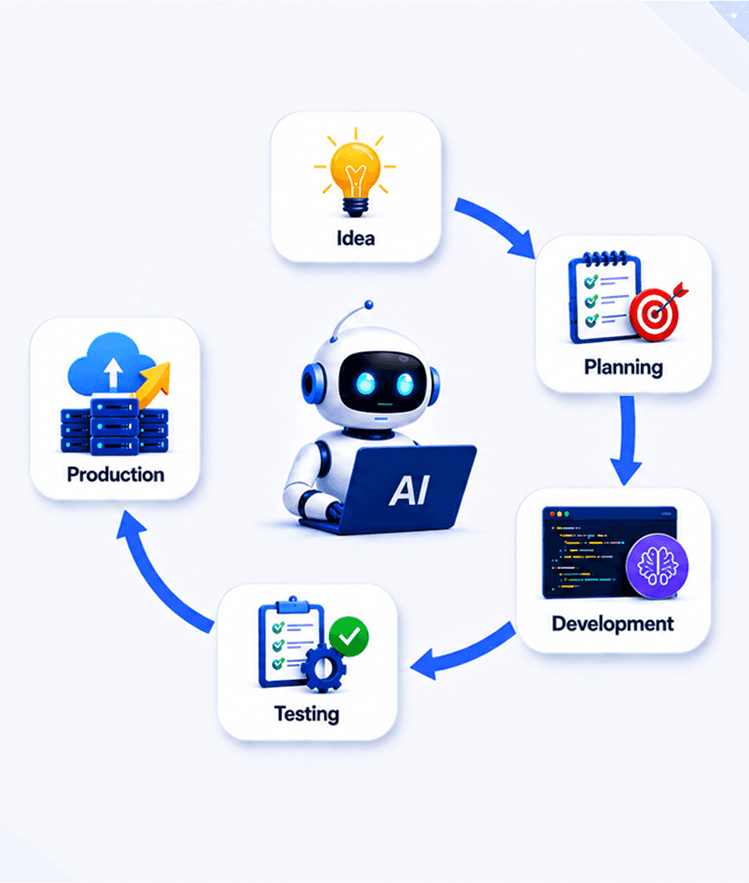
Business problem → Product strategy → Data → AI approach → Prototype → MVP → Evaluation → Production architecture → Deployment → Monitoring → Continuous improvement
This distinction is becoming increasingly important as organizations move from AI experimentation toward production.
McKinsey's 2025 State of AI research found that nearly two-thirds of organizations had not yet begun scaling AI across the enterprise.
At the same time, organizations reported revenue increases from AI use particularly in marketing and sales, strategy and corporate finance, and product and service development.
The opportunity is therefore not simply to build more AI prototypes.
It is to build the right AI products and successfully move them into production.
AI Product Development at a Glance
A practical AI product development lifecycle can be organized into eight stages:
Each stage should have a clear decision.
Stage | Main Question | Output | Gate |
|---|---|---|---|
Problem validation | Is this worth solving? | Validated problem | Build / Don't build |
AI feasibility | Can AI solve it reliably? | AI approach | Proceed / Rework |
Architecture | How should it be built? | Technical architecture | Architecture approval |
Prototype | Does the core AI idea work? | Working proof | Continue / Stop |
MVP | Will real users use it? | Usable product | Validate / Iterate |
Evaluation | Is it reliable enough? | Evaluation results | Production / Rework |
Production | Can it operate safely at scale? | Live product | Launch |
Optimization | Is it creating business value? | Continuous improvements | Scale / Change |
This stage-gate approach prevents teams from spending heavily on an AI product before the underlying business and technical assumptions have been validated.
What Makes AI Product Development Different?
Traditional software products usually operate around deterministic application logic.
AI products introduce another layer:
probabilistic behavior.
An ordinary application might receive:
Input → Business Logic → Output
An AI application may require:
Input → Context → Retrieval → Model → Tool Calling → Validation → Output
The output may also change depending on:
Model version
Prompt
Context
Retrieved information
User input
Temperature or sampling configuration
Tool results
Model routing
Data quality
This changes how the product needs to be designed and tested.
Traditional Product | AI Product |
|---|---|
Fixed application logic | Application + AI reasoning |
Deterministic output | Probabilistic output |
Conventional QA | QA + AI evaluation |
Database-driven | Database + AI knowledge layer |
Static behavior | Behavior can evolve |
Standard monitoring | Infrastructure + AI monitoring |
Feature release | Feature + model/prompt/data changes |
Predictable cost | Variable inference cost |
Rule-based automation | AI-assisted or agentic workflows |
This does not mean AI products require completely different software engineering principles.
They require additional engineering controls around the AI components.
Transform AI Ideas Into Reality

Stage 1: Start With the Business Problem
The first mistake in AI product development is starting with the technology.
A team says:
"We want to build an AI agent."
That is not a product requirement.
A better starting point is:
"We need to reduce the time required to resolve customer support requests."
The AI approach can then be evaluated against that problem.
Define the Problem
Before development begins, document:
Who has the problem?
How frequently does it occur?
What does the existing process look like?
How much does the problem cost?
What alternatives already exist?
Why are existing solutions insufficient?
What outcome would justify building the product?
Example
Suppose a company wants to build an AI contract-review product.
The weak requirement is:
"Build an AI contract reviewer."
The stronger requirement is:
"Reduce the time lawyers spend identifying non-standard clauses in commercial contracts while preserving human approval for legal decisions."
The second requirement provides a much clearer basis for product design.
Stage 2: Validate the Market and Use Case
An AI product can be technically impressive and commercially irrelevant.
Market validation should therefore happen before substantial engineering investment.
Evaluate:
Question | What to Determine |
|---|---|
Target user | Who will actually use it? |
Buyer | Who pays for it? |
Pain | What problem costs them time or money? |
Frequency | How often does the problem occur? |
Existing alternatives | What do customers use today? |
Differentiation | Why would they switch? |
Willingness to pay | Is the problem valuable enough? |
AI advantage | What becomes possible because of AI? |
AI should create a meaningful advantage.
If the product can be built just as effectively without AI, AI may not be the right foundation.
Stage 3: AI Feasibility and Data Discovery
Once the business problem is validated, determine whether AI is actually capable of solving it.
This is where many teams should perform a technical feasibility study or proof of concept before committing to full product development.
Evaluate the AI Requirement
Determine whether the problem requires:
LLMs
RAG
AI agents
Machine learning
Computer vision
Speech AI
Predictive analytics
Recommendation systems
Traditional software logic
A combination of these
Data Assessment
For AI products, data is often as important as the model.
Evaluate:
Data availability
Data quality
Data volume
Data freshness
Data ownership
Data permissions
Label availability
Data sensitivity
Data storage
Data processing requirements
A sophisticated model cannot compensate for unusable data.
The AI Approach Decision Framework
Different AI problems require different approaches.
Requirement | Recommended Approach |
|---|---|
Fixed business rules | Traditional software |
Text classification | LLM / ML classification |
Enterprise knowledge retrieval | RAG |
Structured prediction | ML model |
Content generation | LLM |
Complex multi-step execution | AI agent |
Image understanding | Computer vision / multimodal model |
Forecasting | ML / statistical model |
Personalized recommendations | ML / recommendation system |
Domain-specific behavior | Fine-tuning or specialized models |
The important principle is:
Do not use the most sophisticated AI architecture simply because it is available.
Use the simplest approach that can reliably solve the problem.
Stage 4: Design the AI Product Architecture
After feasibility is established, design the product architecture.
A typical AI product may contain:
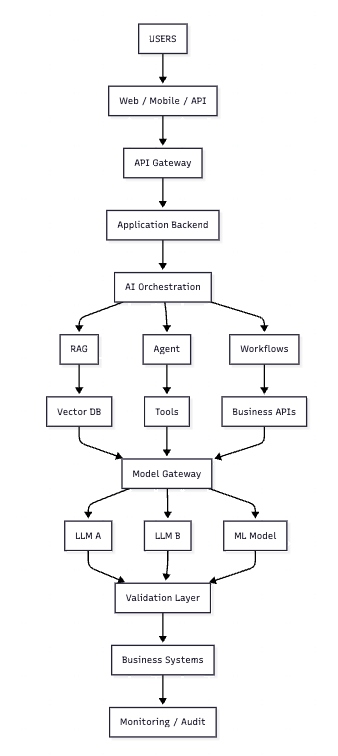
The exact architecture depends on the product.
A simple AI assistant may require only:
Application + API + LLM + database
An enterprise AI platform may require:
Application + orchestration + model gateway + RAG + vector database + multiple models + APIs + security + observability + evaluation infrastructure
Architecture should match the product's actual requirements.
Stage 5: Build the Prototype
The prototype exists to answer one question:
Does the core product hypothesis work?
It should not attempt to solve every production problem.
A useful AI prototype can demonstrate:
Core AI capability
Representative user workflow
Basic UI
Realistic data
Model behavior
Initial output quality
Key integration assumptions
The prototype should use representative data wherever possible.
A prototype that only works on clean demo data can create false confidence.
Transform AI Ideas Into Reality
Prototype vs MVP vs Production
These stages are frequently confused.
Prototype | MVP | Production | |
|---|---|---|---|
Purpose | Validate idea | Validate product | Run business |
Users | Internal team | Early users | Real customers |
Data | Representative | Real | Real at scale |
Security | Basic | Stronger | Enterprise-grade |
Monitoring | Limited | Required | Comprehensive |
Scalability | Not priority | Initial | Critical |
AI evaluation | Initial | Systematic | Continuous |
Reliability | Experimental | Controlled | Production-grade |
UX | Demonstration | Usable | Polished |
Architecture | Flexible | Structured | Scalable |
Rollback | Optional | Recommended | Required |
A prototype proving that something works does not mean it is ready to become a production product.
Recent enterprise guidance emphasizes the gap between a working prototype and a production-ready system, particularly around security, infrastructure, monitoring, and real-world traffic.
Stage 6: Build the MVP
The MVP should contain the smallest set of capabilities required to deliver real value to a defined user group.
For an AI product, an MVP typically needs three things:
AI capability
Usable product experience
Feedback and evaluation mechanism
Example: AI Customer Support Product
Instead of building:
30 integrations
Voice support
Advanced analytics
Multiple AI models
Custom workflow builder
Enterprise marketplace
The MVP might contain:
Customer conversation interface
Knowledge-base ingestion
AI response generation
Human escalation
Basic analytics
Admin controls
The objective is to validate whether the core product creates value.
AI MVP Development Flow
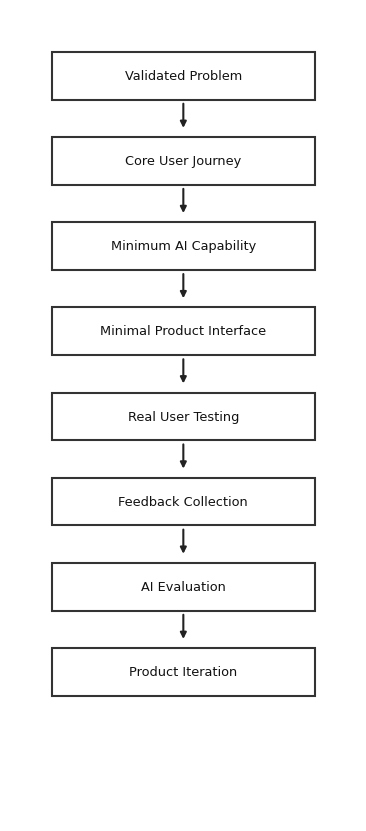
This creates a much stronger feedback loop than building the entire product before real users interact with it.
Stage 7: Design the AI Evaluation Framework
This is one of the biggest differences between AI product development and conventional software development.
Traditional QA can ask:
"Did the application return the expected output?"
AI evaluation often needs to ask:
"Was the output sufficiently correct, relevant, safe, grounded, and useful?"
AI Evaluation Dimensions
Dimension | Example Question |
|---|---|
Accuracy | Is the answer correct? |
Relevance | Does it address the user's request? |
Grounding | Is it supported by trusted information? |
Consistency | Does similar input produce acceptable results? |
Safety | Does it avoid unsafe behavior? |
Latency | Is the response fast enough? |
Cost | Is the inference cost acceptable? |
Tool accuracy | Did the system call the correct tool? |
Business outcome | Did the workflow achieve its objective? |
Build an Evaluation Dataset
Create a representative evaluation set before production.
It can contain:
Normal cases
Edge cases
Ambiguous requests
Failure cases
Adversarial inputs
Long inputs
Missing information
Incorrect information
Sensitive requests
Then evaluate every major model or architecture change against the same benchmark.
This creates a measurable development process instead of relying entirely on subjective testing.
Stage 8: Production Readiness
Before launching, evaluate whether the product can survive real-world usage.
A production AI product should answer:
Reliability
What happens when the model fails?
What happens when an API is unavailable?
What happens when retrieval returns nothing?
What happens when the AI produces an invalid output?
Security
Who can access the AI?
Which data can each user access?
Which tools can the AI execute?
Are sensitive prompts and outputs protected?
Scalability
What happens when traffic increases 10x?
Can inference scale?
Can the database handle the load?
Are API rate limits understood?
Cost
What is the cost per request?
What is the cost per active customer?
What happens to margins at higher usage?
Operations
Can engineers monitor the system?
Can failures be traced?
Can a model be rolled back?
Can prompts be versioned?
Production AI Architecture
A production AI product should generally include:
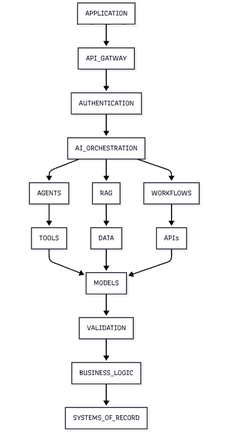
The production architecture should be designed around the product's expected traffic, risk, data sensitivity, and business model.
Transform AI Ideas Into Reality
Stage 9: Security and Governance
Security needs to be designed into the product from the beginning.
Important controls include:
Authorization
Role-based access
Data encryption
Secrets management
API security
Tenant isolation
Audit logging
Prompt-injection protection
Data filtering
Tool permissions
For enterprise AI products, data access is particularly important.
If a user does not have permission to access a document in the source system, the AI should not expose that document through RAG.
The AI layer should respect existing enterprise authorization boundaries.
NIST's AI Risk Management Framework provides a structured approach around governing, mapping, measuring, and managing AI risks.
Stage 10: Deploy to Production
Production deployment should be controlled rather than treated as a single switch.
A practical rollout can be:
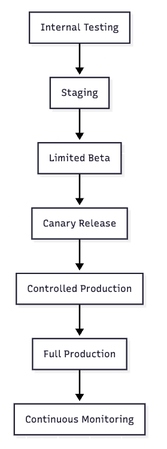
This makes it possible to identify unexpected behavior before the system reaches the entire user base.
Stage 11: Monitor the Product After Launch
AI product development does not end at deployment.
The product now generates the data required for its next development cycle.
Monitor four categories.
Infrastructure
CPU
GPU
Memory
Availability
Errors
AI
Model quality
Hallucination rate
Retrieval quality
Tool-call accuracy
Confidence
Output drift
Product
Daily active users
Feature adoption
Conversion
User feedback
Business
Revenue
Cost per customer
Gross margin
Customer acquisition
Support cost
Productivity gains
A production AI product should continuously answer:
Is the AI working?
Are users using it?
Is it creating business value?
Is it still economically viable?
AI Product ROI: How to Build the Business Case
AI product ROI should be measured differently depending on whether the product is internal or commercial.
Internal AI Product
ROI may come from:
Reduced labor cost
Faster processing
Lower error rates
Reduced support workload
Increased employee capacity
Faster decision-making
Commercial AI Product
ROI may come from:
New subscription revenue
Increased conversion
Higher retention
New enterprise contracts
Higher average revenue per customer
Reduced service cost
A Simple AI Product ROI Formula
For an internal AI product:
Annual Benefit = Labor Savings + Error Reduction + Capacity Gain + Revenue Impact
Then:
ROI = (Annual Benefit - Annual AI Product Cost) / Annual AI Product Cost × 100
AI product cost should include:
Development
Infrastructure
Model/API usage
Data processing
Monitoring
Maintenance
Security
Human review
Support
Example AI Product ROI Calculation
Consider an internal AI document-processing product.
Suppose the organization processes:
100,000 documents per year
Current manual processing cost:
$5 per document
Annual cost:
$500,000
Suppose AI automation reduces the effective processing cost by 45%.
Estimated annual savings:
$225,000
If annual AI product operating and maintenance costs are:
$90,000
Then:
Net annual benefit = $135,000
Estimated ROI = 150%
This is an illustrative calculation, not a benchmark.
The actual business case should use the organization's own baseline.
What Recent AI ROI Data Tells Product Teams
The market data supports both optimism and caution.
McKinsey's 2025 State of AI research found that organizations reported revenue increases from AI use in product and service development, with 62% of respondents using AI in that function reporting some level of revenue increase. The survey also found that only 39% of respondents reported any enterprise-level EBIT impact from AI.
This distinction is important.
A successful AI feature does not automatically mean the company has achieved enterprise-level ROI.
The product still needs:
Adoption
Retention
Efficient infrastructure
Sustainable unit economics
Strong customer value
Scalable operations
McKinsey's broader analysis also estimates substantial economic potential for generative AI, particularly across customer operations, marketing and sales, software engineering, and R&D.
The opportunity is therefore significant, but the development process determines whether that potential becomes actual product value.
Stage-Gate Model for AI Product Development
A useful way to manage AI product development is to establish formal gates.
Gate | Decision | Evidence Required |
|---|---|---|
Gate 1 | Build or don't build | Market + problem validation |
Gate 2 | AI or traditional software | Feasibility analysis |
Gate 3 | Prototype or stop | AI performance evidence |
Gate 4 | MVP or stop | User validation |
Gate 5 | Production or rework | Evaluation + security |
Gate 6 | Scale or optimize | Business and operational metrics |
This reduces the risk of continuing to invest simply because a team has already spent money on development.
Transform AI Ideas Into Reality
How Long Does AI Product Development Take?
There is no universal timeline.
Complexity depends on:
Product scope
AI complexity
Data readiness
Integrations
Security requirements
Team size
Compliance
Infrastructure
Model requirements
A useful planning model is:
Stage | Typical Planning Range |
|---|---|
Discovery | 1-3 weeks |
Feasibility / PoC | 2-6 weeks |
UX + architecture | 2-4 weeks |
MVP | 8-16+ weeks |
Production hardening | 2-8+ weeks |
Continuous optimization | Ongoing |
These are planning ranges, not guaranteed delivery times.
Complex enterprise products, regulated systems, or products with multiple integrations can take substantially longer.
AI Product Development Team Structure
An AI product usually needs cross-functional expertise.
Role | Responsibility |
|---|---|
Product Manager | Product strategy and prioritization |
UX/UI Designer | User experience |
Software Architect | System architecture |
AI/ML Engineer | Models and AI logic |
Data Engineer | Data pipelines |
Backend Engineer | APIs and business logic |
Frontend/Mobile Engineer | Product interface |
DevOps/MLOps Engineer | Deployment and infrastructure |
QA Engineer | Functional and AI testing |
Security Engineer | Security and governance |
Not every product requires a dedicated person for every role.
Smaller teams can combine responsibilities.
The important point is that AI product development is inherently cross-functional.
Build vs Buy vs Integrate
AI product teams should decide which components they actually need to build.
Component | Build | Buy / Use Managed Service |
|---|---|---|
Foundation model | Rarely | Usually |
Embeddings | Usually use existing models | Yes |
Vector database | Depends on requirements | Often |
Authentication | Usually integrate | Yes |
Payment system | Rarely | Yes |
AI orchestration | Depends on differentiation | Often hybrid |
Business logic | Usually | No |
Proprietary data pipeline | Often | Depends |
AI evaluation | Usually customize | Hybrid |
Product UX | Usually | No |
The goal is to invest engineering effort where it creates product differentiation.
How AI Product Development Is Changing
AI is also changing the software development process itself.
AI-assisted engineering can help with:
Requirement analysis
Code generation
Test generation
Documentation
Code review assistance
Technical research
Prototyping
Zignuts describes AI-assisted software engineering as part of its development approach, including AI-assisted code generation and AI-driven requirement analysis.
However, faster code generation does not remove the need for architecture, testing, security, and engineering judgment.
In fact, the faster code can be produced, the more important verification becomes.
Zignuts' Approach to AI Product Development
Zignuts positions AI product development around the full lifecycle rather than isolated model integration.
Its generative AI development approach covers use-case discovery, model selection, RAG architecture, fine-tuning, deployment, LLM applications, intelligent automation, and multimodal solutions.
Its production-ready AI application approach emphasizes scalable architecture, visible sprint-based delivery, integration with existing systems, monitoring, and long-term maintainability.
Zignuts also provides a dedicated AI prototype-to-production approach focused on infrastructure hardening, data pipelines, security, compliance, monitoring, and scaling.
The published service page describes a four-to-eight-week average from audit to first production deployment for well-scoped projects with accessible data and existing cloud infrastructure, while noting that more complex or regulated environments can take longer.
This distinction is important:
The goal is not simply to build an AI demo.
The goal is to create a product that can survive real users, real data, real traffic, and real business requirements.
Zignuts Case Study: AI Workflow Automation Platform
Zignuts' AI workflow automation platform provides a concrete example of how an AI product can evolve beyond a single model integration.
The documented platform includes:
Centralized AI model access
Real-time LLM comparison
Workflow automation
Custom agents
No-code workflow creation
Workflow publishing and monetization
Project management capabilities
Community functionality
The case study is particularly relevant because it illustrates that an AI product can become a platform around the models rather than simply being a user interface connected to one LLM.
The product architecture therefore needs to support:
Models
Workflows
Agents
Users
Integrations
Product functionality
This is the type of complexity that emerges when an AI experiment becomes a real product.
Transform AI Ideas Into Reality
Production Readiness Checklist
Before launching an AI product, verify:
Product
Target user clearly defined
Core problem validated
Value proposition documented
MVP scope controlled
User feedback collected
AI
Model selected based on actual workload
Evaluation dataset created
AI quality benchmarks defined
Edge cases tested
Hallucination/failure handling defined
Data
Data sources identified
Data quality assessed
Access permissions implemented
Data pipeline monitored
RAG evaluated if required
Architecture
Production architecture documented
APIs secured
Database scalable
Model serving strategy defined
Fallback architecture implemented
Security
Authentication
Authorization
Encryption
Secrets management
Audit logging
Data protection
Operations
Monitoring
Logging
Alerting
Cost tracking
Model/version management
Rollback strategy
Business
Baseline metrics established
ROI model created
Pricing validated if commercial
Unit economics understood
Customer success metrics defined
Common AI Product Development Mistakes
Starting With the Model
A model is not a product strategy.
Start with the customer problem.
Building a Large MVP
AI products can become technically complex very quickly.
Keep the first release focused on the smallest valuable workflow.
Using Demo Data
AI behavior can look excellent on clean examples and fail badly on real-world inputs.
Use representative data early.
Skipping Evaluation
Without systematic evaluation, teams cannot confidently determine whether the AI is improving.
Ignoring Unit Economics
A product can attract users and still lose money if inference costs grow faster than revenue.
Treating Production as Deployment Day
Production requires monitoring, security, scaling, incident response, and continuous evaluation.
Building Too Much Custom Infrastructure
Use managed services where they make economic and technical sense.
Build proprietary components where they create differentiation.
Ignoring Human Oversight
High-impact AI decisions often need human approval.
Design escalation into the product from the beginning.
The AI Product Development Flywheel
The development process does not end when the product launches.
A mature AI product creates a continuous loop:
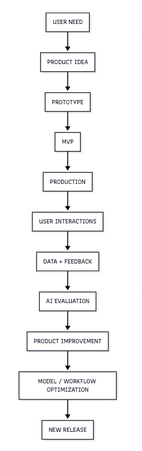
This feedback loop becomes a competitive advantage.
The product gets better because production usage continuously generates information about:
What users need
Where AI fails
Which features matter
Which workflows are valuable
Where costs are increasing
Which outputs users trust
Transform AI Ideas Into Reality
What Success Looks Like
A successful AI product should eventually demonstrate three forms of validation.
Product Validation
Users want it.
Technical Validation
The system works reliably.
Economic Validation
The product creates more value than it costs to build and operate.
These three dimensions can be summarized as:
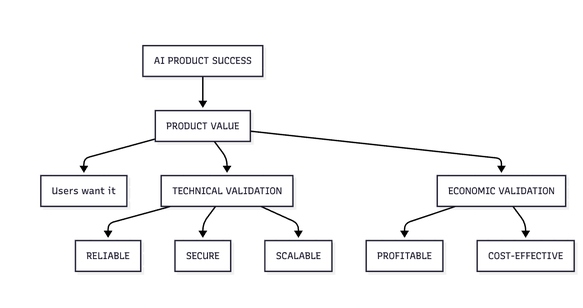
If one of these three is missing, the product is not ready to scale.
Key Takeaways
AI product development starts with a business problem, not an AI model.
Market validation should happen before significant engineering investment.
Data quality and accessibility need to be evaluated early.
The AI approach should match the problem rather than the latest technology trend.
A prototype proves an idea. An MVP validates a product. Production proves the business can depend on it.
AI products require systematic evaluation in addition to conventional software testing.
Production architecture must account for security, scalability, observability, reliability, and inference cost.
ROI should be measured using real product economics rather than generic AI benchmarks.
Human oversight should be designed into high-risk workflows.
Launch is the beginning of the AI product optimization cycle, not the end.
Conclusion
The hardest part of AI product development is rarely getting an AI model to produce an impressive result.
The harder challenge is turning that result into something users can trust and a business can operate.
That requires a disciplined progression:
Validate the problem.
Validate the AI approach.
Build the smallest useful prototype.
Test it with real users.
Develop a focused MVP.
Create systematic AI evaluations.
Engineer production infrastructure.
Secure the data and integrations.
Monitor real-world behavior.
Measure business value.
Continuously improve.
The current AI market makes this discipline increasingly important. McKinsey reports that organizations are seeing revenue benefits from AI in product and service development, but enterprise-wide financial impact remains much less widespread.
That gap between AI capability and business value is where product engineering matters most.
A successful AI product is therefore not simply an application with an LLM inside it.
It is a complete product system in which:
Customer problem + product experience + AI + data + software architecture + infrastructure + governance + economics
work together.
Zignuts' approach spans AI use-case discovery, model selection, RAG, fine-tuning, deployment, production engineering, infrastructure, and continuous optimization.
For companies moving from an AI idea to a production product, the goal should not be to build everything at once.
Build the smallest system that can prove the business case, then scale the architecture as the evidence grows.
That approach reduces wasted engineering investment, improves product-market validation, and creates a much stronger foundation for long-term AI product development.

Pruthvi Darji
A problem solver with a passion for building robust, scalable web solutions that push the boundaries of technology and deliver impactful results