At 3:14 AM on a Tuesday, a fintech engineering team faced a $42,000 AWS bill spike in under 48 hours. The cause was uncontrolled Kubernetes preview environments and excessive Datadog log ingestion.
This highlights a key challenge for CTOs and engineering leaders: DevOps implementation in 2026 is as much about cost control as technical efficiency.
When modernizing delivery pipelines or adopting platform engineering, hidden costs can quickly increase budgets:
Software licenses: Overlapping tools increase recurring expenses.
Idle infrastructure: Unused staging environments continue consuming cloud resources.
Pipeline bottlenecks: Inefficient CI/CD workflows increase build times and engineering effort.
Ongoing maintenance: Infrastructure updates and monitoring add long-term costs.
Understanding the full cost of DevOps implementation means looking beyond hourly rates. The right DevOps Consulting Services can help businesses plan engineering, infrastructure, and tooling costs while building efficient, cost-conscious delivery pipelines.
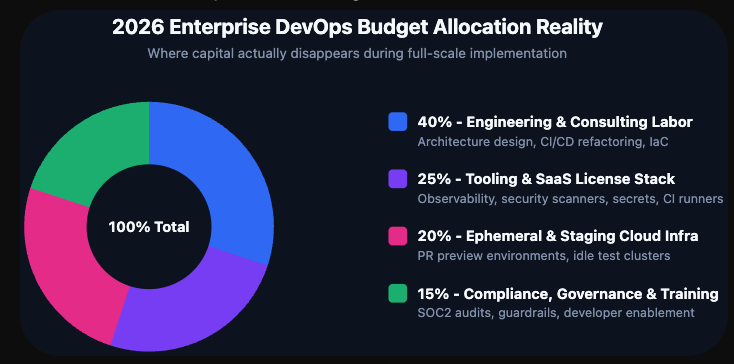
DevOps Implementation Cost by Company Size and Project Scope
DevOps implementation costs vary widely based on organizational size, existing technical debt, and compliance requirements. A startup migrating from a monolithic server to AWS Elastic Container Service requires a completely different strategy than a mid-market healthcare provider building a multi-region Kubernetes platform.
Below is a breakdown of realistic market investments across three corporate maturity stages:
Organization Tier | Typical Scope & Architecture | Timeline | Cost Range (USD) |
|---|---|---|---|
Growth Stage (20 to 50 Engineers) | Basic IaC (Terraform/OpenTofu), GitHub Actions pipelines, single-region EKS/GKE, basic monitoring. | 2 to 3 Months | $35,000 - $65,000 |
Mid-Market Enterprise (50 to 250 Engineers) | Developer Self-Service Portal (Backstage), automated PR environments, multi-account AWS Landing Zones, FinOps policy enforcement. | 4 to 6 Months | $85,000 - $180,000 |
Global Enterprise (250+ Engineers) | Zero-Trust Service Mesh (Istio), multi-cloud failover, automated compliance guardrails, dedicated internal developer platform team. | 6 to 12+ Months | $250,000 - $600,000+ |
Fascinating Engineering Fact
According to recent cloud optimisation reports, enterprise software teams run an average of 42 distinct development tools across their delivery pipelines. Teams that audit and consolidate overlapping tools save an average of $118,000 annually in licensing alone, while reducing context switching across engineering pods.
Ready to Optimize Your DevOps Investment?

Real-World DevOps Implementation: Improving Healthcare Deployment Efficiency
A leading healthcare platform struggled with deployment bottlenecks where manual testing cycles and fragmented environment configurations delayed release cycles to 18 days.
By implementing an automated GitOps deployment pipeline using ArgoCD and standardized Infrastructure as Code templates, our engineering team modernized their deployment workflow.
Measurable Results of DevOps Implementation
Deployment turnaround dropped from 18 days to under 22 minutes.
Staging cloud costs dropped by 41% through auto-teardown scripts for idle pull-request environments.
Achieved 100% HIPAA compliance traceability across all production releases.
3 Hidden DevOps Implementation Costs That Impact Your Budget
When analysing why DevOps implementations exceed budget, financial leaks usually stem from three distinct operational traps:
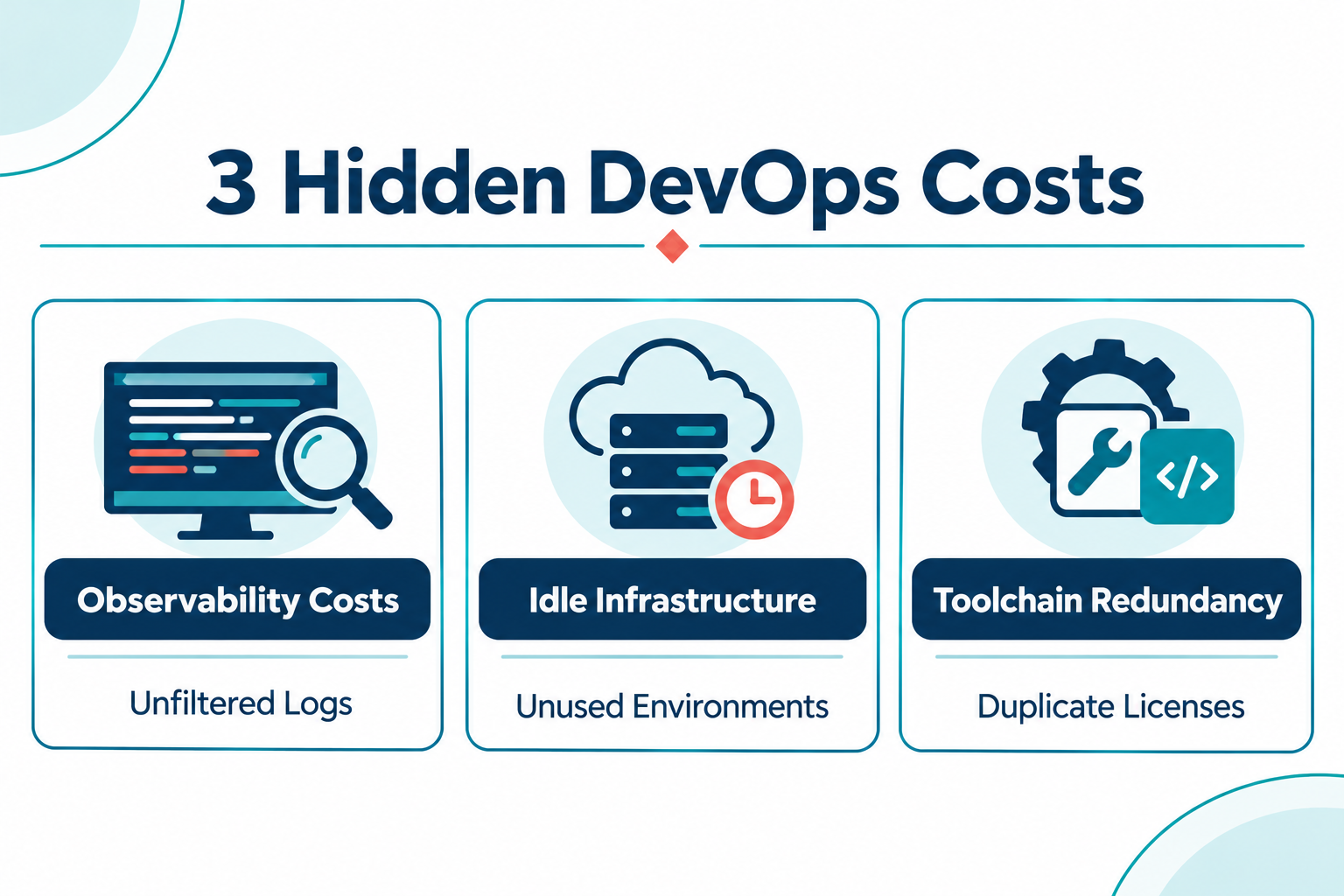
1. Log Ingestion and Observability Costs
Modern observability platforms charge based on ingested data volume. When microservices are configured to print debug logs in staging or production, telemetry costs can quickly rival compute infrastructure bills. Filtering logs at the edge before sending them to third-party tools is a simple step that saves thousands each month.
2. Idle Staging and Temporary Environment Costs
Spinning up preview environments for every pull request improves developer workflows, but leaving these environments running overnight or on weekends drains cloud resources. Implementing automatic Time-To-Live (TTL) teardowns ensures preview environments shut down when branches are merged or left inactive.
3. DevOps Toolchain Redundancy and Licensing Costs
Organisations frequently pay for multiple tools with overlapping capabilities, such as maintaining Datadog alongside AWS CloudWatch, or running Snyk while paying for GitHub Advanced Security. Eliminating redundant licenses is one of the fastest ways to lower monthly operational costs.
Architectural Stage | Unoptimized Pipeline (Cost Trap) | Optimized Platform (Cost-Efficient) | Financial Impact |
|---|---|---|---|
Pull Request (PR) Environment Trigger | Spawns a complete, isolated Kubernetes cluster per branch | Provisions a lightweight ephemeral namespace within a shared cluster | Reduces compute infra overhead by up to 70% |
Log Management & Telemetry | Unfiltered debug traces ingested directly into SaaS observability tools | Edge filtering and trace sampling before indexing high-value data | Cuts telemetry and log ingestion bills by 50% to 65% |
Environment Lifecycle Management | Staging and preview environments left running 24/7 unattended | Automated Time-To-Live (TTL) teardowns shut down idle resources after 2 hours | Eliminates off-hours cloud resource drain completely |
Overall Infrastructure Outcome | Unpredictable month-end cloud bill spikes and 60%+ budget overruns | Predictable unit economics and controlled cloud infrastructure spend | Significant annual OpEx savings across development pods |
The Hidden Production Trap
In platform engineering, 80% of unexpected cloud cost spikes stem from unconstrained auto-scaling policies in non-production environments. Always set strict upper resource limits on staging clusters to prevent runaway processes from consuming your monthly compute budget.
Ready to Optimize Your DevOps Investment?
Build vs. Buy vs. Partner: Comparing DevOps Implementation Costs Over 3 Years
Engineering leaders often debate whether to build an internal developer platform from scratch or partner with specialized DevOps consultants. Below is a realistic three-year financial breakdown:
In-House DevOps Implementation Costs
Initial Implementation Time: 9 to 14 Months
Dedicated Staff Needed: 3 Senior SREs ($540,000/yr total)
Maintenance & Tech Debt Handling: High (Internal team handles all upgrades)
Estimated Year 1 Spend: $620,000
Estimated 3-Year TCO: $1,860,000
DevOps Consulting Partner Costs
Initial Implementation Time: 3 to 5 Months
Dedicated Staff Needed: 0 Full-Time Hires (Project-Based)
Maintenance & Tech Debt Handling: Included in Support SLA
Estimated Year 1 Spend: $140,000
Estimated 3-Year TCO: $380,000
Building internally requires hiring full-time senior engineers in a competitive market. Partnering with a specialized DevOps firm delivers a production-ready platform much faster, at a fraction of the long-term overhead.
How to Control DevOps Implementation Costs and Maximize ROI
To ensure your DevOps implementation delivers strong ROI without budget overruns, follow these key guidelines:
Action Item | Implementation Focus | Business & Financial Impact |
|---|---|---|
1. Tool Audit & Consolidation | Catalog all CI/CD, security, and observability tools. | Eliminates duplicate license spend ($50,000 to $100,000 saved annually). |
2. Cloud Guardrails & FinOps | Enforce TTL auto-teardown and namespace resource limits. | Prevents idle environment waste and unexpected cloud spikes. |
3. Modular IaC Architecture | Deploy reusable Terraform or OpenTofu modules across teams. | Accelerates project onboarding while reducing setup labor. |
4. Hybrid Staffing Strategy | Partner for initial platform architecture, train internal teams. | Lowers long-term headcount overhead while maintaining velocity. |
Conclusion: Planning Your DevOps Implementation Budget
DevOps implementation in 2026 is not just about setting up automation tools or improving deployment speed. It requires a clear understanding of engineering costs, cloud infrastructure, software licensing, observability, and ongoing maintenance. By identifying hidden expenses early and choosing the right architecture, businesses can avoid unnecessary spending while building reliable and efficient development workflows.
Whether you are modernizing existing pipelines or building an internal developer platform, the right implementation strategy can improve delivery efficiency and provide better control over long-term costs. Contact us today to discuss your DevOps requirements and explore how we can help you build a cost-effective, scalable, and reliable DevOps environment.

Utkrishti Mishra
Business Analyst Intern | Exploring data, processes, and business strategies to turn insights into smarter decisions and impactful solutions.