Executive Summary: What FinTech Software Consulting Delivers
FinTech software consulting helps financial-services organizations turn business goals, customer needs, and regulatory requirements into reliable software products. FinTech Software Development can include:
Product strategy and design: Aligning software with business and customer needs.
Software architecture: Building secure, reliable systems.
API integration: Connecting payment providers, banking systems, and financial platforms.
Transaction management: Handling payments, ledgers, reconciliation, and reporting.
Data and fraud controls: Supporting accurate processing, monitoring, and risk management.
Cloud and operations: Improving infrastructure, observability, and delivery processes.
Financial reliability: Managing identity, authorization, transaction states, and customer support to reduce production risks.
Market context: Using official public sources for market indicators without treating them as vendor revenue forecasts.
Illustrative diagrams: Presenting reference models rather than actual client architectures.
The FinTech Opportunity: Why Trust Matters in Financial Software
FinTech products operate at the intersection of money movement, personal data, risk decisions, and customer experience. The user may see a simple action-pay, transfer, apply, invest, or verify-but the software must coordinate several systems and preserve a defensible record of each meaningful state change.
This makes early product and architecture decisions unusually consequential. If payment status is ambiguous, a retry can create duplicate processing. If a loan eligibility rule is embedded in multiple services, policy changes become difficult to test. If partner failures are not distinguished from business declines, customer support cannot explain what happened. If audit events are incomplete, incident response and compliance evidence become manual exercises.
What Effective FinTech Consulting Should Accomplish?
Clarify the product’s operating model: customer types, money flows, regulated roles, partners, revenue mechanics and exception paths.
Convert policy and regulatory requirements into testable system behaviours, ownership and evidence.
Design a maintainable architecture with clear transaction boundaries, consistent identifiers and explicit failure handling.
Reduce delivery uncertainty through prototypes, integration spikes, risk-based testing and staged release gates.
Create operational readiness: monitoring, incident runbooks, reconciliation routines, support workflows and recovery plans.
The outcome should be a set of decisions and deliverables that can be inspected-not simply a collection of meetings or a technology diagram.
Ready to Build a More Reliable FinTech Solution?

What Are FinTech Software Consulting Services?
FinTech software consulting is advisory and engineering support for designing, building, integrating, modernizing, or operating software used in financial services. Depending on the engagement, the consultant may advise on product scope, validate assumptions, design architecture, build components, integrate third-party services, or help establish secure delivery and operational practices.
Engagement type | Typical work | Useful when |
|---|---|---|
Strategy and discovery | Stakeholder workshops, user journeys, capability mapping, risk assumptions, roadmap | The problem, target users, or scope is still uncertain |
Product and UX | Service blueprint, onboarding flows, accessibility, error states, consent and disclosures | A workflow is confusing, high-friction, or difficult to support |
Architecture and engineering | Domain boundaries, APIs, data models, event handling, cloud design, technical standards | The platform is new, brittle, or difficult to extend |
Integration and modernization | Banking/payment APIs, KYC vendors, core systems, legacy migration, data reconciliation | Multiple providers or old systems must work together |
Risk, security and compliance engineering | Identity, access control, audit trails, fraud signals, evidence capture, secure SDLC | Controls need to be designed into product and engineering work |
Delivery and operations | CI/CD, automated tests, observability, incident playbooks, SLOs and recovery | Production quality and predictable change matter |
A Key Boundary: Consulting Does Not Replace Regulatory Approval
A technology partner can help translate obligations into requirements and implement supporting controls, but it cannot substitute for legal advice, a regulated entity’s compliance function, licensing decisions, independent audits or regulator approvals. The client and its authorized advisers must confirm which rules apply to the business model, geography, data and contractual role.
SCOPE THE REGULATED ROLE FIRST
Before estimating software, establish whether the business is a bank, lender, payment service provider, intermediary, technology vendor, data processor, or another type of participant. The answer affects licensing, outsourcing, data, consumer-protection, and operational obligations.
FinTech Market Trends: What the Data Tells Us
Public data shows the scale of digital financial activity, but statistics should be interpreted in their original context. Transaction counts are not the same as unique users, successful transactions, revenue, profitability, or software demand.
The following charts are included to ground the discussion in observable ecosystem activity.
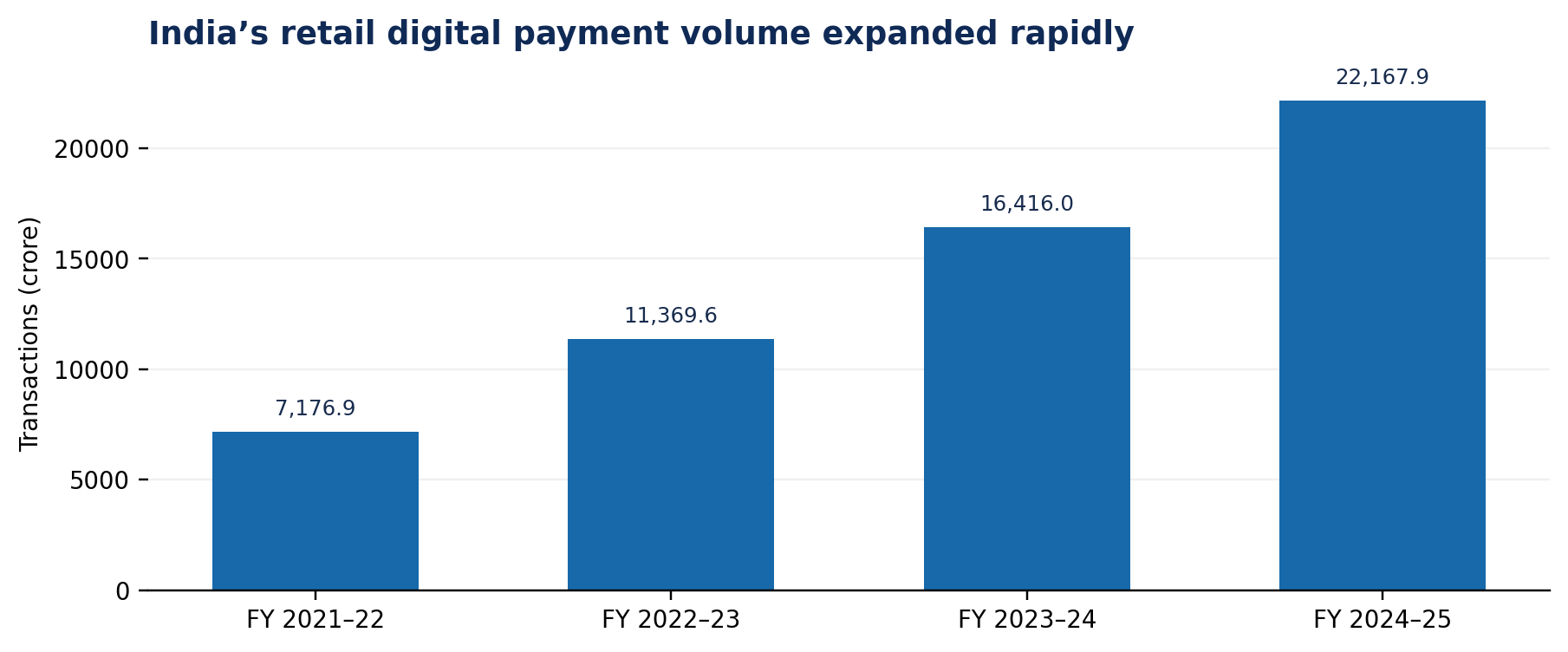
The reported annual volume rose from 7,176.90 crore transactions in FY 2021–22 to 22,167.90 crore in FY 2024–25. That is an approximately 3.1× level over the period (calculated as 22,167.90 ÷ 7,176.90). For software teams, the implication is not that every fintech needs the same scale; it is that products must define throughput, peak load, provider limits, failure recovery, and reconciliation requirements against their own forecast and risk profile.
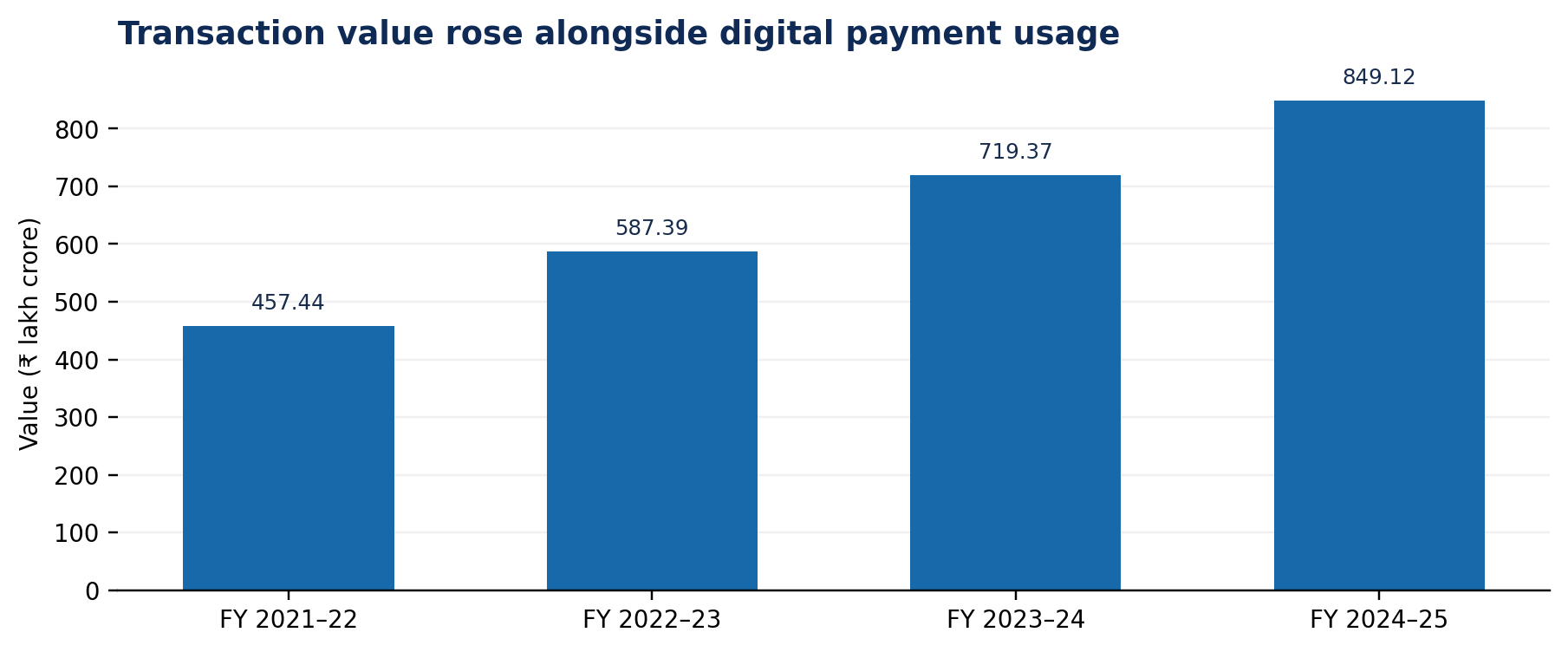
The same government release reports value increasing from ₹457.44 lakh crore to ₹849.12 lakh crore. Volume and value together describe different dimensions: a large count may consist of low-value transactions, while a lower count can still carry significant financial exposure. Risk controls, limits, dispute handling, and reconciliation should therefore consider both transaction count and value.
Ready to Build a More Reliable FinTech Solution?
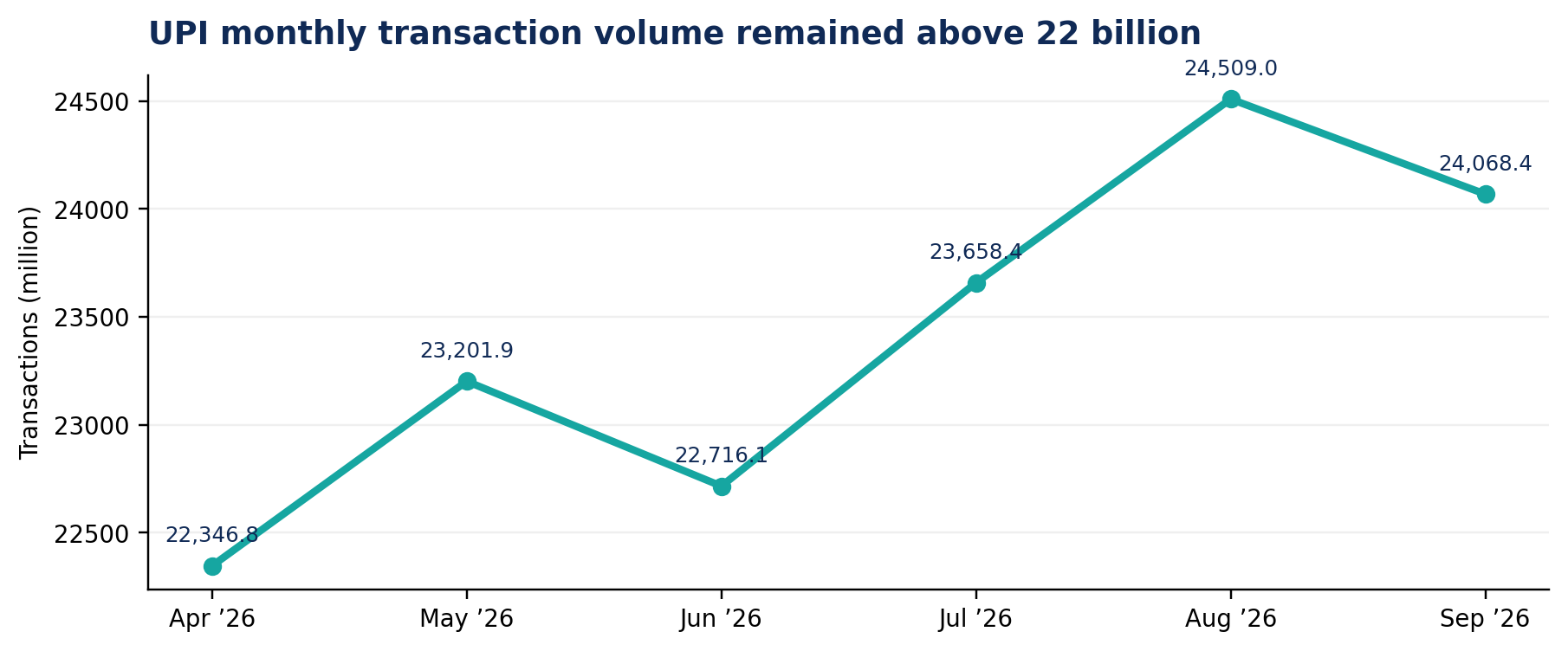
NPCI’s monthly data shows UPI volumes above 22 billion transactions in each displayed month, with a local peak in August 2026 and a lower September reading. A month-to-month dip is not enough to infer a long-term slowdown. The operational takeaway is to size systems for peaks, maintain headroom, watch provider-specific error rates, and measure successful completion-not to extrapolate a market forecast from six months.
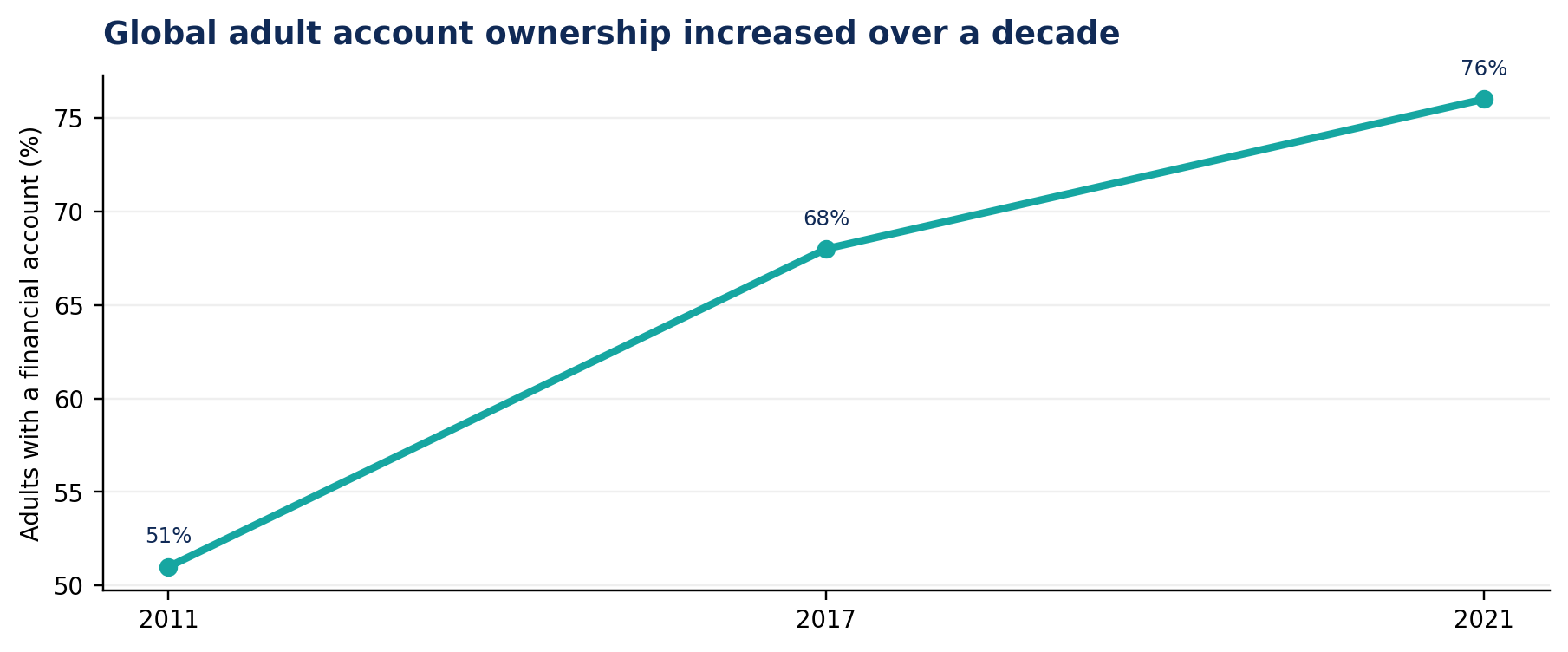
The World Bank reports account ownership rising from 51% of adults in 2011 to 76% in 2021. This is an access indicator, not a direct measure of active digital-payment usage. The distinction matters when designing onboarding: account access alone does not guarantee confidence, accessibility, repeat usage, or successful completion of a specific financial journey.
Core FinTech Software Consulting Services
Product Strategy and Domain Discovery
Discovery should map the full business transaction rather than only the happy-path interface. For a digital wallet, for example, the team must identify account creation, identity verification, funding, authorization, balance calculation, transaction posting, reversals, disputes, statements and support. The same approach applies to lending, investments, insurance and embedded finance.
Define user groups, business outcomes, key journeys and measurable product hypotheses.
Map domain entities and state transitions, including pending, failed, reversed, disputed and expired states.
Identify external dependencies, contractual responsibilities, data sources and manual operations.
Prioritize a minimum viable product by risk and learning value-not only by feature count.
Payment, Wallet, and Transaction Platform Development
Payment systems need a consistent transaction lifecycle and a clear answer to the question: which system is authoritative for each state? A robust design separates the request to initiate a payment from the provider’s response, internal posting, settlement and reconciliation. Idempotency keys, durable records, and explicit retry policies help prevent repeated requests from creating unintended duplicate effects.
Teams should model asynchronous outcomes, provider timeouts, partial outages, reversals and delayed settlement. A timeout does not necessarily mean a payment failed; it may mean the response was not received. Safe recovery may require querying provider status or reconciling later rather than blindly retrying.
Lending and Credit Decisioning Solutions
Lending software combines application intake, consent, identity checks, document collection, eligibility rules, underwriting, offer generation, acceptance, disbursement, repayment and collections. Consulting should help separate configurable policy from code, record which policy version produced a decision, and ensure the system can explain decisions to authorized staff. Model-driven decisions require additional governance, monitoring, fairness assessment and human-review rules appropriate to the jurisdiction and product.
Wealth Management and Investment Applications
Investment applications require careful handling of suitability, permissions, portfolio data, orders, statements and customer communications. A product should distinguish informational views from executable actions and apply explicit authorization before any transaction. Data freshness, market-data licensing, order status, exception handling, and evidence of customer consent are often as important as the visible dashboard.
InsurTech, RegTech, and Embedded Finance Solutions
InsurTech may involve quote generation, underwriting inputs, policy issuance, claims, and partner workflows. RegTech can support monitoring, case management, evidence collection, and regulatory reporting, but the accuracy of rules and reporting remains a governed responsibility. Embedded finance introduces another layer of ownership: the customer experience may sit inside a non-financial platform while a regulated partner owns some financial activities. Contracts and system boundaries must make those responsibilities explicit.
FinTech Modernization, Cloud, and Ongoing Improvement
Modernization should begin with a dependency and risk map. Rewriting a core platform in one step may be inappropriate when it contains poorly documented rules or tightly coupled integrations. Incremental extraction, anti-corruption layers, data reconciliation, parallel validation, and reversible cutovers can reduce migration risk. The best pattern depends on outage tolerance, data integrity, team skills, and the cost of running old and new systems together.
Ready to Build a More Reliable FinTech Solution?
FinTech Application Architecture: Key Design Considerations
There is no universal fintech architecture. A small product with a narrow domain may be best served by a modular monolith with clear internal boundaries; a larger platform with independent scaling and ownership needs may justify services. The key is to make transaction state, permissions, external dependencies, and failure modes explicit before choosing deployment topology.
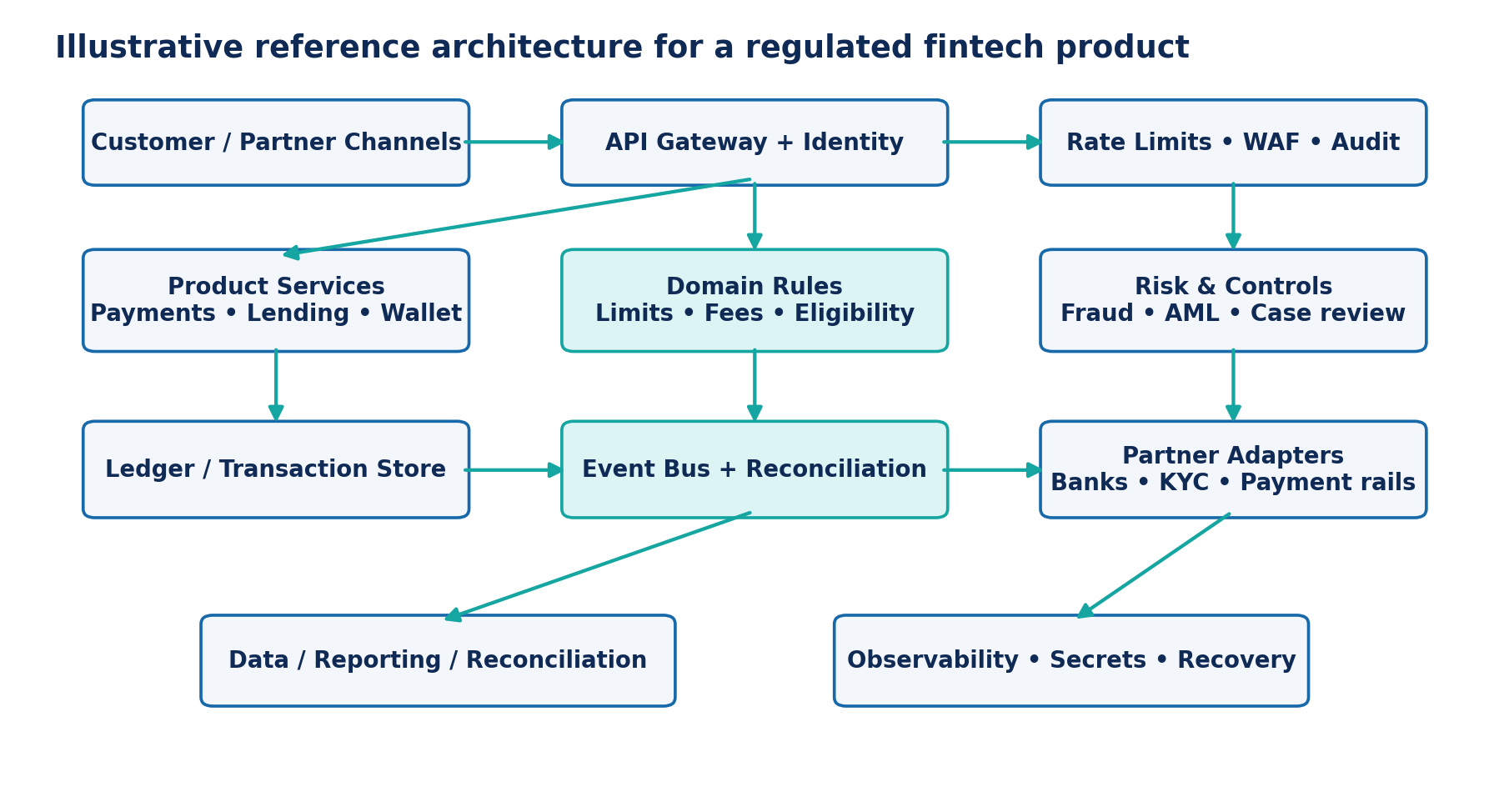
A practical reference model separates customer channels, identity and API controls, domain services, risk controls, transaction storage, event handling, partner adapters and operational data. In a real design, each box needs ownership, data classification, trust boundaries, failure semantics, deployment choices and a defined source of truth.
Architecture concern | Recommended design question | Common failure to avoid |
|---|---|---|
Transaction integrity | What is the authoritative record, and how are duplicate requests handled? | Assuming a provider timeout means the transaction failed |
Ledger and balance | Are balances derived from durable entries with controlled corrections? | Overwriting balances without traceable postings |
API and identity | How are users, services, partners, and tenants authenticated and authorized? | Treating authentication as sufficient authorization |
Partner integration | What are the timeout, retry, rate-limit, and reconciliation rules? | Unbounded retries or hidden provider-specific logic |
Events and jobs | Can work be retried safely and monitored from enqueue to completion? | Losing events between a database write and message publication |
Observability | Can teams trace a request across internal and external boundaries? | Logs without correlation IDs, useful metrics, or alert ownership |
Recovery | What can be restored, in what order, and how is integrity checked? | A backup plan without tested recovery procedures |
FinTech Security, Compliance, and Operational Resilience
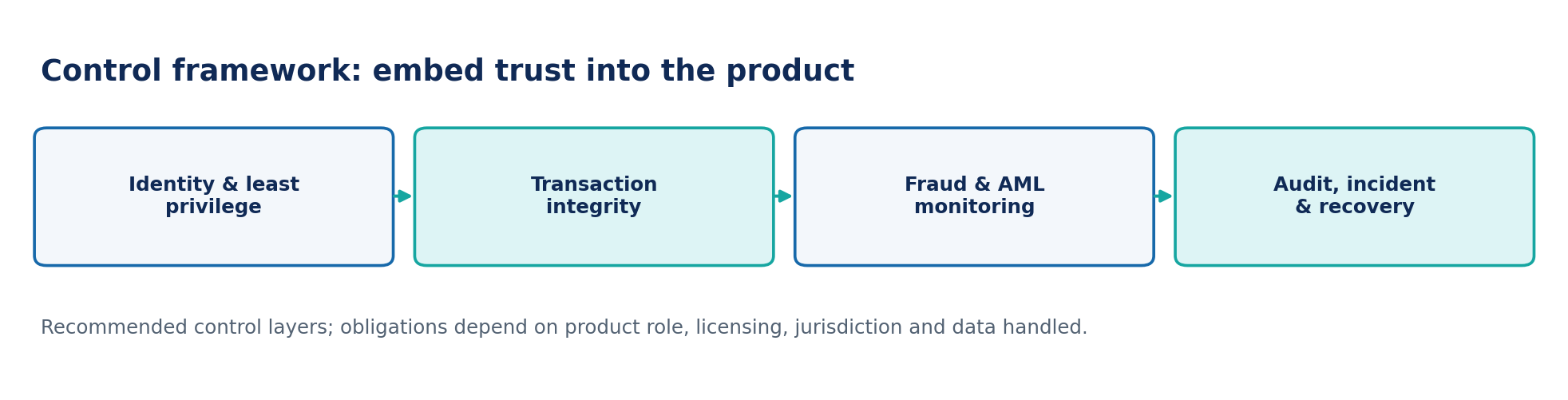
Security and compliance are product properties, not a final testing phase. Requirements depend on the financial activity, the organization’s role, customer geography, data types, contracts, and applicable law. A consulting engagement should create a traceable mapping from obligation to control, test, owner, and evidence.
Identity, Access Control, and Data Protection
Use strong authentication appropriate to the risk, secure session management, and least-privilege authorization.
Separate human access, service identities, administrative actions, and partner credentials.
Protect data in transit and at rest; manage keys and secrets with controlled rotation and access.
Minimize sensitive data collection and retention; document purpose, access, and deletion requirements.
Log privileged access and high-impact actions without unnecessarily copying secrets or sensitive payloads into logs.
Fraud Prevention, Anti-Money Laundering, and Transaction Monitoring
Fraud and anti-money-laundering controls must be matched to the product, risk appetite and regulatory role. Engineering can provide reliable event capture, rule execution, case queues, evidence retention, alert tuning and auditability. It should not hard-code an assumed universal threshold or represent a generic rule engine as sufficient compliance. Risk and compliance owners must define policy, escalation, and disposition.
Reliability, Reconciliation, and Incident Management
Operational resilience means more than uptime. Teams need to detect incomplete transactions, reconcile internal records against external providers, identify backlogs, handle degraded dependencies, and communicate clearly during incidents. Define service-level objectives for customer-critical journeys, then instrument success rates, latency, timeout rates, duplicate-prevention outcomes, queue age and reconciliation exceptions.
Maintain a clear runbook for provider outages, elevated declines, reconciliation mismatches, suspected fraud, and data exposure.
Test backups and restoration, failover behaviour, and recovery-point/recovery-time assumptions.
Use staged rollouts, feature flags and rollback plans for changes affecting money movement.
Review alerts for actionability; alerts without ownership and runbooks create noise rather than resilience.
Ready to Build a More Reliable FinTech Solution?
Build vs. Buy vs. Partner: Choosing the Right FinTech Approach
The right sourcing model depends on whether a capability differentiates the product, how quickly it must be delivered, the organization’s regulated responsibilities, and the lifetime cost of operating it. Buying a provider does not remove integration, oversight, or exit planning; building in-house does not automatically create control if the team cannot operate the system safely.
Decision factor | Build in-house | Buy a platform/provider | Use a consulting partner |
|---|---|---|---|
Differentiation | Strong when the capability is core to product value | Good for commodity capabilities with clear fit | Useful to design, implement, or extend differentiated workflows |
Time to initial release | Often slower if foundations must be created | Can be faster if provider fit and onboarding are proven | Can accelerate discovery and delivery capacity |
Control and flexibility | High control, with full ownership burden | Bound by product roadmap, contract, and APIs | Depends on agreed scope; client should retain architecture and data ownership |
Operational responsibility | Client owns reliability, security, and maintenance | Shared or provider-led, but oversight remains necessary | Partner may implement operations; ownership must be contractually explicit |
Vendor dependency | Lower external product dependency, higher internal skills dependency | Potential lock-in, pricing and exit risk | Knowledge-transfer and handover risk if not planned |
Best fit | Strategic domain with durable internal capability | Standard capability with acceptable risk and integration fit | Complex integration, modernization, specialist gap or delivery acceleration |
Questions to Ask a FinTech Software Consulting Partner
Can they explain transaction states, idempotency, reconciliation, reversals, and failure recovery in concrete terms?
How will architecture decisions, threat models, test evidence, and runbooks be documented and handed over?
What are the assumptions and exclusions around licensing, compliance advice, provider certification, and production support?
How are source code, cloud accounts, secrets, CI/CD pipelines, data exports, and third-party accounts owned and transferred?
What evidence demonstrates delivery quality, test strategy, deployment controls, incident learning, and maintainability-without relying on unsupported promises?
FinTech Software Delivery Roadmap: From Discovery to Launch
Phase 1: Discovery and Risk Assessment
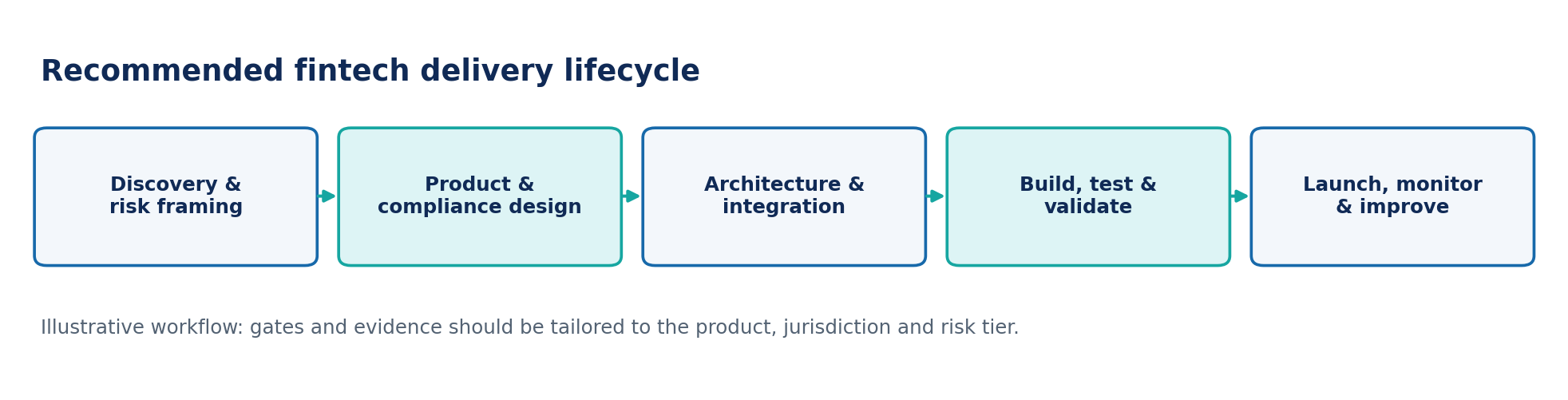
Agree on the business objective, customer journeys, regulated role, target jurisdictions, partner map, data classification, service expectations, and known constraints. Produce a prioritized backlog, assumptions register, risk register and decision log. A discovery phase is valuable when it turns unknowns into explicit tests or decisions.
Phase 2: Product and Compliance Design
Define user journeys, domain models, permission rules, error and exception states, disclosures, evidence requirements, and operational handoffs. Validate high-risk workflows with clickable prototypes or thin technical spikes. Include compliance and operations stakeholders early enough to influence the design.
Phase 3: Architecture and Integration Validation
Confirm system boundaries, authoritative data stores, event patterns, provider contracts, authentication flows, and failure behaviour. Test critical external dependencies in a sandbox where available, but document sandbox-to-production differences, certification steps, rate limits and credential ownership.
Phase 4: Development, Testing, and Validation
Implement in small increments with code review, automated tests, dependency scanning, secrets management, and traceable acceptance criteria. For transaction-heavy features, include duplicate requests, delayed responses, partial failure, reversal, concurrency, and reconciliation mismatch in test scenarios-not just the successful path.
Phase 5: Controlled Launch and Ongoing Operations
Release with feature flags or a controlled cohort when appropriate. Monitor customer journey success, transaction integrity, provider health, fraud signals, and support volume. Define escalation ownership and rollback criteria before launch. Review incidents and near misses as product feedback, not only infrastructure issues.
Release gate | Evidence to require |
|---|---|
Business readiness | Approved scope, target metrics, customer support plan, and known limitations |
Risk and compliance | Control mapping, authorized policy owners, data handling, and required approvals |
Technical readiness | Load and failure tests, dependency review, migration/rollback plan |
Operational readiness | Dashboards, alert routing, runbooks, recovery tests and reconciliation ownership |
Launch decision | Named approvers, go/no-go criteria, monitoring window and escalation channel |
Ready to Build a More Reliable FinTech Solution?
FinTech Software Development Costs: Key Factors to Consider
A responsible estimate starts with scope and risk rather than a generic price per fintech application. The same label can describe a lightweight budgeting tool or a regulated platform that moves money, integrates with multiple providers, and needs extensive audit evidence. Cost should be decomposed into delivery and lifecycle obligations.
Cost driver | Why it changes effort |
|---|---|
Product scope and workflow depth | More states, roles, exception paths, and admin tooling increase design and test needs |
Integrations | Each provider adds authentication, certification, mapping, monitoring, and failure handling |
Risk and compliance | Control implementation, evidence, review cycles, and independent validation can be material |
Data migration and reconciliation | Legacy data quality, mapping and parallel validation affect cutover risk |
Security and resilience | Threat modelling, testing, recovery, monitoring and incident readiness require planned effort |
Operations and support | On-call coverage, service objectives, reporting and provider management continue after launch |
Change and governance | Approval cycles, documentation, auditability and stakeholder dependencies influence delivery cadence |
Ask for estimates with assumptions, exclusions, dependencies, risk ranges and a plan for validating unknowns. Separate one-time build costs from recurring provider fees, cloud usage, monitoring, support, audits, and future change. Avoid treating a low initial quote as total cost of ownership.
Common FinTech Software Implementation Mistakes
Starting with a feature list before mapping money movement and ownership. Correct this by drawing the transaction lifecycle and exception paths first.
Treating a successful API response as proof of settlement. Define provider statuses, internal posting, and reconciliation separately.
Building compliance as a final checklist. Translate obligations into requirements, tests, evidence, and accountable owners from discovery onward.
Using microservices by default. Start from domain boundaries, team ownership, and operational capacity; a modular monolith can be more appropriate for a small team.
Ignoring manual operations. Reconciliation, case review, disputes, customer support, and provider administration need explicit workflows.
Testing only the happy path. Exercise retries, timeouts, concurrency, reversals, delayed events, invalid identity data, and provider outages.
Failing to plan for exit and handover. Contract for documentation, source access, data portability, credential ownership, and knowledge transfer.
Publishing unsupported claims. Keep market data sourced, label illustrative architecture, and do not imply a client result or regulatory certification without evidence.
How to Choose the Right FinTech Software Consulting Partner
When evaluating a FinTech software consulting partner, look for a team whose capabilities align with your product requirements and technical goals. Relevant expertise may include custom software development, solution architecture, API integration, platform modernization, quality engineering, and ongoing product improvement. A well-defined engagement should also establish clear ownership, decision-making responsibilities, delivery expectations, and operational processes.
Before selecting a partner, review their relevant experience, approved case studies, technical capabilities, and any applicable certifications. Make sure the proposed scope, deliverables, and responsibilities are clearly documented. The right partner should offer a transparent approach to development and knowledge transfer while ensuring your team retains the understanding and control needed to manage the product over the long term.
Ready to Build a More Reliable FinTech Solution?
Key Takeaways for Building Reliable FinTech Software
Begin with the financial workflow, business role, and risk boundaries-not the technology stack.
Model transaction states, retries, reversals, and reconciliation as first-class product behaviour.
Use official statistics carefully; transaction activity is not equivalent to market revenue or vendor demand.
Choose architecture based on domain boundaries, team ownership and operational maturity.
Treat security, compliance evidence, observability and recovery as part of the product definition.
Evaluate partners on transparency, implementation evidence, ownership, and handover-not broad guarantees.
FinTech software consulting creates value when it turns business and regulatory complexity into explicit product rules, reliable system boundaries, and operationally supportable software. The strongest delivery plan is one that makes risks visible early, validates the critical dependencies, and leaves the client able to understand and operate what has been built.
Conclusion
Building reliable financial products requires more than developing features or integrating payment APIs. It involves understanding financial workflows, defining clear transaction states, managing third-party dependencies, and addressing security, compliance, reconciliation, and operational resilience from the beginning. The right FinTech software consulting approach helps organizations make informed technology decisions, reduce implementation risks, and create software that can adapt as business needs and regulatory requirements evolve.
Whether you are developing a new fintech product, modernizing an existing platform, or improving integrations and operational processes, choosing the right technical approach is essential. Focus on clear architecture, measurable requirements, transparent delivery, and long-term ownership. Contact us today to discuss your FinTech software requirements and explore how the right engineering approach can help turn your product vision into a reliable financial solution.

Hard Trivedi
Business Enthusiast | Exploring ideas, understanding business challenges, and turning insights into practical solutions that create meaningful value and growth.