When a fast-growing SaaS scale-up engaged an external consultancy for DevOps Consulting Services to modernize its deployment pipeline, the executive team expected faster release cycles and zero-downtime deployments. Six months and $180,000 later, they were left with 4,000 lines of brittle, undocumented Terraform scripts, an opaque Jenkins setup that only one external contractor understood, and a monthly AWS bill that had increased by 35%.
This scenario highlights several challenges engineering organizations face when choosing a DevOps consulting partner:
Engineering leaders hire consultants to solve pipeline bottlenecks and infrastructure overhead, but sometimes receive temporary fixes that create long-term technical debt.
Choosing a DevOps consulting partner in 2026 requires more than finding engineers who can write basic YAML files or configure standard Kubernetes clusters.
The right partner should build developer self-service platforms, enforce strict cloud cost guardrails, and empower internal teams to manage operations independently.
Engineering leaders should look beyond marketing presentations and evaluate partners based on architectural capabilities, operational guardrails, and proven delivery track records. Look beyond marketing presentations and evaluate partners based on architectural capabilities, operational guardrails, and proven delivery track records.
DevOps Consulting Company Evaluation: Key Criteria to Consider
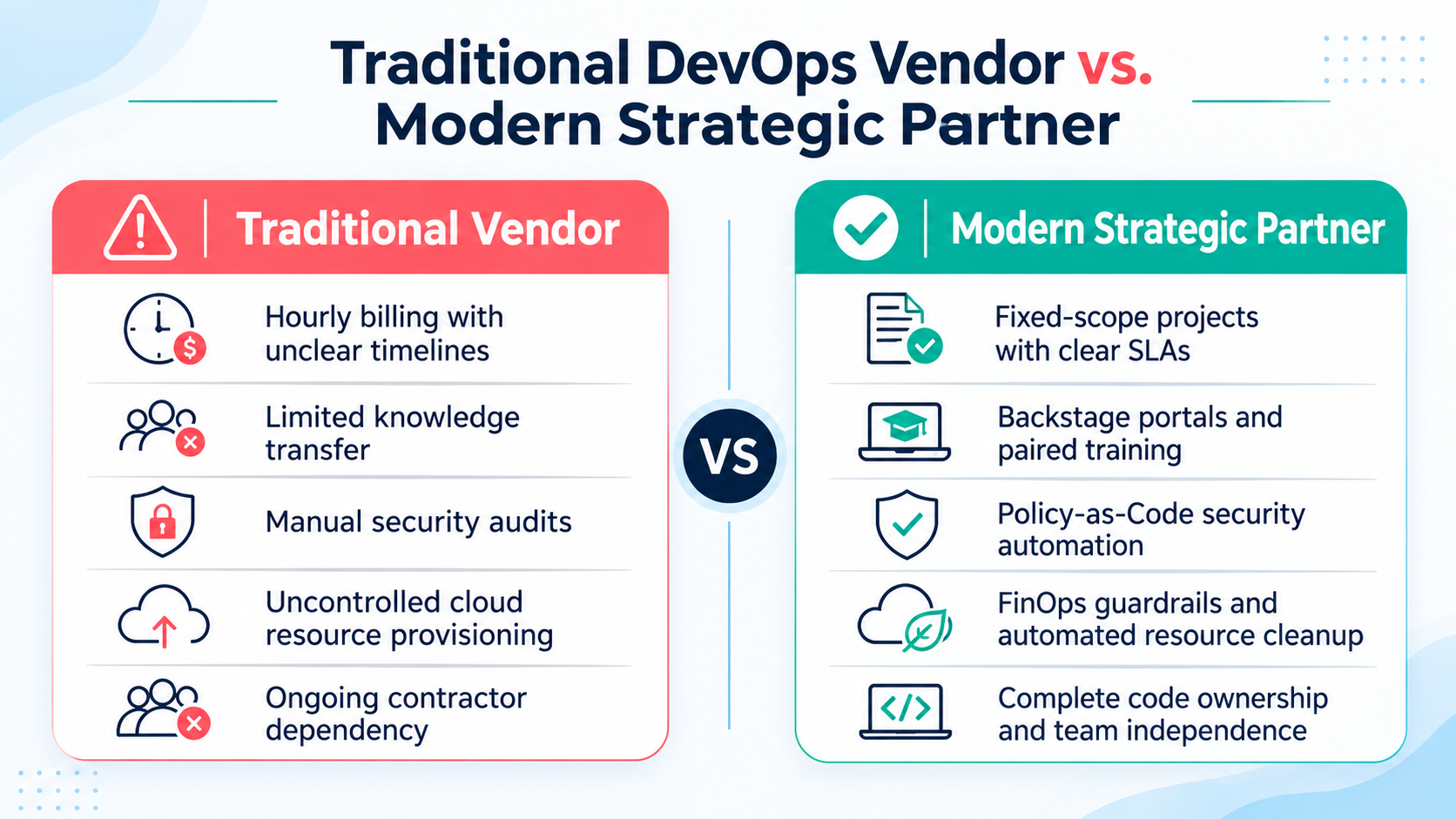
Evaluation Dimension | Traditional Vendor Trap (Red Flags) | Modern Strategic Partner (Green Flags) | Business & Engineering Impact |
|---|---|---|---|
Delivery Model | Staff augmentation and hourly billing with no clear timeline. | Fixed-scope platform engineering sprints with clear SLAs. | Eliminates budget overruns and aligns incentives toward completion. |
Knowledge Transfer | Opaque infrastructure setups that require ongoing retainers. | Comprehensive Internal Developer Portals (Backstage) and paired ops training. | Prevents vendor lock-in and empowers internal teams from day one. |
Security & Compliance | Security audits slapped on at the end of the project cycle. | Policy-as-Code (OPA/Kyverno) integrated directly into CI/CD pipelines. | Ensures continuous SOC 2 and HIPAA compliance without slowing deployments. |
Cloud Cost Strategy | Unconstrained resource provisioning with zero FinOps guardrails. | Ephemeral preview environments with automated TTL auto-teardown. | Prevents unexpected cloud bill spikes during non-production testing. |
FASCINATING ENGINEERING FACT
Studies across enterprise engineering teams show that companies using specialised platform engineering partners achieve 4x higher deployment frequency and 60% faster mean-time-to-recovery (MTTR) compared to teams relying on generalist staff-augmentation agencies.
Ready to Strengthen Your DevOps Strategy?

DevOps Consulting Company Red Flags: What to Watch For
When evaluating a prospective DevOps consulting firm, traditional sales pitches focus heavily on certifications and partner badges. However, production reliability depends on technical execution, operational discipline, and long-term maintainability.
Engineering leaders must scrutinise four core operational areas during the evaluation process:
1. Delivery Models: Fixed-Scope Projects vs. Staff Augmentation
Staff augmentation agencies profit by keeping billable contractors embedded in your organisation as long as possible. Modern platform engineering partners operate on fixed-scope deliverables and milestones tied to measurable outcomes, such as lowering lead time for changes or automating environment provisioning.
2. Infrastructure as Code: Reusable Modules vs. Custom Scripts
Poor consulting engagements often result in thousands of lines of monolithic, copy-pasted Terraform or CloudFormation code. Evaluate whether the firm uses modular, version-controlled Infrastructure as Code (IaC) libraries (such as OpenTofu or Terraform modules) with automated testing frameworks like Terratest.
3. Developer Enablement: Self-Service Platforms vs. Manual Processes
A consulting firm should build self-service capabilities, so your internal developers can deploy microservices independently. If the firm sets up a workflow where your team must open a ticket every time a new database or staging environment is needed, they are creating vendor dependency rather than engineering velocity.
4. Security and Governance: Automated Policies vs. Manual Audits
In 2026, security cannot be an afterthought. Top-tier partners embed Policy-as-Code guardrails (using tools like Open Policy Agent or Kyverno) directly into your deployment pipelines to enforce compliance rules automatically before code hits production.
Technical Checklist for Evaluating a DevOps Consulting Company
Evaluation Area | Major Red Flags (Avoid) | Green Flags (Look For) |
|---|---|---|
Code Ownership | Proprietary modules, hidden repositories, or uncommitted local configurations. | Full repository access from day one, clear documentation, and standard open-source tooling. |
CI/CD Pipeline Design | Complex, custom-scripted Jenkins setups that lack automated rollbacks. | Declarative GitOps workflows using tools like ArgoCD or Flux with automated canary rollouts. |
Cloud Cost Guardrails | No resource tagging, lack of cost alerting, or unconstrained staging clusters. | Automated FinOps policies, spot instance integration, and auto-teardown for idle preview environments. |
Knowledge Transfer | No paired engineering sessions, missing runbooks, and no off-boarding strategy. | Structured training sessions, interactive Backstage portals, and comprehensive architectural decision records. |
THE HIDDEN PRODUCTION TRAP
Never accept a consulting proposal that does not include an explicit off-boarding phase. A reputable DevOps partner plans their exit strategy from day one by documenting system designs, automating runbooks, and conducting hands-on training for your internal team.
Ready to Strengthen Your DevOps Strategy?
DevOps Consulting Case Study: Modernizing Enterprise Delivery Pipelines
A high-growth fintech platform faced severe release delays due to manual environment setups and complex, brittle configuration scripts.
Our engineering team replaced the legacy setup with a standardized GitOps deployment architecture, automated IaC modules, and self-service preview environments with built-in cost guardrails.
Results of the DevOps Modernization Project
Deployment frequency increased from bi-weekly releases to multiple production deployments per day.
Environment setup times dropped from 3 days to under 15 minutes.
Non-production cloud infrastructure costs decreased by 38% through automated environment teardowns.
Complete operational handover completed within 12 weeks with zero ongoing contractor dependency.
10 Questions to Ask Before Hiring a DevOps Consulting Company
Before signing an engagement contract, engineering leaders should put prospective partners through a rigorous technical audit. The questions below help reveal whether a firm possesses genuine platform engineering capability or is simply running a traditional staff augmentation model:
Category | Interview Question for Prospective Partner | Target Answer (What You Want to Hear) |
|---|---|---|
Architecture & IaC | How do you structure, version, and test Infrastructure as Code across multiple environments? | Reusable, modular Terraform or OpenTofu code stored in Git, tested using automated frameworks like Terratest, and deployed via GitOps pipelines. |
Developer Experience | How will developers in our organization interact with the platform once your contract ends? | Through self-service developer portals (such as Backstage) or automated templates without submitting manual ops tickets. |
FinOps & Cloud Costs | What specific controls will you implement to prevent cloud bill spikes during development and testing? | Automated resource limits, spot instance integration, and hard Time-To-Live (TTL) auto-teardown for non-production environments. |
Knowledge Transfer | What does your off-boarding process look like, and how do you ensure our internal team is trained? | Paired engineering sessions, automated documentation generation, comprehensive runbooks, and a dedicated enablement phase before exit. |
Security & Compliance | How do you integrate security checks and compliance requirements into the deployment pipeline? | Automated Policy-as-Code guardrails (OPA/Kyverno) and secret scanners integrated directly into CI/CD workflows. |
Ready to Strengthen Your DevOps Strategy?
How to Plan a Successful DevOps Consulting Engagement
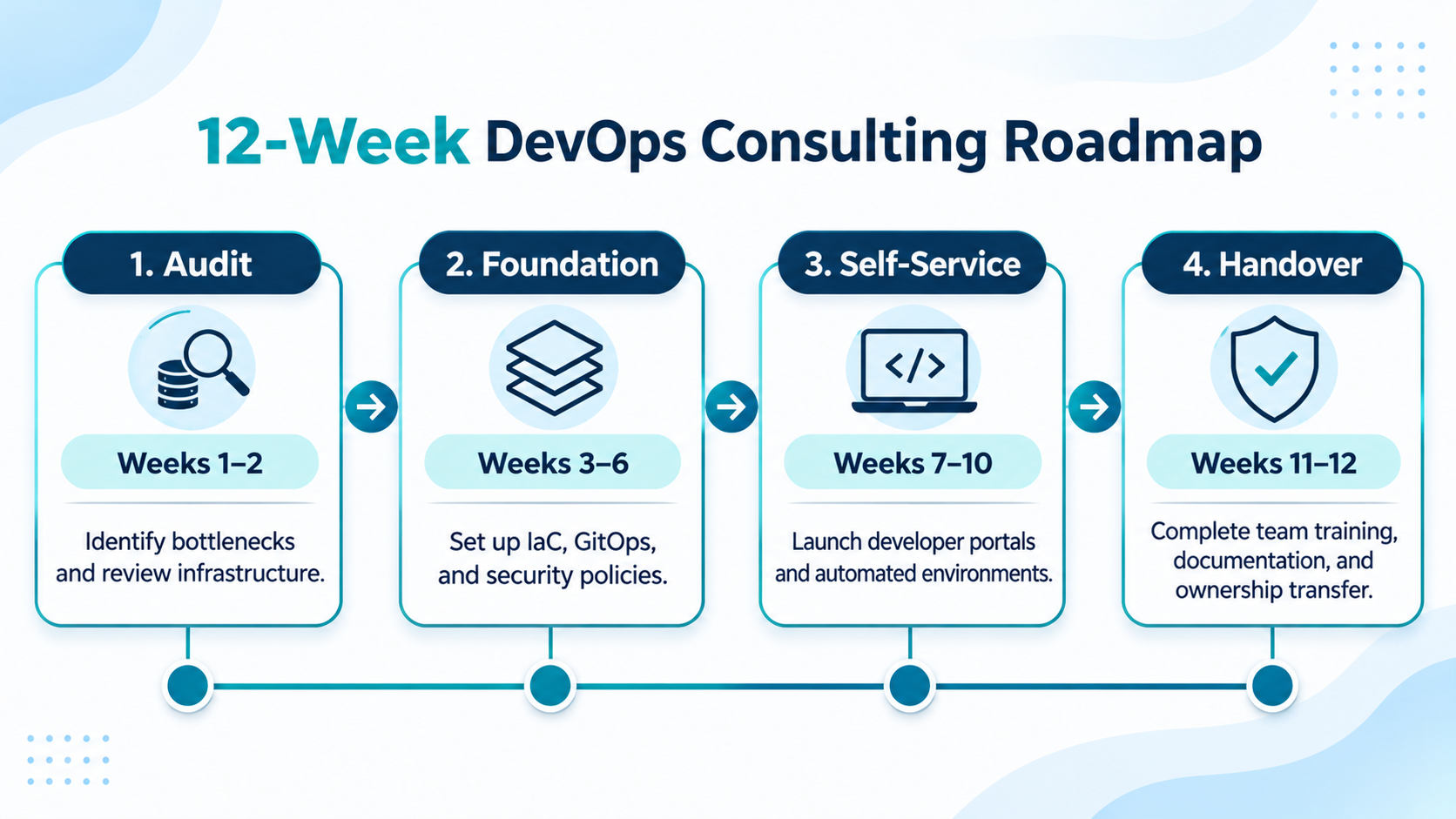
To maximize return on investment and avoid common consulting pitfalls, follow this step-by-step engagement roadmap:
Execution Phase | Strategic Focus & Actions | Expected Outcome |
|---|---|---|
Phase 1: Architectural Audit (Weeks 1-2) | Conduct deep-dive audits of current delivery bottlenecks, toolchain redundancy, and cloud infrastructure waste. | Clear baseline metrics for lead time, deployment frequency, and monthly cloud spend. |
Phase 2: Platform Foundation (Weeks 3-6) | Deploy standardized IaC modules, establish GitOps delivery workflows, and set up Policy-as-Code guardrails. | Production-ready delivery infrastructure built on open-source standards. |
Phase 3: Developer Self-Service (Weeks 7-10) | Roll out developer portals and ephemeral environment templates for internal engineering teams. | Reduced setup friction and faster pull-request validation cycles. |
Phase 4: Enablement & Off-boarding (Weeks 11-12) | Conduct paired ops training, finalize runbooks, and hand over complete repository ownership. | 100% operational autonomy for internal SREs with zero vendor lock-in. |
Conclusion: Choosing the Right DevOps Consulting Company
Choosing the right DevOps consulting company in 2026 goes beyond comparing pricing, certifications, or technical expertise. Businesses need a partner that understands their infrastructure, builds reliable CI/CD pipelines, implements cloud cost controls, and follows security best practices. Clear code ownership, reusable Infrastructure as Code, proper documentation, and structured knowledge transfer are equally important for avoiding vendor lock-in and long-term technical debt.
The right consulting partnership should deliver more than a modernized deployment pipeline. It should leave your internal engineering team with the tools, knowledge, and confidence to manage operations independently. Contact us today to discuss your DevOps requirements and explore how we can help strengthen your infrastructure, improve deployment efficiency, and build a reliable platform for long-term growth.

Swati Bais
Business Enthusiast | Curious about how businesses evolve, connecting ideas with insights to discover opportunities and shape better ways of working.