Why 2026 Is a Turning Point for Islamic Fintech
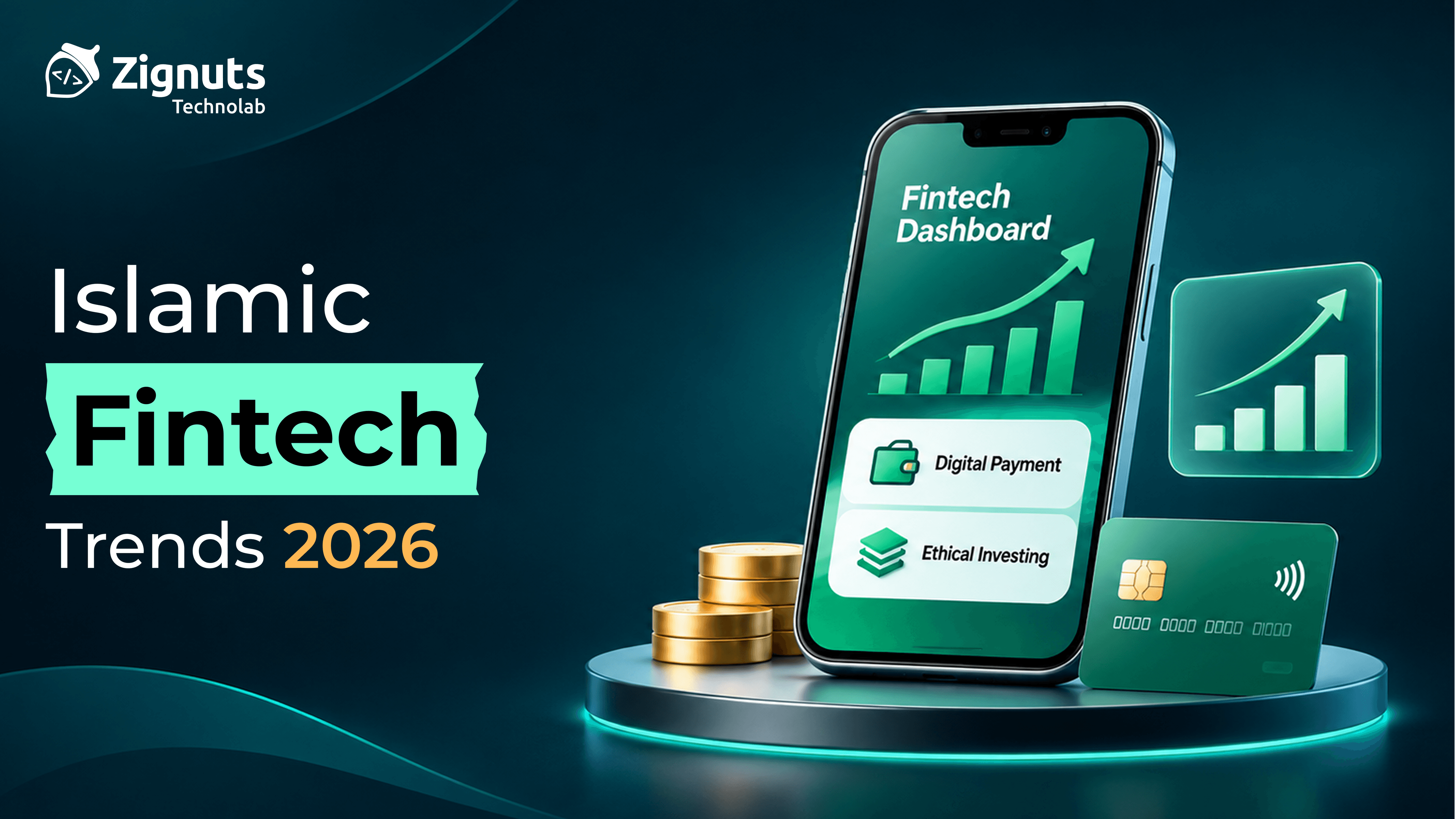
Islamic fintech is no longer a side project. It is growing at roughly the same pace as the wider fintech industry, from a small base, while the focus is shifting from innovation to regulation and supervision. This shift is creating new opportunities for Islamic Core Banking System Development, particularly as regulators and standard setters introduce rules for digital Islamic banks, tokenised assets, and emerging financial product structures.
For bank and fintech leaders, several developments make 2026 an important year:
Growing market opportunities: Islamic fintech is expanding, although it still represents a small share of the wider fintech industry.
Stronger regulatory oversight: Regulators and standard setters are developing rules for digital Islamic banks and tokenised assets.
Changing industry priorities: The conversation is moving beyond whether Islamic fintech is viable to deciding which trends institutions should adopt, pilot, or prepare for.
Platform readiness: Financial institutions need to assess whether their existing platforms can support new products, regulatory requirements, and evolving business models.
Research-backed insights: This guide draws on three primary sources published in 2026:
Global Islamic Fintech Report 2025/26 by DinarStandard and Elipses.
Islamic Financial Services Board's 2026 stability report.
AAOIFI's July 2026 governance announcements.
Understanding market estimates: Market figures are estimates, and different research firms use different definitions. This guide identifies what each figure measures and its source.
Islamic Fintech Market Size and Growth Outlook
Islamic fintech was estimated at USD 198 billion in 2024/25 and is projected to reach USD 341 billion by 2029, growing at 11.5% a year. That is slightly ahead of conventional fintech, which the same report puts at about 11.0%.
Measure | Figure | Source |
|---|---|---|
Global Islamic fintech market, 2024/25 | USD 198 billion | GIFT Report 2025/26 |
Projected market, 2029 | USD 341 billion | GIFT Report 2025/26 |
Expected annual growth to 2029 | 11.5% (conventional fintech: about 11.0%) | GIFT Report 2025/26 |
Share of global fintech | 1.5% | GIFT Report 2025/26 |
Islamic fintechs worldwide | 484 firms | GIFT Report 2025/26 |
Islamic financial services industry assets, 2025 | About USD 4.4 trillion | IFSB Stability Report 2026 |
The shape of the market is more useful than the headline. Saudi Arabia, Iran, Malaysia, the UAE, Indonesia, and Kuwait lead by transaction volume, and 16 countries recorded more than USD 1 billion in Islamic fintech volume in the past year.
The report ranks Saudi Arabia, Malaysia, the UAE, Indonesia, and Bahrain as the five most conducive ecosystems, with Pakistan entering the top 10 for the first time.
By firm count, alternative finance leads with 104 firms, followed by wealth management (74), payments (70), raising funds (55), and deposits and lending (46).
Ready to Build the Future of Islamic Fintech?

6 Key Islamic Fintech Trends to Watch in 2026
Six trends stand out in the 2025/26 GIFT report and its industry survey. The following points reflect what the sources state, while distinguishing industry views from measured findings.
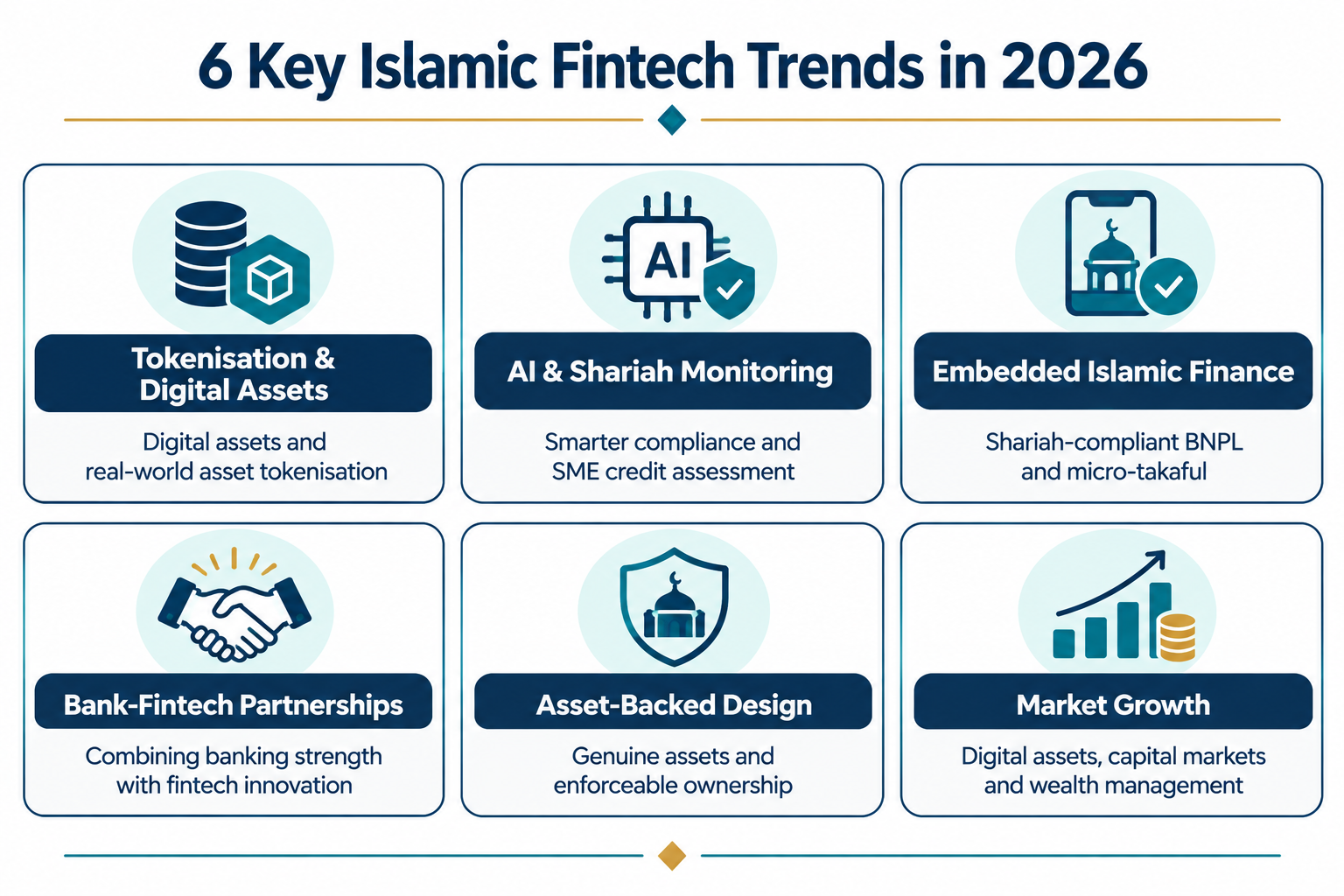
1. Tokenisation and Digital Assets Move Toward Supervision
Across the Gulf and Southeast Asia, the report highlights different use cases for digital assets:
Stablecoins and central bank digital currencies: Used for settlement.
Tokenisation: Used for distributing real assets.
Shariah governance: Becoming an essential operating framework rather than just a marketing label.
Regulatory developments are also moving forward:
Bank Negara Malaysia has published a discussion paper on asset tokenisation.
Saudi Arabia has announced infrastructure for regulated real estate tokenisation.
Fasset received a provisional licence in Malaysia for a stablecoin-powered Islamic digital bank under sandbox parameters.
Industry respondents expect digital assets to be the fastest-growing sector in 2026.
The report also identifies three important questions:
Can Shariah oversight become a system of repeatable controls?
Can tokenised claims be made legally enforceable across borders?
Can the distribution economics of these products work?
2. AI for Shariah Monitoring and SME Credit
The report highlights several ways AI could support Islamic financial services when used responsibly:
Alternative credit scoring: Assessing underserved SMEs and improving access to financing.
Automated Shariah monitoring: Supporting compliance checks and reducing manual reviews.
Risk management: Improving how financial institutions identify and manage risks.
Operational efficiency: Addressing challenges related to bespoke products, manual Shariah reviews, limited data, and high compliance costs.
In the survey, increased digitisation returned to the top five growth enablers for the first time since the Covid-19 period.
3. Embedded Islamic Finance
The report highlights embedded finance as a way to make Islamic financial products more accessible through everyday digital experiences.
Key opportunities include:
Shariah-compliant Buy Now, Pay Later (BNPL): Offering financing options within digital purchasing journeys.
Micro-takaful: Integrating small-scale Islamic insurance products into customer transactions.
E-commerce integration: Making financial products available directly through online shopping platforms.
Mobile app integration: Embedding Islamic financial services into apps and everyday transaction flows.
These approaches can help financial institutions reach customers where they already spend and transact.
4. Bank and Fintech Partnerships
Access to capital and regulatory compliance remain the most consistent hurdles for Islamic fintech founders. The report highlights partnerships as a practical way to address these challenges.
Key developments include:
Bank-fintech collaboration: Traditional Islamic banks bring capital, regulatory permissions, and established customer bases, while fintechs offer faster development and innovation.
B2B business models: Fintechs can provide technology and financial capabilities to established institutions.
B2B2C business models: Partnerships can help fintechs reach end customers through existing banking channels.
Selective consolidation: The report expects more market participants, increased competition, and selective consolidation.
5. A Return to Asset-Backed Design
The report highlights a shift from distribution-led growth toward stronger balance sheet integrity, asset backing, and governance.
Key considerations include:
Asset backing: Financial products should be supported by genuine underlying assets.
Legal ownership: Technology does not replace the need for legally enforceable ownership of the underlying asset.
Ownership mechanics: Clear ownership structures are essential for establishing product credibility.
Digital gold: The report identifies it as an example of a retail asset-backed product.
For financial platforms, the credibility of these products depends on ownership mechanics rather than just the digital interface.
6. Where the Survey Sees Growth, and Where the Gaps Are
The survey identifies several sectors with growth potential, alongside areas that remain underdeveloped.
Digital assets and capital markets: Expected to be the fastest-growing sectors in 2026.
Wealth management: Continues to gain importance within Islamic fintech.
Social finance: Also gaining importance.
Deposits and lending: Remains a top-five sector but has declined in importance compared with earlier years.
Capital markets: Has fewer than 20 Islamic fintechs worldwide.
Shariah-compliant insurance: Has fewer than 20 Islamic fintechs worldwide.
Social finance: Also has fewer than 20 Islamic fintechs worldwide.
Ready to Build the Future of Islamic Fintech?
Islamic Fintech Regulations and Shariah Governance in 2026
Two 2026 publications matter most for decision makers. Both point the same way: more structure around digital Islamic banking, and closer attention to what is underneath new products.
Date | Development | Source |
|---|---|---|
5 July 2026 | AAOIFI's Governance and Ethics Board approves, in principle, exposure drafts of governance standards on "Digital Islamic Banks" and on converting a conventional institution into an Islamic one | AAOIFI |
26 May 2026 | IFSB publishes its 2026 stability report on hybrid risks in Islamic banking | IFSB |
Key Regulatory and Governance Developments
Governance Standards for Digital Islamic Banks
AAOIFI's draft establishes governance principles for digital Islamic banks.
It explains how existing AAOIFI governance standards apply to digital banking institutions.
It allows certain flexibilities for lean structures and distinctive operating models.
It also calls for suitable enhancements to governance and control environments.
These are exposure drafts, not final standards. Public hearings are still to come, so the details may change.
Increasing Focus on Hybrid Risks
The IFSB reports that new products, structures, and balance-sheet configurations increasingly mimic conventional banking.
These developments can reshape the risk profile of Islamic banks.
Existing frameworks do not always capture these emerging risks.
The IFSB calls for:
Capital frameworks that account for hybrid risks.
Closer macroprudential monitoring.
Stronger oversight of operational dependencies and interconnectedness.
Developments in Digital Asset Regulations
Pakistan, Jordan, and Morocco made progress in 2025 on lifting crypto bans and establishing regulatory frameworks.
Malaysia launched a three-year asset tokenisation initiative.
Dubai launched a tokenisation sandbox.
Why Shariah Governance Matters
The common thread across these developments is substance over label. A financial product that appears Islamic on the surface but operates like a conventional product underneath raises both Shariah compliance and prudential concerns. Financial institutions must therefore ensure that their product structures, underlying transactions, and governance processes genuinely align with Islamic financial principles.
Strategic Priorities for Islamic Banks and Fintech Leaders: The trends above do not all deserve the same response. Here is how we would sort them for a leadership discussion.
Decide where to partner and where to build: The GIFT report points to bank and fintech partnerships as a practical route, because banks hold capital, licenses, and customers, while fintechs ship faster. Settle which capabilities you will own and which you will plug in before you commit to a roadmap.
Audit your products for substance: In light of the IFSB's hybrid risk warning, review whether each product's structure and cash flows genuinely follow its contract, not just its name.
Treat Shariah governance as an operating system: The report describes this shift directly. Rulings should be versioned, approved, and traceable inside your platform, not held in minutes.
Pick one or two pilots: Tokenised sukuk, embedded Shariah-compliant products, and AI-assisted Shariah monitoring are all credible, and none needs a full-scale launch to learn from. Choose where your customers and your Shariah board are ready.
If you run or plan a digital-only model, follow the AAOIFI draft closely: Its public hearings are your chance to shape how governance applies to lean digital structures.
Educate customers deliberately: Lack of customer education ranks among the top hurdles Islamic fintechs report, so budget for explaining how products work, not only for acquiring users.
None of this requires betting on every trend. It requires being clear about which ones fit your institution and why.
Ready to Build the Future of Islamic Fintech?
Key Technology Requirements for the Future of Islamic Fintech
Most of these trends fail at the same point: a platform that cannot model Islamic contracts properly, or cannot connect to partners cleanly. A few capabilities show up again and again.
Native contract models. Murabaha, Ijarah, and Musharakah each need their own lifecycle, ownership timing, and accounting. Systems that treat them as relabeled loans are exactly where hybrid risk hides.
Configurable, versioned Shariah rules. When standards and rulings change, as they are doing in 2026, you want a controlled change, not a code release.
A full audit trail. Tokenisation, embedded products, and AI monitoring all raise the bar on showing which rule applied, to which transaction, and on whose approval.
Enforceable ownership records. The GIFT report is clear that technology does not replace legal title. Any asset-backed or tokenised product needs a reliable record of who owns what.
API-first integration. Partnerships, embedded distribution, and new settlement rails all depend on clean interfaces, so that adding or replacing a component is a project, not a rewrite.
Clean contract-level data. AI-assisted Shariah monitoring and credit scoring are only as good as the data they read.
Our earlier guides on build vs buy, the compliance checklist, and Murabaha, Ijarah, and Musharakah go deeper on each of these.
Conclusion: Preparing for the Future of Islamic Fintech
Islamic fintech is growing in 2026, creating new opportunities for banks and financial institutions. With the market projected to grow at 11.5% annually, AI, tokenisation, and embedded finance are gaining importance. Stronger regulations and Shariah governance also make compliance and transparency essential.
To stay ahead, financial institutions need reliable platforms that support Islamic contracts, Shariah rules, audit trails, and seamless integrations. Contact us today to discuss your Islamic fintech requirements and explore how Zignuts can help build or modernise your financial technology platform.

Deep Mistry
Digital Marketing Enthusiast | Diving into the world of trends, tools, and strategies, sharing discoveries that help create impactful online experiences.