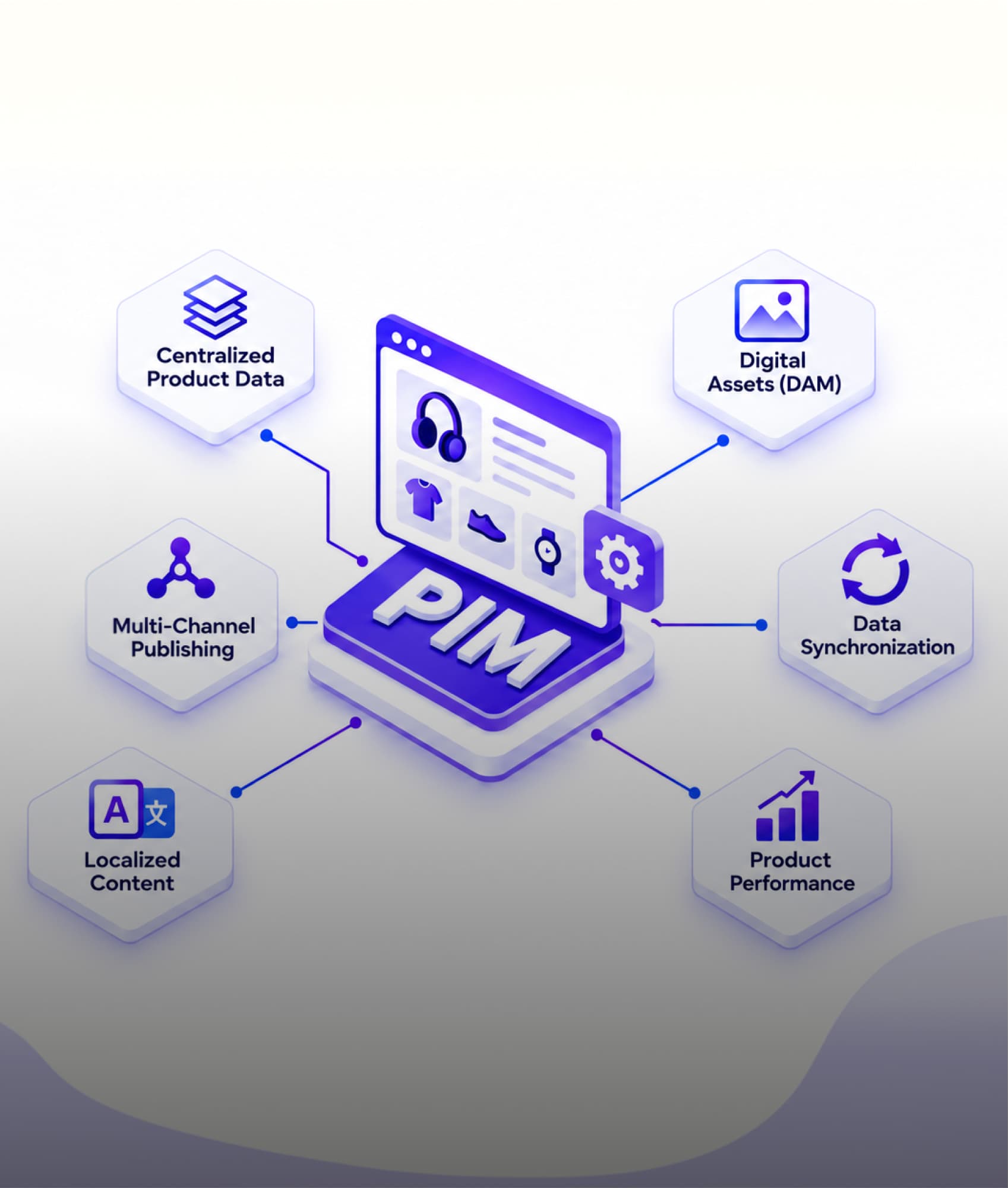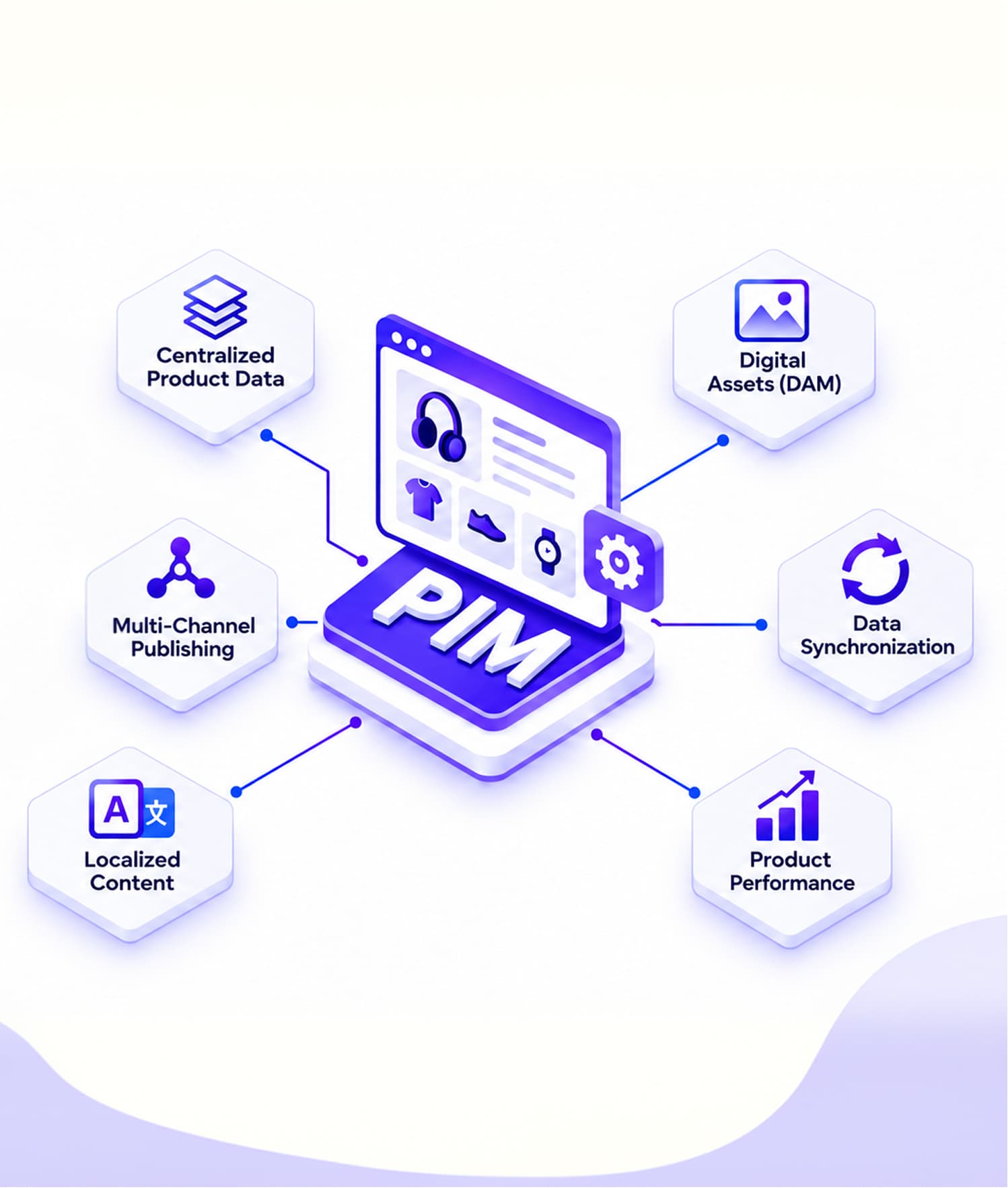
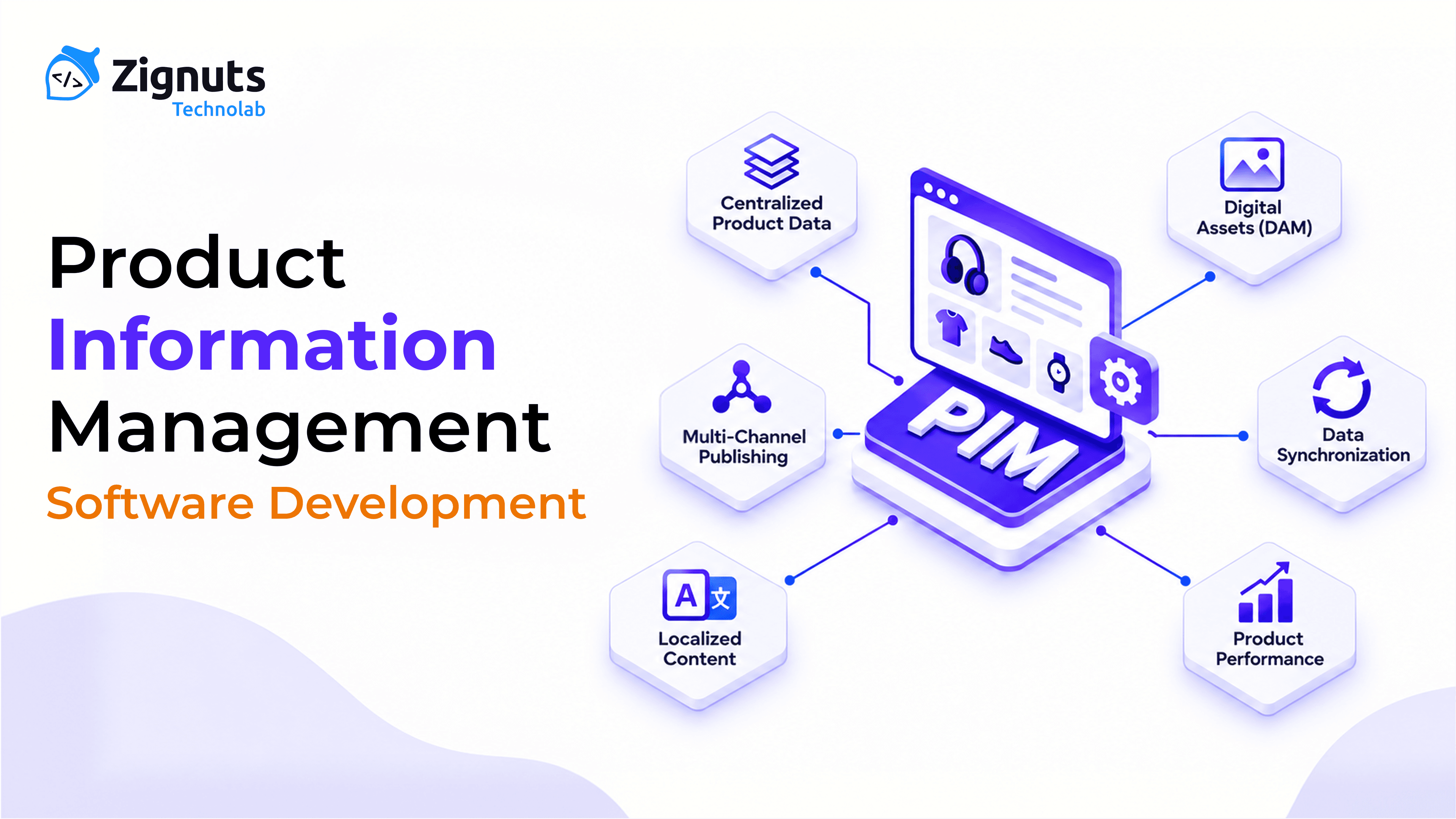
PIM software development is the work of designing, building, customizing, and integrating a product information management system, the single place where a company keeps its product data and from which it publishes that data to every sales channel. PIM Development Services help businesses create or customize these systems to manage product information more efficiently. A common trigger is a familiar pain: product data lives in spreadsheets, an ERP, supplier emails, and a commerce platform, and no copy is trustworthy. This guide covers what a PIM system has to do, how it is built, when to build versus buy, and how to choose a development partner.
Key Takeaways for Successful PIM Software Development
A PIM system is a product-data hub. It centralizes, enriches, validates, and distributes product information; it does not replace your ERP, DAM, or storefront.
The decision is rarely a pure "build or buy." Customizing an existing platform such as Akeneo or Pimcore, or building a thin custom layer around one, is often the pragmatic middle route.
Standards drive architecture. GS1 identifiers, ETIM classification, schema.org, and marketplace feed specifications should shape the data model before the first screen is designed.
Integrations and data migration carry much of the project risk, so scope them as carefully as the PIM interface.
What Is a Product Information Management (PIM) System?
A PIM system is a business application for managing product information. Pimcore describes it as gathering product data from many sources into accurate, consistent, and complete datasets, mainly for marketing and selling across channels (Pimcore, "PIM vs MDM", undated vendor page).
In practice, a PIM does five jobs:
Collects data from ERP, supplier files, PLM, and manual entry.
Models products, variants, attributes, categories, and relationships.
Enriches records with descriptions, translations, images, and channel-specific content.
Validates completeness and quality before anything is published.
Distributes data to storefronts, marketplaces, print, and partners.
PIM vs. ERP vs. MDM vs. DAM: Key Differences Explained
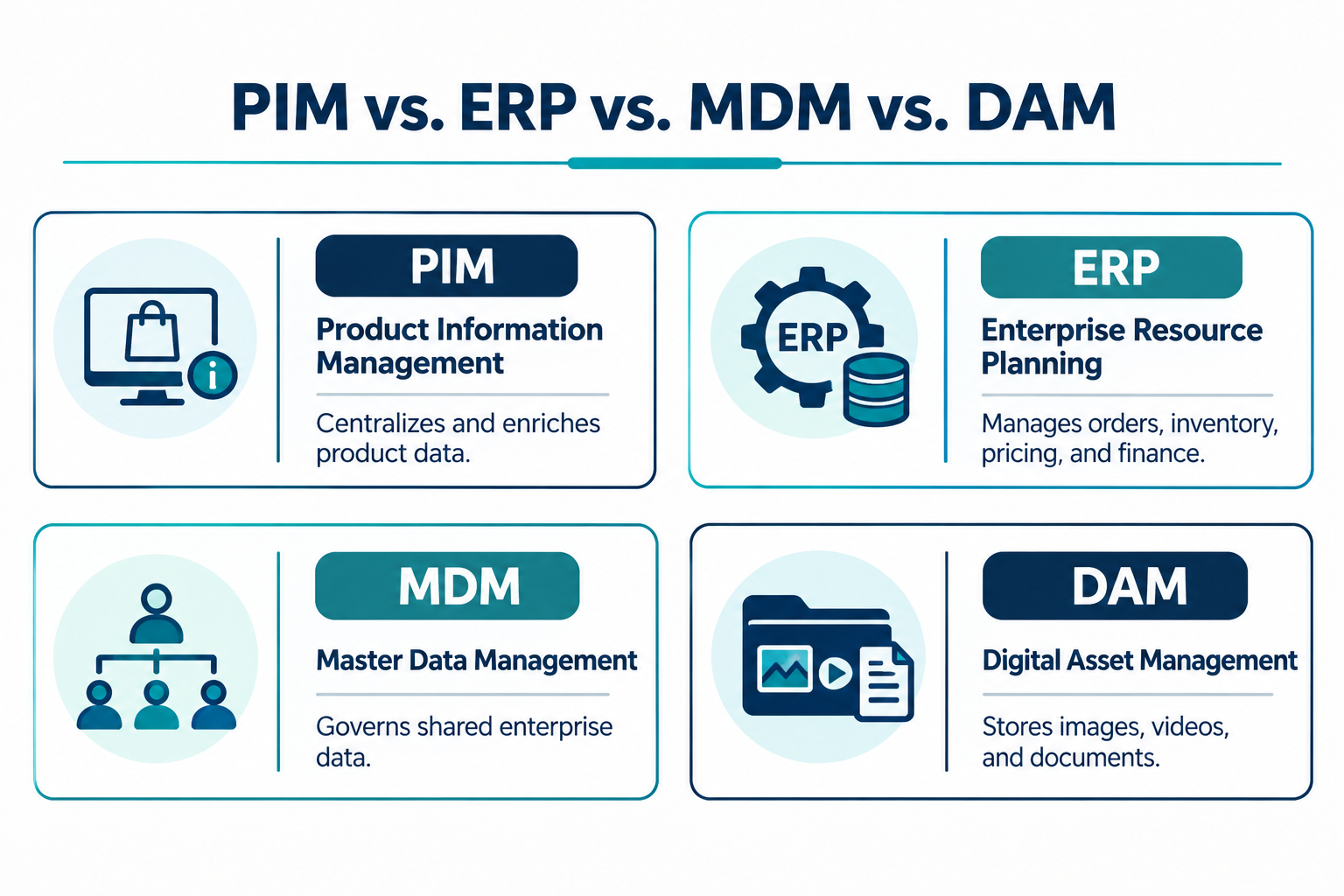
System | Primary Job | Owns |
|---|---|---|
ERP | Run transactions: orders, inventory, pricing, finance | Operational and commercial records |
PIM | Prepare product content for selling across channels | Product attributes, enrichment, channel content |
MDM | Govern shared enterprise entities | Customers, suppliers, locations, products ("golden record") |
DAM | Store and manage media assets | Images, video, documents |
Pimcore's own comparison defines MDM as an IT-led initiative that centralizes all enterprise data entities, with PIM covering product data only. It also says DAM "falls under the ambit of PIM" (Pimcore). That is a vendor's positioning, not a universal rule. Many companies run a separate DAM and connect it to the PIM. Decide this early, because it changes your data model and your integration list.
Ready to Build a Scalable PIM Solution?

Why Product Data Quality Matters for Business Growth
The business case for a PIM rests on what bad product data does at the point of sale.
The available evidence is mostly vendor-commissioned survey data, so read the figures as directional, not as independent audits.
Akeneo's 2025 consumer survey found that:
59% of respondents had made a return because an online product description was misleading or inaccurate.
62% said more accurate product information upfront would make them less likely to return an item.
The release does not state the sample size or research firm (Akeneo press release, February 2025).
Syndigo's State of Product Content 2024, with YouGov fieldwork among 6,480 adults in the US, France, Germany, and the UK, found that:
50% had dropped a potential purchase in the previous six months because they could not find enough product information (Syndigo, June 2024).
One caution on the Akeneo numbers:
The same release lists "inaccurate online product information" as a return reason for 29% of respondents, against 59% for "misleading or inaccurate" descriptions.
The wording differs, so the two figures are not directly comparable.
No independent, non-vendor study putting a dollar figure on the cost of poor product data was located while researching this guide, so none is quoted.
If you are building a business case, measure your own return reasons, time-to-publish, and channel rejection rates first.
PIM Software Market Size and Growth Trends
Estimates vary widely, and differing category definitions may be part of the reason. Fortune Business Insights values the market at USD 5.48 billion in 2025 and projects USD 20.66 billion by 2034, a 15.00% CAGR for 2026 to 2034 (Fortune Business Insights, updated October 2026). Global Market Insights reports a higher base: USD 12.2 billion in 2023, growing at over 13% a year from 2024 to 2032 (Global Market Insights, April 2024). Treat both as estimates and expect others to differ again.
Build vs. Buy vs. Customize: Choosing the Right PIM Software Development Approach
No primary-source cost data comparing these routes was located, and cost figures published by agencies could not be verified, so none appear here. Use a decision framework instead.
Approach | Best When | Main Risk |
|---|---|---|
Buy SaaS PIM (for example Salsify or inriver) | Standard product model, fast time to value, small engineering team | Limits on data-model changes and integration depth |
Customize an open-core PIM (Akeneo, Pimcore) | Complex catalog, need for extensions and ownership, existing PHP/Symfony skills | Upgrade burden on heavy customizations |
Build custom | Unusual workflows, domain-specific data (regulated, technical, B2B configurable), PIM as a product capability | Highest upfront effort; you own every feature, including the boring ones |
Key Questions to Consider Before Choosing a PIM Solution
How different is your data model? Deep variant matrices, technical attributes by class, or configurable products push toward customization or custom builds.
How many systems must it integrate with? Each integration is a long-term maintenance commitment, whichever route you take.
Who will own it for years? Choose a platform your team can realistically maintain over a multi-year horizon.
How much regulatory data do you carry? Compliance fields are easier to model in a system you control.
Ready to Build a Scalable PIM Solution?
Popular PIM Platforms: Akeneo, Pimcore, and SaaS Solutions
Akeneo. The community edition is open source. Its GitHub repository lists PHP, Symfony, and TypeScript in its stack, and the licence file begins "The Open Software License version 3.0" (Akeneo on GitHub). That licence covers the community edition only. Akeneo's API documentation lists both a REST API and a GraphQL API under its PIM APIs (Akeneo API docs).
Pimcore. Pimcore is licensed under the Pimcore Open Core License. Its repository describes a Symfony and PHP backend, MySQL or MariaDB persistence, OpenSearch or Elasticsearch for search, Redis or Symfony Cache for caching, and headless delivery through REST and GraphQL via Datahub (Pimcore on GitHub). It combines PIM with DAM and other data-management capabilities in one platform.
SaaS options. Inriver and Salsify are SaaS products. Evaluate them on data-model flexibility, API limits, and export formats, since those decide how far you can bend them later.
PIM Software Architecture: Core Components and Design
A well-built PIM has these layers, regardless of platform.
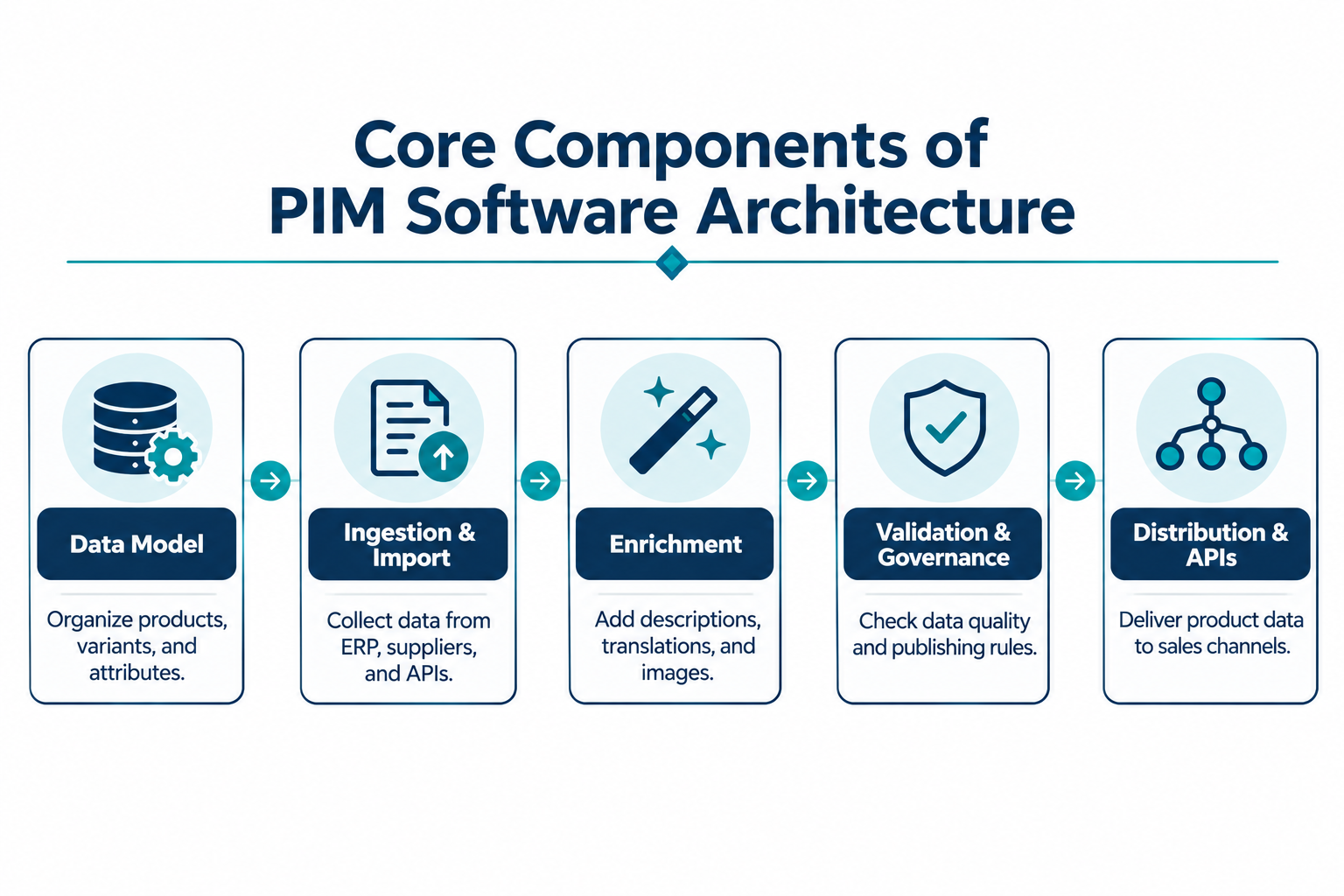
1. The Data Model
This is the hardest part and the one to get right first. Define:
Product types and families, with the attributes each requires.
Variants: which attributes vary (size, colour) and which stay on the parent.
Attribute types: text, number with unit, select, reference, table, localizable and scopable values.
Categories and classification: your own tree plus external standards.
Relationships: accessories, replacements, bundles, spare parts.
2. Ingestion and Import
Expect many formats: CSV and Excel from suppliers, ERP exports, API pushes, and PLM data. Build import pipelines with a staging area, mapping profiles, validation reports, and the ability to re-run safely. Idempotent imports, which can be re-run without duplicating or corrupting data, make failed loads far less painful to recover from.
3. Enrichment Workflow
Define who edits what, and when a record is ready. Typical elements are completeness scores per channel and locale, approval states, role-based permissions, and an audit trail. Translation and AI-assisted drafting plug in here (see the AI section below).
4. Validation and Governance
Rules should block publishing, not just warn. Examples: required GTIN for marketplace channels, minimum image dimensions, allowed value lists, unit consistency.
5. Distribution and APIs
Expose product data through REST and, where it helps front-end teams, GraphQL. Add webhooks or events so downstream systems react to changes, and bulk endpoints so large catalogs sync efficiently. Keep channel-specific mapping in configuration, not code.
Ready to Build a Scalable PIM Solution?
Product Data Standards for Scalable PIM Software Development
Standards are where a generic PIM becomes one that works with your trading partners.
GS1 Identifiers and GDSN
GTINs are the identifiers retailers and marketplaces expect.
The Global Data Synchronisation Network (GDSN) connects trading partners to what Salsify's guide calls "a trusted, continuously synchronized product information source."
GDSN uses data pools to store and transmit product data (Salsify GDSN guide, vendor source).
If you sell to large retailers, plan for GDSN publication as a distribution channel.
Industry Classification: ETIM and ECLASS
For technical products, classification standards matter more than marketing copy.
ETIM describes itself as "a format to share and exchange product data based on taxonomic identification."
ETIM is organized into groups, classes, synonyms, features, values, and units, and is available in 17 languages.
It is run by ETIM International, a non-profit based in the Netherlands.
ETIM covers sectors including electrotechnical, HVAC and plumbing, and building materials (ETIM International).
If you operate in those sectors, support ETIM classes and features natively.
ECLASS is a comparable standard; verify its current structure at eclass.eu before committing to it.
schema.org and Merchant Center
schema.org defines Product as "any offered product or service."
Its properties include gtin, sku, brand, offers, mpn, and additionalProperty.
Generating this markup from the PIM keeps storefront structured data consistent with the source of truth.
Google Merchant Center's product data specification sets hard limits that your validation rules should mirror.
Required attributes include:
id (maximum 50 characters)
title (150 characters)
description (5,000 characters)
link
image_link
price
availability
Brand is required for new products except movies, books, and music recordings.
MPN is required only when there is no manufacturer GTIN.
The specification states that image_link must be at least 500 × 500 pixels, with enforcement starting 31 January 2027 (as read on the specification page in November 2026; re-check before relying on the date).
Image dimension validation in your PIM is a practical feature to ship before that date.
Essential PIM Integrations for ERP, PLM, DAM, and Commerce Systems
Integration | What It Does | Design Notes |
|---|---|---|
ERP | Source of SKUs, prices, stock | Decide which system owns which field; avoid two-way edits on the same attribute |
PLM / supplier portals | Early-stage technical data | Map lifecycle status to publishable states |
DAM | Media assets | Reference assets by ID; keep rights metadata |
Commerce platform | Storefront publication | Push through APIs; keep channel mapping configurable |
Marketplaces | Amazon, Google, others | Each has its own schema; expect to maintain mappings |
Amazon's Selling Partner API offers a Listings Items API for "programmatic access to selling partner listings on Amazon" and is meant to be used with the Product Type Definitions API (Amazon developer docs). That pairing matters for design: product types and required attributes come from Amazon's definitions, so your PIM should fetch and cache them rather than hard-coding attribute lists.
Ready to Build a Scalable PIM Solution?
PIM Data Migration: Steps, Challenges, and Best Practices
Migration is often the least predictable part of a PIM project, because the real condition of the source data only shows up once you profile it. A workable sequence:
Inventory every source. Spreadsheets, ERP tables, legacy PIM, supplier files, shared drives.
Define the target model first, then map sources to it.
Profile the data. Count missing values, duplicate SKUs, inconsistent units, and free-text attributes that should be structured.
Clean and deduplicate in staging, not in production.
Run trial migrations and review completeness reports with the people who own the data.
Cut over by channel or product line, not all at once, with rollback plans.
How AI Improves Product Information Management Workflows
AI is most useful for first-draft descriptions, attribute extraction from supplier text, auto-classification suggestions, and translation. Vendor surveys report high adoption, but the methods are rarely disclosed, and no independent 2025 to 2026 adoption data was located, so this guide does not quote an adoption figure.
Design guidance that holds regardless: store AI-generated content with a clear state ("suggested"), require approval before publication, log the source and model for each change, and validate output against the same rules as human edits.
Digital Product Passports and Regulatory Requirements in PIM Systems
The EU's Ecodesign for Sustainable Products Regulation (Regulation (EU) 2024/1781) introduces digital product passports, with product-group requirements set through delegated acts. Timelines differ by product group, so confirm the current status on the European Commission's digital product passport page before planning. For PIM design, the practical takeaway is stable: sustainability, material, and compliance attributes are product data, so give them a place in the model now rather than retrofitting them later.
Ready to Build a Scalable PIM Solution?
How to Choose the Right PIM Software Development Partner
Whether you use an in-house team or an agency, check these points:
Data modelling depth. Ask to see a sample attribute and family model, not only UI screenshots.
Platform fit. A partner who recommends Akeneo, Pimcore, SaaS, or custom depending on your needs is more useful than one who only does one.
Integration track record. Ask how they handle ERP ownership conflicts, retries, and failed syncs.
Migration method. Look for profiling, staging, trial runs, and sign-off by data owners.
Governance and handover. Documentation, role design, upgrade plan, and training.
Testing and monitoring. Import validation, API contract tests, and alerts on failed publications.
A typical engagement runs in phases: discovery and data audit, data model and architecture, platform setup or build, integrations, migration, user acceptance, and go-live with support. Ask any provider to show how scope, timeline, and responsibilities are broken out across those phases.
How to Get Started with PIM Software Development
Audit your current product data. Count sources, owners, channels, and the most common errors.
Write down your target channels and their requirements, including marketplaces and retailers.
Draft a data model for one product family and test it against real records.
Pick the approach with the decision table above, and shortlist platforms.
Run a pilot on one category and one channel before scaling.
Conclusion
A PIM succeeds when its data model reflects how you actually sell, its integrations are owned and monitored, and its data is migrated and governed with care. Start with the data audit and a single product family, base the model on the standards your trading partners use, and choose a platform approach that your team can maintain over the long term.
If you are weighing a custom build, a Pimcore or Akeneo implementation, or a migration from spreadsheets, a scoped discovery phase is the lowest-risk next step. Contact us today to discuss your PIM requirements and explore an approach that fits your business needs.

Deep Gondaliya
Business Analyst | Turning business challenges into clear insights, practical solutions, and meaningful improvements that help teams move forward.