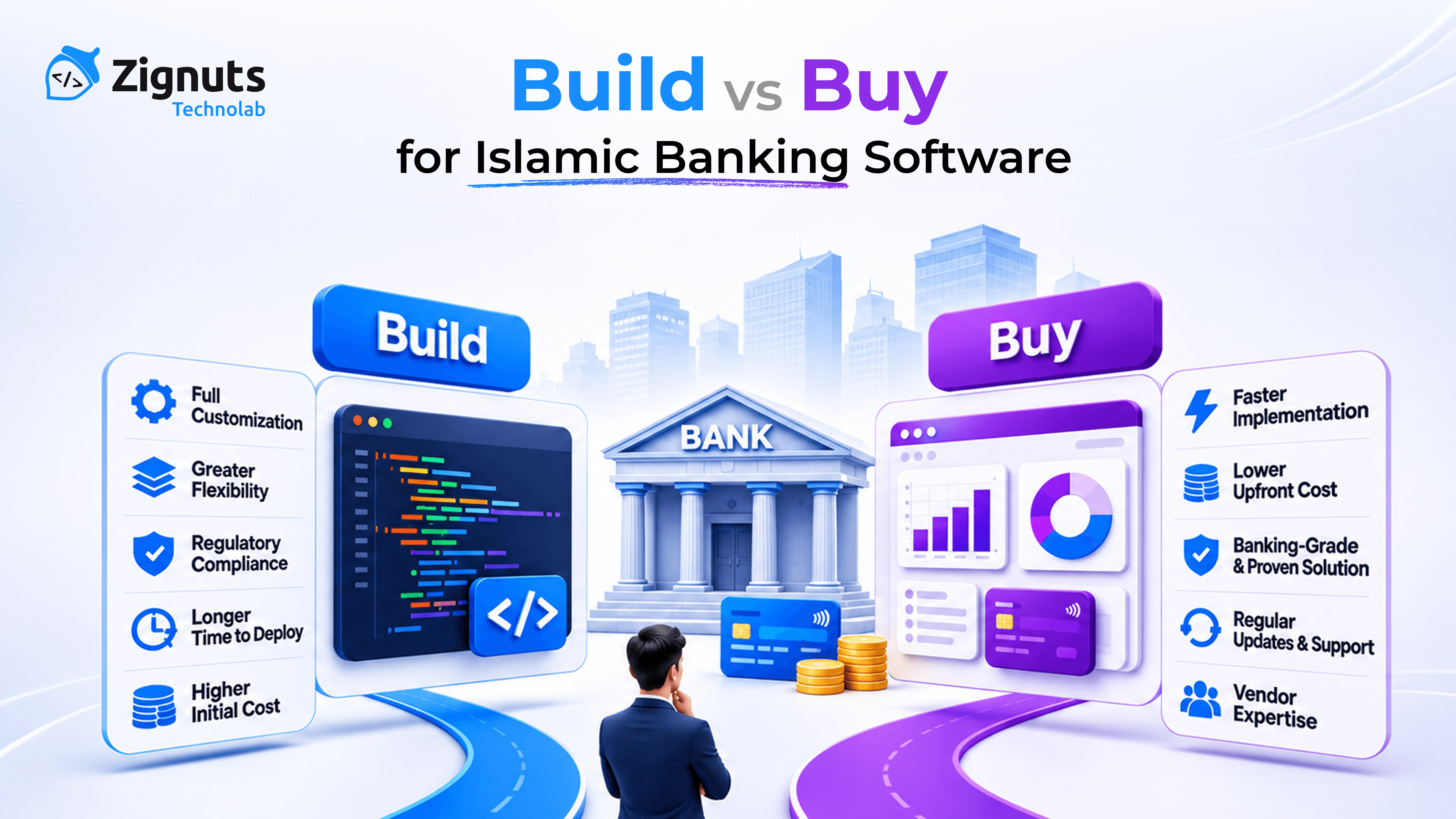
Every few months, a conversation like this lands on our desk. A bank, an Islamic window, or a fintech with a regulatory license in the GCC, Southeast Asia, or the UK sits down with us and asks the same question: should we build our own Islamic banking platform, or buy one?
The honest answer is that it depends. But “it depends” is not a strategy, so let’s unpack what it depends on.
Why Choosing the Right Islamic Banking Software Matters
In conventional banking, build vs. buy is already a difficult decision because you are choosing a technology foundation you may rely on for a decade or more.
Islamic banking adds another layer that many vendor comparisons overlook. The software must support your Shariah governance, product philosophy, and regulatory expectations.
Choosing the right system can help you:
Launch products faster.
Scale operations more smoothly.
Maintain confidence among your Shariah board.
Choosing the wrong system can lead to:
Manual workarounds.
Spreadsheet-based profit calculations.
Growing compliance risks.
Before comparing the build and buy approaches, it is important to understand what makes Islamic banking software different.
Key Features That Make Islamic Banking Software Different
If you are a decision-maker coming from conventional banking, here is the shift in thinking. A lot of generic core banking systems assume that money earns interest. Islamic finance assumes something else entirely: that money must be tied to real assets, real trade, and shared risk.
Contracts, Not Loans
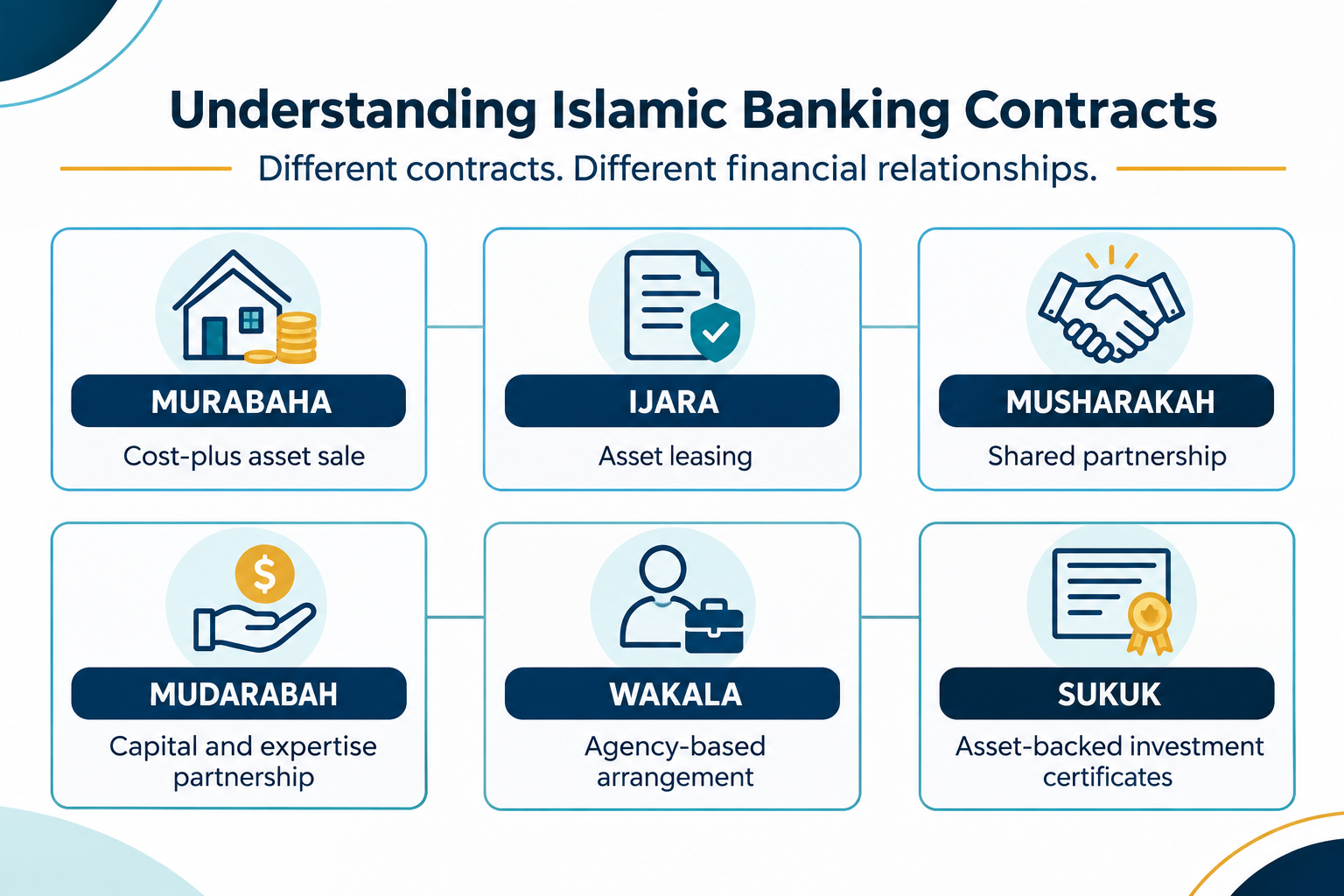
A conventional loan is a loan. An Islamic financing product is a contract, and each contract has its own rules.
Murabaha is a cost-plus sale. The bank buys an asset and sells it to the customer at a disclosed markup.
Ijara is a lease, with variations such as Ijara Muntahia Bittamleek, which ends in ownership transfer.
Musharakah and Diminishing Musharakah are partnerships where ownership shifts over time.
Mudarabah and Wakala govern investment and agency relationships.
Sukuk are asset-backed certificates rather than debt instruments.
Each of these has a different lifecycle, different ownership timing, different accounting treatment, and different points where the bank holds risk. A system that models them as “loans with a different label” will break the first time your Shariah board asks, “At what exact moment did the bank own this asset?”
Shariah Governance Inside the System
Your Shariah Supervisory Board does not just approve products on paper. Their rulings affect how fees are treated, how late payments are handled (for example, late-payment amounts directed to charity rather than recognized as income), and which transactions are permissible at all.
Good Islamic banking software treats those rulings as configuration with an audit trail, not as tribal knowledge. That means version-controlled product rules, approval workflows for changes, and the ability to show a Shariah auditor why a transaction behaved the way it did.
Profit Calculation and Pool Management
On the deposit side, many Islamic banks run investment pools. Profit is distributed based on pool performance, weightages, and agreed ratios, not a fixed interest rate. Calculating, allocating, and reporting that correctly is one of the hardest parts of the platform, and it is where generic systems struggle most.
Keep these three realities in mind as we weigh both options. They are the lens through which every build vs buy trade-off should be read.
Ready to Build the Right Islamic Banking Solution?

Buying Islamic Banking Software: Benefits and Considerations
Buying an Islamic core banking or product platform is often the right call, and we say that as a team that builds software for a living.
Speed to Market
If you have a license, a launch window, and competitors moving, a proven platform gets you live far faster than building from a blank page. A mature vendor has already modeled the standard contracts, built the accounting treatments, and been through regulatory scrutiny in several jurisdictions.
Embedded Product Knowledge
A good vendor carries years of accumulated Islamic finance knowledge. Their product factory already knows how a Murabaha differs from a Tawarruq, and their reporting aligns with recognized standards such as AAOIFI and IFSB guidance. You are effectively renting experience you would otherwise have to earn the hard way.
Where Buying Goes Wrong
Buying fails in predictable ways:
The “Islamic module” problem. Some vendors bolt Islamic features onto a conventional core. It demos well and then struggles with real pool accounting or asset-ownership logic.
Vendor lock-in. Your product roadmap becomes the vendor’s release calendar. Want a new Shariah-compliant SME product? Join the queue.
Customization debt. Heavy customization on a packaged system makes every future upgrade painful and expensive.
Total cost surprises. License fees are rarely the full story. Implementation, integration, per-module pricing, and change requests add up.
Buying is a strong choice when your needs are standard, and your differentiation lives elsewhere, such as distribution, customer experience, or pricing.
Building Custom Islamic Banking Software: Benefits and Challenges
Building is a bigger commitment, and it is not for everyone. But for some institutions, it is the only path that makes strategic sense.
Differentiation and Control
If your competitive edge is the product itself, for example, a novel Shariah-compliant SME financing structure, a profit-sharing investment offering, or an embedded Islamic finance experience inside a super app, a packaged system may constrain you. When the system is yours, you can model exactly what your Shariah board approves, not the nearest thing the vendor supports.
Ownership of the Roadmap
With a custom platform, your release calendar is your own. You can respond to a regulatory change, a new fatwa interpretation, or a market opportunity on your timeline. You also own the intellectual property, which matters for fintechs planning to scale, license, or raise capital.
Where Building Goes Wrong
We have seen this too, and it is worth being direct about it:
Underestimating domain depth. Engineers who have never worked on Islamic finance often treat it as “conventional banking minus interest.” It is not, and rework is expensive.
Scope creep toward a full core. Teams set out to build a product layer and end up rebuilding a general ledger, which is a multi-year effort.
Compliance as an afterthought. If Shariah governance and audit trails are bolted on late, you will feel it during your first review.
Key-person risk. If the two people who understand the profit-distribution engine leave, you have a problem.
Building works when you have a clear differentiator, strong domain input from day one, and the patience to treat the platform as a long-term product, not a one-off project.
Ready to Build the Right Islamic Banking Solution?
How to Choose Between Building and Buying Islamic Banking Software
Instead of debating in the abstract, we suggest pressure-testing the decision against a handful of questions. Be honest with the answers.
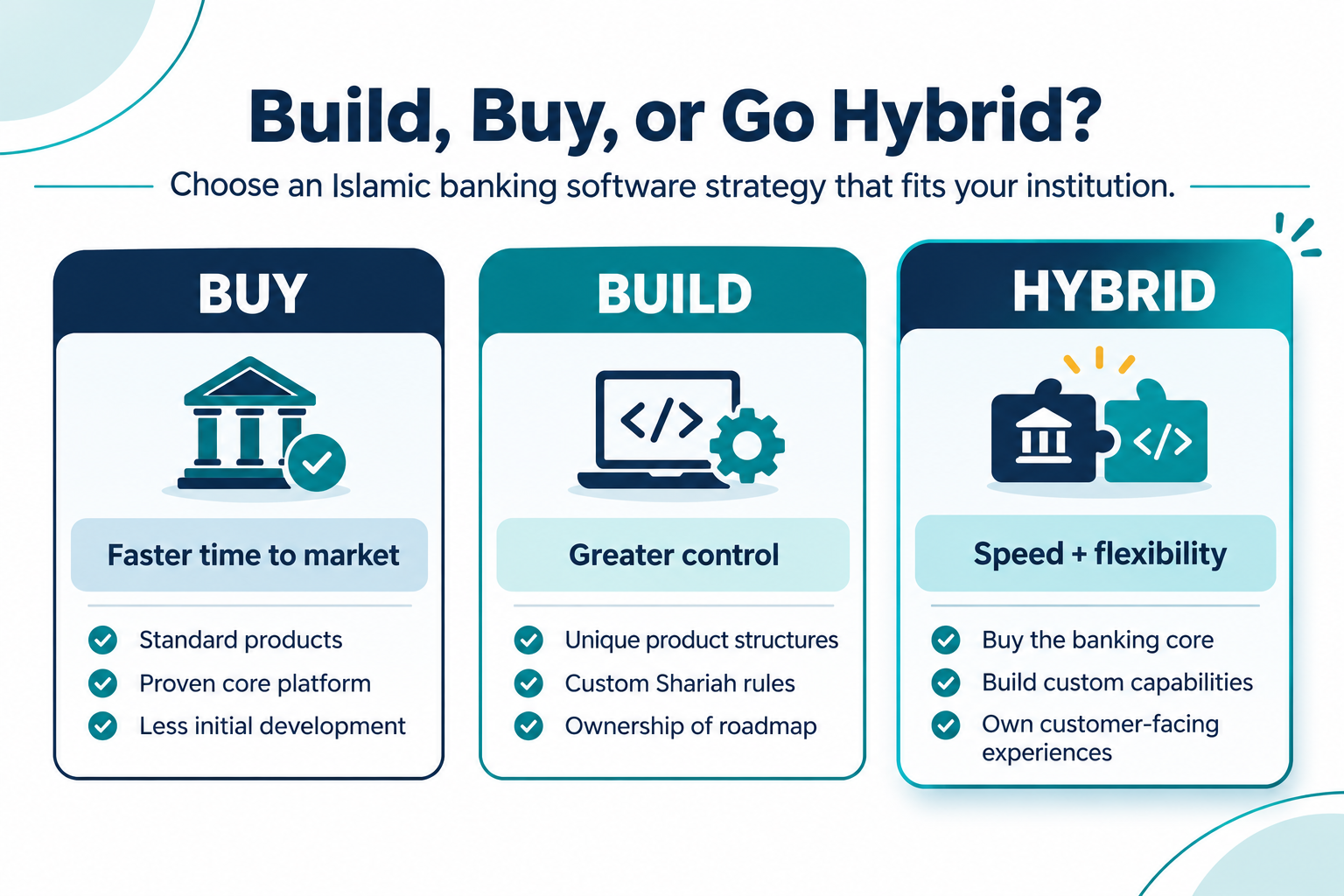
Where does our competitive advantage live? If it is in distribution or service, buy the core. If it is in the product structure itself, building (at least the product layer) deserves serious consideration.
How standard are our products? Plain-vanilla Murabaha, Ijara, and current accounts are well served by packaged platforms. Hybrid or novel structures are not.
What is our time-to-market constraint? A hard regulatory or competitive deadline favors buying or a hybrid approach.
What does our Shariah board need to see? If they require granular traceability and rule-level control, test vendors on that specifically, not just on feature lists.
What is our five-year total cost of ownership? Include licenses, customization, integration, upgrades, and the internal team required to run either option.
How exposed are we to lock-in? Ask any vendor how easily you can extract your data, configurations, and product definitions if you leave.
Do we have the in-house capability? Building without product owners, architects, and Shariah-literate analysts is a recipe for delay.
If most of your answers point in one direction, you probably have your answer. If they split evenly, which is common, the next section is for you.
Hybrid Islamic Banking Software: Buy the Core and Build Custom Capabilities
Increasingly, the most practical answer is neither pure build nor pure buy.
Think of your banking technology like a building. The foundation, plumbing, and wiring (the ledger, core accounts, regulatory reporting, and payments rails) are rarely where you win. They need to be reliable, certified, and boring. The interiors, the layout, and the customer-facing experience are where your identity shows.
A hybrid, composable architecture follows the same logic:
Buy or adopt a proven core for ledgering, accounting, and regulatory reporting.
Build the Islamic product layer and customer experience on top through an API-first architecture, so your Shariah-approved product logic and your digital journeys stay under your control.
Keep your Shariah rules as configurable, versioned, auditable assets that can move with you if you change vendors.
Integrate through clean APIs and event-driven patterns, so replacing a component later is a project, not a rewrite.
This approach gives you speed where speed matters and ownership where differentiation matters. It also reduces lock-in, which is a quiet but significant risk for any institution planning past the next three years.
Ready to Build the Right Islamic Banking Solution?
Key Lessons from Building Software for Islamic Finance
At Zignuts, we build software for financial institutions and fintechs, and a few lessons keep repeating across projects.
Start with the Shariah rules, not the screens. The most successful projects begin by mapping each product’s contract structure, ownership transfer points, and permitted and prohibited treatments before a single design is drawn. Rework drops dramatically when engineers, product owners, and Shariah advisors sit in the same room early.
Model the contract lifecycle explicitly. When the system understands that a Diminishing Musharakah is a changing ownership stake and not a loan with funny repayments, everything downstream gets simpler: accounting, reporting, customer statements, and audits.
Treat auditability as a feature, not a report. Every rule change, every override, and every exception should leave a trail. Your Shariah auditors will thank you, and so will your risk team.
Design for change. Interpretations evolve, regulators update guidance, and products mature. Platforms built with configurable product rules and modular services adapt. Platforms with hard-coded logic crack.
Be honest about what not to build. Sometimes the best advice we give a client is to buy a component rather than build it. Our job is to help you make the right decision, not the most billable one.
These lessons shape how we approach discovery with every client, and they are why we usually begin with a short architecture and product-mapping exercise before recommending anything.
Conclusion: Choosing the Right Islamic Banking Software Strategy
Build vs buy for Islamic banking software is not a technology question first. It is a strategy question: where do you want to differentiate, how fast do you need to move, and how much control do you need over your Shariah-compliant product logic?
Buy when your products are standard, your timeline is tight, and your edge lies elsewhere.
Build when the product itself is your advantage, and you have the domain depth to do it properly.
Go hybrid when you want proven foundations underneath and full ownership of what customers actually see and what your Shariah board actually approves.
Whichever way you lean, test the decision against real product scenarios, real audit questions, and a real five-year cost view. Contact us today to discuss your Islamic banking software requirements and explore the right strategy for your business.

Deep Mistry
Digital Marketing Enthusiast | Diving into the world of trends, tools, and strategies, sharing discoveries that help create impactful online experiences.