

Most enterprise operations teams do not suffer from a lack of software. They suffer from the manual glue holding disconnected software together. Finance specialists spend hours entering PDF vendor invoices into SAP or NetSuite, plant supervisors often discover critical compressor failures only after an assembly line halts, and operations directors still reconcile shift schedules and SLA backlogs across exported spreadsheets every Monday morning. For Chief Operating Officers (COOs), VPs of Operations, and Enterprise Architects, adopting AI in operations management is fundamentally an engineering reliability problem, not a reporting exercise. Enterprise AI Solutions deliver value when they remove human friction from high-volume, repetitive workflows while enforcing strict financial and safety guardrails.
This guide explores:
Where enterprise operations break down: Common bottlenecks across finance, maintenance, workforce scheduling, and compliance.
AI capabilities that improve efficiency: Practical applications that deliver measurable cycle-time compression.
Confidence-gated human-in-the-loop (HITL) workflows: How to balance AI-driven automation with human oversight and control.
Build-versus-buy decisions: Key factors to evaluate before investing in an operations AI solution.
Where AI Solutions Can Improve Enterprise Operations
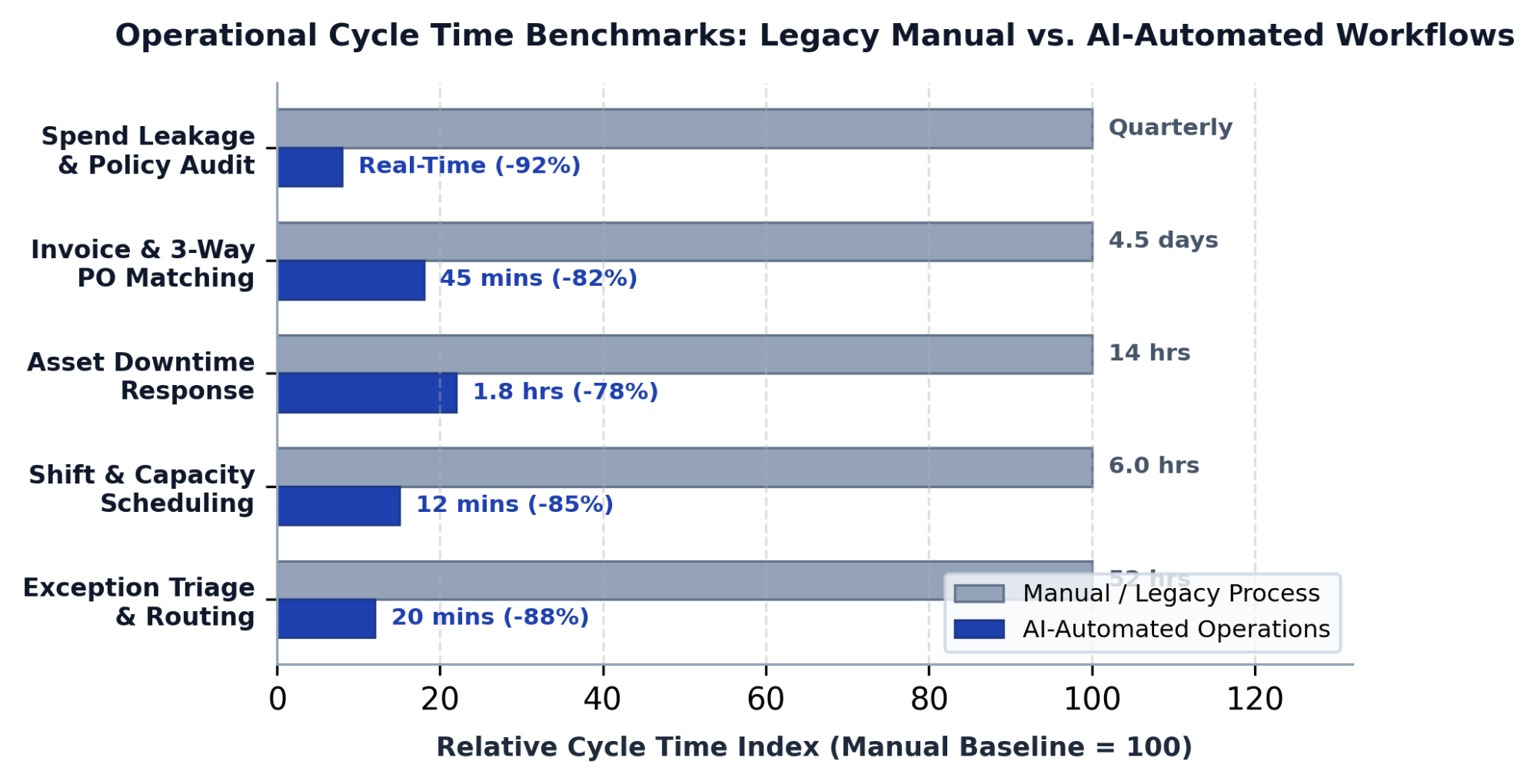
Before selecting algorithms or vendors, operations leaders should map where labor hours and margin leakage actually concentrate. Across mid-market and enterprise organizations we have advised, operational drag consistently clusters in five bottlenecks: three-way invoice and PO reconciliation, reactive equipment maintenance, manual exception triage, static shift scheduling, and quarterly sample-based compliance audits.
When AI models are wired directly into ERP event streams and operational portals, cycle times drop by 78% to 92% across these workflows because routine transactions execute automatically while human specialists focus solely on genuine exceptions.
Four High-Impact AI Solutions for Operations Management
Rather than deploying broad, generic AI assistants, enterprises can focus on four specific operational capabilities that directly impact working capital, uptime, and labor efficiency:
1. AI-Powered Invoice Processing and Three-Way PO Reconciliation
Extracts line-item quantities, unit prices, and tax codes from unstructured vendor PDF invoices using multi-modal vision and layout-aware transformer models.
Automatically matches invoice details against ERP purchase orders and warehouse receiving logs.
Posts clean matches directly to the general ledger.
Flags price or quantity discrepancies for finance analysts to review.
Reduces dependence on fragile rule-based RPA scripts when invoice layouts or shipment documents change.
2. Predictive Maintenance and Automated CMMS Work Order Dispatch
Analyzes vibration, thermal, and amperage data from shop-floor IoT gateways.
Uses time-series anomaly models to continuously calculate Remaining Useful Life (RUL).
Identifies equipment degradation when it crosses a verified threshold.
Automatically reserves spare parts and creates CMMS work orders.
Schedules maintenance during planned changeover windows to help avoid unexpected downtime.
3. AI-Powered Workforce and Capacity Scheduling
Combines demand-forecasting models with constraint-satisfaction solvers such as Google OR-Tools.
Considers fluctuating order volumes, technician certifications, and overtime limits.
Regenerates shift and production-line assignments when urgent orders arrive or employees call out.
Helps operations teams reduce dependence on manual scheduling spreadsheets.
4. AI-Powered Spend Monitoring and Policy Auditing
Uses statistical outlier models, such as Isolation Forests, and rule engines to evaluate operational transactions.
Monitors transactions for duplicate vendor billing, unauthorized off-contract purchases, and SLA penalty triggers.
Supports real-time scoring across all operational transactions rather than relying only on quarterly sample-based audits.
Helps finance and operations teams identify potential spend leakage before funds leave the organization.
Ready to Streamline Your Enterprise Operations With AI?

Designing a Confidence-Gated AI Architecture for Safe Operations Automation
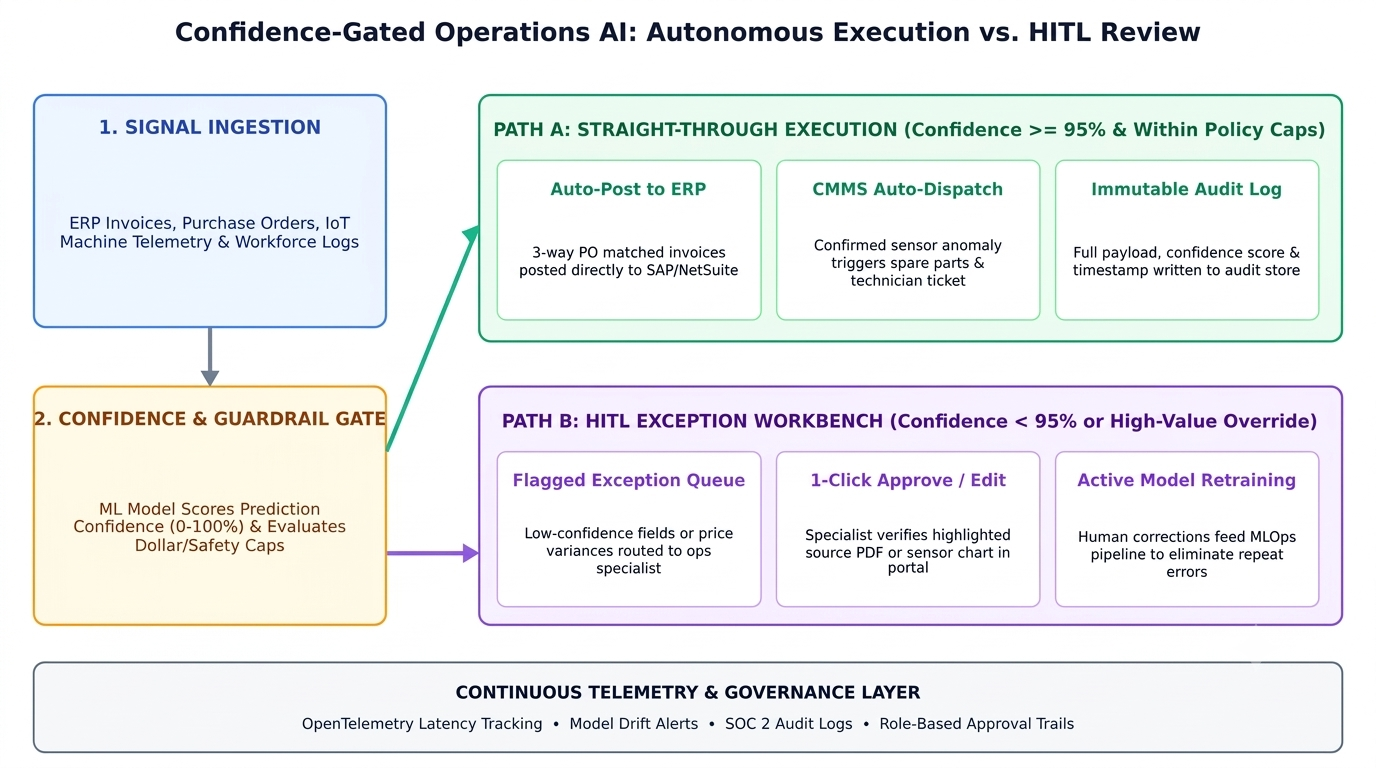
The biggest concern COOs and controllers raise about operations AI is accountability: no organization wants an autonomous model approving a $250,000 duplicate invoice or altering a physical equipment parameter without oversight. From our experience working on similar automation solutions, the safest and most scalable pattern is a Confidence-Gated Human-in-the-Loop (HITL) Decision Pipeline.
In this architecture, every prediction passes through a deterministic guardrail gate that evaluates two criteria simultaneously: the model's mathematical confidence score and hard-coded business policy caps (such as dollar limits or safety boundaries).
Path A (Straight-Through Execution): Transactions scoring at or above 95% model confidence and falling within pre-approved policy caps (for example, an invoice under $10,000 matching PO quantities within 1% tolerance) post automatically to the ERP or CMMS with an immutable audit record.
Path B (HITL Exception Workbench): Anything below the confidence threshold, above the financial cap, or showing a structural mismatch routes to an operator review queue. The workbench highlights the exact mismatched line item or sensor anomaly so a specialist can approve or correct it in one click, feeding that correction back into the MLOps retraining loop.
Build vs. Buy vs. Hybrid: Choosing the Right Operations AI Approach
Operations leaders generally choose between three delivery models when modernizing workflows: standalone RPA or point SaaS tools, native ERP AI add-on modules, or a custom event-driven AI layer built around existing core systems. Our team evaluates these trade-offs across legacy ERP compatibility, exception handling, 3-year cost structure, and data governance.
Evaluation Criterion | Point RPA / Off-the-Shelf SaaS | Native ERP Vendor AI Modules | Custom Event-Driven Operations AI (Zignuts Approach) |
|---|---|---|---|
Legacy & Multi-ERP Fit | Brittle UI screen-scraping; breaks frequently when ERP patches update screens. | Strong inside a single vendor ecosystem; poor across mixed ERPs, WMS, and custom apps. | API & Event-Native: Connects SAP, Oracle, custom SQL, and IoT gateways via Kafka/REST. |
Unstructured Exception Handling | Fails on varying vendor PDF layouts and ambiguous operational edge cases. | Limited to standard vendor-supported document templates and rigid workflows. | Confidence-Gated HITL: Custom multi-modal extraction paired with a tailored review workbench. |
3-Year Cost & Licensing | Escalating per-bot, per-page, or per-seat SaaS subscription taxes. | High enterprise tier upgrades and mandatory per-module licensing fees. | Zero Seat Taxes: Predictable build investment plus optimized cloud hosting; 100% IP ownership. |
Audit & Guardrail Control | Basic bot execution logs; limited custom financial threshold enforcement. | Constrained to vendor-defined approval hierarchies and audit schemas. | Full Control: Custom deterministic dollar caps, SOC 2 audit trails, and private VPC hosting. |
Ready to Streamline Your Enterprise Operations With AI?
Operational Readiness Assessment Before Implementing AI Solutions
Operations AI projects can stall not because the machine learning model fails, but because of poor master data, undocumented ERP workarounds, or resistance to adopting new workflows. Before starting a production build, a four-part readiness audit can help identify and reduce implementation risks.
1. Master Data Quality and Preparation
Identify duplicate vendor IDs and inconsistent SKU naming across regional ERP systems.
Use automated entity-resolution and fuzzy deduplication scripts during discovery.
Resolve data inconsistencies before model training to improve data quality and reliability.
Target readiness gate: Achieve at least 98% clean vendor and SKU master mapping before model training begins.
2. Protecting Legacy ERP Systems During AI Integration
Avoid high-volume AI API polling that can lock production ERP database tables.
Introduce an asynchronous Kafka queue between the AI system and ERP.
Use a read-replica cache to reduce direct database load.
Run stress tests to verify that AI integrations do not affect existing transaction performance.
Target readiness gate: Ensure zero impact on peak ERP transaction latency during stress tests.
3. Validating AI Models Through Shadow-Mode Testing
Run AI models passively alongside human teams for 3 to 4 weeks.
Compare AI-generated outputs with actual human decisions.
Identify accuracy gaps before allowing AI to handle live financial or plant workflows.
Validate model performance using real operational data before production rollout.
Target readiness gate: Verify at least 95% precision against real historical human decisions before production rollout.
4. Improving Operator Adoption of AI Workflows
Involve operations leads in designing the human-in-the-loop (HITL) workbench.
Use single-screen, side-by-side comparisons to make exception reviews easier.
Keep review workflows simple so employees do not revert to spreadsheets.
Test the workbench during user acceptance testing (UAT) to measure review efficiency.
Target readiness gate: Keep average exception review time under 20 seconds during UAT trials.
Practical Lessons From Implementing AI in Enterprise Operations
Implementing AI in enterprise operations requires more than automating individual tasks. Systems need to exchange data reliably, handle exceptions consistently, maintain accurate records, and operate without adding unnecessary infrastructure costs. A few important lessons from these areas include:
1. Automated Financial Reconciliation & FinOps
Financial workflows require accurate data extraction and consistent validation. Combining optical data extraction with deterministic rules helps identify ledger discrepancies while keeping financial records traceable and auditable.
2. Cross-System Workflow Orchestration
Complex approval workflows can become difficult to manage when they depend on monolithic databases. Separating workflow execution from core databases allows multi-step processes to run asynchronously while maintaining visibility into their status.
3. Multi-System Logistics & Operational Visibility
When ERP, warehouse, and tracking systems operate separately, teams often need to check multiple platforms for updates. Connecting these systems through a shared operational layer provides a more consistent view of inventory, shipments, and order status.
4. Continuous Compliance & Audit Engines
Automated validation helps review large volumes of transactions without relying entirely on manual sampling. Combining risk-scoring rules with immutable audit trails also makes decisions easier to trace and flagged activity easier to review.
5. FinOps Cloud Cost Governance
Operational AI pipelines can become expensive as transaction volumes and processing requirements increase. Monitoring and adjusting container resources, database capacity, and event queues helps keep infrastructure usage aligned with actual workloads.
Ready to Streamline Your Enterprise Operations With AI?
AI Implementation Recommendations for Operations Leaders
Instrument Cycle Time Before Picking a Use Case: Measure exactly how many hours each workflow loses to manual handoffs, re-keying, and exception chasing, then target the single highest-cost bottleneck first.
Insist on Shadow-Mode Testing: Never cut over live ERP postings or maintenance dispatches on day one; validate model confidence against real production volume in passive shadow mode for at least three weeks.
Separate ML Confidence from Business Policy: Keep financial approval limits, tolerance bands, and equipment safety bounds in explicit deterministic code outside the neural network so leadership can audit and adjust rules instantly.
Build the Exception Workbench for Speed: An AI pipeline is only as fast as its exception handling. Invest in a clean, single-screen UI where staff can verify flagged items in seconds without switching tabs.
Protect Legacy Backends with Event Queues: Buffer all AI reads and writes behind message brokers like Apache Kafka or AWS SQS so bursty document batches never degrade core ERP performance.
Conclusion
AI solutions for operations management help enterprises move beyond fragmented systems and manual processes toward more connected and efficient workflows. From invoice reconciliation and predictive maintenance to workforce scheduling and compliance monitoring, AI can reduce repetitive tasks while keeping critical decisions accurate, traceable, and under human oversight. Successful implementation depends on identifying operational bottlenecks, preparing reliable data, integrating existing systems, and validating automation with clear business guardrails.
If you're planning to automate workflows, connect enterprise systems, or develop AI-powered operational capabilities, contact us today to explore how the right AI solution can support your business requirements.

Swati Bais
Business Enthusiast | Curious about how businesses evolve, connecting ideas with insights to discover opportunities and shape better ways of working.