


Enterprise identity and access management (IAM) software development involves designing, building, extending, and integrating systems that determine who or what can access specific resources through authentication, authorization, user and workload lifecycle management, federation, and auditing. As a key part of Enterprise Security Software Development, IAM helps organizations establish secure access controls across their applications and infrastructure. For security software teams, the hard part is rarely the login screen. It is token design, authorization at scale, provisioning across dozens of systems, and producing evidence an auditor will accept. This guide covers the architecture, the standards that should drive it, and how to decide between building, buying, and extending.
Key Takeaways for Enterprise IAM Software Development
IAM is a set of cooperating services (identity store, authentication, token service, authorization, provisioning, audit), not one product. Decide which you own.
Let standards set the design: OpenID Connect and OAuth for sign-in and delegation, RFC 9700 for OAuth security, SCIM for provisioning, and NIST SP 800-63-4 for assurance levels.
Authorization is where custom work usually pays off. Choose RBAC, ABAC, or relationship-based access control (ReBAC) from your data model, not from fashion.
Machine and AI-agent identities now need first-class design, not a service-account afterthought.
Build, buy, and extend are not exclusive. In our view, buying the identity provider and building the authorization and integration layers around it is often the better fit.
Why Identity and Access Management Is Critical to Enterprise Security
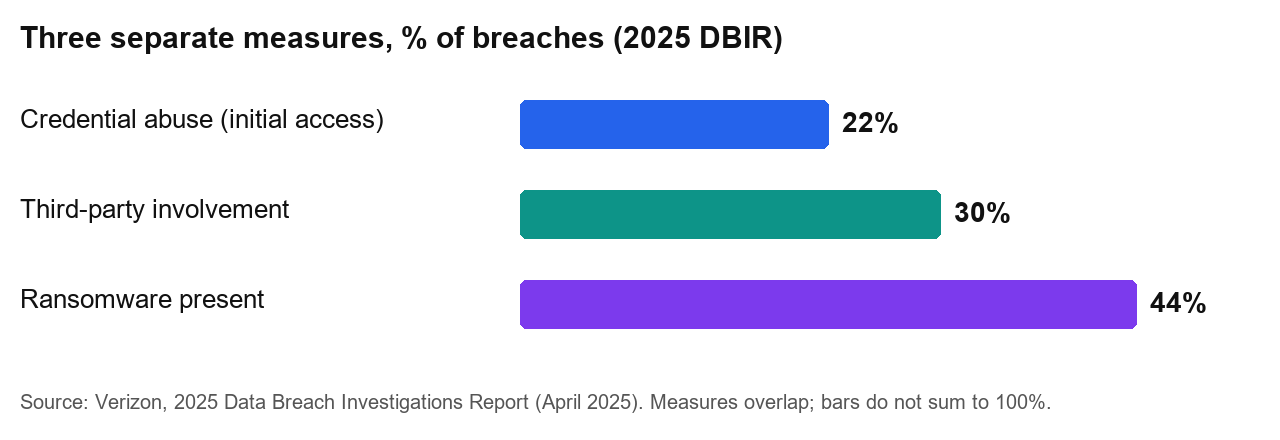
Stolen or abused credentials remain a common way attackers gain access to enterprise systems. Verizon's 2025 Data Breach Investigations Report, which analyzed more than 22,000 security incidents and 12,195 confirmed breaches, found that credential abuse was the initial access vector in 22% of breaches. Third-party involvement doubled to 30%, while ransomware appeared in 44% of breaches. These categories overlap, highlighting why identity security remains an important part of enterprise protection (Verizon, 2025 DBIR press release, April 2025).
Key findings and security considerations:
Changing attack patterns: The 2026 Verizon DBIR landing page reports that software vulnerabilities now more often serve as the initial access point than stolen passwords. Identity is therefore one of several important security fronts, not the only one (Verizon DBIR).
Financial impact of breaches: IBM's Cost of a Data Breach 2025 reported a global average breach cost of $4.44 million, with identification and containment taking an average of 241 days.
AI access risks: 13% of organizations reported breaches involving AI models or applications, and 97% of those organizations lacked proper AI access controls (IBM Newsroom, July 2025). IBM's report page now lists a 2026 edition with a higher average, so verify the latest figures before using them in a business case.
Effectiveness of MFA: A Microsoft Research study published on arXiv in May 2023, which has not been peer-reviewed, estimated that multi-factor authentication reduces compromise risk by 99.22% across the population and by 98.56% when credentials have leaked (arXiv 2305.00945). The study covers MFA generally; phishing-resistant methods such as passkeys should be evaluated separately as a design choice.
Ready to Strengthen Your Enterprise IAM Strategy?

Core Components of an Enterprise IAM Platform
An enterprise IAM platform is a group of services that share one identity model. Naming the services is the first scoping exercise, because each can be built, bought, or delegated separately.
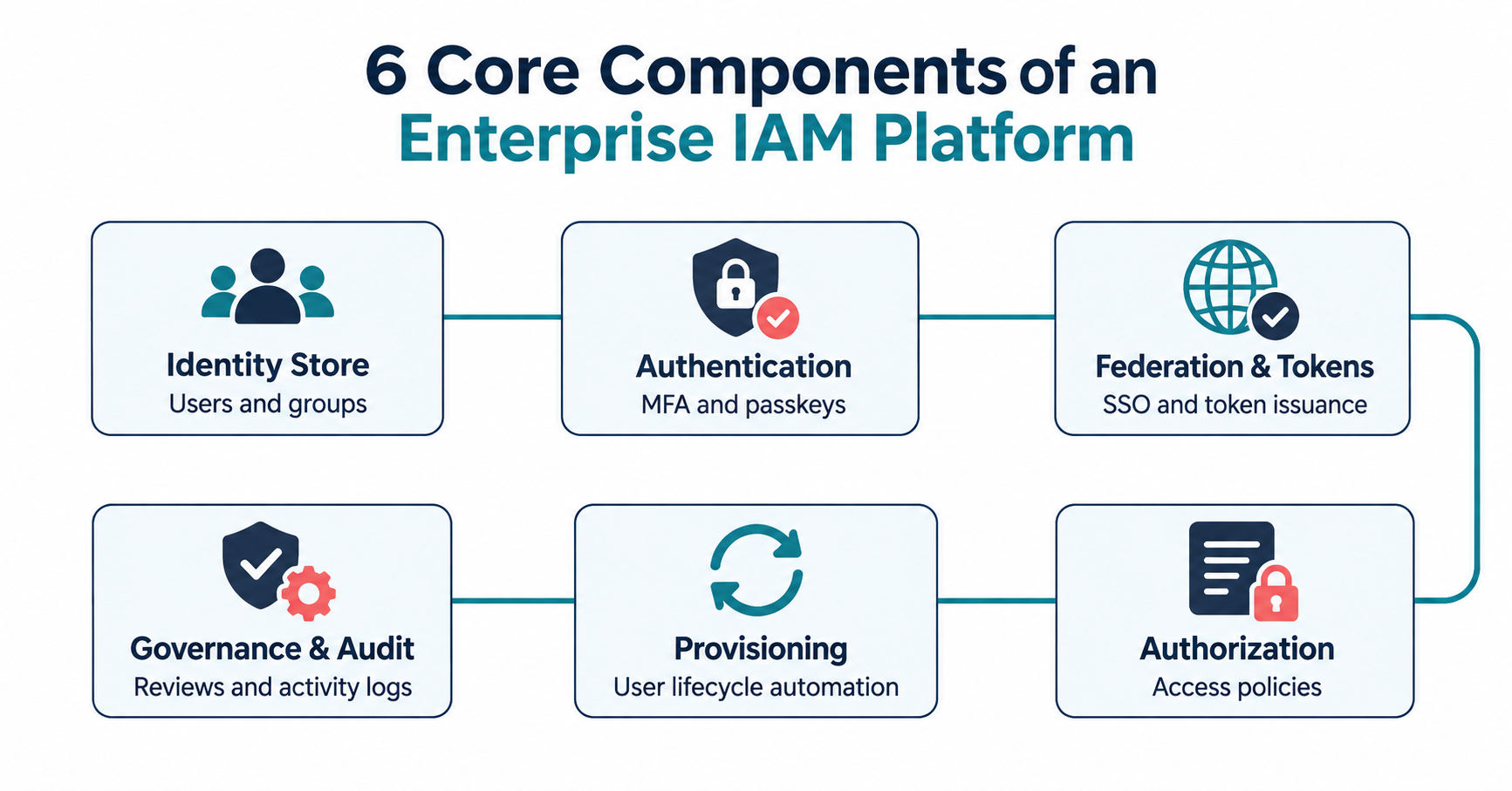
Layer | Responsibility | Typical standards |
|---|---|---|
Identity store | Users, groups, attributes, credentials, device and workload records | SCIM data model (RFC 7643) |
Authentication | Passwords, MFA, passkeys, risk-based step-up | WebAuthn, NIST SP 800-63B-4 |
Federation and tokens | Single sign-on, token issuance, validation, revocation | OpenID Connect, OAuth 2.0, RFC 9068 |
Authorization | Policy decision and enforcement across apps and APIs | RBAC, ABAC, ReBAC; policy engines |
Provisioning | Joiner-mover-leaver automation into downstream apps | SCIM protocol (RFC 7644) |
Governance and audit | Access reviews, separation of duties, evidence | Control frameworks, event logs |
Signals | Share risk and session events between systems | OpenID Shared Signals Framework |
Draw this on a whiteboard before any vendor conversation. For each row, write who owns it today, what system of record backs it, and which team is on call for it.
Essential Standards for Enterprise IAM Software Development
Following established standards helps teams build secure, interoperable identity systems without having to design authentication protocols from scratch. Several standards and guidelines are particularly important when developing enterprise IAM solutions:
OpenID Connect Core 1.0: Defines the identity layer built on top of OAuth 2.0, including ID tokens, claims, and sign-in flows. The current version incorporates Errata Set 2, published in December 2023 (OpenID Foundation).
OAuth 2.0 Security Best Current Practice (RFC 9700): Provides security recommendations for OAuth 2.0 implementations. It requires PKCE for public clients, recommends exact-string matching for redirect URIs, and advises against using the implicit grant (IETF).
OAuth 2.1: Brings together current OAuth security practices, but it remains an active Internet-Draft rather than a finalized standard. At the time of writing, the latest revision was draft-ietf-oauth-v2-1-17. For current implementations, follow RFC 9700 and treat OAuth 2.1 as an evolving direction (IETF Datatracker).
JWT Access Token Profile (RFC 9068): Defines a standard format for JWT-based access tokens. It specifies the
at+jwttype header, requires tokens to be signed, and identifies essential claims such asiss,exp,aud,sub,client_id,iat, andjti(IETF).System for Cross-domain Identity Management (SCIM): Standardizes user and identity provisioning across systems. RFC 7643 defines the SCIM schema, while RFC 7644 defines the protocol. Both were published in September 2015. Check the IETF RFC index for any subsequent updates before implementation.
NIST SP 800-63-4: Published in July 2025, this final revision of the US digital identity guidelines supersedes SP 800-63-3. It consists of four volumes covering the main guidelines, identity proofing and enrollment (63A), authentication (63B), and federation (63C). Its assurance levels also provide a useful framework for defining identity requirements beyond US government environments (NIST CSRC).
Web Authentication (WebAuthn) Level 3: Published as a W3C Recommendation on 25 August 2026, WebAuthn defines the browser API that enables passwordless authentication methods, including passkeys (W3C).
Ready to Strengthen Your Enterprise IAM Strategy?
Token Service Design: Security and Access Management Best Practices
The token service is where authentication becomes authorization for everything downstream, so mistakes here spread widely. A sound design has four parts.
Pick a profile, then enforce it. Use authorization code flow with PKCE for browser and mobile clients, following RFC 9700. Reject the implicit grant and require exact redirect URI matches.
Use a predictable access token format. If tokens are JWTs, follow RFC 9068 so resource servers can validate issuer, audience, and expiry the same way everywhere.
Constrain tokens to the caller. For high-risk APIs, the OpenID Foundation's FAPI 2.0 Security Profile (final, February 2025) shows what a strict profile looks like: pushed authorization requests, PKCE with S256, sender-constrained tokens through mTLS or DPoP, and authorization codes that live at most 60 seconds (OpenID Foundation). You do not need every FAPI rule for every app, but it is a useful checklist for your most sensitive APIs.
Plan revocation before launch. Short-lived access tokens limit exposure, but enterprises also need to cut off sessions on termination or compromise. The OpenID Shared Signals Framework 1.0, published in August 2025, defines event streams between a transmitter and receiver so one system can tell another that a session or credential is no longer trustworthy (OpenID Foundation).
A common mistake is validating the token signature but skipping the audience check, so a token minted for one API is accepted by another. Write a test for that specific case.
Worked example. Suppose an orders API and a billing API both trust the same issuer. A client obtains a token with aud: "https://api.example.com/orders" and replays it against billing. If billing verifies only the signature and expiry, the call succeeds. The fix is a resource-server check that rejects any token whose aud does not match its own identifier, plus a test that sends an orders token to billing and expects a 401. The URLs are illustrative; no real system is described.
Choosing the Right Authorization Model for Enterprise IAM
Authorization answers "can this subject perform this action on this resource?" Three models cover most enterprise needs, and they combine well.
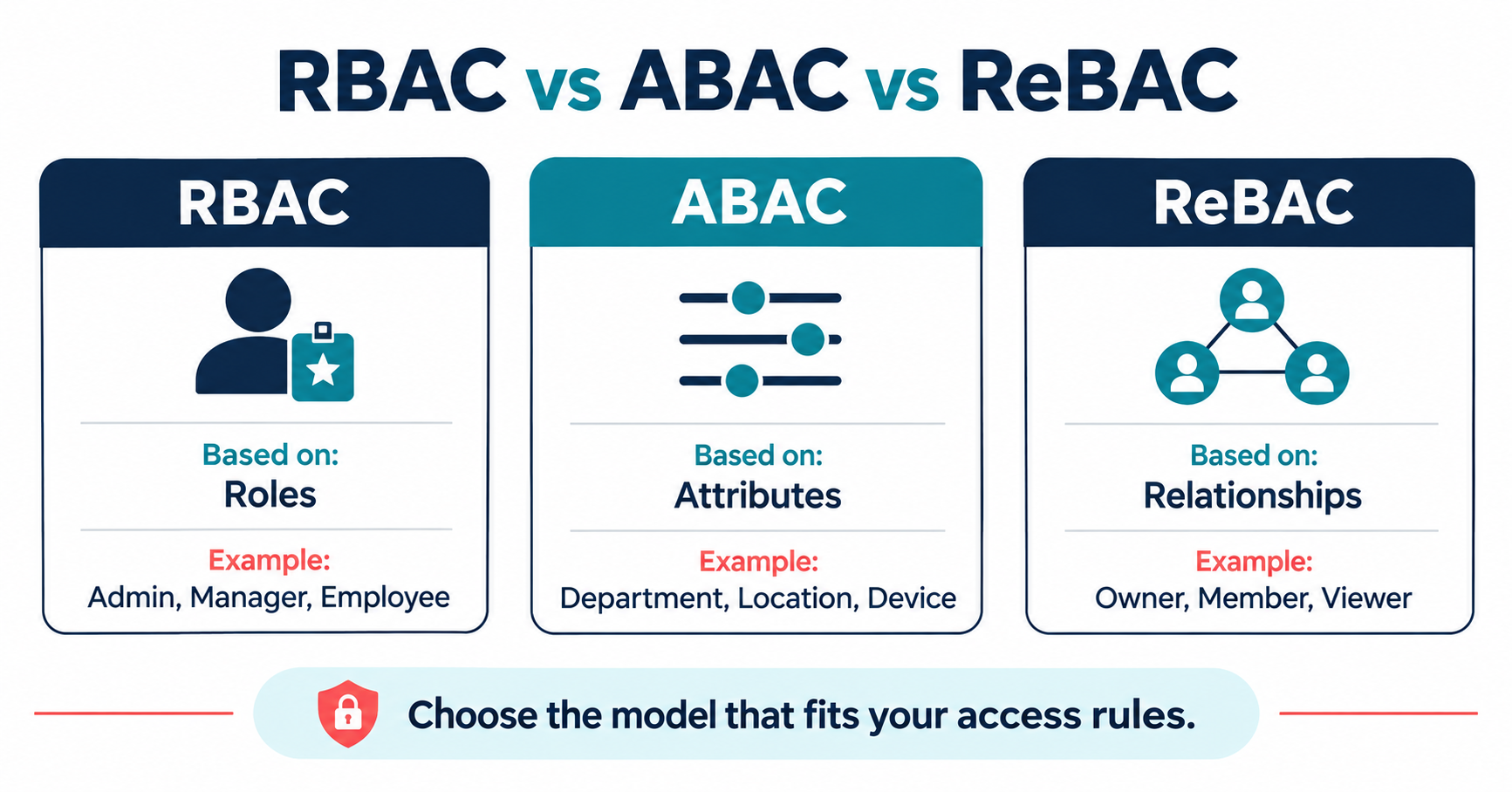
Model | Decision based on | Strong when | Watch out for |
|---|---|---|---|
RBAC | Roles assigned to users | Job functions are stable and few | Role explosion as exceptions pile up |
ABAC | Attributes of subject, resource, context | Rules depend on department, region, device, time | Policies get hard to test and explain |
ReBAC | Relationships in a graph (owner, member, viewer) | Sharing and hierarchies, as in documents or folders | Needs a consistent relationship store |
Google's Zanzibar paper is the reference for ReBAC at scale. It describes a global authorization system that handles trillions of access control lists and millions of authorization checks per second, with 95th-percentile latency under 10 ms and availability above 99.999% over three years of production use (Google Research). Open source projects inspired by it exist; OpenFGA moved to CNCF Incubating on 28 October 2025, and Open Policy Agent (OPA) has been CNCF Graduated since January 2021 (CNCF OpenFGA, CNCF OPA).
Practical guidance:
Separate decision from enforcement. Applications enforce; a policy service decides. This keeps rules out of application code and makes audits possible.
Start with RBAC for coarse access and add attribute or relationship checks only where roles cannot express the rule.
Version and test policies like code. Policy changes need review, automated tests, and a rollback path.
Log every decision. Record who asked, what was decided, and which policy version decided it. Auditors ask for exactly this.
Ready to Strengthen Your Enterprise IAM Strategy?
Identity Provisioning and Lifecycle Automation in Enterprise IAM
Provisioning keeps downstream systems in step with the identity store. SCIM gives you a common protocol so you do not write a custom connector for every application that supports it.
A solid joiner-mover-leaver flow looks like this:
An HR system of record emits a hire, transfer, or termination event.
The IAM platform updates the identity record and recalculates group and role membership.
The platform pushes changes to downstream applications over SCIM or an application-specific API.
Failures retry with backoff and surface in a dashboard, not a log file nobody reads.
A termination also triggers session and token revocation, not just account disablement.
Plan for applications that lack SCIM. They will need adapters, so budget extra integration effort for them.
Managing Machine, Workload, and AI Agent Identities
Non-human identities now rival human ones in volume. CyberArk's 2026 Identity Security Landscape, a survey of 2,930 IT and security leaders (May 2026, now published under Palo Alto Networks), reports a machine-to-human identity ratio of 109 to 1 and says 96% of human users have excess access (Palo Alto Networks). It is vendor research, so treat the ratio as directional.
Design implications:
Give workloads short-lived, automatically issued credentials rather than long-lived secrets. SPIFFE, a CNCF Graduated project since August 2022, defines a standard workload identity format (CNCF SPIFFE).
Assign every service account and agent an owner, a purpose, and an expiry.
Apply least privilege to AI agents the way you would to a contractor, and log what they do.
Ready to Strengthen Your Enterprise IAM Strategy?
Enterprise IAM Compliance: Mapping Security Controls and Requirements
Regulators rarely prescribe a product. They prescribe outcomes, and IAM supplies the evidence. The EU's NIS2 Directive lists access control policies and multi-factor or continuous authentication among the security measures covered entities must consider (EUR-Lex, Directive (EU) 2022/2555, Article 21). DORA, SOC 2, ISO 27001, HIPAA, and PCI DSS carry their own access control requirements.
Rather than memorize each, build a control matrix: one row per IAM capability (MFA, access review, privileged access, logging), one column per framework, and a link to the evidence your system produces. Get the exact requirement text from the regulation or standard itself, since requirements and deadlines change.
Build vs. Buy vs. Extend: Choosing the Right Enterprise IAM Approach
The guidance below is our reasoning; we found no analyst source on build versus buy that we could verify and quote.
Option | Choose it when | Main risk |
|---|---|---|
Buy an identity provider | Authentication, SSO, and MFA are not your differentiator | Vendor lock-in; limits on custom policy |
Build custom | IAM is the product, or requirements are truly unusual | Ongoing security maintenance and standards churn |
Extend (buy core, build around it) | You need custom authorization, integrations, or tenant models | Integration complexity between layers |
Ask these questions before deciding:
Does the team have protocol and cryptography expertise, plus a plan to patch for years?
Who produces audit evidence, and how?
How many applications must integrate, and which protocols do they speak?
Is multi-tenancy, with strict data isolation, a requirement?
Writing your own password storage, session handling, or token signing is rarely a good idea. Custom work belongs in the layers specific to your business: authorization rules, workflows, tenant models, and integrations.
Ready to Strengthen Your Enterprise IAM Strategy?
Enterprise IAM Software Development: A Phased Implementation Roadmap
Discover (planning estimate: 2 to 4 weeks): Inventory applications, identity sources, and protocols. Define assurance levels and compliance targets.
Foundation: Stand up the identity store, authentication, and token service with a pilot application.
Authorization and integration: Add the policy service, then onboard applications in waves, hardest first.
Lifecycle and governance: Connect HR sources, automate provisioning, and add access reviews.
Operate: Monitor, rotate keys, track standards changes, and rehearse incident response.
Scope varies widely with the number of applications and how many lack standard protocols.
Enterprise IAM Testing, Monitoring, and Operations
IAM failures are security incidents, so testing deserves its own plan.
Protocol tests: Verify redirect URI matching, PKCE enforcement, audience checks, and token expiry.
Authorization tests: Run a matrix of subjects, actions, and resources against policy, including deny cases.
Resilience tests: The identity service sits in the path of everything. Test what each application does when it is slow or down.
Key management: Rotate signing keys on a schedule and rehearse emergency rotation.
Observability: Alert on authentication failure spikes, unusual token issuance, and policy changes.
Conclusion: Building Secure and Scalable Enterprise IAM Software
Building secure and scalable enterprise IAM software starts with treating identity and access management as a set of interconnected services rather than a single solution. Use established standards for authentication, token management, and identity provisioning, while focusing custom development on authorization policies, integrations, and business-specific workflows. Machine, workload, and AI agent identities should also be part of the architecture from the beginning. Support the implementation with thorough testing, audit logs, and clear security controls.
If you are planning an enterprise IAM project, begin by assessing your existing applications, identity sources, and integration requirements. We can help you evaluate your requirements and develop an IAM solution aligned with your security and business goals. Contact us today to discuss your project and plan the next steps.

Deep Gondaliya
Business Analyst | Turning business challenges into clear insights, practical solutions, and meaningful improvements that help teams move forward.