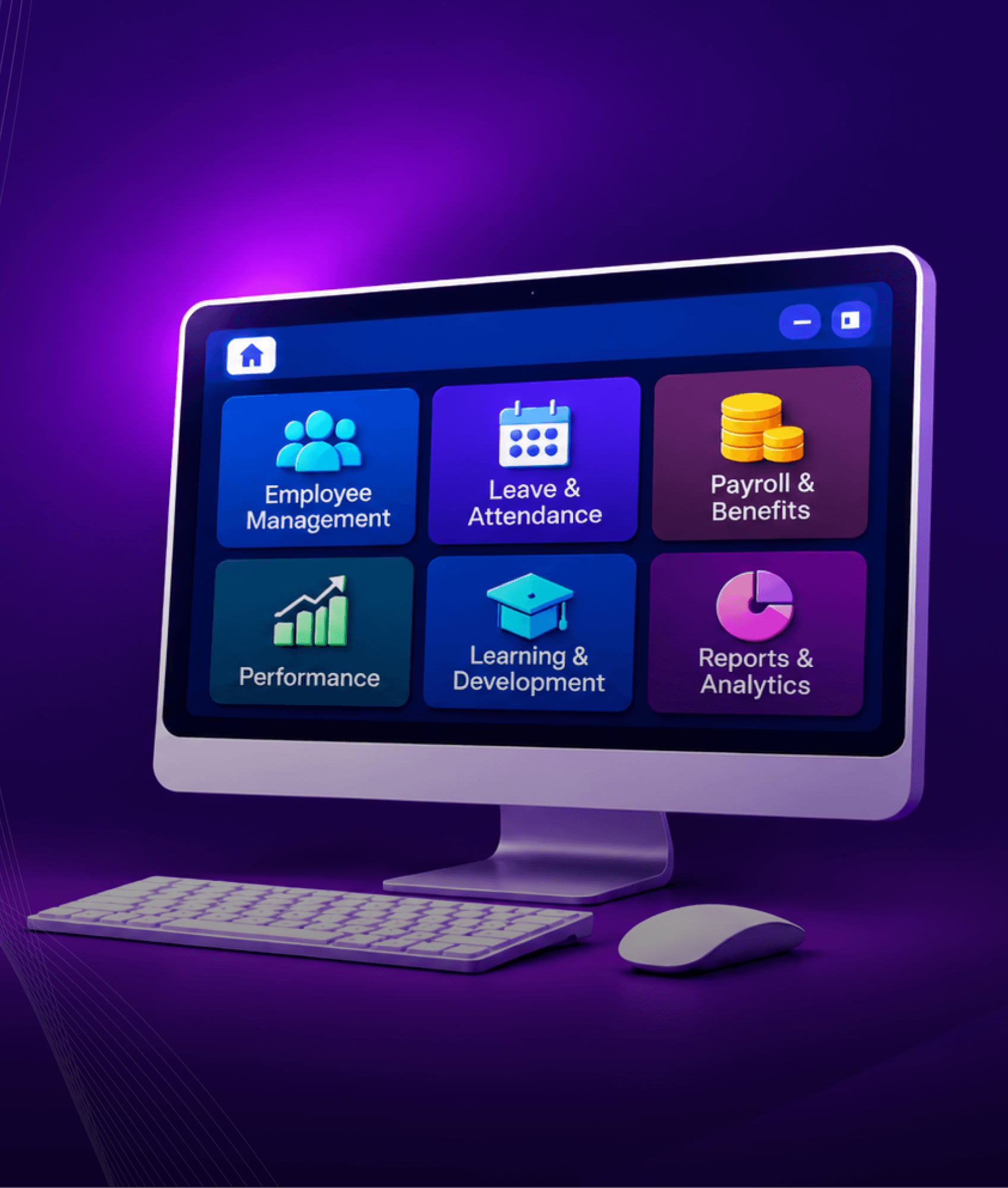


HCM Platform Development: Key Considerations for Enterprise Leaders
Enterprise human capital management has evolved far beyond digitized filing cabinets and basic attendance punching. Today, global organizations face distributed workforces, complex multi-country labor regulations, dynamic project-based staffing models, and intricate incentive compensation structures that commercial off-the-shelf software can struggle to support without expensive, brittle customizations. As part of HR Software Development, custom HCM platform development enables enterprises to build a unified, compliant, and highly integrated workforce ecosystem tailored to their organizational needs.
Key considerations for enterprise leaders include:
Workflow flexibility: Commercial SaaS platforms can require organizations to adapt their workflows to fit rigid software constraints.
Licensing costs: Per-seat licensing models can compound as organizations and workforces grow.
Operational efficiency: Product limitations and costly customizations can hinder workforce management and daily operations.
Organizational alignment: The platform should reflect the enterprise's organizational hierarchy, payroll logic, and strategic talent workflows.
Technical planning: Successful development requires careful consideration of functional requirements, system architecture, data models, and integration topologies.
Development roadmap: A clear roadmap helps guide the engineering and implementation of an enterprise-grade HCM platform.
Key Takeaways for HCM Platform Development
Architectural Decoupling: Modern HCM platforms must decouple Core HR data contracts from transactional services (payroll, scheduling, benefits) through event-driven message buses.
Data Privacy and Security: Employee data mandates field-level encryption, immutable audit trails, and granular Attribute-Based Access Control (ABAC) to comply with SOC 2, GDPR, and localized labor standards.
Build vs Buy Breakeven: For enterprises with specialized workforce dynamics or headcounts exceeding 2,500 employees, custom HCM solutions typically achieve total cost of ownership (TCO) parity within 24 to 30 months compared to Tier-1 SaaS suites.
AI Enablement: AI implementation in HCM must prioritize deterministic compliance checks, automated shift optimization, and skill-gap analytics rather than unconstrained conversational models.
Custom HCM Platform Development vs. Off-the-Shelf SaaS
Organizations evaluating human resources software generally start with established SaaS vendors such as Workday, SAP SuccessFactors, ADP, or BambooHR. While these platforms serve standardized operational models well, growing and mid-to-large enterprises frequently hit operational bottlenecks.
From our experience working on similar solutions, the decision to build a custom HCM platform is driven by four primary constraints:
Licensing Escalation at Scale: Commercial HCM vendors charge between $18 and $45 per employee per month. For a workforce of 5,000 employees across multiple operating divisions, annual recurring SaaS fees easily exceed $1.2M to $2.5M, excluding recurring implementation partner fees.
Complex Shift and Union Scheduling: Industries such as manufacturing, healthcare, and logistics operate on complex, non-linear shift models governed by regional labor unions, overtime limits, and certification requirements that standard platforms cannot model without cumbersome manual workarounds.
Proprietary Incentive and Compensation Logic: Many enterprises calculate commissions, variable bonuses, and equity vesting schedules based on internal operational metrics that cannot be exposed or calculated within closed SaaS ecosystems.
Data Sovereignty and Custom Integration: Multinationals operating across regions with strict data residency laws (such as the EU, Middle East, and APAC) face friction when SaaS platforms store centralized tenant data in single geographic zones.
Custom HCM Platform vs. Enterprise SaaS: A Strategic Comparison
Decision Factor | Off-The-Shelf Enterprise SaaS | Custom HCM Platform Development |
|---|---|---|
Initial Time to Production | 6 to 12 months (configuration and vendor onboarding) | 5 to 8 months (core MVP release) |
Custom Workflow Flexibility | Low to Moderate (limited to vendor customization APIs) | 100% tailored to exact operational workflows |
Long-Term Licensing Costs | High recurring per-user/month fees that grow with headcount | Zero recurring user licensing fees; predictable infrastructure costs |
Data Control and Sovereignty | Multi-tenant cloud with restricted database-level access | Full data ownership, custom residency zones, and dedicated encryption keys |
Integration Flexibility | Dependent on pre-built connectors and rate-limited APIs | Native event-driven integration with internal ERPs, IoT devices, and data lakes |
Proprietary IP Ownership | No equity value or intellectual property generated | Enterprise owns the intellectual property and can commercialize the asset |
Our team typically recommends building a custom HCM platform when an organization possesses unique operational workflows, manages hybrid or contingent workforces, or requires deep integration with proprietary internal production systems.
Ready to Build a Smarter HCM Platform?

Core Functional Modules of an Enterprise HCM Platform
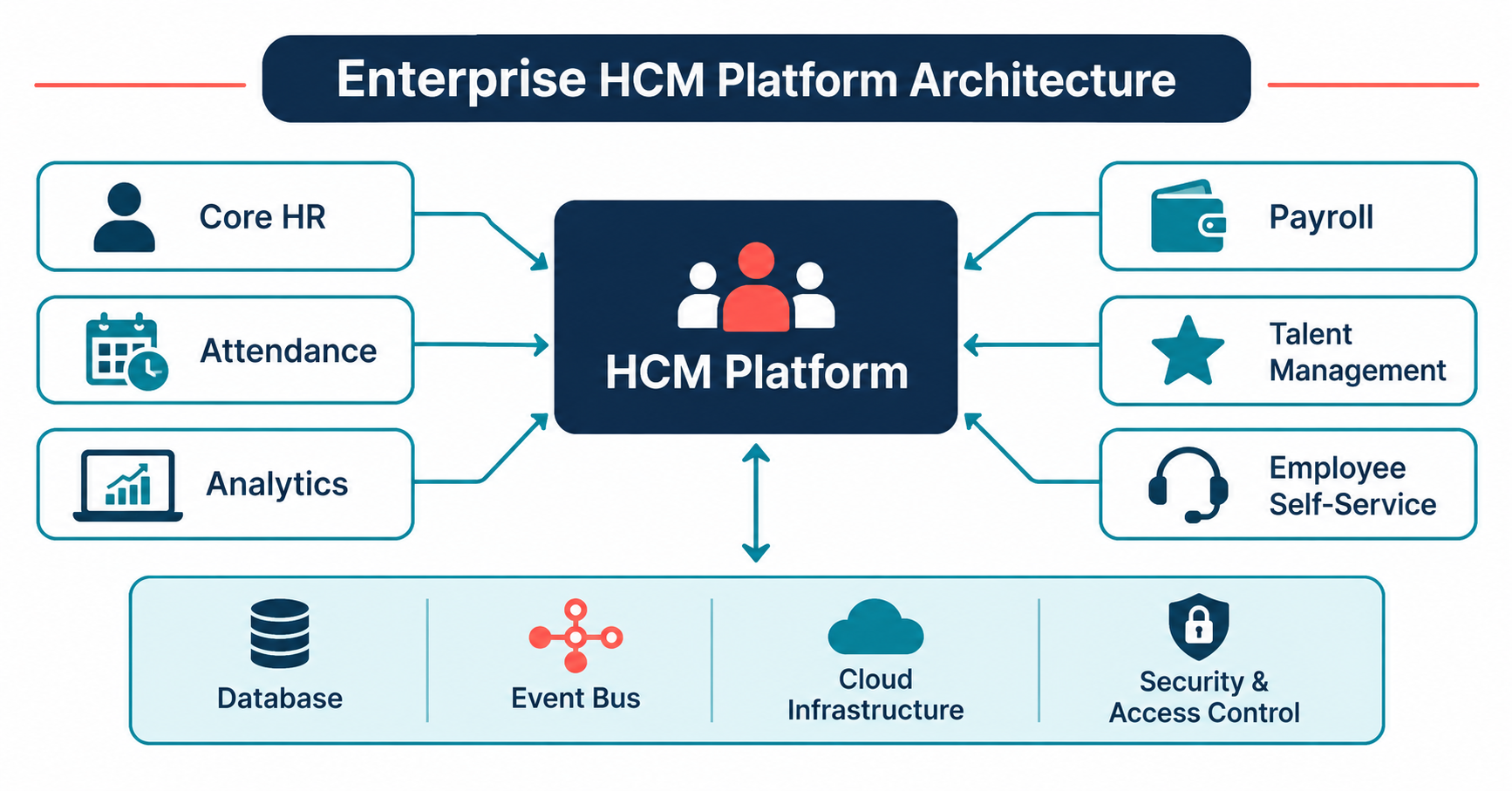
An enterprise HCM platform is not a monolithic application; it is an orchestrated collection of domain-driven modules. Based on our experience, architecting an HCM platform requires clean separation of concerns across six core pillars:
Core HR Management and Organizational Hierarchy
The foundation of the entire system. It acts as the single source of truth for worker identities, reporting hierarchies, cost centers, and employment statuses:
Dynamic Organization Chart: Bi-temporal data modeling that allows the system to reflect historical reporting structures as well as planned future restructurings without data loss.
Global Worker Profile: Support for direct employees, contractors (1099/SOW), temporary staff, and seasonal workers under a unified data contract.
Document and Lifecycle Management: Secure digital document vaults for contracts, NDAs, and certifications with automated expiration tracking.
Time and Attendance Management with Smart Scheduling
Geofenced and Biometric Ingestion: Real-time clock-in/out via mobile GPS geofencing, hardware biometric clocks, or software-based terminal punch systems.
Automated Overtime Rules Engine: Automated calculation of shift premiums, rest-break violations, and holiday pay tailored to local statutory legislation.
Algorithmic Shift Planning: Schedule generation considering worker availability, required skill certifications, fatigue management, and budget limits.
Payroll Management and Automated Tax Calculations
Payroll processing requires absolute precision. We typically architect payroll as an isolated calculation engine:
Multi-Currency and Multi-Entity Processing: Consolidated payroll processing across various business entities with inter-company journal entries.
Statutory Deductions Engine: Automated income tax brackets, social security contributions, healthcare deductions, and pension schemes.
Disbursement Orchestration: Direct integration with banking rails (ACH, SEPA, SWIFT) and automated payslip generation.
Talent Acquisition and Employee Onboarding
Applicant Tracking System (ATS): Pipeline stages, interview scheduling with automated calendar synchronization, and candidate scorecard evaluation.
Paperless Onboarding Workflows: Automated account provisioning, hardware requests, e-signature collection, and automated task assignments for managers and IT teams.
Performance Management and Skills Gap Analysis
Continuous Feedback and OKRs: Goal-setting frameworks supporting quarterly milestones, 360-degree peer reviews, and automated check-in reminders.
Skills Inventory and Succession Planning: Capability tagging across roles to identify critical organizational dependencies and talent pipelines.
HCM Platform Architecture and Recommended Technology Stack
To ensure high availability, enterprise data isolation, and low latency, our approach relies on a modular, event-driven architecture leveraging proven cloud-native technologies.
Choosing the Right Technology Stack for HCM Development
Architecture Layer | Recommended Technology | Technical Justification |
|---|---|---|
Frontend Web Dashboard | Next.js (React), TypeScript, Tailwind CSS | Server-side rendering (SSR) for fast initial load times, strict type safety for mission-critical forms, and responsive desktop dashboards. |
Mobile ESS App | Flutter or React Native | Cross-platform code parity across iOS and Android with native hardware integration for GPS geofencing and biometric authentication. |
Backend Services | Node.js (NestJS) or Go / Java Spring Boot | NestJS provides modular structure and TypeScript consistency; Go provides high throughput and low memory footprints for calculation-intensive payroll routines. |
Primary Relational Store | PostgreSQL (Amazon RDS / Aurora) | Robust support for JSONB, multi-tenant row-level security (RLS), temporal data tables, and ACID transaction compliance. |
Event Bus & Messaging | Apache Kafka or AWS EventBridge | Decoupled asynchronous communications between Core HR mutations and downstream payroll, notifications, and analytics pipelines. |
Analytical Store | ClickHouse or AWS Redshift | Columnar database optimized for real-time reporting across millions of historical attendance and compensation records without degrading operational performance. |
Cache & Session | Redis Cluster | High-speed caching for organization trees, user permission matrices, and token revocation. |
Ready to Build a Smarter HCM Platform?
HCM Database Design: Managing Bi-Temporal Organizational Data
One of the most complex architectural challenges in HCM development is handling historical records. In an enterprise, organizational structures change constantly: an employee changes managers, shifts department, or changes compensation bands.
If an HR administrator views payroll records from six months ago, the platform must display the exact department, title, and compensation that existed on that specific date, while preserving the present and scheduled future configurations.
Our team solves this by implementing Bi-Temporal Data Modeling:
Valid Time (Effective Time): The period during which the record is actually true in the real world (e.g., effective date of a promotion).
Transaction Time (System Time): The timestamp when the record was inserted or modified in the database.
Bi-Temporal vs. Traditional Database Design for HCM Platforms
Architecture Dimension | Traditional Single-Timestamp Database | Bi-Temporal Enterprise HCM Architecture |
|---|---|---|
Historical Auditing | Overwrites prior states; requires separate backup logs to reconstruct history. | Immutable historical preservation; every update generates a new validity interval. |
Future Reorganizations | Cannot stage upcoming restructurings without corrupting current operations. | HR teams can model and schedule future department reorgs months in advance. |
Retroactive Corrections | Difficult to fix past payroll errors without breaking current reporting. | Retroactive adjustments update system time while accurately preserving effective date ranges. |
Tax & Legal Audits | High risk of discrepancy during statutory or union labor audits. | Full mathematical certainty; the system can recreate the organization exactly as it stood on any given day. |
This structural discipline guarantees that audit inquiries, historical tax audits, and retro-pay calculations remain deterministic and tamper-evident.
Enterprise HCM Integrations: Connecting Core Business Systems
An HCM platform cannot operate in an operational vacuum. It functions as the central identity and employment registry for the entire enterprise software ecosystem.
Essential Integration Capabilities for an HCM Platform
Automated Identity Lifecycle Management (SCIM 2.0): When an employee is created or terminated in the HCM, our team typically implements SCIM protocols that automatically provision or revoke access across Okta, Microsoft Entra ID (Azure AD), Google Workspace, and internal company tools.
Financial Ledger Synchronization: Every payroll run produces balanced credit and debit journals categorized by cost center, department, and subsidiary. These automatically flow into enterprise accounting suites such as NetSuite, SAP, or QuickBooks via secure APIs.
Biometric Hardware Integration: Supporting standard open protocols (such as MQTT or REST Webhooks) to connect physical turnstiles, biometric fingerprint scanners, and facial recognition terminals directly to attendance tables.
Benefits Data Feeds (EDI 834): In regions like the United States, medical and life insurance carriers require weekly electronic data interchange (EDI 834) batch file generations to process employee enrollments and plan modifications.
HCM Platform Security, Compliance, and Data Governance
Employee records contain the most sensitive confidential data within an organization, including national identification numbers, banking information, home addresses, compensation records, and medical leaves. Compromising this data leads to severe regulatory sanctions, reputational damage, and legal penalties.
From our experience, building custom HCM software requires adherence to three mandatory security layers:
Implementing Attribute-Based Access Control (ABAC) in HCM
Standard Role-Based Access Control (RBAC) often proves inadequate for HCM systems. An HR generalist should be able to view an employee profile, but not view salary data if that employee belongs to the executive leadership team.
We recommend deploying Attribute-Based Access Control (ABAC), evaluating:
Subject Attributes: User role, department, security clearance level.
Resource Attributes: Employee record department, salary band, confidentiality tier.
Contextual Attributes: Network IP origin, multi-factor authentication status, office hours.
Employee Data Encryption and PII Protection
At-Rest Encryption: Complete storage volume encryption using cloud Key Management Services (KMS) with customer-managed keys.
Field-Level Application Encryption: Highly sensitive fields (National Identification Numbers, Personal Bank Accounts, Compensation Figures) are encrypted at the application level using AES-256-GCM before entering database tables, ensuring database administrators cannot access plain text values.
Implementing Immutable Audit Logs for HCM Security
Every single access point, mutation, view action, or export operation must be registered in an immutable, append-only log store.
This log records:
The actor ID and authenticated identity.
The targeted record ID and affected fields.
The exact difference between pre-mutation and post-mutation values.
The cryptographic hash linking the log entry to prior entries to prevent database tampering.
Ready to Build a Smarter HCM Platform?
HCM Platform Development Cost, Timeline, and Resource Planning
Developing a custom enterprise HCM is a major strategic software investment. Organizations must evaluate development phases objectively against multi-year commercial licensing fees.
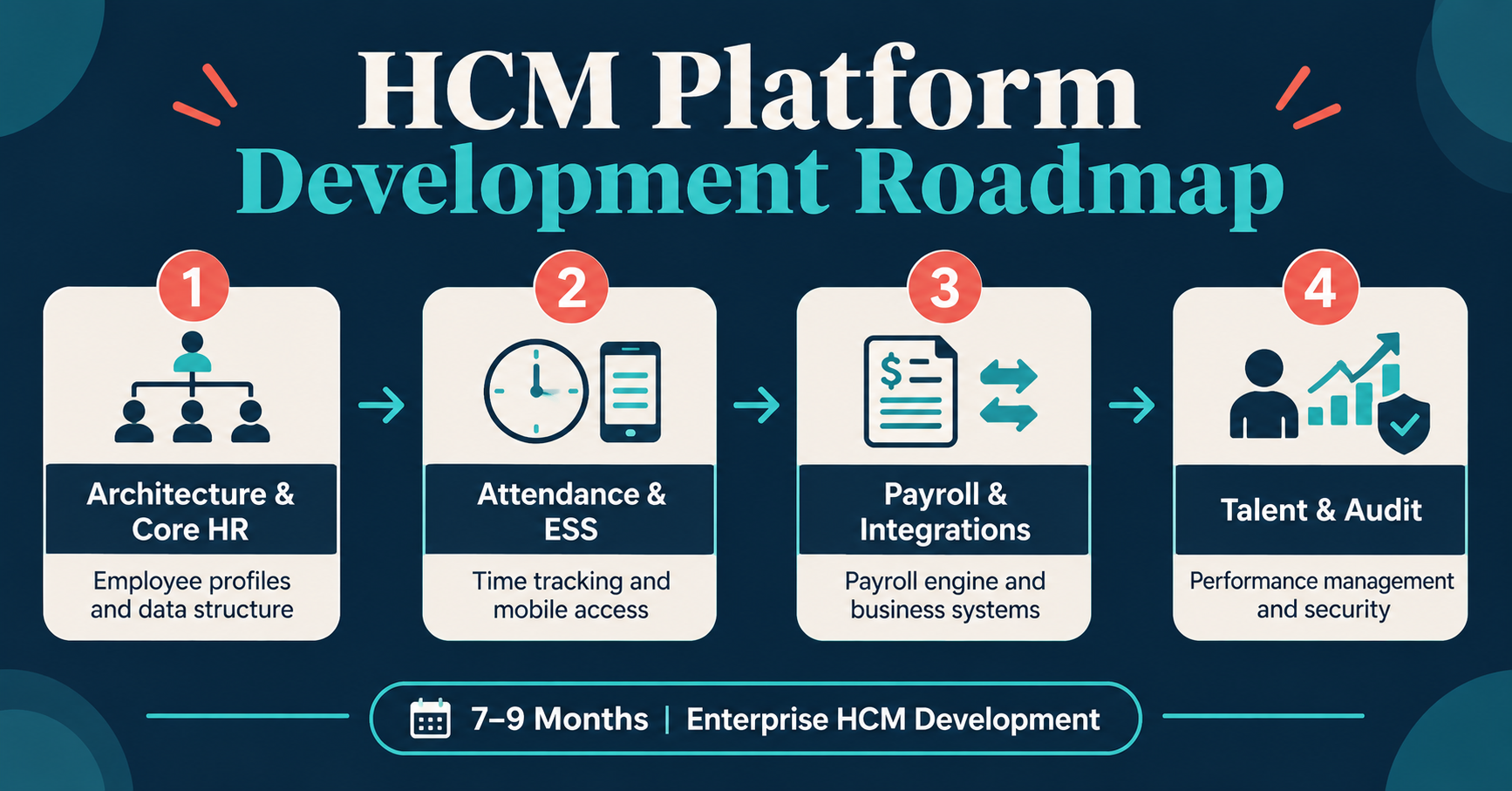
HCM Development Budget and Resource Allocation
Implementation Phase | Timeline | Dedicated Agile Engineering Pod | Core Deliverables | Estimated Investment |
|---|---|---|---|---|
Phase 1: Architecture & Core HR | 8 to 10 Weeks | 1 Solution Architect, 1 Senior BA, 2 Backend Engineers, 1 Frontend Engineer, 1 QA | Data schemas, Org Directory, ABAC security, Employee Profile Vault, Bi-temporal engine. | $45,000 - $65,000 |
Phase 2: Attendance & ESS Mobile | 7 to 9 Weeks | 1 Tech Lead, 2 Full-stack Engineers, 1 Mobile Developer, 1 UI/UX Designer, 1 QA | Time tracking, shift scheduling, geofenced mobile apps (iOS/Android), manager approval workflows. | $40,000 - $60,000 |
Phase 3: Payroll & Integrations | 8 to 10 Weeks | 1 Architect, 2 Senior Backend Developers, 1 Integration Specialist, 1 QA | Payroll rule calculation engine, tax deductibility rules, ERP sync, banking disbursement APIs. | $55,000 - $75,000 |
Phase 4: Talent, OKRs & Audit | 6 to 8 Weeks | 1 Product Manager, 2 Full-stack Engineers, 1 Security Specialist, 1 QA | Talent acquisition, performance reviews, 360 feedback, SOC 2 audit trail compliance, penetration testing. | $35,000 - $50,000 |
Total Comprehensive Build | 7 to 9 Months | Dedicated Cross-Functional Agile Pod | Full Enterprise-Grade, Self-Hosted or Cloud HCM Platform | $175,000 - $250,000 |
Common HCM Implementation Challenges and How to Address Them
Throughout our experience implementing complex enterprise software, we have seen teams encounter recurring challenges during HCM rollouts.
Here is how our team navigates these risks:
Challenge 1: Managing Multi-Country Payroll Requirements
The Risk: Attempting to code custom tax rules for dozens of international jurisdictions from scratch results in maintenance nightmares and statutory compliance exposure.
Our Approach: We typically recommend architecting a hybrid model where the custom HCM owns the core workforce data, attendance rules, and proprietary bonus calculations, while delegating the final localized tax calculations to specialized calculation APIs (such as Gust Embedded, Deel, or localized payroll clearinghouse microservices).
Challenge 2: Creating a User-Friendly Employee Self-Service Experience
The Risk: Building an engineering-centric dashboard that frontline employees find complicated leads to missed timesheets, unsubmitted expenses, and low adoption.
Our Approach: We prioritize an intuitive, mobile-first Employee Self-Service (ESS) experience. Actions such as requesting leave, viewing paystubs, or submitting an expense receipt require three clicks or fewer.
Challenge 3: Ensuring Accurate HCM Data Migration and Cleansing
The Risk: Transferring inaccurate, duplicate historical records from legacy spreadsheets and disparate systems into the new relational schema causes immediate system failure.
Our Approach: We implement a structured automated ETL (Extract, Transform, Load) staging pipeline with automated validation scripts. Legacy records undergo data cleansing, role deduplication, and reconciliation checks prior to database cutover.
Conclusion: Building a Scalable Enterprise HCM Platform
A custom Human Capital Management (HCM) platform helps enterprises manage workforce operations more effectively while adapting to changing business needs. By centralizing employee data, automating complex workforce processes, and supporting organization-specific workflows, businesses can improve operational agility and maintain greater control over their systems and data.
Whether you are modernizing a legacy HR system or developing an enterprise workforce management platform from scratch, the right approach starts with understanding your requirements, defining a scalable architecture, and planning for long-term growth. Our engineering team works with enterprises to design and develop secure, scalable platforms aligned with their business models. Contact us today to discuss your HCM requirements, evaluate your technical approach, and plan a development roadmap with our solution architects.

Mukund Patil
Business Enthusiast | Exploring ideas, trends, and opportunities, turning curiosity into meaningful insights and discovering smarter ways to make an impact.