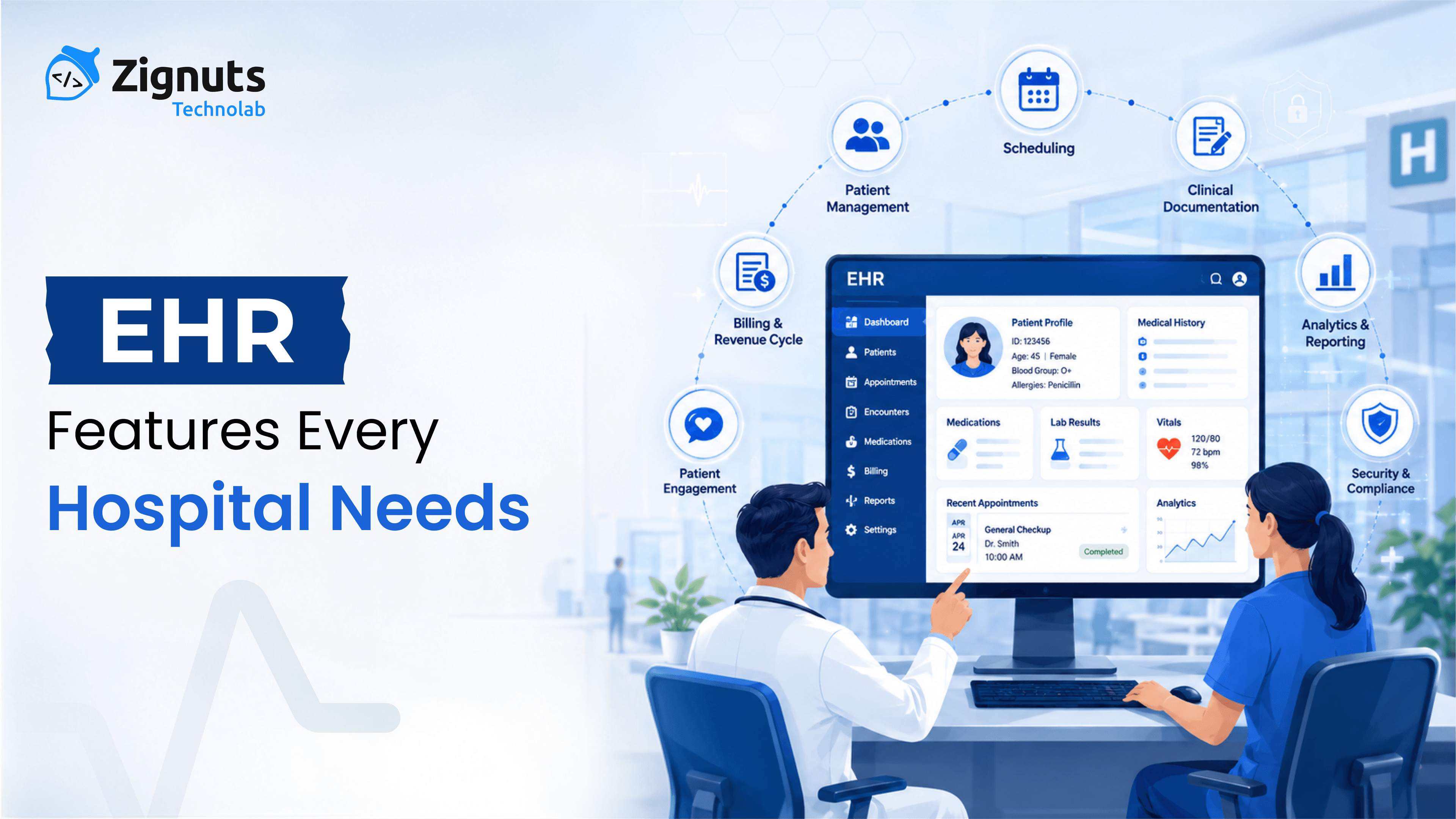
Essential EHR Features for Hospitals: A Complete Guide
A hospital EHR should do more than digitize paper charts. It should help clinicians make safe decisions, coordinate care across departments, keep a trustworthy longitudinal record, and exchange data with the wider health ecosystem without making downtime, poor usability, or privacy failures a routine operational risk. Effective EHR Software Development should prioritize features that fit real clinical practice, are governed appropriately, and can be operated safely.
Essential EHR Features at a Glance
Capability Layer | Must-Have Capabilities | Why It Matters |
|---|---|---|
Clinical record | Patient identity, encounter history, notes, diagnoses, allergies, vitals | Creates a coherent longitudinal record and reduces fragmented documentation. |
Care delivery | Orders, e-prescribing, medication reconciliation, results, care plans | Connects decisions to execution and follow-up. |
Hospital operations | Scheduling, admissions/discharge/transfer, bed and department workflows | Coordinates patients, staff, and capacity. |
Information exchange | FHIR/HL7 interfaces, terminology mapping, interface monitoring | Makes data useful across labs, imaging, pharmacies, payers, and referrals. |
Trust & resilience | Identity, least-privilege access, audit logs, backup, downtime procedures | Protects sensitive information and supports continuity of care. |
Insight & engagement | Clinical/operational reporting, patient portal, accessible mobile access | Improves visibility and supports patient participation. |
Why Choosing the Right EHR Features Matters for Hospitals
EHR procurement is not just a software checklist. Feature choices influence clinical handoffs, documentation burden, medication safety, revenue-cycle work, and the hospital’s ability to participate in regional or national data exchange. The best requirements begin with patient journeys and safety-critical workflows, not a vendor’s longest feature list.
A useful requirements process distinguishes three categories:
(1) safety-critical capabilities that must work from day one;
(2) operational capabilities that reduce friction across departments
(3) advanced capabilities that should follow once data quality, governance, and adoption are established.
Ready to Build a Better Hospital EHR?

15 Must-Have EHR Features for Modern Hospitals
1. Patient Identity, Registration, and Longitudinal Record
Support reliable patient matching, demographic updates, encounter history, allergies, problems, immunizations where relevant, and clear provenance for imported data. Duplicate-record handling needs both prevention and a governed reconciliation process.
2. Clinical Documentation and Templates
Provide structured and narrative notes, specialty-aware templates, configurable forms, clinical history review, and clear authorship/time stamps. Avoid forcing clinicians into templates that make complex cases harder to document.
3. Computerized Provider Order Entry and Results Management
Let authorized clinicians place and track laboratory, imaging, procedure, and referral orders. Results should route to the right inbox, show abnormal flags in context, and remain open until reviewed or escalated according to policy.
4. Medication Management and E-Prescribing
Maintain medication lists, reconciliation at transitions, allergy and interaction checks, dose/route/frequency support, refill workflows, and links to pharmacy systems where available. Alert design should minimize low-value warnings while preserving high-severity safety checks.
5. Clinical Decision Support
Use governed rules for contraindications, preventive-care reminders, order sets, and evidence-based prompts. Every alert should have an owner, review cycle, severity, override reason where appropriate, and monitoring for alert fatigue.
6. Scheduling, Admission, Discharge, and Transfer
Connect appointment scheduling with registration, bed management, transfers, discharge planning, and follow-up. Make status changes visible to the departments that need them, while avoiding unnecessary access to sensitive details.
7. Billing, Coding, and Payer Workflows
Support charge capture, coding assistance, claims preparation, eligibility checks, denials tracking, and reconciliation with finance systems. Clinical documentation should support accurate coding without allowing billing goals to distort clinical judgment.
8. Laboratory, Imaging, and Pharmacy Integrations
Integrate with LIS, PACS/RIS, pharmacy, devices, and external providers. Track interface health, failed messages, retries, and reconciliation queues. An interface that silently drops data is a patient-safety risk.
9. Interoperability and Standards Support
Plan for HL7 v2 where existing systems require it and FHIR APIs for modern exchange, with appropriate profiles, terminology services, consent, and identity matching. Standards support does not automatically guarantee semantic interoperability.
10. Security, Privacy, and Auditability
Use unique user identities, role- or attribute-based permissions, least privilege, MFA for appropriate access paths, encryption, session controls, break-glass access with review, and immutable or tamper-evident audit trails.
11. Reporting and Analytics
Provide operational dashboards for throughput, appointment access, length of stay, result turnaround, documentation completion, medication safety signals, and data quality. Define each metric precisely and document its source and limitations.
12. Patient Portal and Digital Access
Offer secure access to appropriate records, results, appointments, instructions, and communication. Design for accessibility, language needs, proxy access, and consent boundaries for minors or caregivers.
13. Mobile and Point-of-Care Usability
Support the workflows clinicians actually need on approved devices, with secure authentication, appropriate screen design, and clear handling of offline or intermittent connectivity. Mobile access must not weaken access control.
14. Downtime, Backup, and Disaster Recovery
Define clinical downtime procedures, recovery objectives, backup protection, restore testing, and reconciliation of work performed during outages. A backup is not proven until restoration has been tested.
15. Configuration, Governance, and Change Management
Maintain controlled terminology, order sets, templates, permissions, release notes, training, and a clinical governance process. Track adoption and safety outcomes after each major change.
According to U.S. federal health IT survey summaries:
Approximately 9 in 10 U.S. hospitals enabled patients to access electronic health information through an API in 2024.
Around 7 in 10 hospitals reported using standards-based APIs for patient access.
In 2025, 76% of U.S. hospitals engaged in all four measured interoperability domains.
Sending, receiving, and finding health information exceeded 90% among surveyed U.S. non-federal acute care hospitals.
Integrating exchanged information into the EHR remained less common.
Key insight: Hospitals are making progress in health information exchange, but integrating that information into clinical workflows remains an important challenge.
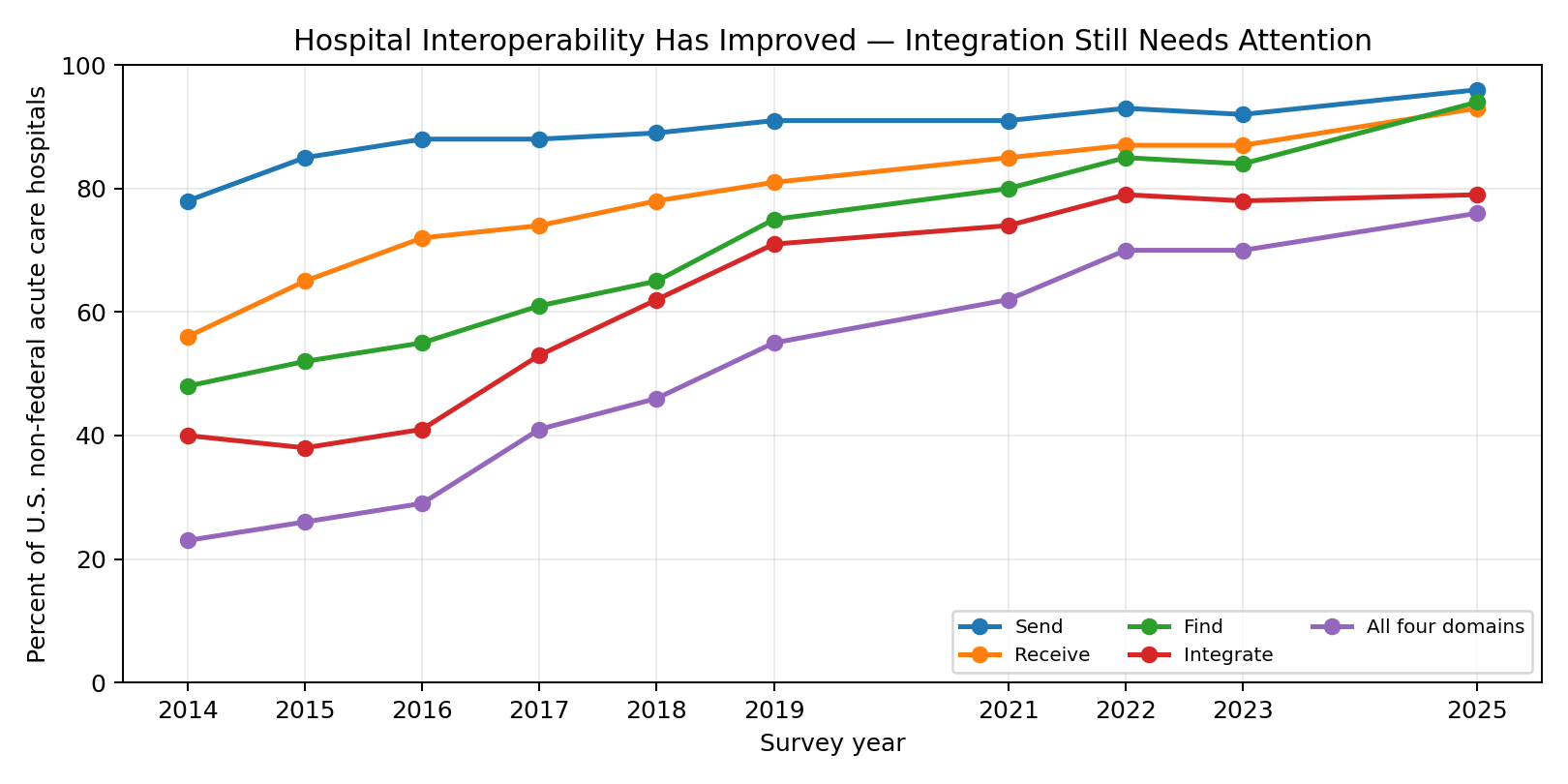
Hospital interoperability trends, 2014–2025. Source: ONC Health IT Quick Stat #66, based on the 2014–2025 American Hospital Association Health IT Survey. The population is U.S. non-federal acute care hospitals.
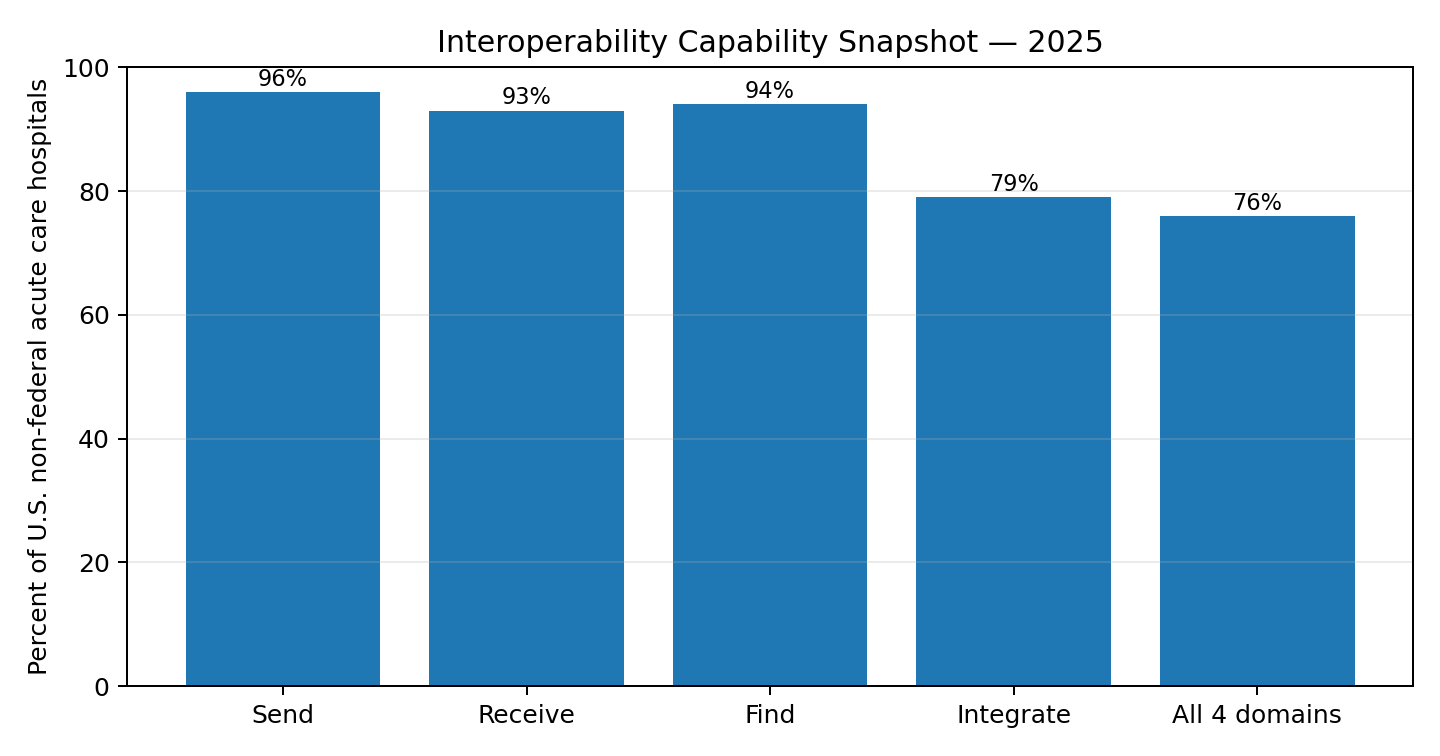
2025 snapshot across four exchange domains and the all-four-domains measure. Source: ONC Health IT Quick Stat
Ready to Build a Better Hospital EHR?
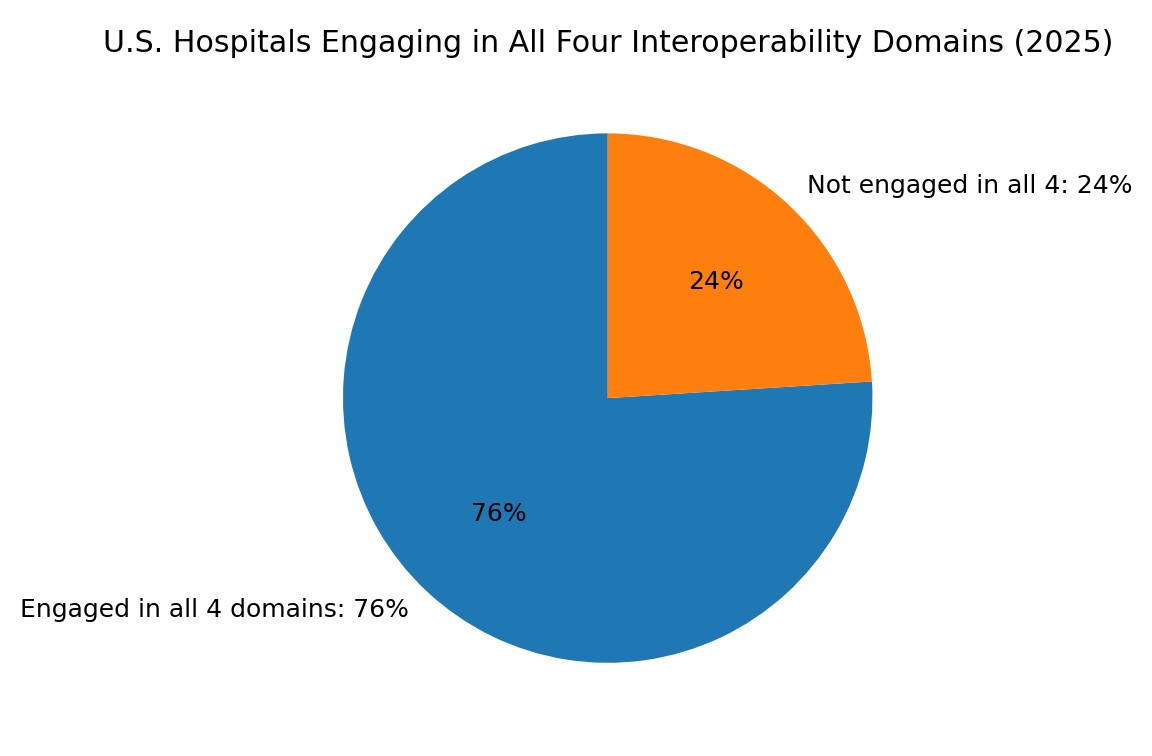
In 2025, 76% engaged in all four measured interoperability domains; the remaining 24% did not meet that combined measure, which does not imply zero interoperability capability.
How to Prioritize EHR Features for Hospital Implementation
The following is an editorial prioritization framework, not a measured industry benchmark. Score features against local clinical risk, regulatory obligations, current system gaps, patient volume, and integration dependencies.
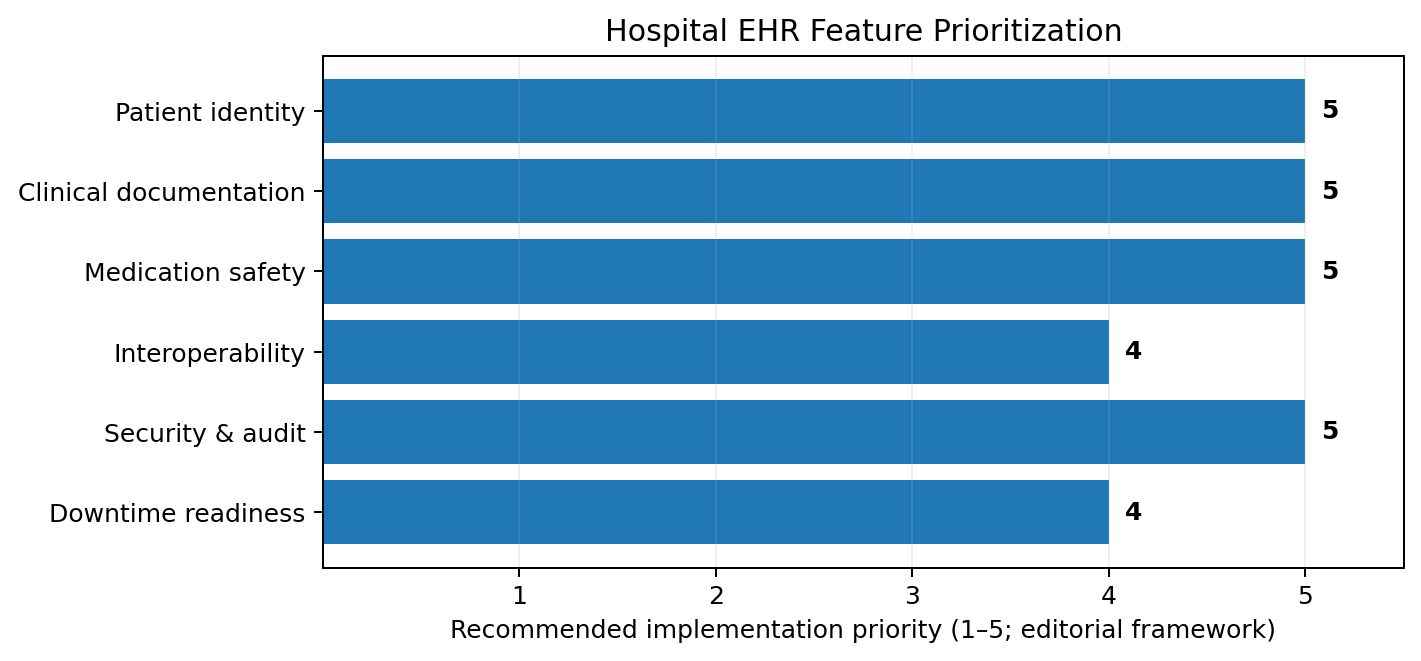
Recommended starting priority (1 = lower, 5 = highest); scores are a planning aid, not empirical survey data.
Wave | Focus | Exit Criteria |
|---|---|---|
Wave 0 - safety foundation | Patient identity, access control, audit, backup/downtime plan | Clinical safety review signed off; restore and access tests passed. |
Wave 1 - core care | Documentation, orders/results, medication reconciliation, allergies | End-to-end patient journeys validated by clinicians. |
Wave 2 - hospital operations | Scheduling, ADT, billing/coding, departmental workflows | Cross-department handoffs and exception paths tested. |
Wave 3 - connected care | LIS/PACS/pharmacy interfaces, FHIR/HL7, patient portal | Interface monitoring and reconciliation queues operational. |
Wave 4 - optimization | Analytics, automation, AI-assisted workflows | Data quality, governance, evaluation, and human oversight established. |
Hospital EHR Architecture: Key Components and Design Principles
A practical architecture separates user experiences, identity and API controls, clinical and operational services, integration adapters, and data/analytics capabilities. This is an illustrative reference architecture, not a description of a specific deployed system. Start with a modular architecture and clear boundaries; introduce independently deployed services only where scale, reliability, team ownership, or release cadence justify their operational cost.
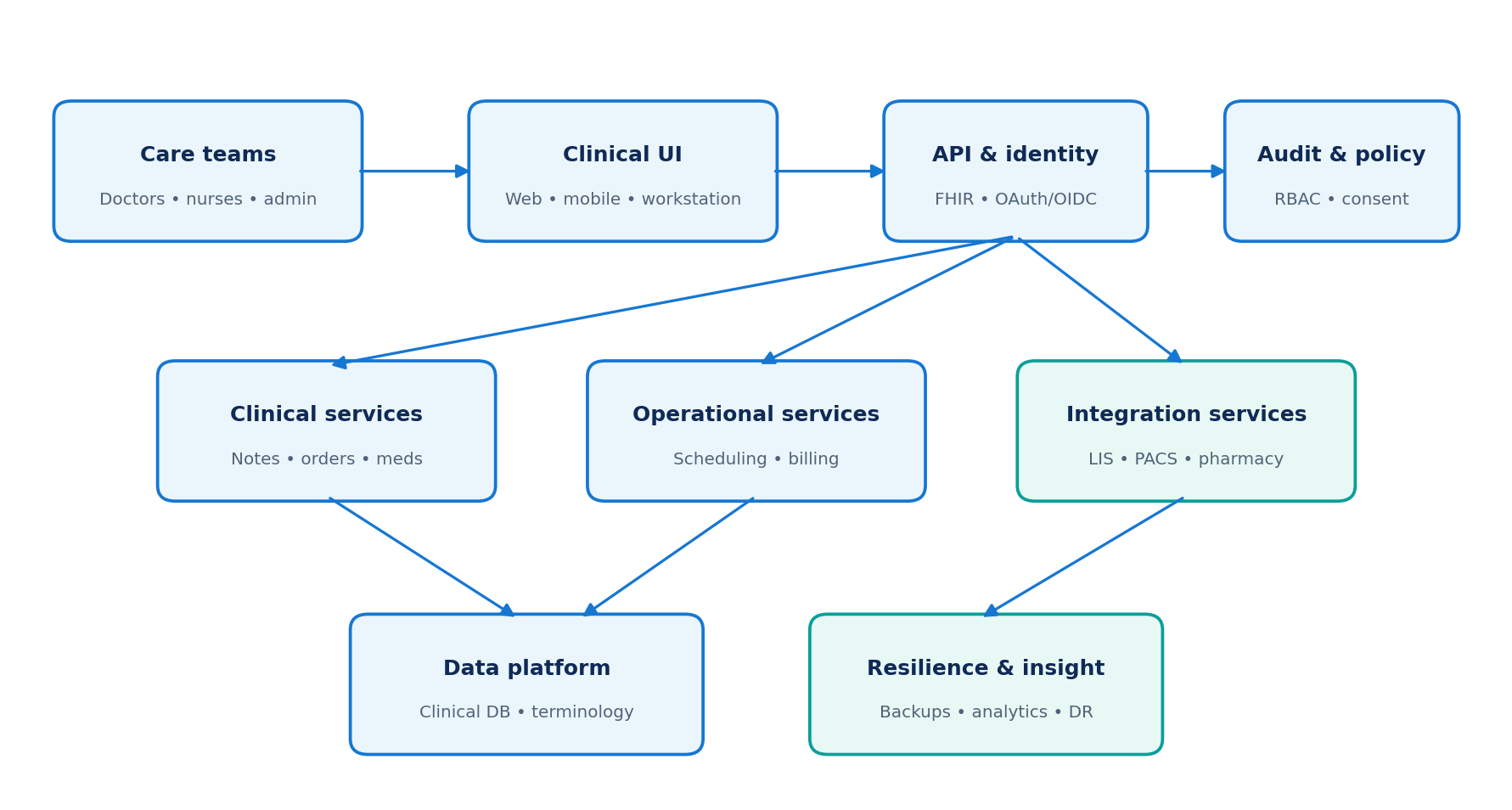
Illustrative logical architecture. Real deployments should be adapted to clinical scope, legacy systems, hosting constraints, and jurisdictional requirements.
Key Architecture Considerations for Hospital EHR Systems
Identity and access: Centralize authentication; enforce authorization close to each resource; log sensitive access and administrative changes.
Data model: Preserve source, author, time, status, and provenance. Use clinical terminology mappings rather than relying on free-text alone.
Integration: Use adapters and queues where appropriate; include idempotency, retries, dead-letter handling, reconciliation, and interface monitoring.
Availability: Define service-level objectives around clinical impact, not just server uptime. Plan for degraded modes and documented downtime workflows.
Analytics: Isolate reporting workloads where needed and make metric definitions transparent. Do not let dashboards become an ungoverned secondary source of clinical truth.
Ready to Build a Better Hospital EHR?
How EHR Features Support the Complete Patient-Care Workflow
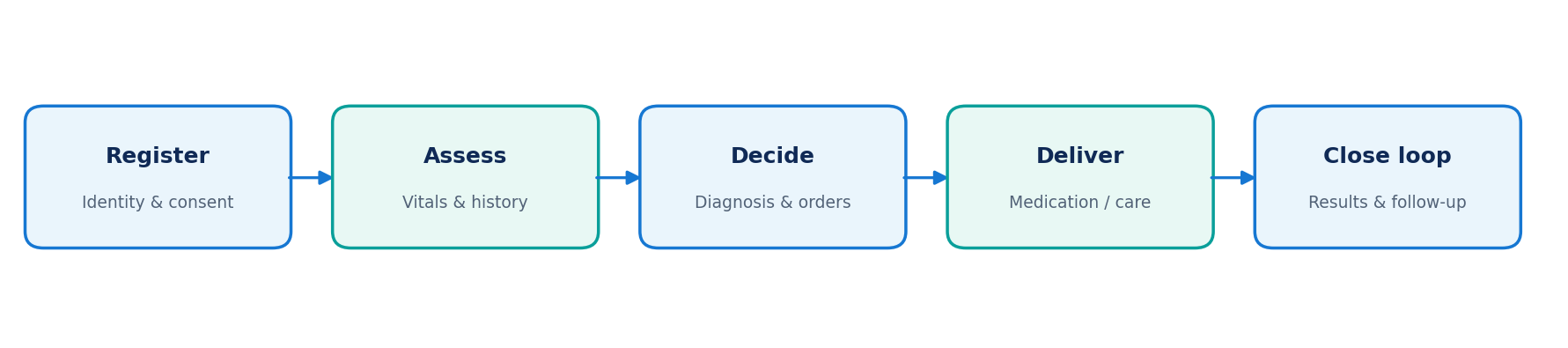
Simplified patient journey. Each stage should include ownership, exception handling, and an audit trail.
An EHR workflow is incomplete when a clinician places an order, but no one owns the result, when a discharge plan is documented but follow-up is not coordinated, or when an external message fails without surfacing to staff. Requirements should define completion states and escalation paths, not merely screen fields.
According to ONC’s 2026 Quick Stat summary of the 2014–2025 American Hospital Association IT Supplement:
76% of U.S. non-federal acute care hospitals engaged in all four measured interoperability domains in 2025.
96% reported sending health information.
93% reported receiving health information.
94% reported finding health information.
79% reported integrating information into their EHR.
Key insight: Exchanging information does not guarantee that it is integrated into clinical workflows and usable for patient care.
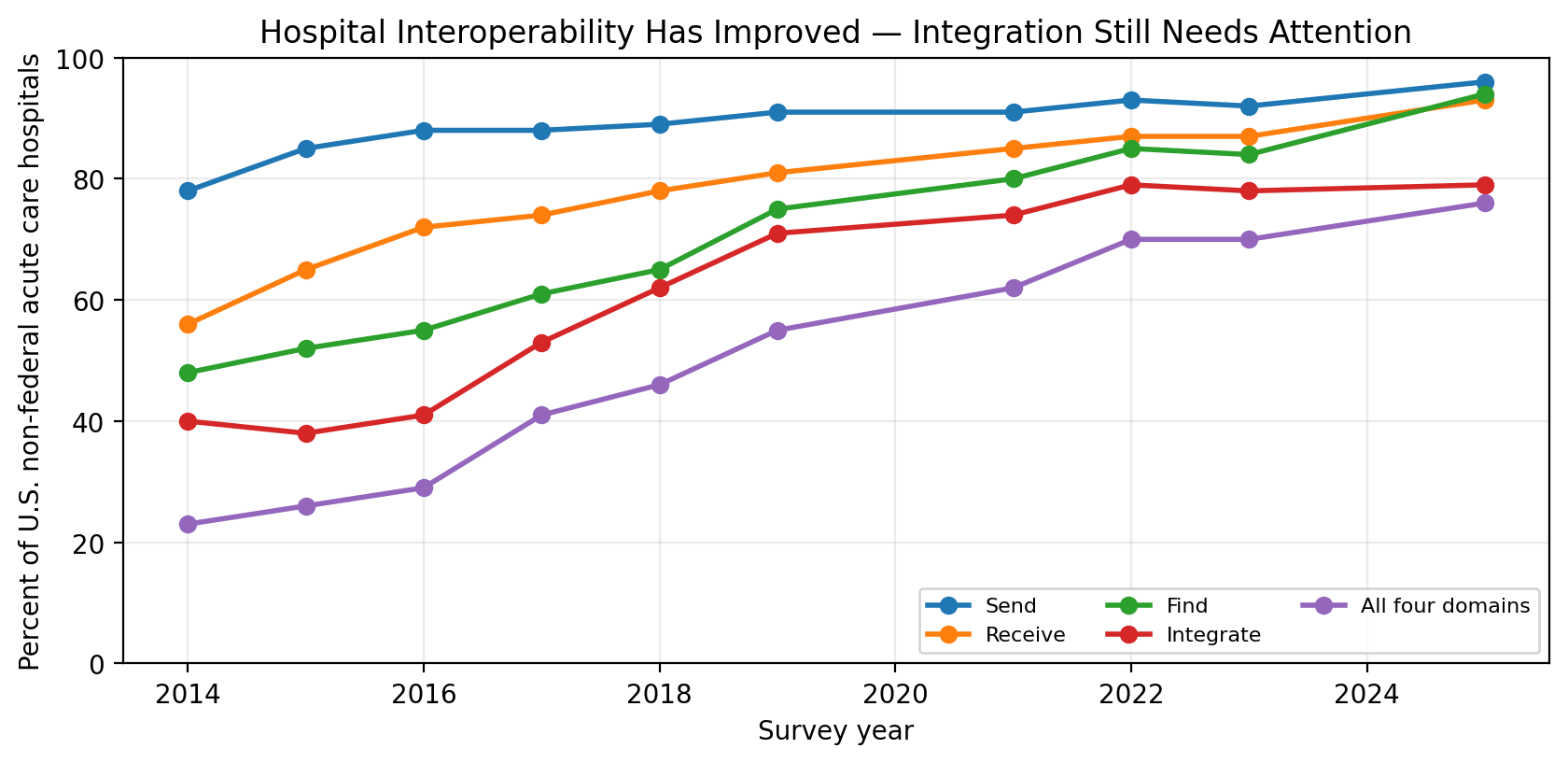
U.S. hospital engagement in electronic information exchange domains, selected survey years 2014–2025. Source: ASTP/ONC, Electronic Health Information Exchange by Hospitals, updated February 2026. Values describe U.S. non-federal acute care hospitals; they are not global or India estimates.
EHR Interoperability: HL7 and FHIR Standards for Healthcare Data Exchange
Hospitals often operate a mixed estate of older and newer applications. Interoperability planning must cover transport, syntax, semantics, identity, consent, and workflow. HL7 v2 remains common in many existing hospital interfaces; FHIR offers resource-based APIs and exchange patterns. Neither standard removes the need for local implementation guides, terminology alignment, conformance testing, and operational monitoring.
Area | Questions to Resolve |
|---|---|
Standards and profiles | Which HL7 v2 messages, FHIR resources, profiles, and versions are required? |
Terminology | How are local codes mapped to agreed clinical terminologies and units? |
Identity | How will duplicate identities and cross-organization matching be handled? |
Consent and purpose | What data can be shared, with whom, for which purpose, and under which legal basis? |
Operations | Who monitors failed messages, stale endpoints, and mismatched results? What is the recovery SLA? |
Ready to Build a Better Hospital EHR?
EHR Security, Patient Privacy, and Clinical Safety Features
Security is not a final checklist. It is an architectural and operational property. Map controls to the jurisdictions in which the hospital operates and validate them with legal, privacy, clinical safety, and security leaders. HIPAA applies to covered entities and business associates in the United States; hospitals in India should assess applicable Indian data-protection and health-data requirements, including current commencement rules and sector-specific obligations.
Control | Implementation Guidance |
|---|---|
Identity and MFA | Unique accounts; MFA for privileged and remote access; rapid revocation when roles change. |
Authorization | Least privilege; role-based rules plus context where needed; periodic access recertification. |
Audit | Record access, changes, exports, break-glass events, and administrative actions; alert on suspicious patterns. |
Data protection | Encrypt traffic and storage; manage keys and secrets; restrict non-production data and exports. |
Clinical safety | Hazard analysis for medication, identity, results, and alerting workflows; test failure and override paths. |
Resilience | Immutable/offline backups where appropriate; restore tests; incident response and downtime rehearsals. |
Custom EHR Development vs. Buying an Existing EHR System
Decision Factor | Buy / Configure an Established EHR | Build or Extend Custom Software |
|---|---|---|
Core clinical functions | Often faster when workflows fit the product. | Higher validation burden for core clinical logic. |
Workflow differentiation | May require vendor roadmap or configuration. | More control over unique workflows. |
Interoperability | Assess available connectors, APIs, and fees. | Control adapters, but must build and operate them. |
Time to value | Potentially faster; migration and configuration still take time. | Depends on scope, integrations, clinical validation, and team capacity. |
Long-term ownership | Vendor dependency, licensing, upgrades, data export. | Engineering ownership, maintenance, security, and support obligations. |
Best fit | Hospitals with standard needs and strong vendor fit. | Specific gaps, extension layers, or differentiated workflows where value justifies lifecycle cost. |
Practical default: Evaluate established EHR platforms first for core clinical recordkeeping. Consider custom development for integration layers, patient-facing services, analytics, or workflows that cannot be met safely and economically through configuration.
Ready to Build a Better Hospital EHR?
EHR Implementation Roadmap: From Planning to Optimization
Discover: Map clinical journeys, stakeholders, regulatory context, current applications, data quality, and safety hazards.
Define: Create role-based workflows, non-functional requirements, data migration rules, interface inventory, and measurable acceptance criteria.
Design: Agree on architecture, identity, audit, terminology, integration contracts, downtime approach, and reporting definitions.
Configure and integrate: Build or configure in small increments; validate interfaces with representative data and failure cases.
Validate: Run clinical scenario testing, usability sessions, security testing, migration reconciliation, recovery tests, and role-permission checks.
Roll out: Use a phased deployment with training, super-users, support coverage, rollback criteria, and clear ownership.
Optimize: Monitor adoption, incident trends, interface failures, workflow time, data quality, and clinician feedback.
How to Measure EHR Performance and Effectiveness
Do not select metrics only because they are easy to collect. Establish a baseline, define denominators, segment by department and patient pathway, and review unintended consequences. Example measures include:
Clinical workflow: Documentation completion time, unsigned notes, order turnaround, and result acknowledgement latency.
Safety and quality: Medication-reconciliation completion, allergy-data completeness, duplicate-record rate, and near-miss reports.
Operations: Appointment lead time, admission-to-bed time, discharge processing time, and interface failure recovery time.
Adoption and usability: Active use by role, training completion, help-desk themes, and clinician-reported burden.
Resilience and security: Restore-test success, downtime duration, access-review completion, and time to detect/respond to incidents.
Measurement caution: Do not publish a claimed improvement without a defensible baseline, measurement period, clear definition, and attributable evidence. Correlation alone does not prove the EHR caused the change.
Ready to Build a Better Hospital EHR?
Common EHR Implementation Mistakes and How to Avoid Them
1. Buying by Feature Count
Choosing features without assessing actual hospital workflows.
Overlooking specialty-specific requirements.
How to avoid: Prioritize essential features and validate them with clinical teams.
2. Underestimating Migration
Missing records, inconsistent data, and duplicate patient identities.
How to avoid: Map, clean, test, and validate data before migration.
3. Treating Interoperability as a One-Time Task
Ignoring failed messages, system updates, and interface issues.
How to avoid: Monitor integrations and establish clear maintenance procedures.
4. Over-Alerting Clinicians
Too many low-priority alerts can cause alert fatigue.
How to avoid: Prioritize relevant, actionable alerts based on clinical severity.
5. Ignoring Downtime
Unplanned outages can interrupt access to patient information and care workflows.
How to avoid: Maintain tested backups and clear downtime procedures.
6. Launching Without Change Management
Insufficient training and support can reduce user adoption.
How to avoid: Provide role-based training, ongoing support, and regular feedback sessions.
How to Choose the Right EHR Vendor or Development Partner
Ask for a workflow demonstration using your own scenarios, not a generic product tour.
Request evidence of standards conformance, interface monitoring, auditability, data export, and recovery testing.
Review how clinical rules are governed, versioned, tested, and rolled back.
Confirm migration approach, reconciliation responsibility, and what happens to data if the contract ends.
Clarify service levels, incident response, upgrade windows, support coverage, and subcontractors.
Validate accessibility, localization, role-specific usability, and patient/caregiver access boundaries.
Assess total lifecycle cost: licensing, configuration, integrations, migration, validation, infrastructure, training, support, and upgrades.
Ready to Build a Better Hospital EHR?
Key Takeaways: Choosing the Right EHR Features
Design around clinical journeys and safety-critical work, not feature counts.
Treat identity, medication safety, result follow-up, interoperability, and downtime as foundational.
Standards require terminology alignment, governance, conformance testing, and ongoing operations.
Buy-versus-build decisions should consider lifecycle cost, validation burden, differentiation, and vendor dependence.
Measure outcomes with defined baselines and transparent methodology; do not invent performance claims.
Conclusion: Build a Dependable Hospital EHR with the Right Features
A hospital EHR succeeds when it helps people deliver coordinated care safely, makes information available to the right person at the right time, and remains dependable under real operating conditions. A disciplined feature roadmap, clear governance, standards-based integration, and a realistic validation plan provide a stronger foundation than pursuing every available module at once.
For healthcare organizations considering custom portals, workflow applications, integration services, or system modernization, a structured discovery process can help clarify requirements, architecture choices, risks, and delivery priorities. Contact us today to discuss your healthcare software needs and explore an approach that aligns with your hospital’s workflows and goals.

Hard Trivedi
Business Enthusiast | Exploring ideas, understanding business challenges, and turning insights into practical solutions that create meaningful value and growth.