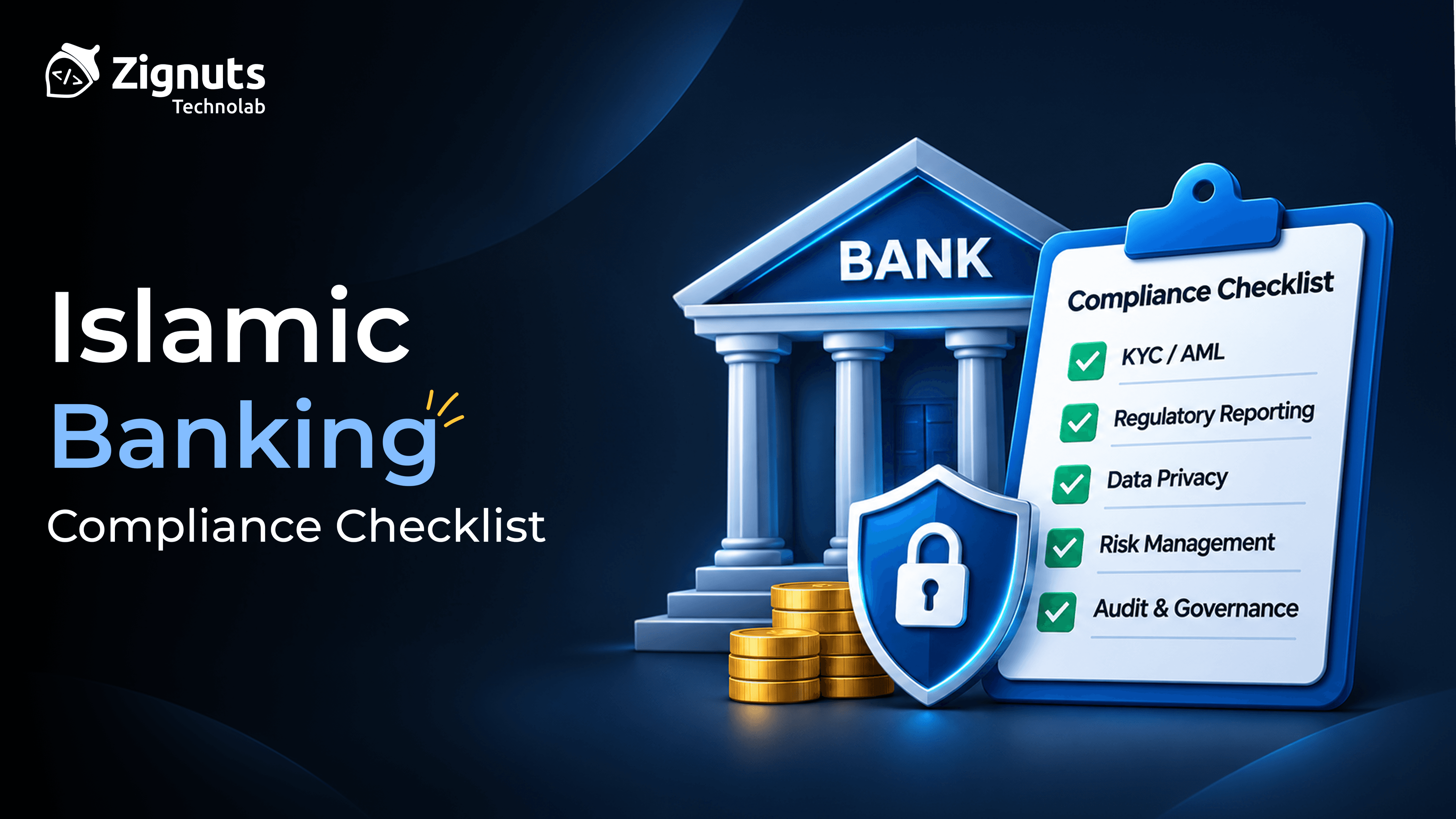
Why Islamic Banking Compliance Requires Strong Systems and Controls
A compliance review in an Islamic bank rarely starts with a document. It starts with a question: "Show me why this transaction was treated this way."
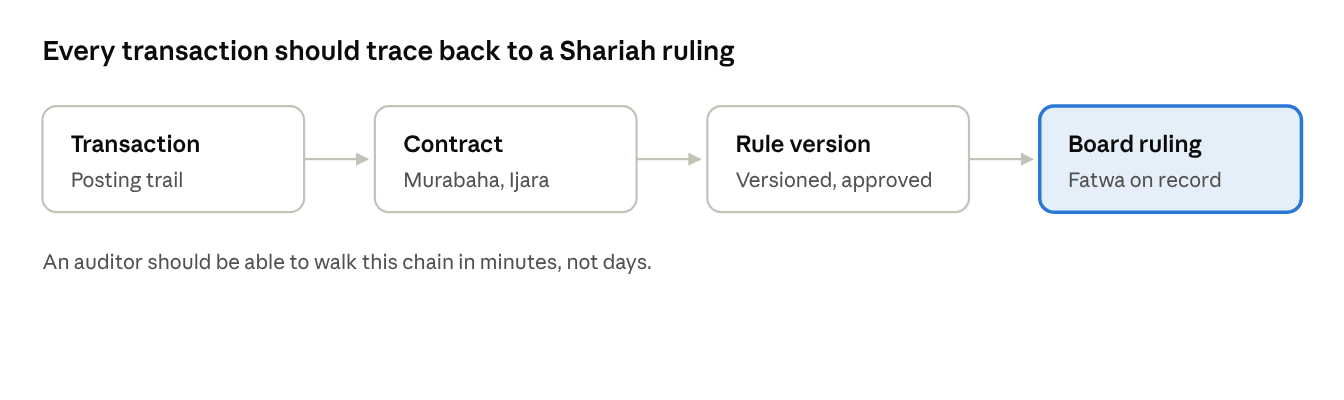
If your team can answer that in minutes, with the contract, the approved ruling, the rule version, and the posting trail, you are in good shape.
If the answer involves three spreadsheets and a phone call to someone who knows how it works, this checklist is for you.
We built it for decision-makers: CEOs, COOs, heads of compliance, and technology leaders at Islamic banks, Islamic windows, and fintechs.
It is not a substitute for advice from your Shariah board or regulator. It is a structured way to find out where you stand.
In conventional banking, compliance is largely about conduct, capital, and reporting.
Islamic banking carries all of that and adds a second obligation: the institution must be able to show that its products and operations conform to Shariah as determined by its Shariah Supervisory Board.
That obligation cannot live only in policy manuals.
A Murabaha has to involve a real asset, ownership at the right moment, and a disclosed markup.
A late-payment amount has to be routed to charity rather than booked as income.
Profit has to be distributed to depositors according to approved pool rules.
Every one of these is something a system either enforces or does not.
That is why we think of Islamic banking compliance as a systems question first.
Policies describe what should happen. Software determines what does.
The Two Pillars of Islamic Banking Compliance: Shariah and Regulatory Requirements
Shariah compliance covers conformity with the rulings of your Shariah Supervisory Board and, where applicable, the standards your jurisdiction adopts, such as those from AAOIFI and IFSB.
Regulatory compliance covers central bank requirements, licensing conditions, capital and liquidity rules, AML and KYC obligations, data protection, and financial reporting.
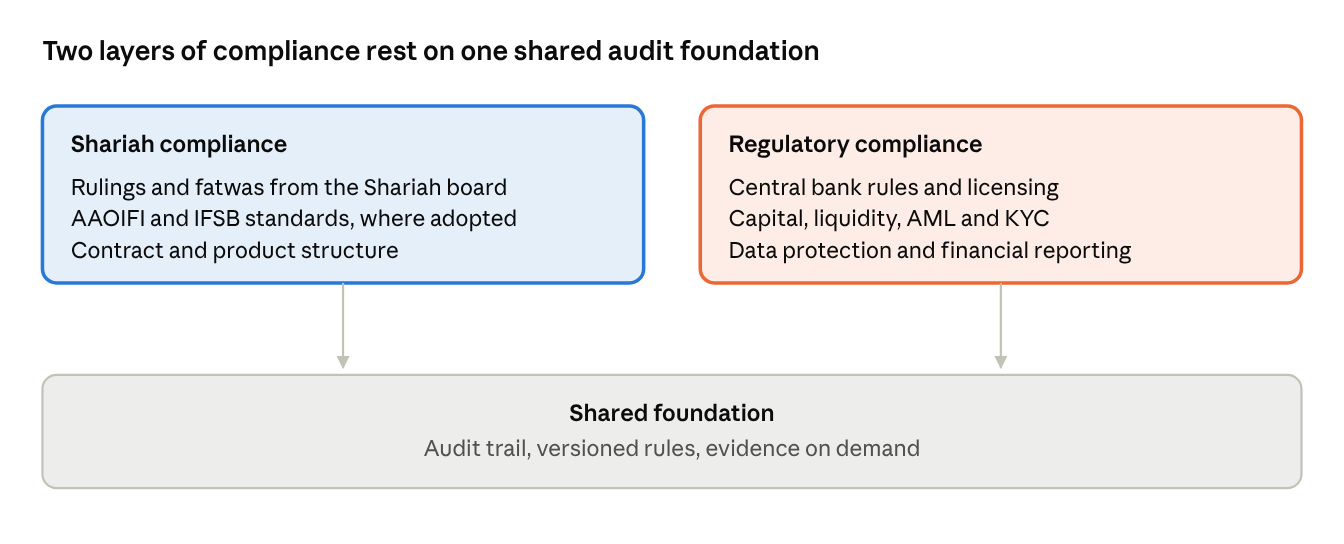
Two compliance layers and their shared foundation
The two layers overlap but are not the same, and both depend on the same audit trail.
A product can satisfy your regulator and still raise a Shariah concern, and the reverse is also true.
Jurisdictions differ in how they structure oversight.
Some have a central Shariah authority, others rely on each institution's board, and others apply Shariah governance rules through the general banking framework.
Confirm which model applies to you before using any checklist as a basis for sign-off.
Ready to Strengthen Your Islamic Banking Compliance?

Islamic Banking Compliance Checklist: 8 Essential Areas to Review
Use each item as a question you can answer with evidence, not just a yes or no.
Eight Key Areas of an Islamic Banking Compliance Framework
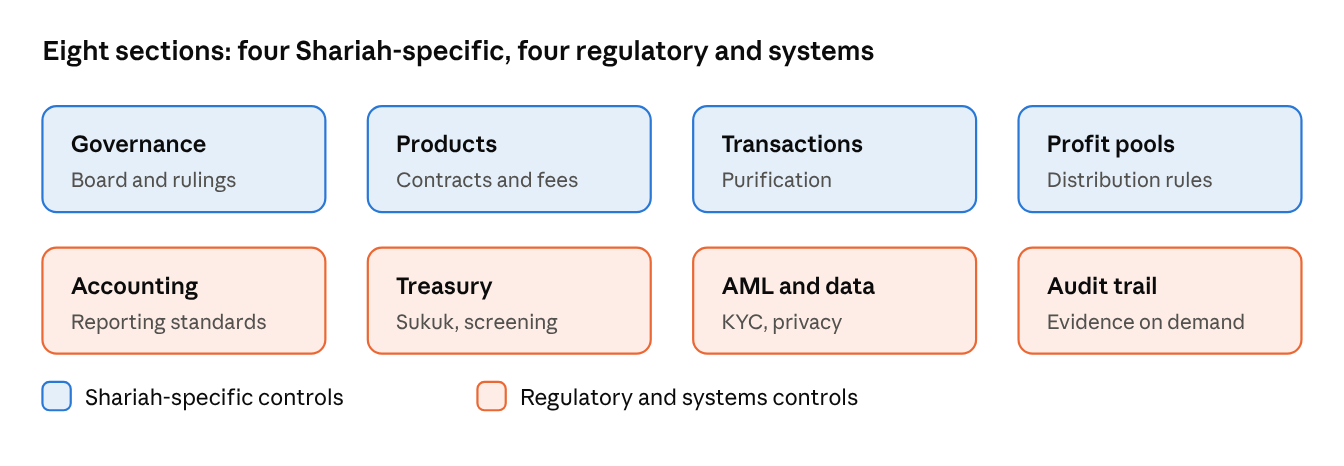
The sections run from governance to audit readiness, and the numbered lists below follow the same order.
1. Shariah governance
Shariah Supervisory Board members are appointed, documented, and meet independence and qualification expectations in your jurisdiction.
A clear mandate defines what the board approves, reviews, and can veto.
An internal Shariah compliance function exists and is separate from business lines.
Internal Shariah review and external Shariah audit are scheduled, resourced, and reported to the board.
Rulings and fatwas are recorded in a central register with dates, scope, and version history.
A defined process handles non-compliance events, including escalation, remediation, and reporting.
Board and management receive regular reporting on Shariah compliance metrics.
2. Product and contract controls
Every product has an approved structure document describing the contract, parties, ownership timing, risk allocation, and permitted fees.
Approval of new products and material changes follows a documented workflow with Shariah sign-off before launch.
Contract templates, customer disclosures, and marketing materials match the approved structure.
Each contract's lifecycle events are defined: origination, ownership transfer, settlement, early settlement, restructuring, default, and rebate.
Prohibited elements are explicitly blocked, such as interest-based charges, uncertain terms, and unapproved penalties.
Hybrid or novel structures (for example, Tawarruq variations) have documented rulings and clear scope limits.
3. Transaction-level controls and purification
Asset-backed financings verify that the asset exists and that the bank owns it at the required point.
Sequence controls prevent steps from happening out of order, for example, a sale to the customer before the bank takes ownership.
Late-payment amounts are identified, kept out of income, and routed to a designated charity account.
Non-compliant income, whenever it arises, is detected, quarantined, and purified according to board guidance.
Manual overrides require authorization, a reason, and a trail.
Exceptions are reported, reviewed, and used to improve the controls.
4. Deposits, pools, and profit distribution
Deposit products (Wakala, Mudarabah, current accounts, savings) have defined contract bases and are not presented as guaranteed-return interest products unless the structure permits it.
Investment pools are documented, with clear rules on what assets and income enter each pool.
Profit-sharing ratios, weightages, and the bank's share as Mudarib or agent are approved and applied consistently.
Expense allocation and any reserve mechanisms (such as profit equalization) follow approved policies.
Profit calculations are reproducible: given the same inputs, an auditor can recompute the same distribution.
Customers receive statements that explain how returns were determined.
5. Accounting and financial reporting
Accounting treatments follow the standards your regulator adopts, whether AAOIFI, IFRS with Islamic finance adjustments, or local requirements.
The chart of accounts separates Shariah-relevant items such as charity funds, restricted investment accounts, and pool assets.
Revenue recognition for each contract type follows its approved treatment.
Regulatory returns and Shariah governance disclosures are produced from the same source data.
Reconciliation between sub-ledgers and the general ledger runs on a schedule and is evidenced.
6. Treasury and investments
Investments, Sukuk holdings, and liquidity instruments are screened and approved against Shariah criteria.
Equity screening rules, if relevant, are documented and applied on a defined cycle.
Counterparties and instruments used for liquidity management are covered by approved structures.
Hedging or risk-management tools follow approved, Shariah-compliant alternatives where required.
Takaful arrangements, if offered or used, have their own governance and documentation.
7. AML, KYC, and data protection
Customer onboarding, due diligence, and monitoring meet your regulator's AML and KYC requirements.
Screening covers sanctions, politically exposed persons, and ongoing monitoring.
Data residency, retention, and privacy obligations are mapped to where data actually lives.
Access controls follow least privilege, with logging for sensitive actions.
Third-party providers and cloud vendors are assessed for security and compliance.
8. Technology and audit readiness
Product rules are configurable, versioned, and approved through a controlled workflow rather than hard-coded.
Every rule change, override, and exception leaves an immutable audit trail with who, what, when, and why.
You can trace any transaction back to its contract, rule version, and applicable ruling.
Reports for the Shariah board and auditors can be produced on demand without manual assembly.
Testing includes Shariah-specific scenarios such as early settlement, default, and ownership transfer, not just functional tests.
Disaster recovery, backup, and change-management practices are documented and tested.
Your data, configurations, and product definitions can be exported if you change vendors.
Ready to Strengthen Your Islamic Banking Compliance?
How to Assess and Apply the Islamic Banking Compliance Checklist
Do not try to tick every box in one sitting. A pragmatic approach:
Score each section as strong, partial, or weak, with a named owner.
Mark evidence gaps. A control that exists but cannot be demonstrated counts as partial.
Prioritize by exposure. Items touching customer money, income recognition, and profit distribution come first.
Separate process fixes from system fixes. Some gaps need a policy. Others need a platform change, and those take longer and need planning.
Review with your Shariah board and compliance team and agree which items matter most for your products and jurisdiction.
Repeat on a schedule. Interpretations, products, and regulations change.
Common Islamic Banking Compliance Gaps and Risks
Across the conversations we have with banks and fintechs, the same gaps come up again and again:
Rulings that live in minutes, not in the system. The board decided something, but the platform does not reflect it consistently.
Spreadsheet-based profit distribution. It works until volumes grow or someone leaves.
Charity routing handled manually. This is a common weak point in reviews.
Weak traceability. Teams can show what happened but not which rule version applied.
Shariah review too late in product change. Small changes ship without a second look.
Data migration without contract history. Legacy accounts move across but lose the ownership and profit history that auditors ask about.
Vendor opacity. The institution cannot see or export how its own rules are configured.
Key Software Questions for Islamic Banking Compliance
Whether you run a packaged platform or a custom one, these questions reveal a lot:
How does the system model each contract, as a native structure or as a relabeled loan?
Where are Shariah rules stored, and who can change them?
Can we see the full version history of any product rule and the approval behind it?
How are late-payment amounts, charity routing, and purification handled?
Can profit distribution be recomputed and explained for any period?
What does a Shariah audit extract look like, and how long does it take to produce?
What happens to our configurations and data if we leave?
Questions 2, 3, and 6 all test the same thing: whether any transaction links back to a contract, a rule version, and a board ruling.
Lessons from Building Software for Shariah Compliance
At Zignuts, we build software for financial institutions and fintechs, and compliance requirements shape nearly every design conversation. A few lessons hold up across projects.
Turn rulings into configuration. When a Shariah board decision becomes a versioned, approved rule inside the platform, compliance stops depending on memory and starts depending on evidence.
Design the audit trail before the screens. Teams that decide up front what an auditor must be able to see build better data models. Retrofitting traceability is slow and expensive.
Test the unhappy paths. Early settlement, restructuring, default, and reversal expose more compliance issues than any happy-path demo.
Bring Shariah and compliance people into sprint reviews. Fast feedback beats a big review at the end, both for quality and for the schedule.
Keep jurisdiction-specific logic separate. Institutions operating in more than one market save a great deal of effort when local requirements sit in configuration layers rather than in the core logic.
Be honest about scope. A checklist shows you where the gaps are. Sometimes the right answer is process change, not new software, and we would rather say so.
Conclusion: Improving Islamic Banking Compliance Through Better Systems
Islamic banking compliance comes down to one capability: being able to show, for any product and any transaction, that it did what your Shariah board approved and your regulator expects. This requires strong governance, clear and versioned rulings, controlled product and contract structures, automated purification, pool accounting, and profit distribution wherever possible. Audit readiness should also be built into your technology rather than managed separately.
If you would like to assess how well your platform or processes support these requirements, contact us today. Our team at Zignuts will be happy to walk through your current approach with you.

Parth Trivedi
Co-founder and CTO of a global software agency, I lead innovative IT solutions across industries, focusing on scalable architectures and agile methodologies. Let’s connect to scale your digital initiatives!