EHR vs EMR: Understanding the Key Differences
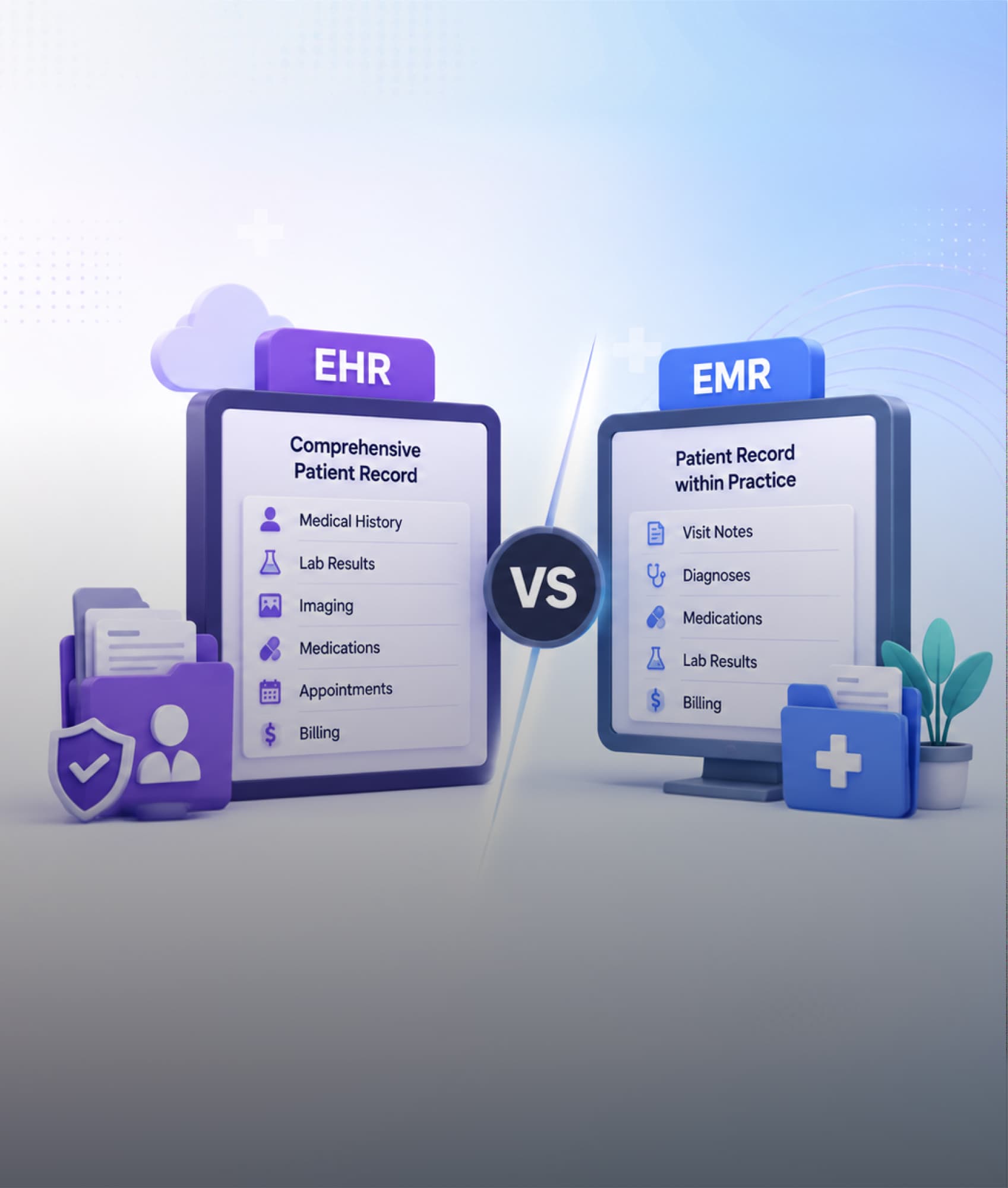
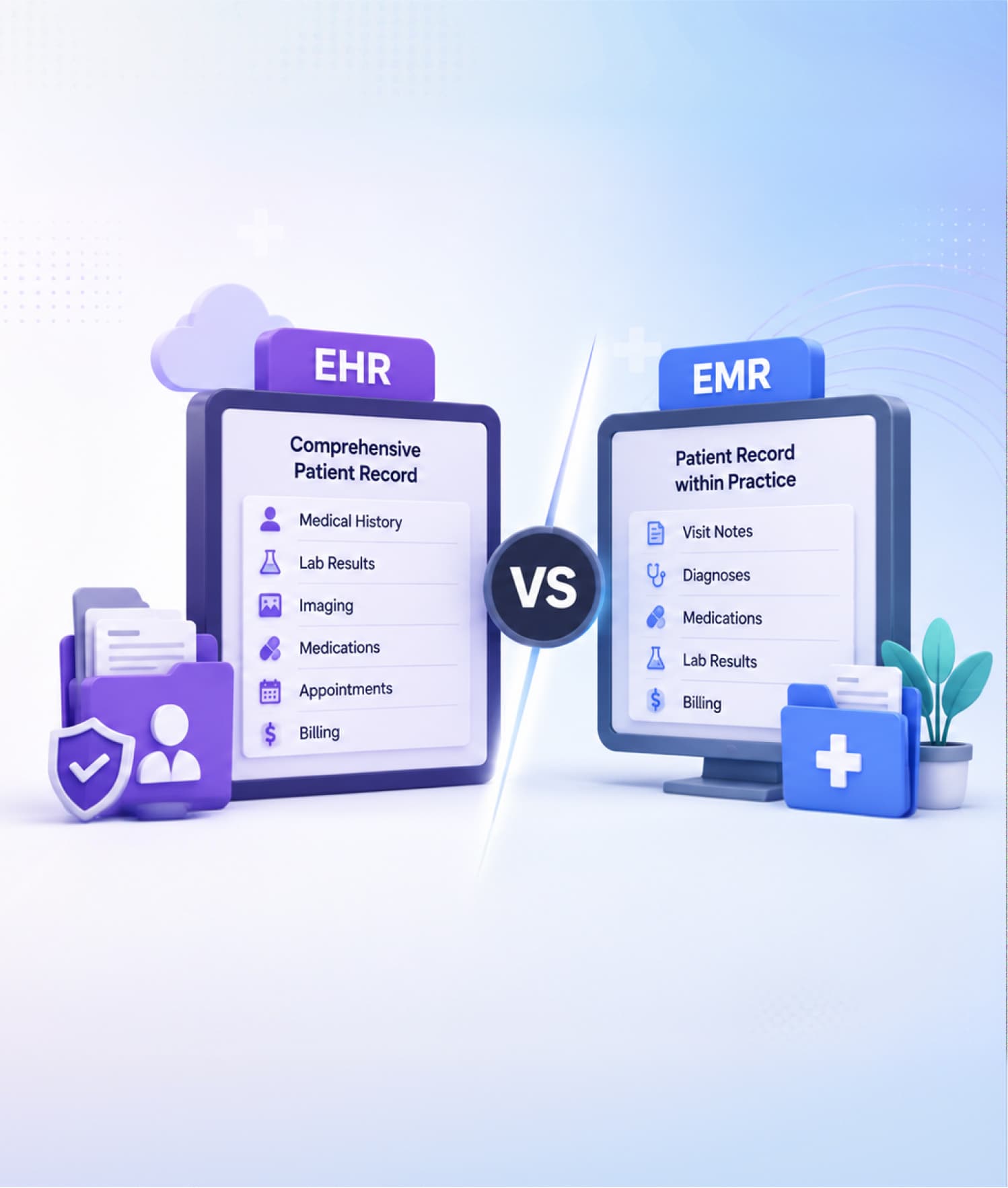
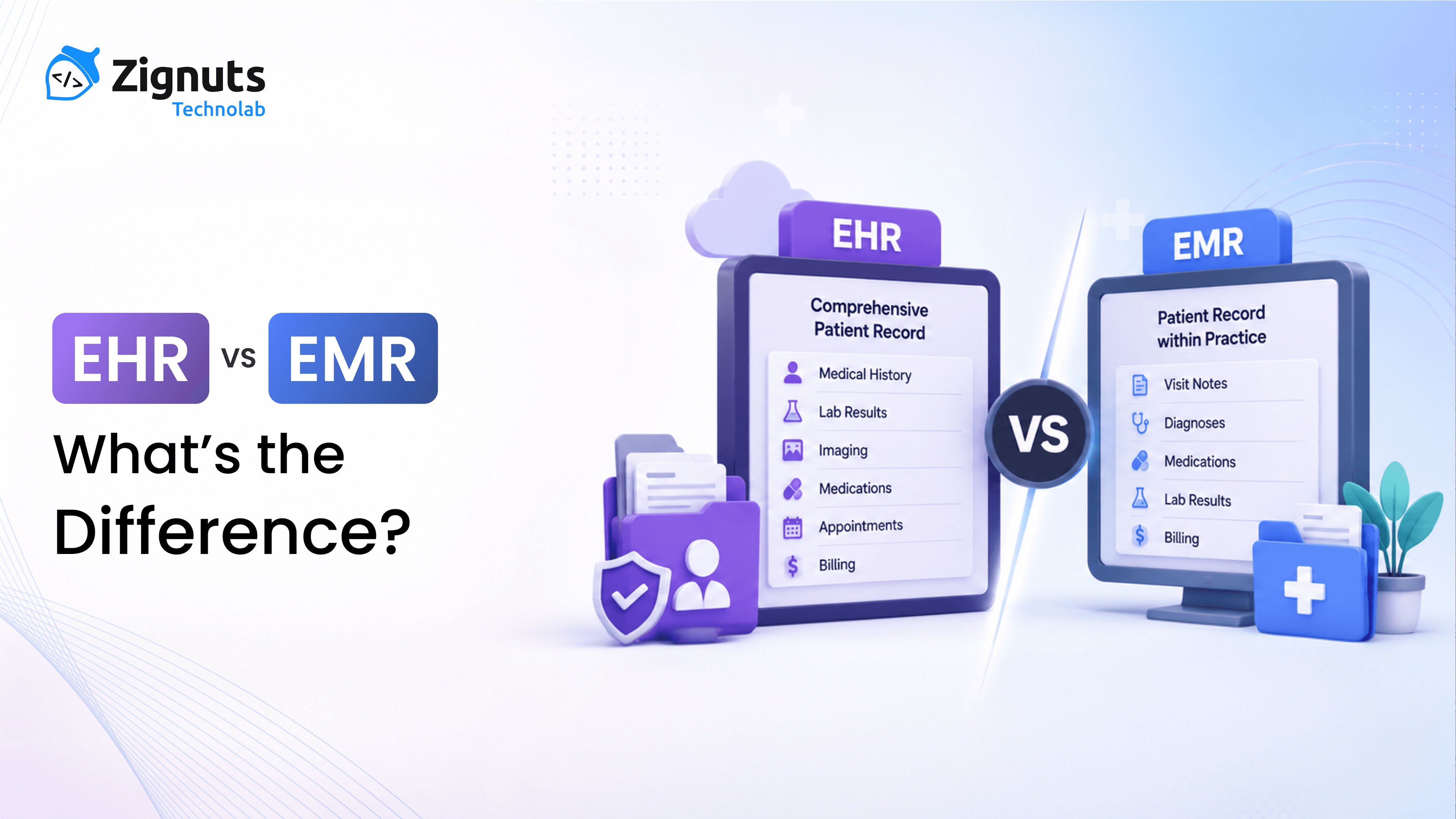
An electronic medical record (EMR) is typically focused on the clinical record created and used within a single practice or care organization. An electronic health record (EHR) is designed to support a broader, longitudinal view of a person’s health and to make relevant information available to authorized professionals across care settings. EHR Software Development focuses on building systems that support these broader records and information exchange. The labels are not perfectly consistent across vendors and jurisdictions, so buyers should evaluate real capabilities, not just product names.
EHR vs EMR: The Main Difference Explained
EMR = primarily practice-centred digital charting.
EHR = broader, longitudinal health information with stronger emphasis on authorized exchange across providers. An EHR may include EMR-like functionality; the terms can overlap in everyday usage.
EHR vs EMR: Side-by-Side Comparison
Decision Dimension | EMR | EHR |
|---|---|---|
Primary scope | Often one practice, clinic, or facility | Across providers and care settings, where integrations are implemented |
Core purpose | Document visits and manage clinical workflows | Support continuity, coordination, and a broader patient history |
Data exchange | May be limited or depend on add-ons | Interoperability is a central design objective |
Typical capabilities | Notes, diagnoses, prescriptions, visit history | EMR capabilities plus broader records, exchange, patient access, and coordination |
Best-fit starting point | A smaller practice with mostly local workflows | A network, multi-site provider, or care model requiring cross-organization data |
Key caveat | An EMR can still exchange data if configured to do so | An EHR label alone does not guarantee useful interoperability |
Ready to Build the Right Healthcare Software?

What Do EHR and EMR Mean in Healthcare?
What Is an Electronic Medical Record (EMR)?
An EMR is a digital version of the paper chart used by clinicians in an office, clinic, or hospital. It commonly stores encounter notes, diagnoses, medication lists, allergies, vital signs, orders, and results. It helps a care team document treatment, review a patient’s history within its system, and manage routine clinical workflows.
What Is an Electronic Health Record (EHR)?
An EHR is intended to provide a more comprehensive, longitudinal view of a patient’s health. It can bring together information from multiple clinicians and organizations such as hospitals, laboratories, pharmacies, specialists, and primary-care providers when secure exchange and data governance are in place.
The US Office of the National Coordinator for Health Information Technology (ONC) describes EHRs as real-time, patient-centred records available to authorized users and distinguishes their broader cross-provider scope from the more practice-centred EMR. In real procurement, however, vendors may use these terms differently; verify workflows and interoperability in demonstrations.
EHR vs EMR: Key Differences Compared
Aspect | EMR | EHR |
|---|---|---|
Information horizon | Often visit- and practice-centred | Longitudinal history across encounters and providers |
Users | Clinicians and staff in a practice or facility | Authorized care teams across participating organizations |
Interoperability | Could be minimal, proprietary, or integration-dependent | Usually a core requirement; actual exchange depends on standards and implementation |
Care coordination | Strong within one workflow; handoffs may require extra work | Designed to support coordination between care settings |
Analytics | Practice-level operations and clinical reporting | Can support broader population, quality, and cross-setting reporting if data is normalized |
Patient access | May offer portal features | Often supports a wider view through portals or connected services |
Implementation complexity | Can be simpler for a narrow scope | May be more complex due to identity matching, consent, interfaces, governance, and migration |
Evaluation focus | Usability, clinical fit, local reporting, cost | All EMR criteria plus exchange quality, data governance, and multi-organization workflows |
Why an EHR Is Not Always the Better Choice
EHR does not automatically mean “better” for every clinic. A well-fitted EMR may be the right choice for a single-site practice. An EHR that cannot exchange clean, timely, meaningful data may fail to deliver its main promise.
Why the EHR vs EMR Difference Matters for Healthcare Organizations
The choice affects more than software terminology. It changes how information moves, how teams coordinate care, what integrations must be maintained, and how the organization governs access to sensitive health data.
Continuity of care: A specialist needs relevant history, medications, allergies, and test results, not merely a PDF from the last visit.
Clinical safety: Better information availability can help clinicians make decisions, but the quality and currency of the source data still matter.
Operational efficiency: Electronic workflows can reduce repeated data entry and make records easier to retrieve; poorly designed systems can instead create alert fatigue and duplicate work.
Reporting and quality: A more complete data set can support care-gap identification, quality measurement, and population-health work, provided definitions and data quality are consistent.
Patient experience: Portals and connected records can reduce the burden of repeating histories and help people participate in their care.
Ready to Build the Right Healthcare Software?
EHR Architecture: What Enables Healthcare Data Exchange Across Organizations
Interoperability involves more than connecting systems. It requires technical interfaces, consistent data formats, accurate patient identification, appropriate access permissions, coordinated processes, and clear governance. Together, these elements help healthcare organizations exchange information securely and make it useful across different care settings.
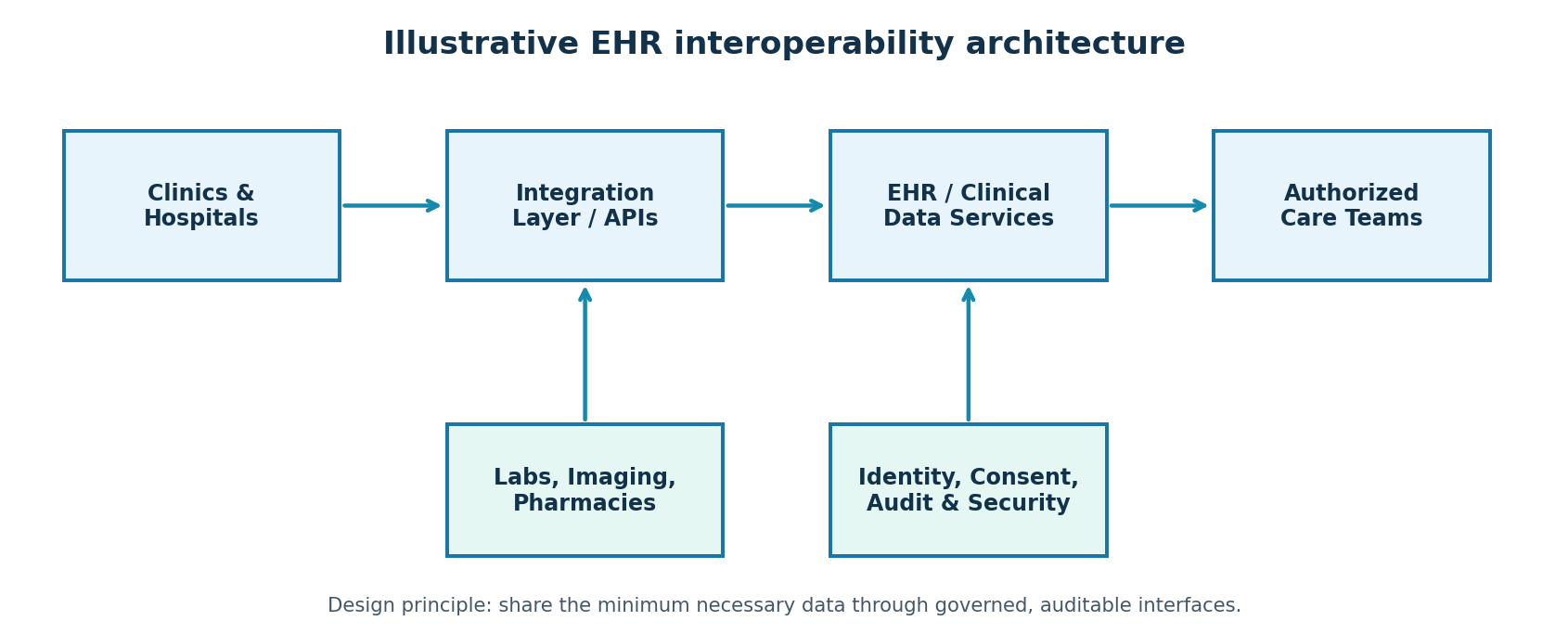
Core Components of an Interoperable EHR Architecture:
Clinical applications: Clinician UI, scheduling, orders, results, documentation, and patient-facing services.
Integration layer: APIs, interface engines, terminology mapping, event handling, and validation.
Data services: Patient identity resolution, clinical repositories, document storage, and reporting models.
Security and governance: Authentication, role- or attribute-based access, consent and disclosure rules, audit trails, retention, and incident response.
Operations: Monitoring, backup and recovery, interface error queues, release controls, and support procedures.
EHR vs EMR Interoperability: Standards and Integration Options
A buyer should ask which data formats and exchange patterns the product supports, what is available out of the box, and what requires paid implementation work. In many environments, HL7 v2 remains relevant for messages such as admissions, orders, and results; FHIR APIs can support resource-based exchange; and DICOM is common for medical imaging. The right mix depends on the ecosystem and local requirements.
Integration Concern | Questions to Ask Vendors |
|---|---|
Standards | Which versions and implementation guides are supported? Are interfaces certified or independently tested? |
Semantic consistency | How are codes, units, allergies, medications, and local terminology mapped? |
Identity matching | How are duplicate patients and uncertain matches detected and resolved? |
Failure handling | Are failed messages visible, retryable, and traceable? Who owns the queue? |
Access and consent | Can permissions vary by role, purpose, organization, and patient consent? |
Change management | How are API changes, interface downtime, and partner onboarding managed? |
EHR vs EMR Interoperability: Standards and Integration Options
Both EMR and EHR platforms handle highly sensitive information. The product label does not determine whether a deployment is secure or compliant. Requirements vary by jurisdiction, organization type, contracts, and data flows; legal and compliance teams should validate applicable obligations.
Identity and least privilege: Use strong authentication, role-based permissions, timely joiner/mover/leaver processes, and privileged-access controls.
Auditability: Record access, changes, exports, administrative actions, and integration activity; ensure logs are protected and reviewed.
Data protection: Encrypt data in transit and at rest, manage keys securely, and apply backup, recovery, and retention controls.
Privacy by design: Minimize collection and disclosure, govern secondary use, and make consent or legal basis explicit where required.
Resilience: Test restoration, incident response, downtime procedures, and recovery objectives, not just backup creation.
Vendor assurance: Review security documentation, subcontractors, data residency, breach notification, penetration-test summaries, and exit/export arrangements.
Healthcare Data Compliance: United States and India Requirements
HIPAA is a United States framework for covered entities and business associates; it is not a universal global standard. For India deployments, assess applicable Indian law and rules, contractual requirements, and relevant health-data standards with qualified counsel. Do not assume one country’s compliance label proves compliance elsewhere.
Ready to Build the Right Healthcare Software?
EHR and EMR Market Trends: The Growing Role of Digital Health Records
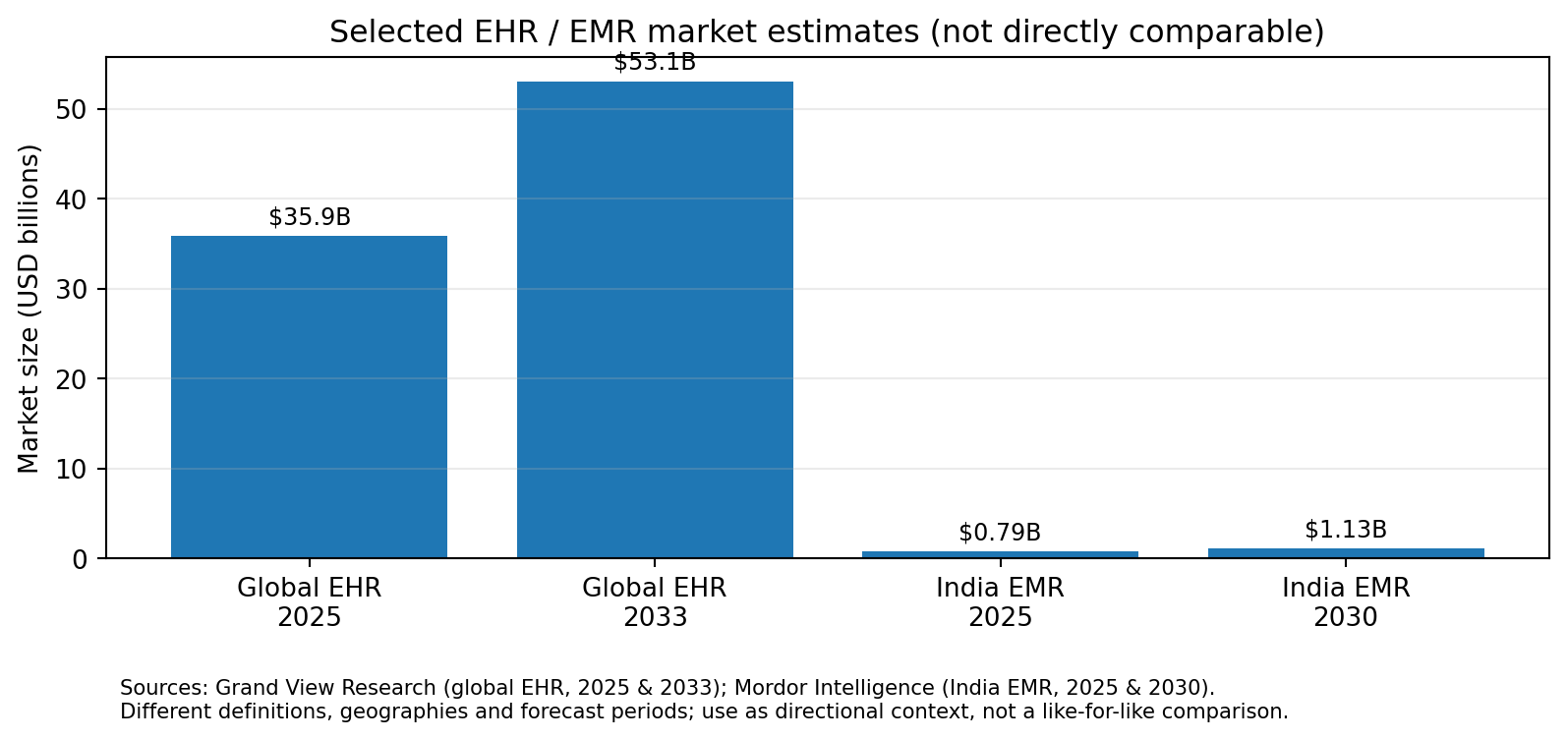
Market outlook: Market forecasts help frame vendor activity, but they are estimates rather than guarantees of adoption or return on investment.
Market definitions: Different research firms define the EHR/EMR market differently, so global EHR and India EMR figures should not be compared as if they represent the same market.
Global EHR market: Grand View Research estimates the market at USD 35.9 billion in 2025, with a forecast of USD 53.1 billion by 2033.
Global market growth: The forecast represents a 5.1% CAGR for 2026–2033.
India EMR market: Mordor Intelligence estimates the market at USD 0.79 billion in 2025, with a forecast of USD 1.13 billion by 2030.
India market growth: The forecast represents a 7.56% CAGR.
Investment consideration: These are third-party commercial estimates with differing definitions and forecast windows. Validate their methodology before using them in investment cases.
How to Choose Between an EHR and EMR System
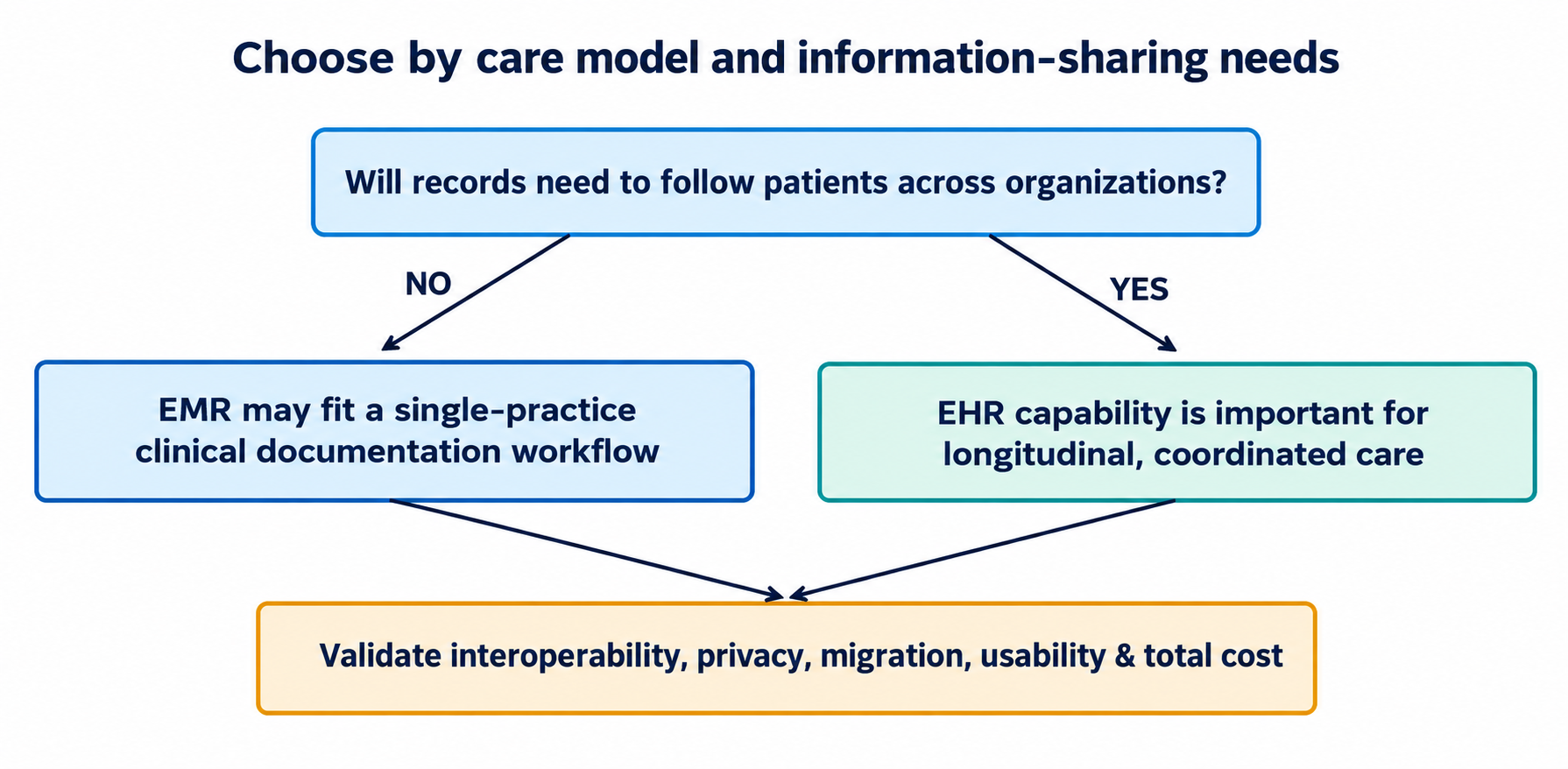
Use the framework as a starting point, then score shortlisted products against actual workflows. A multi-location organization may need a unified EHR, or it may need an integration strategy that connects several existing systems. A single clinic may prefer an EMR with reliable export and referral workflows over a costly enterprise platform.
EHR and EMR Implementation Roadmap for Healthcare Organizations
Phase | Key Activities | Evidence of Readiness |
|---|---|---|
1. Discovery | Map clinical workflows, roles, pain points, regulatory scope, and desired outcomes | Approved requirements and current-state data map |
2. Vendor and architecture evaluation | Run scripted demos; validate standards, APIs, hosting, security, and support | Scored shortlist and documented gaps |
3. Data and integration design | Profile legacy data; map codes; plan patient matching, interfaces, and cutover | Migration plan, interface catalogue, reconciliation rules |
4. Configuration and build | Configure templates, permissions, integrations, reports, and workflows | Configuration baseline and tested interfaces |
5. Validation and training | Run clinical scenarios, security tests, usability checks, and role-based training | Signed UAT, issue disposition, trained users |
6. Go-live and stabilization | Use staged rollout where feasible; monitor errors, adoption, and safety issues | Daily operational dashboard and escalation plan |
7. Continuous improvement | Review outcomes, user feedback, interface quality, and vendor releases | Governed improvement backlog and periodic risk review |
Ready to Build the Right Healthcare Software?
EHR vs EMR Cost: Understanding Total Cost of Ownership
There is no reliable universal price for an EMR or EHR. Licensing is only one component. Cost depends on deployment model, number of clinicians and sites, data migration, integrations, security controls, custom workflows, reporting, training, downtime planning, and ongoing support.
Cost Driver | What Can Increase Cost |
|---|---|
Scope and scale | More facilities, specialties, users, environments, and complex permissions |
Data migration | Poor data quality, duplicate records, historical documents, terminology mapping, reconciliation |
Integration | Legacy interfaces, external labs, imaging, pharmacy, billing, payer, and national/regional networks |
Security and assurance | Identity management, monitoring, audit retention, independent testing, resilience requirements |
Change management | Workflow redesign, super-users, training coverage, temporary productivity dip |
Operations | Hosting, support SLAs, upgrades, interface maintenance, disaster recovery, exit costs |
Common EHR and EMR Selection and Implementation Mistakes
Choosing by label alone instead of testing interoperability with the actual partners and systems.
Underestimating data cleanup, duplicate-patient resolution, and clinical terminology mapping.
Treating a successful interface connection as proof that the data is semantically correct.
Designing permissions around job titles only, without considering context, purpose, and sensitive records.
Skipping clinician involvement, workflow observation, and realistic user acceptance testing.
Failing to define ownership for interface errors, vendor escalations, downtime, and data corrections.
Assuming implementation is finished at go-live rather than planning optimization and ongoing governance.
Ready to Build the Right Healthcare Software?
Questions to Ask an EHR or EMR Implementation Partner
Can you map our clinical workflows and convert them into testable requirements?
How will you assess data quality and plan migration reconciliation?
Which standards, APIs, and interface patterns fit our existing ecosystem and why?
How will identity, authorization, consent, and auditability be designed and tested?
What operational dashboards, alerting, backups, and recovery tests will be delivered?
How will clinical users participate in design, testing, training, and go-live decisions?
What documentation, source-code or configuration access, export capability, and exit plan will we retain?
EHR vs EMR: Key Takeaways for Healthcare Organizations
EMR is usually practice-centred; EHR aims to support a broader, longitudinal record across authorized care settings.
Interoperability is a delivered capability, not a label. Validate real interfaces, semantics, identity matching, and operational support.
Security, privacy, migration, usability, resilience, and governance matter for both.
Use third-party market forecasts carefully: definitions and geographies differ, and estimates are not ROI evidence.
Select based on the care model, integration ecosystem, clinical workflows, and total cost of ownership.
Conclusion: Choosing the Right EHR or EMR System
Choosing between an EHR and EMR depends on your organization's clinical workflows, care model, and data-sharing needs. Both systems can support better record management, but interoperability, security, usability, and implementation costs should guide your decision.
A well-planned solution can improve information access and care coordination. If you're planning to implement or modernize a healthcare system, contact us today to discuss your requirements.

Hard Trivedi
Business Enthusiast | Exploring ideas, understanding business challenges, and turning insights into practical solutions that create meaningful value and growth.