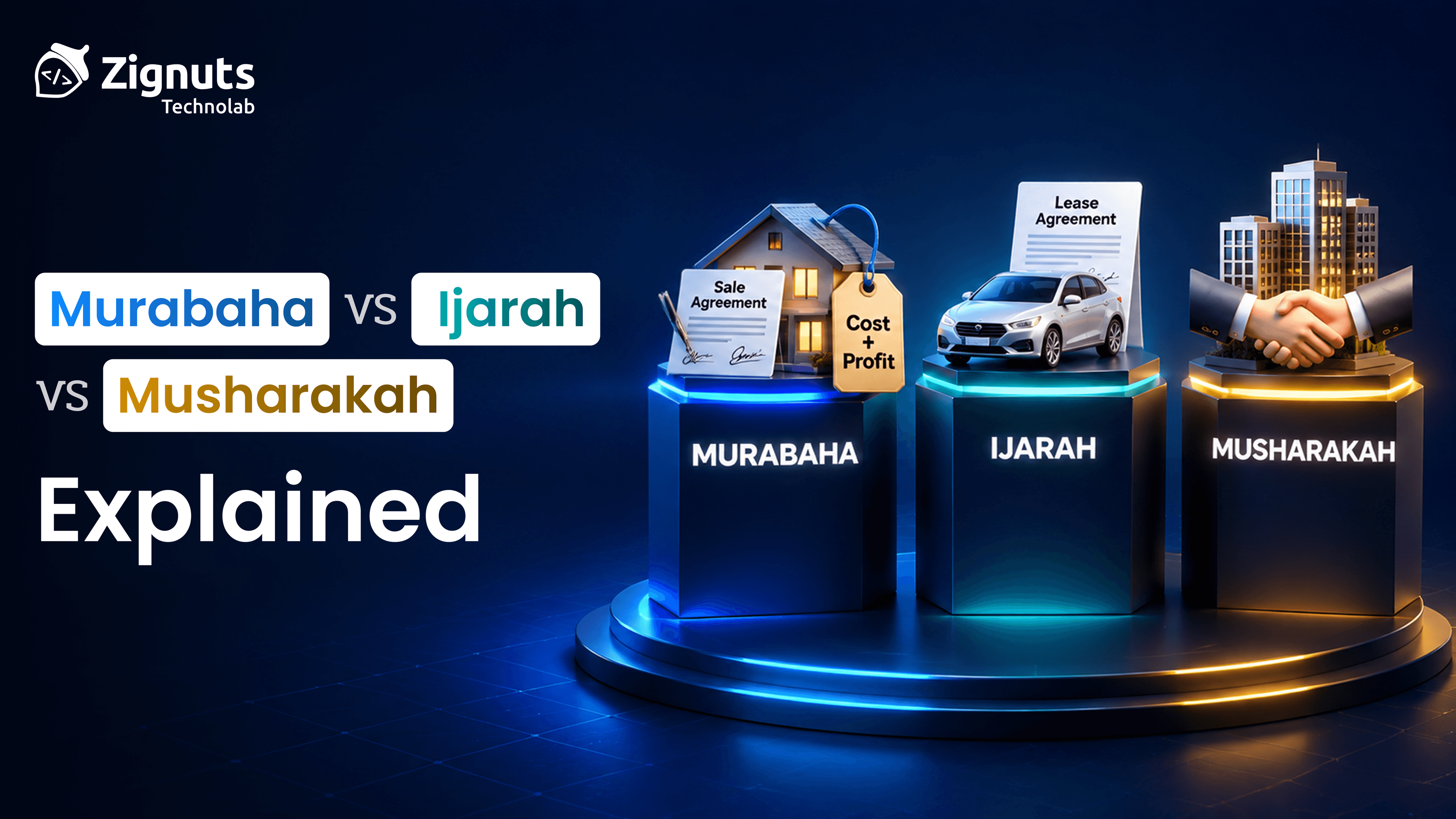
Three Islamic Banking Contracts: Sale, Lease, and Partnership
When a board asks, "What Islamic products should we launch?", the answer almost always starts with three words: Murabaha, Ijarah, and Musharakah.
On a product sheet, they can look interchangeable. Each one gives a customer money to buy an asset, and each one ends with the bank being paid. Underneath, they are three different legal relationships: a sale, a lease, and a partnership.
They differ on who owns the asset, when, who carries which risk, and where the bank's return comes from.
Those differences are not academic. They decide how your Shariah Supervisory Board reviews a product, how your finance team books it, how your operations team services it, and what your software has to model.
A bank that treats all three as "a loan with a different label" will discover the difference during its first audit.
This guide explains each contract in plain language, compares them side by side, and ends with what they mean for the decisions you make as a leader: which to launch first, and what your platform must support.
Murabaha in Islamic Banking: How Cost-Plus Financing Works
A Murabaha is a cost-plus sale. The customer identifies an asset, the bank buys it from the supplier, and then sells it to the customer at its cost plus a markup that both sides know and agree on. The price is fixed at the sale, and the customer can pay in installments.
The point that matters most is sequence. The bank has to own the asset, and carry the risk that goes with it, before it sells. If that order is skipped, the structure no longer works as a sale.
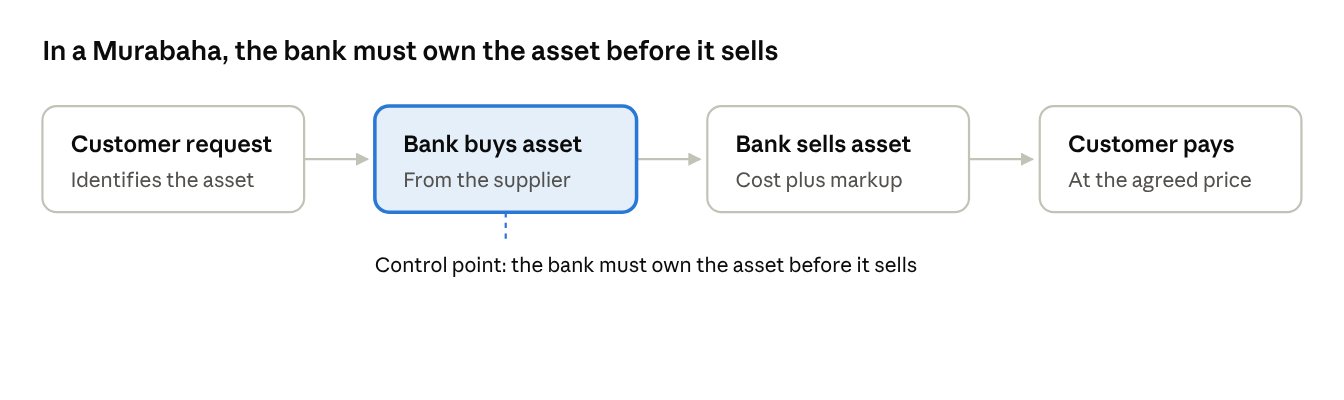
Murabaha Financing Process: Four Steps and Key Controls
Because the price is fixed once agreed, late-payment amounts are typically routed to charity rather than booked as income, where the board requires it. Murabaha is the simplest of the three contracts to operate, which is why many institutions launch with it. Typical uses are vehicles, goods, and working capital.
Ijarah in Islamic Banking: How Lease-Based Financing Works
Ijarah, also spelled Ijara, is a lease. The bank owns the asset and gives the customer the right to use it for a fixed term in return for rent. Ownership, and the risks that come with owning, stay with the bank for the length of the lease.
What happens at the end depends on the contract. The customer can return the asset, renew the lease, or, in the variation called Ijarah Muntahia Bittamleek, take ownership of it at the end.
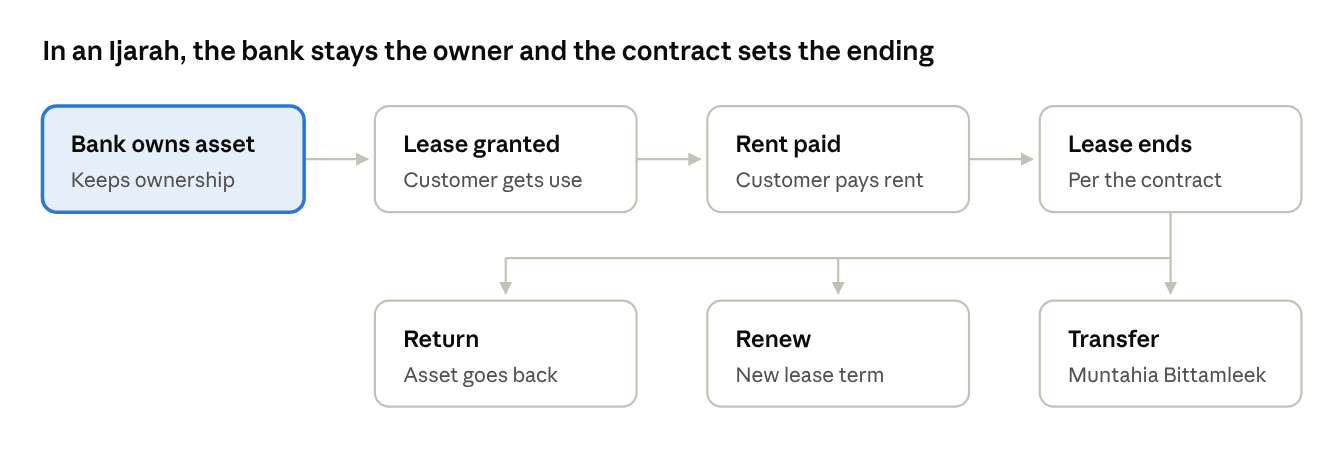
Ijarah Financing Process: Key Steps and Contract Endings
Ijarah suits equipment, property, and vehicles. For your platform, it means an asset register, a rental schedule, and a clear rule for each possible ending, none of which a plain loan system needs.
Musharakah in Islamic Banking: Partnership and Diminishing Ownership
Musharakah is a partnership. The partners contribute capital, share profit at an agreed ratio, and share losses in proportion to the capital they put in. The bank is not lending money. It is a co-owner.
The version most customers meet is Diminishing Musharakah, common in home and asset financing. The bank and the customer buy the asset together. The customer then buys out the bank's share in steps, so the customer's ownership grows and the bank's shrinks until the customer owns it outright. The customer typically also pays rent for using the bank's remaining share.
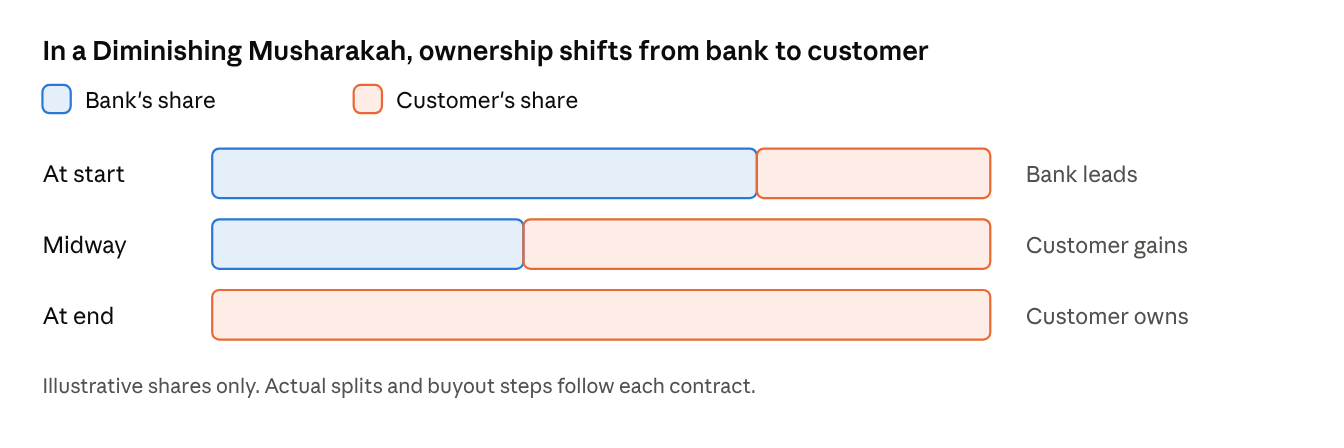
Diminishing Musharakah: How Shared Ownership Changes Over Time
This is the most demanding of the three for your platform. Every buyout changes who owns what, so capital accounts, profit ratios, and the buyout schedule all have to be modeled explicitly, and every step has to be explainable to an auditor.
Murabaha vs Ijarah vs Musharakah: A Side-by-Side Comparison
The three contracts answer the same customer need in different ways. This table is the one to keep open when your product, finance, and Shariah teams meet.
Aspect | Murabaha | Ijarah | Musharakah |
|---|---|---|---|
Legal nature | Cost-plus sale | Lease of an asset | Partnership with shared ownership |
Who owns the asset | Bank first, then the customer after the sale | Bank throughout the lease, unless the contract ends in transfer | Bank and customer together, in agreed shares |
Where the bank's return comes from | A disclosed markup on cost, fixed at the sale | Rental payments | A share of profit at an agreed ratio |
Main risk the bank carries | Holding the asset before the sale, and credit risk on deferred payment | Ownership risks of the leased asset | Business or asset performance, with losses in proportion to capital |
Pricing behavior | Price is fixed once agreed | Rental can be fixed or reviewed if the contract allows | Profit varies with performance |
Typical uses | Vehicles, goods, trade and working capital | Equipment, property, vehicles | Projects, ventures, and home financing through Diminishing Musharakah |
What your software must get right | Sequence: the bank owns the asset before it sells | The asset register, rental schedule, and end-of-lease outcome | Capital shares, profit ratios, and the buyout schedule |
Naming and permitted structures differ by jurisdiction and by Shariah board. Treat this table as a starting point, and confirm each product's exact structure with your own board.
How to Choose Between Murabaha, Ijarah, and Musharakah
Most institutions do not pick one. They launch in an order that fits their balance sheet, customers, and operational readiness. These questions help leadership teams decide.
What is the customer buying? A defined good or vehicle with a clear price suits Murabaha. An asset the customer wants to use, not necessarily own, suits Ijarah. A shared venture or a home suits Musharakah.
How much risk is the bank ready to hold? Murabaha concentrates risk in the short window before the sale. Ijarah keeps ownership risks with the bank for the full term. Musharakah ties the bank's return to the performance of what it co-owns.
How ready are operations? Murabaha is the simplest to service. Ijarah adds asset management and rental billing. Musharakah adds capital accounts, profit sharing, and buyouts.
How does your Shariah board see it? Boards differ on structures, particularly for hybrid products. Bring them real product scenarios early rather than final designs.
How much can your platform model today? A product your system cannot represent properly is a compliance risk, however attractive it looks on a roadmap.
A common path is to launch Murabaha first for speed, add Ijarah as asset-based financing grows, and introduce Diminishing Musharakah once the platform and teams are ready for partnership accounting. Your own order may differ.
Banking Software Requirements for Murabaha, Ijarah, and Musharakah
A generic system that assumes interest-bearing loans can display all three contracts. It usually cannot enforce them. The difference shows up in a few places.
Murabaha needs sequence control. The system should stop a sale to the customer from posting before the bank's purchase and ownership are recorded.
Ijarah needs an asset register. The bank owns the asset during the lease, so the platform must track the asset, the rental schedule, and what happens at the end: return, renewal, or transfer.
Musharakah needs capital accounts. Shares, profit ratios, and buyout schedules have to be explicit, and in Diminishing Musharakah they change over time.
All three need a trail. Early settlement, restructuring, default, and late-payment handling should follow approved rules, with charity routing where the board requires it, and every exception should be explainable to an auditor.
If you are weighing a platform, our guides on build vs buy for Islamic banking software and on the Islamic banking compliance checklist show how to test these capabilities before you commit.
Key Lessons from Building Software for Islamic Finance Contracts
At Zignuts, we build software for financial institutions and fintechs, and the contract model is where most Islamic finance projects are won or lost.
Model the contract, not the label. When the platform knows a Murabaha is a sale and a Diminishing Musharakah is a changing ownership stake, accounting, statements, and audits get simpler downstream.
Start with one product, finished properly. Delivering a single contract end to end, reviewed by the Shariah board, teaches the team more than building every product halfway.
Put scenarios in front of the Shariah board early. Early settlement, default, and restructuring raise the hardest questions. They are cheaper to answer in design than in testing.
Keep rules configurable. Boards refine their positions over time. Versioned, approved rules adapt, while hard-coded logic needs a release every time.
Say so when a contract is not the right fit. Sometimes the honest advice is to launch a simpler product first. We would rather help you choose well than build the most.
Conclusion: Choosing the Right Islamic Finance Contract
Murabaha, Ijarah, and Musharakah are three different answers to the same customer need, and the difference lies in ownership, risk, and where the bank's return comes from. Murabaha is a sale with a disclosed markup, and the key control is sequence. Ijarah is a lease, and the key control is asset ownership through the term. Musharakah is a partnership, and the key control is shared capital and profit accounting.
Choose the order that fits your customers, risk appetite, and operational readiness, and make sure your platform models each contract as it truly works. Contact us today if you would like a second opinion on your product roadmap or platform. Our team at Zignuts is happy to talk it through.

Parth Trivedi
Co-founder and CTO of a global software agency, I lead innovative IT solutions across industries, focusing on scalable architectures and agile methodologies. Let’s connect to scale your digital initiatives!