Custom EHR System Development: Overview and Key Considerations
A custom electronic health record (EHR) system is justified when a healthcare organization has distinctive clinical workflows, integration needs, data governance requirements, or product goals that packaged products cannot meet economically. EHR Software Development may be a suitable approach when existing solutions cannot support these requirements effectively. It is not automatically the right choice: buying, configuring, extending an existing platform, or building a narrow clinical product may reduce risk.
The safest path is to treat the EHR as a clinical information system, not simply as a CRUD application. Clinical terminology, patient identity, auditability, downtime operations, data exchange, and usability in real care settings must shape the architecture from discovery onward.
Decision Area | Practical Recommendation |
|---|---|
Scope | Start with one care setting and a prioritized clinical workflow; avoid an all-at-once hospital suite. |
Architecture | Use a modular domain design, explicit API contracts, and independently testable integration adapters. |
Interoperability | Evaluate HL7 FHIR, HL7 v2, DICOM, terminology services, and payer interfaces according to actual counterparties. |
Security | Perform a documented risk analysis; design least privilege, strong authentication, encryption, audit trails, backup, and incident response. |
Rollout | Pilot with clinicians, validate migration and downtime procedures, then expand in controlled waves. |
Economics | Model total cost of ownership, including integrations, clinical validation, security operations, support, and regulatory work. |
Custom EHR System Standards: Clinical Safety and Interoperability
EHR design should be anchored in clinical safety and interoperability guidance, not decorative market claims. These verified reference points are useful for planning:
Verified Reference Point | Why It Matters |
|---|---|
2025 SAFER Guides: 8 guides across 3 broad groups; updated 27 February 2026. | Use this framework to review EHR safety across foundational responsibilities, infrastructure, and clinical processes. |
The SAFER High Priority Practices guide contains 16 recommendations. | Prioritize high-risk practices rather than treating every EHR control as equally urgent. |
India's EHR standards guidance covers architecture, terminology, data exchange, and imaging standards. | For India deployments, evaluate national guidance and partner requirements rather than assuming a US-only standards profile. |
Ready to Build a Custom EHR System?

Custom EHR System: EHR Adoption, Patient Safety, and Artificial Intelligence Trends
The adoption of electronic health records has grown significantly across U.S. healthcare settings. Alongside this growth, healthcare organizations are paying closer attention to EHR safety practices, interoperability, and the use of artificial intelligence in clinical workflows. The following data points provide context for these developments and help explain the considerations involved in planning a custom EHR system.
Chart 1. EHR Adoption Among U.S. Office-Based Physicians
EHR adoption among U.S. office-based physicians has increased substantially over the years. In 2008, approximately 40% reported using an EHR. By 2024, that figure had reached 95%. In the same year, 91% reported using a certified EHR.
These figures highlight how widely EHR systems are now used in U.S. physician practices. For organizations planning a custom EHR, they also underline the importance of supporting reliable clinical documentation, secure access to patient information, and compatibility with established healthcare workflows.
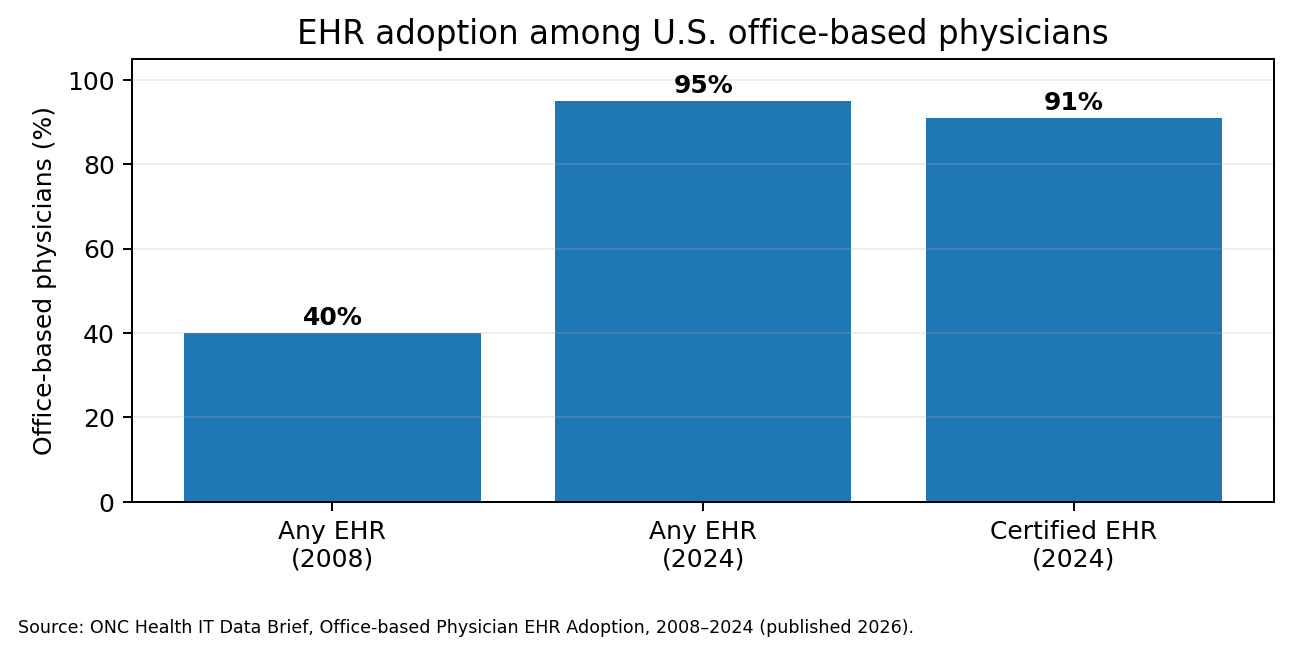
Chart 2. Hospital EHR Adoption and Continuity
Certified EHR adoption among non-federal acute care hospitals reached 99% by 2018. Another important development is the growing use of the same EHR developer across inpatient and outpatient settings. This increased from 62% in 2010 to 90% in 2024.
This trend highlights the importance of continuity when patient information moves between different care settings. Custom EHR planning should account for data exchange, consistent patient records, and integration with existing clinical systems.
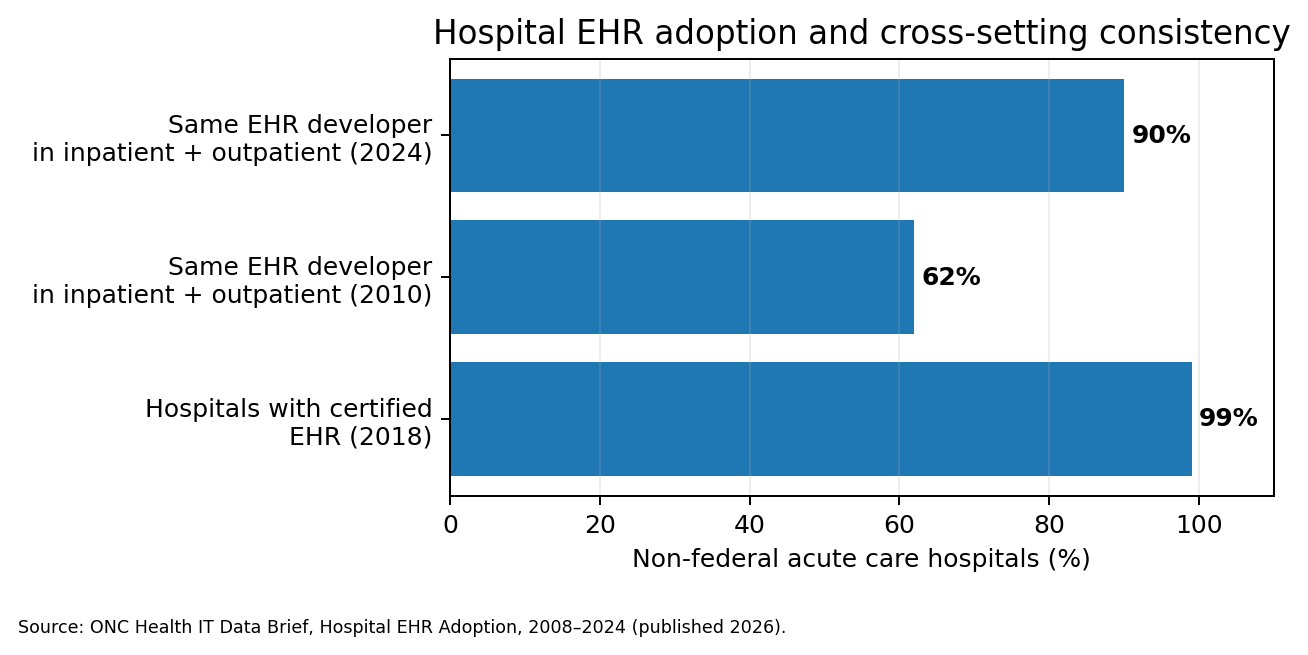
Chart 3. Predictive AI Integrated With EHRs
The share of U.S. hospitals reporting predictive AI integrated into their EHRs increased from 66% in 2023 to 71% in 2024. This indicates growing adoption of predictive AI within hospital EHR environments.
However, adoption alone does not demonstrate improved clinical outcomes. Healthcare organizations should evaluate each AI use case for clinical relevance, data quality, reliability, workflow fit, and appropriate human oversight.
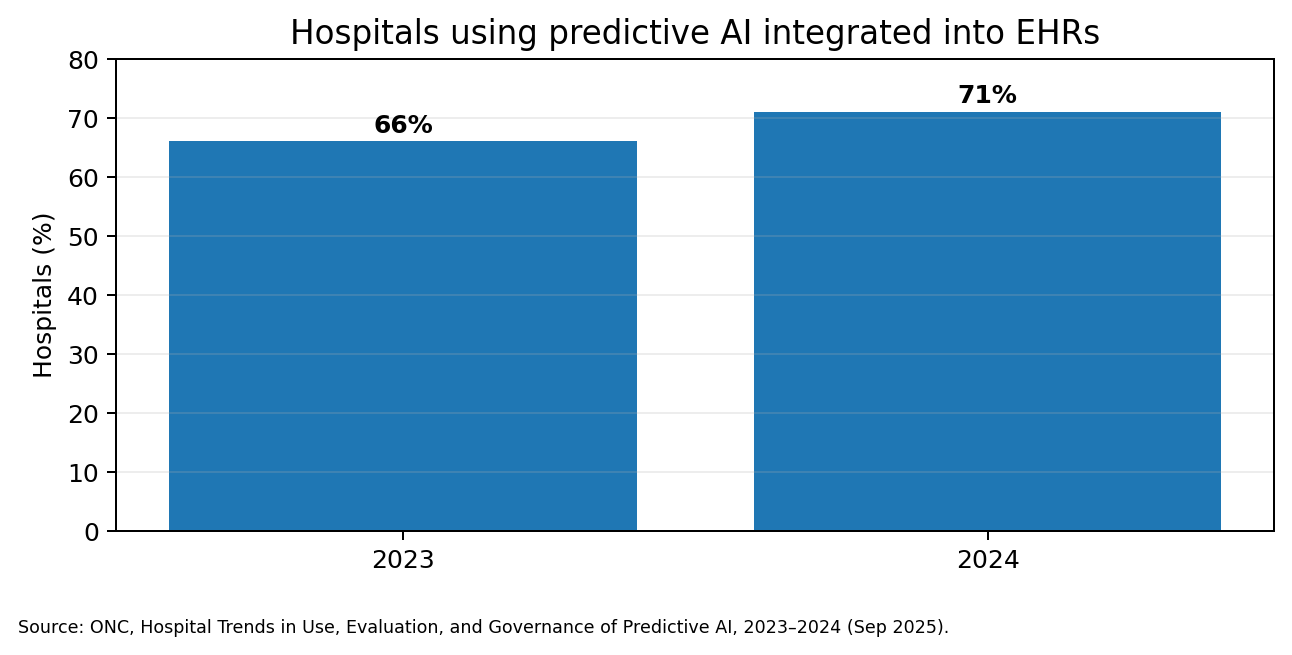
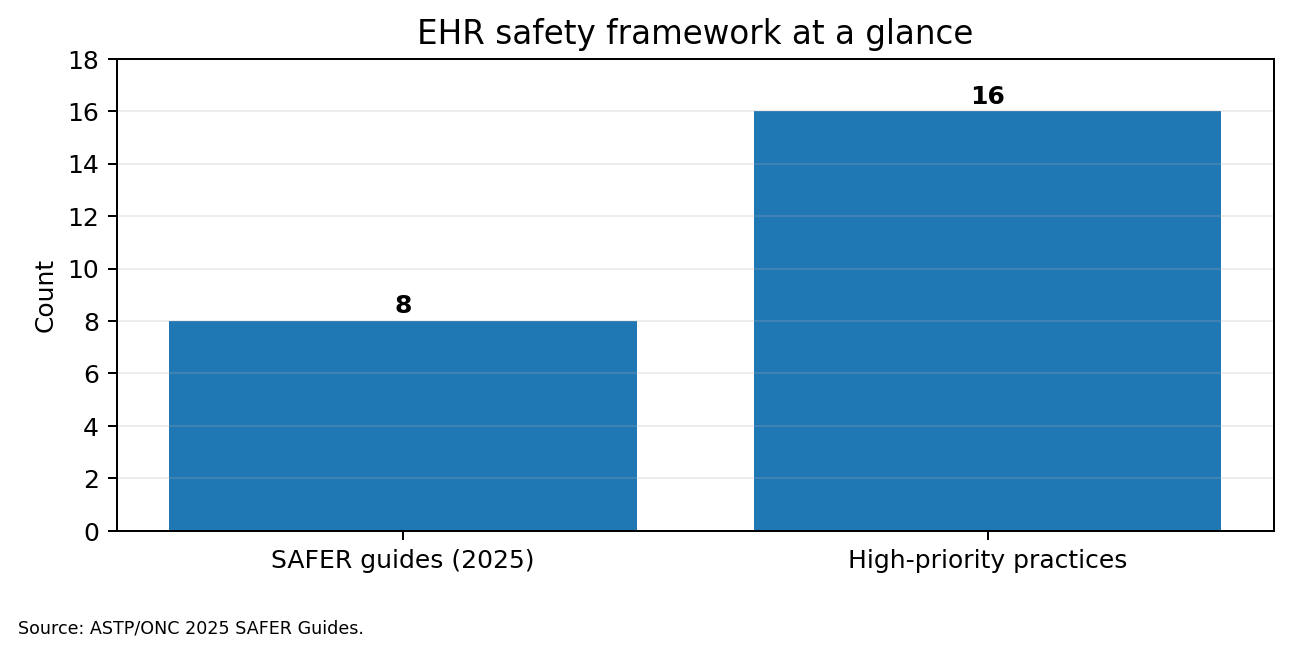
Chart 4. EHR Safety Guidance
The 2025 SAFER framework includes eight guides, with a High Priority Practices guide containing 16 recommendations. Healthcare organizations can use these resources to assess EHR safety practices and identify areas that need attention.
The framework can support reviews of system safety, infrastructure, and clinical workflows. It should be used as a self-assessment aid rather than a replacement for organization-specific risk analysis, regulatory review, or clinical validation.
Ready to Build a Custom EHR System?
What Is a Custom EHR System and How Does It Work?
An EHR is a digital system for capturing, organizing, using, and exchanging patient health information across clinical and operational workflows. A custom EHR is designed around a defined organization or product's workflows rather than forcing every workflow into a standard vendor configuration.
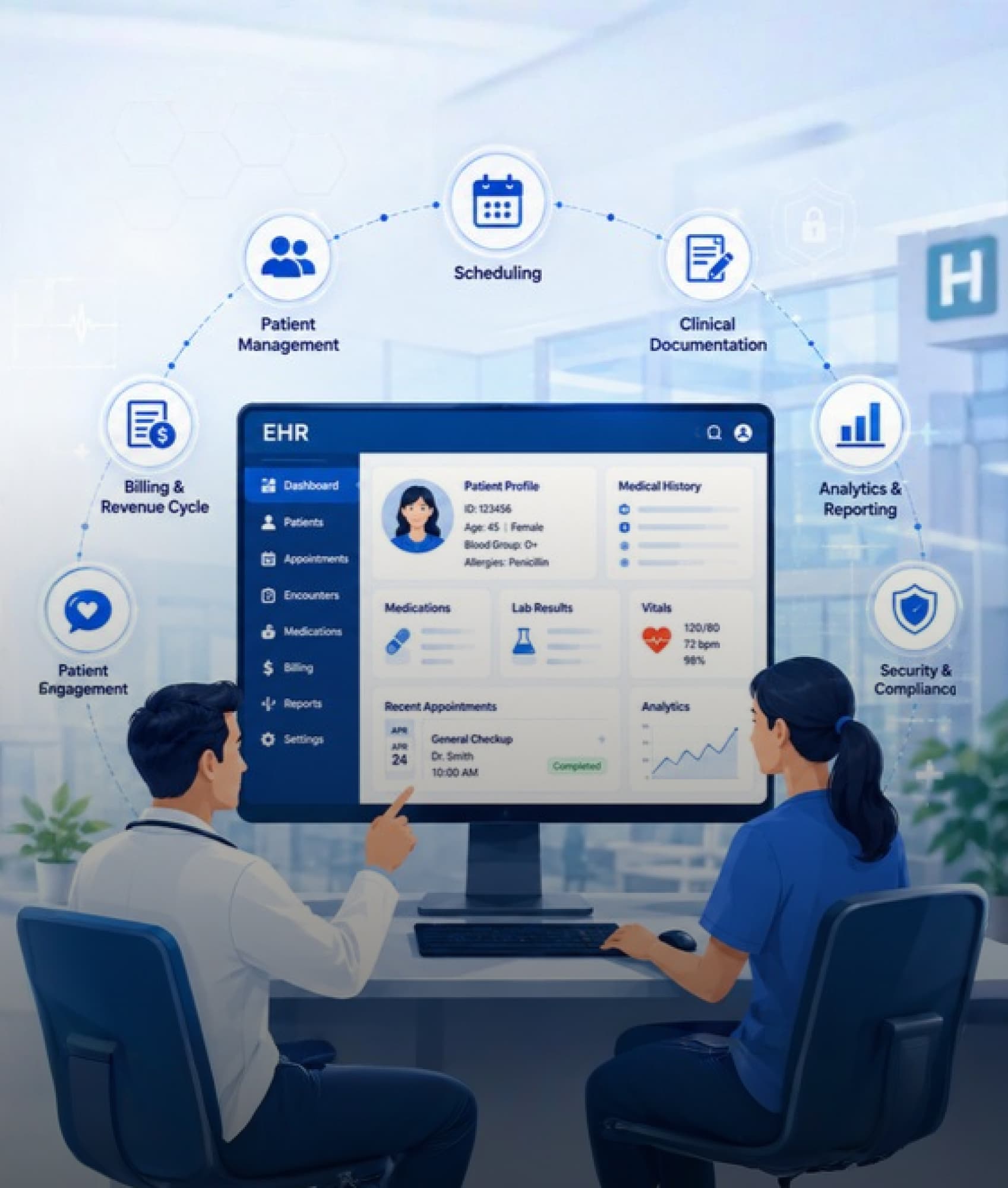
An EHR may include charting, orders, results, medication workflows, scheduling, patient access, billing interfaces, and analytics. It may also connect to separate systems for laboratory information, imaging, pharmacy, revenue cycle, identity, and health information exchange.
When Should Healthcare Organizations Choose a Custom EHR System?
Trigger | What Custom Engineering Can Address | Trade-Off to Acknowledge |
|---|---|---|
Distinctive specialty workflows | Purpose-built screens, templates, and rules. | Clinical validation and maintenance become your responsibility. |
Complex integration landscape | Adapters and normalized interfaces across systems. | External vendors may impose fees, certification, or change windows. |
Product differentiation | A workflow or patient experience that is central to the product. | Requires a durable roadmap and investment beyond launch. |
Data governance needs | More control over data flows, retention, access, and reporting. | Control does not remove legal or contractual obligations. |
Legacy constraints | A staged replacement or modern interface around legacy systems. | Migration and coexistence add temporary complexity. |
Custom EHR System: Build, Buy, or Extend an Existing Platform?
Custom development should win only when its strategic and operational value outweighs the full lifecycle cost. Compare packaged EHR procurement, configuration, extending an open-source or existing platform, and building from scratch against the same workflow, integration, security, and ownership criteria.
Option | Best Fit | Advantages | Main Risks |
|---|---|---|---|
Buy a commercial EHR | Common workflows and fast deployment matter most. | Established workflows, vendor support, existing integrations. | Licensing, limited differentiation, vendor roadmap dependency. |
Configure / extend | Most needs fit an existing platform with a manageable gap. | Faster than a full build; preserves proven components. | Extension limits, upgrade friction, platform constraints. |
Open-source foundation | Team can operate and govern the chosen platform. | Source visibility and customization flexibility. | Security maintenance, ecosystem maturity, support ownership. |
Custom build | Unique workflows or product IP justify ownership. | Control over UX, data model, and roadmap. | Highest responsibility for clinical safety, validation, uptime, and ongoing cost. |
How to Evaluate Your Custom EHR Development Approach
Can the key workflow be met through configuration?
Can a vendor demonstrate the workflow with real clinical scenarios, not just slides?
Are the required interfaces supported by documented, testable contracts?
Who owns safety validation, security operations, upgrades, and 24/7 incidents?
Does the business case include 3–5 years of operating and integration costs?
Ready to Build a Custom EHR System?
Custom EHR System Requirements and Essential Modules
Translate clinician and patient needs into testable workflows before defining the feature list. Observe actual work across registration, encounter preparation, documentation, orders, results review, sign-off, follow-up, and correction of mistakes.
Capability | Typical Functions | Design Considerations |
|---|---|---|
Patient identity and registration | Demographics, identifiers, duplicate detection, merge workflow. | Reliable matching, provenance, and safe correction paths. |
Clinical chart | Problems, history, allergies, vitals, notes, diagnoses. | Structured data plus narrative; versioning and authorship. |
Orders and results | Lab and imaging orders, result ingestion, review and acknowledgment. | Order lifecycle, abnormal-result escalation, reconciliation. |
Medication workflows | Medication list, prescriptions, allergy checks, renewals. | Drug terminology, pharmacy interfaces, clinical decision support. |
Appointments and care plans | Scheduling, referrals, follow-up tasks, care coordination. | Role-aware workflows and exception handling. |
Patient portal | Access, summaries, secure messaging, forms, appointments. | Identity proofing, consent, accessibility, caregiver access. |
Billing and operations | Eligibility, coding, claims interfaces, statements, reporting. | Separate clinical and financial permissions; reconciliation. |
Administration and audit | Users, roles, locations, configuration, audit review. | Least privilege, immutable event history, delegated administration. |
Non-Functional Requirements for a Reliable Custom EHR System
Specify measurable targets for availability, response time, recovery point objective (RPO), recovery time objective (RTO), supported devices, accessibility, audit retention, backup restoration, and integration throughput. Targets should be agreed with clinical operations and risk owners rather than copied from generic benchmarks.
Custom EHR System Architecture: Key Components and Technology Layers
For an initial product or single organization, a modular monolith is often a sensible starting point. It keeps deployment and transaction boundaries manageable while preserving clear domain modules. Split services only when independent scaling, release cadence, fault isolation, or team ownership makes the added operational overhead worthwhile.
Layer | Responsibilities / Example Components |
|---|---|
Experience | Clinician web app, patient portal, mobile workflows, admin console. |
Identity and edge | SSO/OIDC, MFA, API gateway, rate limits, session controls. |
Application domains | Patient identity, encounter, clinical notes, orders/results, medication, scheduling, billing. |
Interoperability | FHIR APIs, HL7 v2 adapters, DICOM/PACS integration, terminology mapping, partner-specific connectors. |
Data services | Transactional database, document/object storage, search index, event queue, analytics store. |
Trust and operations | Audit events, consent/policy enforcement, secrets management, monitoring, backup/recovery, CI/CD. |
How Clinical Data Flows Through a Custom EHR System
Clinician opens patient chart |
Ready to Build a Custom EHR System?
Custom EHR System Interoperability and Healthcare Data Modeling
Interoperability is a product requirement, not a final integration sprint. Confirm the standards, versions, profiles, code systems, transport mechanisms, and partner-specific constraints for each exchange. HL7 FHIR defines a resource-based standard for exchanging healthcare information; HL7 v2 remains relevant in many operational interfaces, while imaging workflows may require DICOM.
FHIR is not a magic connector. Two systems can both support FHIR and still disagree on profiles, required fields, terminology, identifiers, authorization, or workflow semantics. Define conformance expectations, examples, error handling, retries, idempotency, versioning, and operational ownership for each partner.
Need | Potential Standard / Pattern | Implementation Check |
|---|---|---|
Modern application APIs | HL7 FHIR REST APIs | Confirm version, profiles, scopes, pagination, search, and supported resources. |
Existing hospital interfaces | HL7 v2 messages | Map message types, acknowledgments, retries, and duplicate handling. |
Imaging | DICOM / PACS interfaces | Clarify image storage, metadata, viewer integration, and access controls. |
Terminology | SNOMED CT, LOINC, RxNorm, or local approved sets as applicable | Check licensing, jurisdiction, mapping governance, and version updates. |
Claims / payer workflows | Jurisdiction-specific transaction standards and payer APIs | Validate payer requirements and clearinghouse contracts. |
Identity matching | Master patient index / deterministic and probabilistic matching | Establish duplicate review, merge audit, and unmerge procedures. |
Custom EHR System Security, Privacy, and Compliance Requirements
Compliance depends on jurisdiction, organizational role, data flows, intended use, and contracts. HIPAA applies to covered entities and business associates in the United States; other markets may impose separate privacy, health-record, hosting, residency, medical-device, or procurement requirements. Obtain qualified legal and compliance review rather than treating a checklist as certification.
Control Area | Baseline Design Questions |
|---|---|
Identity and access | MFA where appropriate; SSO; role- and attribute-based permissions; emergency access with review. |
Data protection | Encryption in transit and at rest; managed keys; secret rotation; minimal copies of sensitive data. |
Auditability | Record access and change events with actor, timestamp, patient/resource, action, and outcome; restrict audit alteration. |
Consent and purpose | Model patient preferences, permitted uses, proxy/caregiver access, and sensitive-data restrictions where applicable. |
Secure delivery | Threat modeling, dependency scanning, code review, secrets scanning, penetration testing, and remediation tracking. |
Resilience | Encrypted backups, isolated recovery paths, tested restoration, downtime procedures, and incident playbooks. |
Vendor governance | Business associate agreements where applicable, subprocessors, breach notification, retention, and exit/export terms. |
Security and Access Control in Custom EHR Systems
User authentication |
Ready to Build a Custom EHR System?
Custom EHR System Development Roadmap: From Discovery to Deployment
Phase | Key Work | Exit Evidence |
|---|---|---|
1. Discovery | Clinical observation, stakeholder interviews, workflow maps, jurisdiction and risk discovery. | Prioritized scope, clinical owner, risk register, integration inventory. |
2. Product and UX design | Personas, encounter journeys, prototypes, accessibility review, usability sessions. | Validated workflows and acceptance criteria. |
3. Architecture and data | Domain boundaries, data model, API contracts, identity strategy, threat model. | Architecture decision records, data dictionary, integration contracts. |
4. Build the vertical slice | Implement one end-to-end workflow, including audit and a real integration sandbox. | Demonstrable workflow with automated tests and operational telemetry. |
5. Integrate and validate | Partner testing, terminology mapping, migration rehearsals, security testing. | Reconciled test data, conformance evidence, resolved critical defects. |
6. Pilot and train | Controlled user cohort, training, downtime drill, support coverage. | Clinician sign-off, rollback criteria, go-live checklist. |
7. Scale and operate | Wave rollout, incident reviews, performance tuning, roadmap governance. | Service-level reporting, patch cadence, recovery tests, improvement backlog. |
Clinical Validation and Testing for Custom EHR Systems
Test realistic clinical scenarios, including duplicate patients, conflicting medication lists, missing results, abnormal-result escalation, amended notes, wrong-patient prevention, access revocation, network loss, partial interface failure, and downtime recovery. Use synthetic or properly governed test data. Clinicians must review whether the system supports safe and understandable work.
Custom EHR System Development Cost, Timeline, and Resources
There is no reliable universal price for a custom EHR. Public vendor guides publish broad estimates, but their scopes, geographies, team rates, integration assumptions, and certification requirements differ. Treat them as directional market commentary rather than a quote or guarantee. Build a bottom-up estimate after discovery.
Cost Driver | Why It Changes the Estimate |
|---|---|
Clinical scope | Number and complexity of specialties, workflows, decision support, and user roles. |
Interoperability | Number of systems, partner maturity, interface types, certification, and testing environments. |
Data migration | Legacy quality, deduplication, mapping, historical documents, reconciliation, and cutover. |
Security and regulatory | Risk analysis, privacy engineering, evidence, audits, legal review, and jurisdictional requirements. |
Availability and scale | Hosting model, disaster recovery, monitoring, support hours, and performance targets. |
Adoption and operations | Training, change management, help desk, release management, and long-term maintenance. |
A focused pilot can be planned in phases, but timelines should be expressed as a range only after scope, integrations, and regulatory obligations are known. A full multi-specialty or hospital-grade EHR can require substantially more work than a narrow scheduling-and-charting MVP.
Ready to Build a Custom EHR System?
Common Custom EHR System Development Risks and How to Avoid Them
Risk | Typical Consequence | Mitigation |
|---|---|---|
Over-scoping v1 | Long delivery cycle and unvalidated assumptions. | Pilot one clinical pathway; defer lower-value modules. |
Treating FHIR as plug-and-play | Silent data loss, mismatched meaning, fragile interfaces. | Profile-specific conformance tests and operational reconciliation. |
Weak patient matching | Duplicate charts or wrong-patient decisions. | Explicit matching policy, human review, audited merge/unmerge. |
Security added late | Expensive redesign and exposure. | Threat model in discovery; automate checks in CI/CD. |
Poor clinician usability | Workarounds, incomplete notes, low adoption. | Observe real work; test prototypes; measure task completion and error patterns. |
No downtime plan | Care disruption during outage. | Offline or contingency workflows, tested recovery, clear clinical ownership. |
Underfunded operations | Unpatched dependencies and unresolved incidents. | Fund support, monitoring, security, and upgrades as product costs. |
How to Choose the Right Custom EHR System Development Partner
Ask for a discovery deliverable that includes clinical workflows, system context, a risk register, and measurable acceptance criteria.
Request evidence of interoperability capability, such as sample FHIR contracts, an HL7 interface strategy, a mapping approach, and test harnesses.
Confirm who owns clinical safety review, privacy and legal coordination, security testing, migration reconciliation, and production operations.
Ask how architecture decisions are documented and how the team prevents tenant or patient data leakage across boundaries.
Require transparent assumptions, exclusions, dependencies, milestone acceptance, change control, and source-code/IP terms.
Validate team experience with healthcare data through references and demonstrable work rather than relying on marketing language alone.
Conclusion: Building a Custom EHR System for Long-Term Healthcare Needs
Building a custom EHR requires more than developing clinical screens and storing patient data. The system must support real workflows, secure information exchange, reliable patient identity, strong access controls, and long-term operational ownership.
Start with a focused clinical workflow, validate the build-versus-buy decision, and expand only when the architecture, integrations, and safety controls are ready. If you're planning to build or improve an EHR solution, contact us today to discuss your requirements and explore how we can support your healthcare software development goals. A well-planned approach helps create an EHR that fits both current needs and future healthcare requirements.

Hard Trivedi
Business Enthusiast | Exploring ideas, understanding business challenges, and turning insights into practical solutions that create meaningful value and growth.