


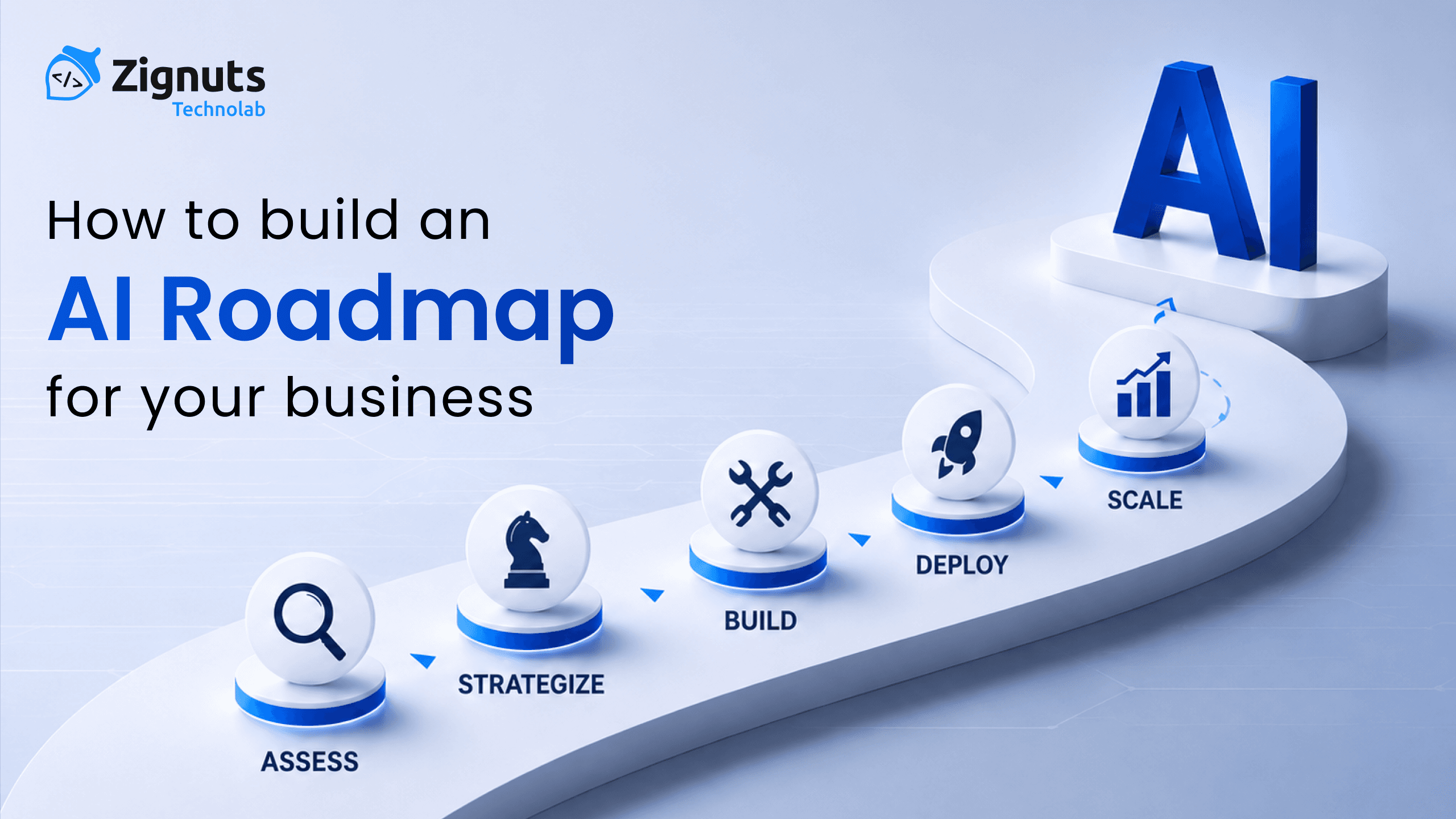
Most business leaders do not need another list of artificial intelligence use cases. They need a defensible way to decide which opportunities deserve funding, which data can support them, and how to move from an attractive pilot to a dependable operating capability. Without that discipline, teams often approve disconnected experiments while finance sees rising platform costs and employees see little improvement in daily work.
An effective AI roadmap connects business outcomes, workflow design, data readiness, governance, and delivery capacity. It also makes uncomfortable choices visible. A use case that sounds impressive but saves only 40 hours a month may deserve less attention than a less glamorous forecasting improvement that releases $2 million in working capital. The objective is not to adopt the most advanced model. It is to improve measurable performance with acceptable operational and regulatory risk.
Start With Business Constraints, Not AI Features
The strongest roadmaps begin with bottlenecks in the operating model. Ask where decisions are slow, where specialists repeat the same analysis, where errors create financial exposure, and where customers or employees abandon a workflow. These questions produce better priorities than asking departments to submit ideas for an AI assistant.
Consider a B2B software company with 5,000 enterprise customers and 3 million monthly active users. Summarizing support tickets may be useful, but predicting renewal risk from product usage, unresolved incidents, contract terms, and billing history may have a clearer commercial outcome. The latter requires stronger data integration and careful review of false positives, yet it can directly influence retention and account planning.
Large organizations commonly fail here because each department optimizes its own backlog. Sales wants lead scoring, operations wants document extraction, finance wants invoice matching, and security wants strict controls. A central roadmap should not silence those needs. It should rank them against shared measures such as revenue protected, cycle time reduced, error cost avoided, employee capacity released, and customer satisfaction improved.
Use a baseline before approving a project. Record current processing time, exception rates, manual effort, decision latency, and cost per transaction. If invoice reconciliation takes 12 minutes per item across 80,000 monthly invoices, even a modest reduction creates a credible business case. If nobody can measure the current workflow, the project is not ready for an investment decision.
Note: If a proposed use case cannot name its baseline metric, process owner, and failure consequence, treat it as an experiment rather than a roadmap commitment.
This business framing leads naturally to the next question: whether the organization has the data and workflow conditions required to deliver the expected result.
Turn AI Ideas Into a Practical Business Roadmap

Assess Data, Workflow, and Technical Readiness
AI projects usually fail after the demonstration, not during it. A prototype can work with a carefully selected sample, while production data contains duplicated customers, missing timestamps, inconsistent product identifiers, and access rules that prevent the model from seeing essential context. Data quality is not a preparation task that can be postponed. It is part of the product.
Evaluate each candidate across four dimensions: data availability, data quality, workflow fit, and integration effort. For a logistics provider managing 10,000 daily shipments across three continents, delivery prediction depends on carrier feeds, scan events, weather data, customs status, and local operating calendars. A model may be accurate in one region and unreliable in another because event definitions differ. The roadmap must fund data contracts and exception handling, not only model development.
The READ Framework for Roadmap Readiness
Dimension | Readiness question | Evidence required |
|---|---|---|
Results | What measurable outcome will change? | Baseline, target, owner, and review period |
Evidence | Is the data representative and governed? | Coverage, quality tests, lineage, and access controls |
Adoption | Where will a person use the output? | Workflow map, human review, training, and escalation path |
Delivery | Can the organization operate it reliably? | Integration design, monitoring, budget, and support ownership |
Score each dimension from 1 to 5. A total below 14 means discovery is more appropriate than production delivery. A score of 18 or above supports a controlled implementation, provided the highest risk dimension has a named mitigation. This simple test prevents teams from confusing model feasibility with business readiness.
The hidden risk appears around six months after launch, when source systems change, and the model quietly receives different inputs. Without data quality alerts, version tracking, and a process owner, accuracy declines before anyone notices. Organizations also underestimate workflow resistance. A recommendation that adds a second review screen may reduce theoretical efficiency even when its predictions are strong.
Prioritize data contracts, audit logging, and workflow testing as critical work. Choose a simpler model when it is easier to explain, monitor, or challenge. More sophistication is not automatically more value. Once readiness is understood, architecture and sourcing decisions become much more rational.
Choose an Architecture That Can Survive Production
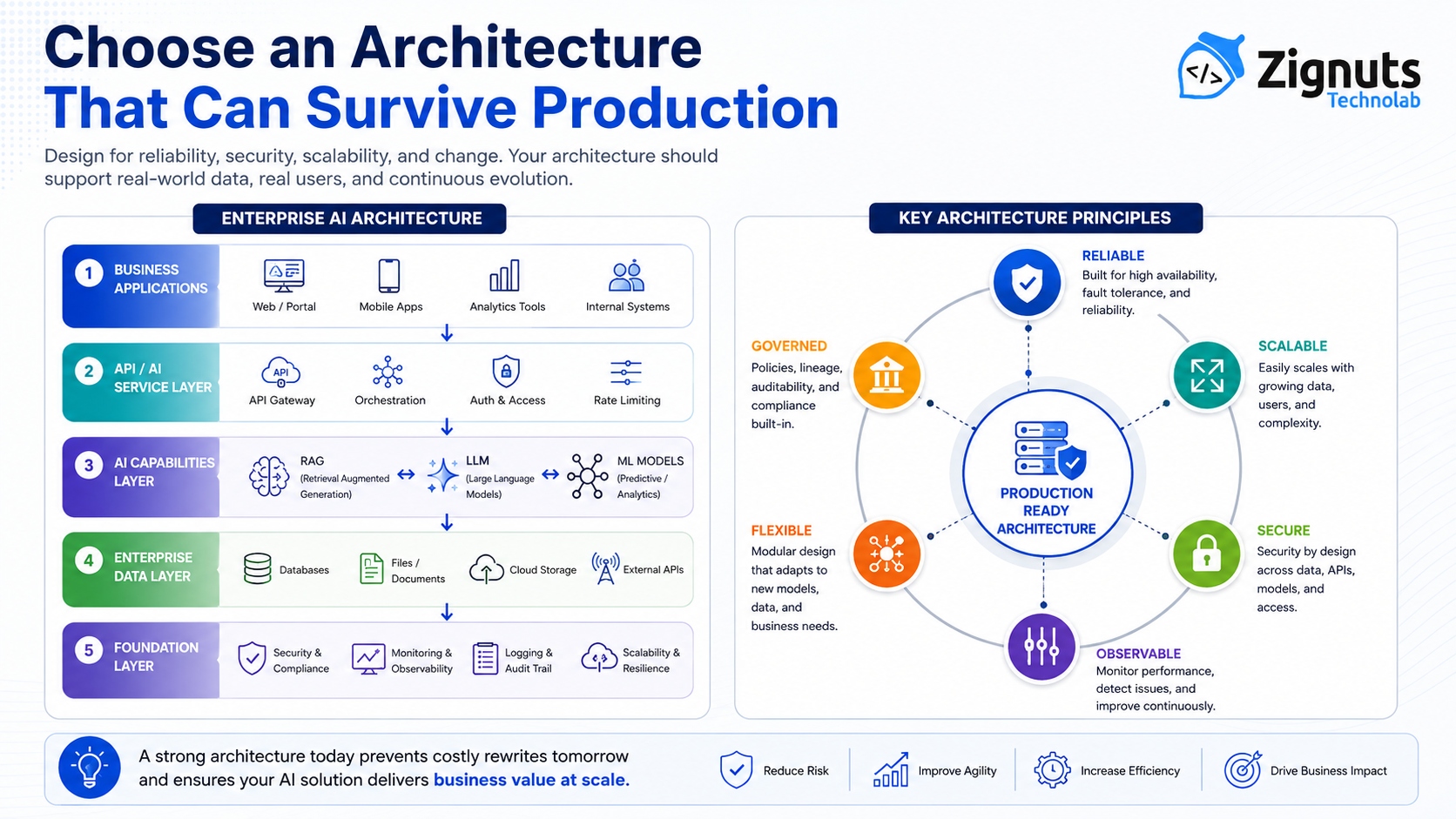
The most practical enterprise architecture separates the business workflow from the model provider. An application service should manage identity, authorization, prompt or input construction, retrieval, validation, human approval, and audit records. The model should be replaceable. This reduces dependence on one vendor and makes it possible to use different models for summarization, classification, forecasting, and high-sensitivity tasks.
For an insurer processing prior authorization for 5 million members, an AI service may extract clinical evidence and suggest missing documentation. It should not independently approve coverage unless the applicable policy, clinical governance, and regulatory review explicitly permit that behavior. A human decision maker needs the source evidence, confidence indicators, policy version, and an auditable record of what the system produced.
Many teams begin with a general model connected directly to production records. That approach is fast, but it creates risks involving sensitive data exposure, inconsistent responses, provider outages, and uncontrolled usage costs. Retrieval can improve factual grounding, but it does not fix incomplete source content. Fine-tuning can improve a narrow task, but it adds dataset management and evaluation obligations. Rules may outperform a model when the policy is stable and deterministic.
Use a layered design: deterministic rules for eligibility and safety constraints, retrieval for governed organizational knowledge, models for interpretation or generation, and human approval for material decisions. For every response, capture model version, source documents, user identity, timestamp, latency, token or usage cost, and final disposition. That telemetry supports incident investigation and shows whether the system is producing business value.
Note: Keep the model responsible for judgment support, not system authority, until accuracy, exception behavior, auditability, and ownership have been demonstrated over at least one complete operating cycle.
Security must be designed with the same seriousness as functionality. Apply least privilege, tenant isolation, encryption, retention controls, redaction, and prompt injection defenses. Map controls to the relevant obligations, such as HIPAA for protected health information, GDPR for personal data, PCI DSS for payment data, or SOC 2 evidence requirements. A vendor claim of compliance does not transfer accountability to the buyer.
The architecture choice affects operating economics. A hosted model can accelerate deployment and reduce infrastructure administration, while usage-based pricing may become material at scale. A private deployment offers more control but requires specialist skills, hardware planning, patching, and capacity management. Estimate costs for peak volume, retries, evaluation, monitoring, support, and data egress. Most budgets omit these categories.
Build Production-Ready AI Solutions That Scale
Turn Experiments Into Governed Products
A roadmap should distinguish exploration from production. An experiment tests whether a capability is technically plausible. A pilot tests whether users can incorporate it into work. A production service carries an availability expectation, security review, support process, recovery plan, and measurable ownership obligation.
A useful stage gate requires five approvals before expansion: a business owner confirms the target metric, a domain expert validates outputs, security reviews data flows, legal or compliance reviews the decision impact, and engineering confirms supportability. For a financial platform handling 10 million daily transactions across 40 currencies, an AI fraud signal must be evaluated against approval rates, false declines, investigator workload, latency, and regulatory reporting. Accuracy alone is insufficient.
Run evaluations on representative historical and current data. Measure precision, recall, abstention rate, latency, cost per outcome, and performance by customer segment or geography. Define a fallback path before launch. If the model is unavailable, the workflow should continue with rules, manual review, or a queue, rather than fail silently. Test adversarial inputs and deliberately ambiguous cases because normal examples rarely reveal the most expensive failure.
Ownership should be explicit after release. The product owns the outcome and adoption. Engineering owns reliability and integration. Security owns control verification. Legal and compliance define review requirements. Operations owns exception handling. Without this model, every incident becomes a debate about who was supposed to act.
Organizations often struggle because they measure activity instead of impact. Counting prompts, users, or pilot projects can create the appearance of progress while cycle time remains unchanged. Establish a three-, six-, and twelve-month review with a stop-or-expand decision. This governance connects the readiness assessment to the financial case and prevents permanent pilots.
Ready to Move From AI Planning to Production?
Build the Investment Case and Sequence Delivery
Rank initiatives by value, confidence, urgency, and effort. High value with low confidence belongs in a time-boxed discovery. High value with strong evidence should receive delivery funding. Low value projects should not survive because a senior executive finds the demonstration interesting.
Criterion | Weight | Question |
|---|---|---|
Business impact | 30% | Will revenue, cost, risk, or capacity materially improve? |
Readiness | 20% | Are data, workflow, and owners available now? |
Risk | 20% | Can failure be contained and audited? |
Speed | 15% | Can evidence be produced within 8 to 12 weeks? |
Reuse | 15% | Will the platform or data benefit later use cases? |
Score each category from 1 to 5 and multiply by the weight. Fund candidates above 3.8 for controlled delivery, investigate those between 2.8 and 3.7, and stop those below 2.8 unless a regulatory or strategic reason changes the threshold. These numbers are illustrative, but the discipline is important.
Include three- to five-year operating costs. A mid-sized enterprise may spend $300,000 to $1.5 million on an initial program, then another 20% to 35% of delivery cost annually on monitoring, evaluation, security, data maintenance, model changes, and support. A business case that counts only implementation can look profitable while creating an unfunded operational obligation.
Begin with one or two workflows that have measurable value and a limited blast radius. Reuse identity, telemetry, evaluation tooling, and governance patterns, but do not force every department onto one model or one delivery method. A claims team may need document extraction, while a factory may need sensor anomaly detection. Shared controls matter more than identical use cases.
Note: Treat the first production use case as an operating model test. Its greatest value may be proving governance, measurement, and support patterns that make the next five initiatives cheaper and safer.
Approval Checklist, Roadmap, and Priorities
Before approval, the sponsor should answer these questions clearly:
Which business metric will improve, and what is the current baseline?
Which workflow owner is accountable for adoption and exceptions?
Which data sources and integrations cannot fail?
What is the human fallback when the service is unavailable or uncertain?
Which privacy, security, and regulatory controls apply?
Who owns the platform, evaluation process, and budget after launch?
What evidence will support an expand, pause, or redesign decision at 3, 6, and 12 months?
Phase | Duration | Milestone | Success metric |
|---|---|---|---|
Discovery and baseline | 4 to 6 weeks | Use case and architecture approved | Metric, owner, data map, and risk register complete |
Controlled pilot | 8 to 12 weeks | Workflow tested with users | Target quality and adoption thresholds met |
Production foundation | 8 to 12 weeks | Monitoring, controls, and fallback live | 99.5% service availability and audited outputs |
Scale and optimize | 12 to 16 weeks | Additional workflows released | Documented ROI and stable cost per outcome |
Continuous governance | Ongoing | Quarterly review operating | Drift, incidents, cost, and value reported |
Critical: establish business ownership, data governance, security controls, evaluation baselines, and a safe fallback.
Important: standardize telemetry, reusable integration services, user training, and quarterly model review.
Optional: add advanced personalization, broader automation, and cross-department recommendations after core value is proven. Future: consider autonomous decisions only when evidence, controls, and accountability justify the increased risk.
Turn AI Ideas Into a Practical Business Roadmap
The high confidence recommendations are to start with measurable workflows, separate model services from business authority, and fund governance before scale. Confidence is medium for the choice between hosted and private models because volume, data sensitivity, and team capability vary. Confidence is lower for autonomous operation because its value and risk depend heavily on the domain. A credible AI roadmap is therefore not a catalog of tools. It is a sequence of accountable business improvements, each earning the right to expand.