


Enterprise digital transformation in 2026 requires more than a technology plan. It needs a phased, architecture-driven roadmap that helps organizations modernize legacy systems, improve integration, strengthen security, and deliver measurable business value without disrupting ongoing operations. A well-planned approach helps technology leaders manage risks, control costs, and adapt to changing business needs. Our Digital Transformation Consulting services help organizations plan and execute modernization initiatives with a focus on practical architecture and long-term outcomes.
A successful enterprise digital transformation roadmap should focus on:
Phased modernization: Replace or decouple legacy components incrementally instead of relying on risky, large-scale rewrites.
Cloud infrastructure and cost management: Build scalable cloud environments with automation, monitoring, and FinOps practices.
Seamless system integration: Connect ERP, CRM, databases, and applications through reliable APIs and event-driven architectures.
Security and governance: Integrate identity management, access controls, auditability, and security practices throughout the transformation.
Continuous delivery: Release improvements in manageable stages, validate results, and reduce the risk of major disruptions.
Measurable business outcomes: Track progress through delivery speed, operating costs, system reliability, user experience, and return on investment.
This guide outlines a practical 24-month transformation roadmap, including implementation phases, integration architecture, risk management, investment considerations, and ROI measurement.s.
Executive Summary: A 24-Month Enterprise Digital Transformation Roadmap
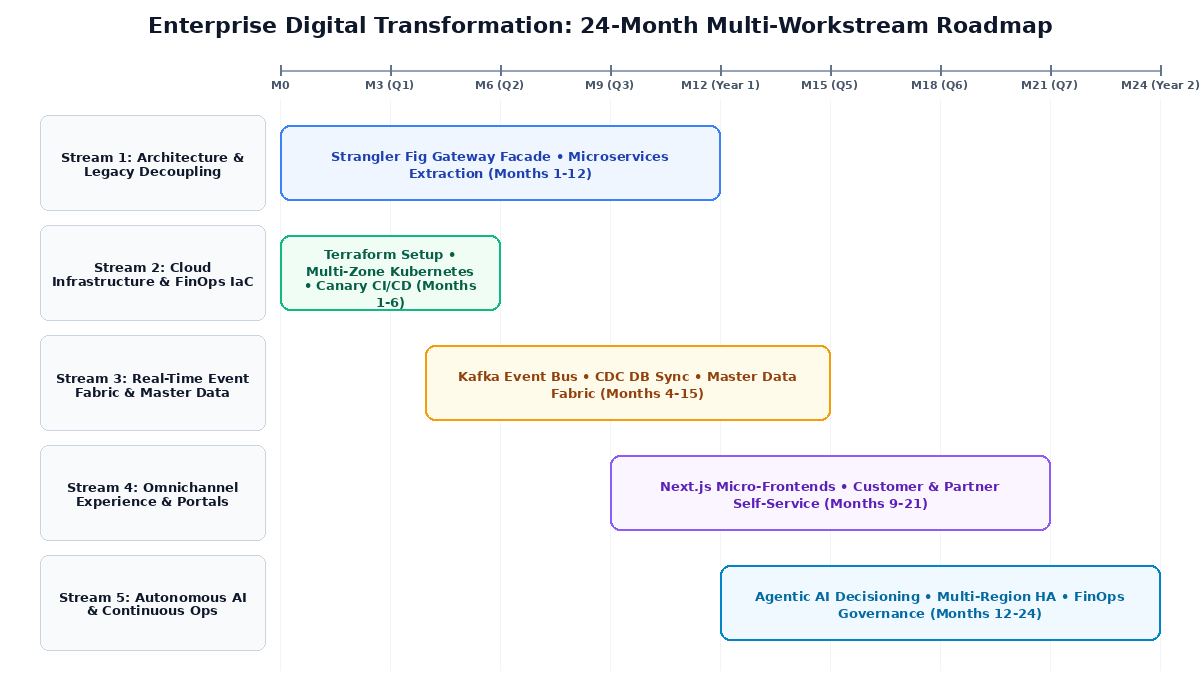
An enterprise digital transformation roadmap must deliver continuous business value at every milestone rather than delaying ROI until a distant multi-year cutover. Our framework structures enterprise modernization into five concurrent technical workstreams across a 24-month execution horizon:
Stream 1: Architecture & Legacy Decoupling (Months 1 - 12): Codebase audit, OpenAPI schema contract specifications, and Strangler Fig API routing facade deployment to incrementally extract microservices from legacy monoliths.
Stream 2: Cloud Infrastructure & FinOps IaC (Months 1 - 6): Declarative Terraform modules, multi-zone Kubernetes orchestration (EKS/GKE), automated CI/CD canary pipelines, and proactive cloud cost guardrails.
Stream 3: Real-Time Event Fabric & Master Data (Months 4 - 15): Apache Kafka event streaming bus, change data capture (CDC) database replication, and master data management (MDM) connecting core ERP and CRM systems.
Stream 4: Omnichannel Experience & Portals (Months 9 - 21): Modular Next.js micro-frontends powering unified customer self-service, partner collaboration hubs, and employee workspaces.
Stream 5: Autonomous AI & Continuous Operations (Months 12 - 24): Embedding cognitive AI decisioning agents, multi-region active-active disaster recovery, and automated FinOps optimization.
Enterprise Digital Transformation 24-Month Multi-Workstream Roadmap Swimlane
Ready to Build a More Scalable Enterprise?

Enterprise Digital Transformation Roadmap: Event-Driven Integration Architecture
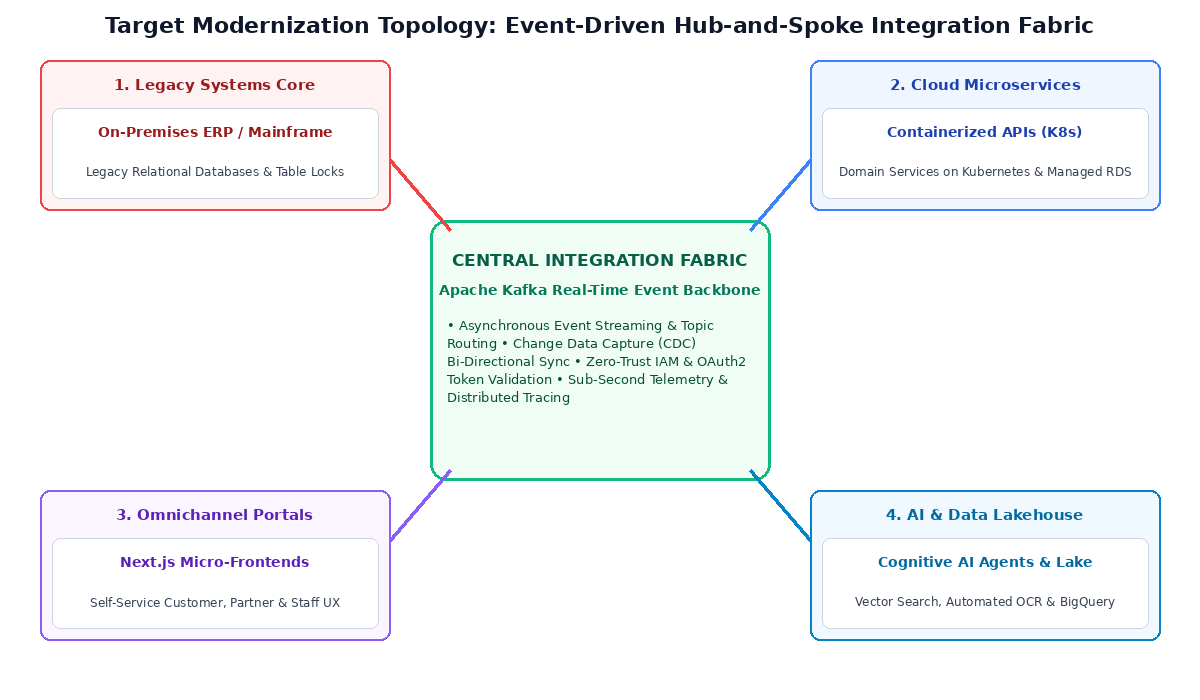
A digital transformation roadmap succeeds or fails based on how effectively new cloud applications interface with legacy on-premises backends. To eliminate brittle point-to-point integrations and avoid database lockups during modernization, top-performing enterprises establish an event-driven Hub-and-Spoke integration topology:
Central Real-Time Event Backbone: A managed Apache Kafka or Redis Streams message bus serves as the central integration hub, handling asynchronous event ingestion, topic partitioning, and sub-second message routing.
Legacy Core Spoke: Connects legacy on-premises ERPs, mainframes, and relational databases via non-intrusive Change Data Capture (CDC via Debezium), streaming database transaction logs to the cloud in real time without impacting production transactional throughput.
Cloud Microservices Spoke: Domain microservices on Kubernetes ingest events asynchronously, executing business logic and writing to managed cloud databases (Amazon RDS / Aurora / CockroachDB).
Omnichannel Experience Spoke: Customer and partner portals subscribe to real-time event updates via GraphQL subscriptions and WebSockets, delivering sub-second UI interactivity.
AI & Lakehouse Spoke: Normalized event streams feed directly into enterprise data lakehouses (BigQuery, Snowflake, Vector DBs) for real-time analytics and cognitive AI decision support.
Target Modernization Topology: Event-Driven Hub-and-Spoke Integration Fabric
Enterprise Digital Transformation Roadmap: Phases, Timelines, and Investment Benchmarks
To assist executive decision-makers in formulating capital expenditure plans, the following matrix benchmarks timelines, investment brackets, deliverables, and technical team profiles across each roadmap phase.
Enterprise Digital Transformation Phased Roadmap Delivery Matrix
Roadmap Phase | Duration | Estimated Investment | Key Architectural Deliverables | Required Engineering Pod Profile |
|---|---|---|---|---|
Phase 1: Discovery & Blueprint | Weeks 1 - 6 | $25,000 - $65,000 | Legacy codebase audit, OpenAPI schema contracts, data entity mapping, threat modeling, and target cloud blueprint. | Principal Enterprise Architect, Lead Data Architect, Senior SecOps Engineer. |
Phase 2: Foundation & MVM | Months 2 - 5 | $60,000 - $140,000 | Terraform cloud IaC, containerized API gateway facade, initial domain microservice MVP, and automated CI/CD pipelines. | Lead Architect, 2 Senior Full-Stack Engineers, DevOps/FinOps Engineer, QA Automation Lead. |
Phase 3: Multi-System Decoupling | Months 5 - 10 | $80,000 - $220,000 | ERP/CRM core decoupling, Kafka event streaming backbone, master data management, and zero-trust IAM rollout. | Principal Distributed Systems Engineer, 3 Senior Backend Engineers, Data Engineer, SecOps Specialist. |
Phase 4: Omnichannel Portals | Months 8 - 14 | $75,000 - $180,000 | Next.js micro-frontend portal, customer self-service billing, partner collaboration console, and Core Web Vitals optimization. | Lead Frontend Architect, 2 UI/UX Engineers, 2 Full-Stack Engineers, QA Automation Engineer. |
Phase 5: Autonomous AI & FinOps | Months 12 - 24 | $60,000 - $160,000/yr | Pragmatic AI decision agents, semantic vector search, multi-region active-active failover, and automated FinOps guardrails. | AI/ML Pipeline Engineer, Cloud Reliability Engineer (SRE), FinOps Specialist. |
Ready to Build a More Scalable Enterprise?
Enterprise Digital Transformation Roadmap: Risk Assessment and Mitigation
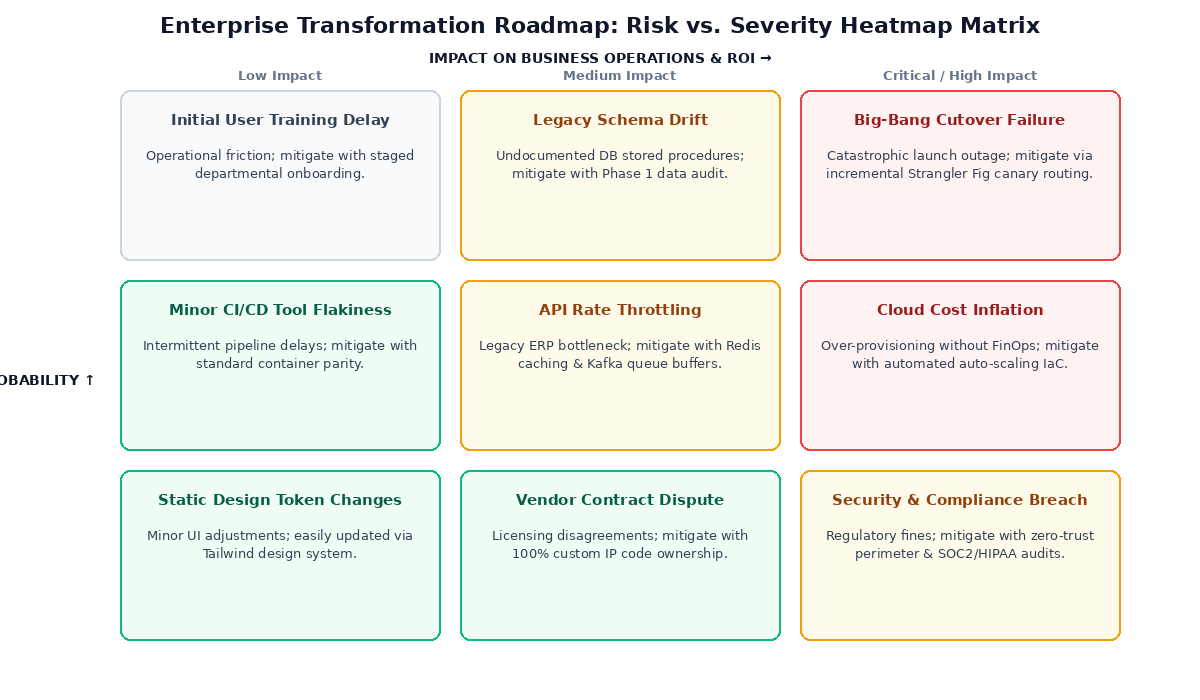
Anticipating operational and technical failure modes before writing code is essential to protect enterprise capital. Our risk management matrix maps transformation risks across probability and business severity, detailing concrete engineering countermeasures.
Key Risk Mitigation Strategies for Enterprise Modernization
Mitigating Big-Bang Cutover Failure (High Probability / High Impact): Mandate the incremental Strangler Fig pattern with live canary routing (5%, 25%, 100%) and automated dual-run reconciliation scripts to eliminate cutover downtime.
Mitigating Undocumented Schema Drift (High Probability / Medium Impact): Execute a 4-week deep data audit during Phase 1 to catalog hidden stored procedures and relational dependencies before decoupling databases.
Mitigating Cloud Cost Overruns (Medium Probability / High Impact): Embed infrastructure-as-code guardrails, automated container bin-packing on Kubernetes, and spot-instance asynchronous workers into initial Terraform templates.
Measuring Return on Investment From Digital Transformation
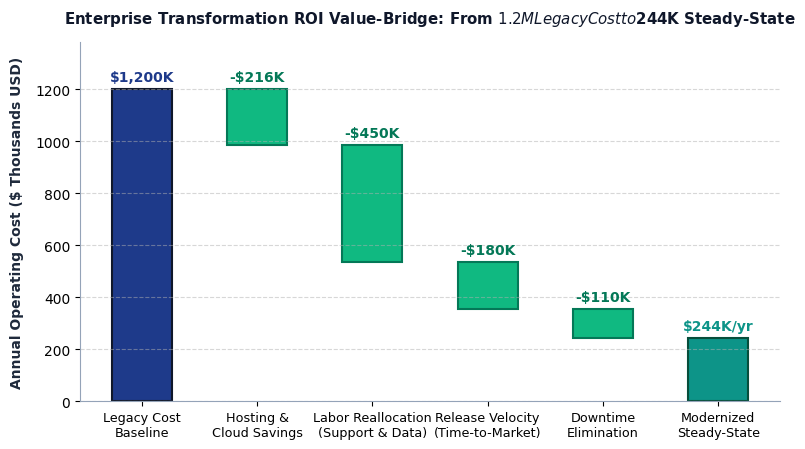
To justify multi-million-dollar modernization programs to board directors, technology executives must clearly articulate the financial bridge from legacy operational costs to modernized steady-state efficiencies.
Enterprise Transformation ROI Value-Bridge: From $1.2M Legacy Cost to $244K Steady-State
Enterprise Digital Transformation: Value Realization and Cost Savings
Value Realization Dimension | Baseline Legacy Operating Metric | Modernized Cloud-Native Platform | Net Annual Financial Realization |
|---|---|---|---|
Infrastructure & Hosting Costs | $18,000 / month ($216,000/yr) in dedicated legacy servers & licensing | $6,500 / month ($78,000/yr) in optimized serverless & auto-scaling cloud | $138,000 Annual Savings (64% hosting cost reduction) |
Engineering Release Velocity | Bi-monthly monolithic deployments with 14-day QA cycle | Daily automated CI/CD releases with zero-downtime canary rollouts | 6x Faster Time-to-Market for new customer-facing features |
System Downtime & Outage Recovery | 48 hours of unplanned downtime/yr (~$120,000 in lost revenue & labor) | 99.99% availability with automated multi-zone failover (<1 hr downtime/yr) | $110,000 Saved Annually in downtime prevention |
Operational Labor Efficiency | 8 FTEs managing manual data reconciliation & legacy system workarounds | 2 FTEs managing automated event pipelines & exception triage | $450,000 Reallocated (6 FTEs shifted to revenue-generating products) |
Net Financial Realization | High ongoing operational friction & technical debt burden | Streamlined, scalable, and secure operating backbone | Total Year 1 Net Benefit: $698,000 (Payback Period: ~4.2 Months on a $240K build) |
Ready to Build a More Scalable Enterprise?
Continuous Modernization: Turning Roadmap Delivery Into Ongoing Value
Enterprise digital transformation is not a project with a fixed endpoint; it is an ongoing organizational capability. Once the core foundation is established, top-tier engineering organizations operate a continuous modernization flywheel:
Continuous Discovery & Contract Mapping: Auditing new micro-capabilities and mapping OpenAPI schemas every sprint.
Strangler Decoupling & API Facades: Isolating domain services behind API gateways with zero legacy disruption.
Production Canary Releases: Shifting live traffic in controlled increments with automated rollback triggers.
Observability & Telemetry: Monitoring Core Web Vitals, API latency, and OpenTelemetry distributed traces.
Autonomous AI & Cloud FinOps: Applying AI optimization, rightsizing cloud compute, and feeding insights back into discovery.
Enterprise Digital Transformation Examples and Implementation Lessons
Our strategic modernization frameworks are supported by practical software delivery experience across multiple enterprise environments:
Cross-Cloud Migration & Architecture Modernization: Migrating complex containerized workloads across cloud environments helped support high availability, reduce platform latency, and establish multi-region disaster recovery capabilities.
Cloud Cost Optimization & FinOps Governance: Cloud-native infrastructure modernization through automated scaling, database rightsizing, and architectural refactoring helped reduce infrastructure costs while improving platform resource utilization and throughput.
Intelligent Workflow Automation & Middleware Modernization: Decoupling business workflows from monolithic databases enabled the development of custom orchestration platforms for automating multi-step business processes with responsive system interactions.
Multi-System Supply Chain & Data Integration: Integrating ERP systems, warehouse management databases, and real-time tracking feeds helped create unified operational visibility and reduce manual data-entry bottlenecks.
Financial Modernization & Automated Reconciliation: Modernizing legacy financial systems with secure digital architectures and automated validation workflows helped improve reconciliation, reduce billing discrepancies, and support audit and regulatory requirements.
Ready to Build a More Scalable Enterprise?
Enterprise Digital Transformation Roadmap: Key Takeaways
Structure Roadmaps Around Continuous Production Releases: Avoid big-bang rewrites; deliver production microservices every 4 to 6 weeks to de-risk investment and validate technical assumptions early.
Invest in Technical Discovery and API Blueprinting: Allocate 10% to 15% of the transformation budget to discovery and OpenAPI contract mapping to prevent costly downstream refactoring.
Embed FinOps and Cloud Governance from Day One: Implement automated container auto-scaling and database rightsizing in Terraform templates to control monthly cloud consumption.
Fund Change Management and Developer Enablement: Allocate 15% of the budget to developer documentation, automated test pipelines, and team training to ensure long-term operational velocity.
Partner with Experienced Software Engineers: Modernizing enterprise architectures requires proven expertise in distributed systems, legacy API integration, cloud governance, and security compliance. Collaborating with an experienced engineering team mitigates architectural risk and accelerates time-to-market.
Conclusion
Enterprise digital transformation in 2026 requires more than a long-term technology plan. It requires a phased, architecture-driven approach that balances legacy modernization, cloud infrastructure, system integration, security, AI adoption, and cost governance while continuing to deliver business value throughout the transformation.
A well-structured digital transformation roadmap can help organizations reduce modernization risks, improve system scalability, strengthen operational resilience, and create a foundation for continuous innovation. By combining technical discovery, incremental modernization, FinOps governance, continuous delivery, and experienced engineering teams, enterprises can move from legacy constraints toward a more flexible and sustainable technology environment.
Whether you are planning a new transformation roadmap, modernizing legacy systems, migrating to the cloud, or integrating AI into enterprise operations, contact us today to discuss your requirements and explore a practical approach for your digital transformation journey.

Swati Bais
Business Enthusiast | Curious about how businesses evolve, connecting ideas with insights to discover opportunities and shape better ways of working.