


AI Workflow Automation Cost: The Financial Reality of Enterprise Automation
Enterprise workflow automation in 2026 has shifted from experimental pilots to strict financial scrutiny. AI Workflow Automation is increasingly being evaluated not only for its automation potential but also for its long-term operating costs.
During the initial wave of AI adoption, organisations routinely overspent on unmonitored API calls, redundant cloud infrastructure, and fragile point-to-point wrappers.
Today, enterprise leaders face a clear mandate: establishing predictable Total Cost of Ownership (TCO) while deploying agentic workflow automations across core systems of record.
A common budgeting error is calculating automation costs based solely on initial software development or base model API token pricing.
In production, model execution fees represent only 15% to 25% of the total operating budget.
The remaining financial footprint is consumed by data pipeline engineering, vector database hosting, Model Context Protocol (MCP) tool integrations, inline security guardrails, LLMOps tracing, and continuous platform maintenance.
Without a structured cost architecture, enterprise automation projects face severe financial drag.
Token volume expands non-linearly as dynamic agents execute recursive reasoning steps, multi-system tool lookups, and automated retry loops.
Uncapped cloud compute bills can increase unexpectedly, while legacy system changes may require constant refactoring.
Accurately forecasting and controlling AI workflow automation costs requires analysing the entire platform, from initial process discovery to ongoing operational maintenance.
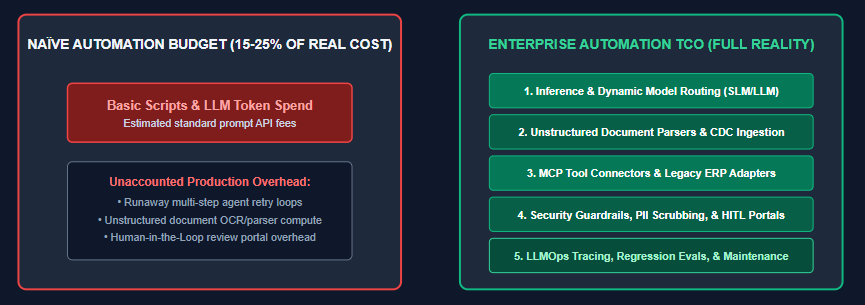
AI Workflow Automation Cost Drivers: Where Does the Budget Go?
Calculating enterprise AI workflow automation investment requires categorising expenditures across four core technical operational pillars:
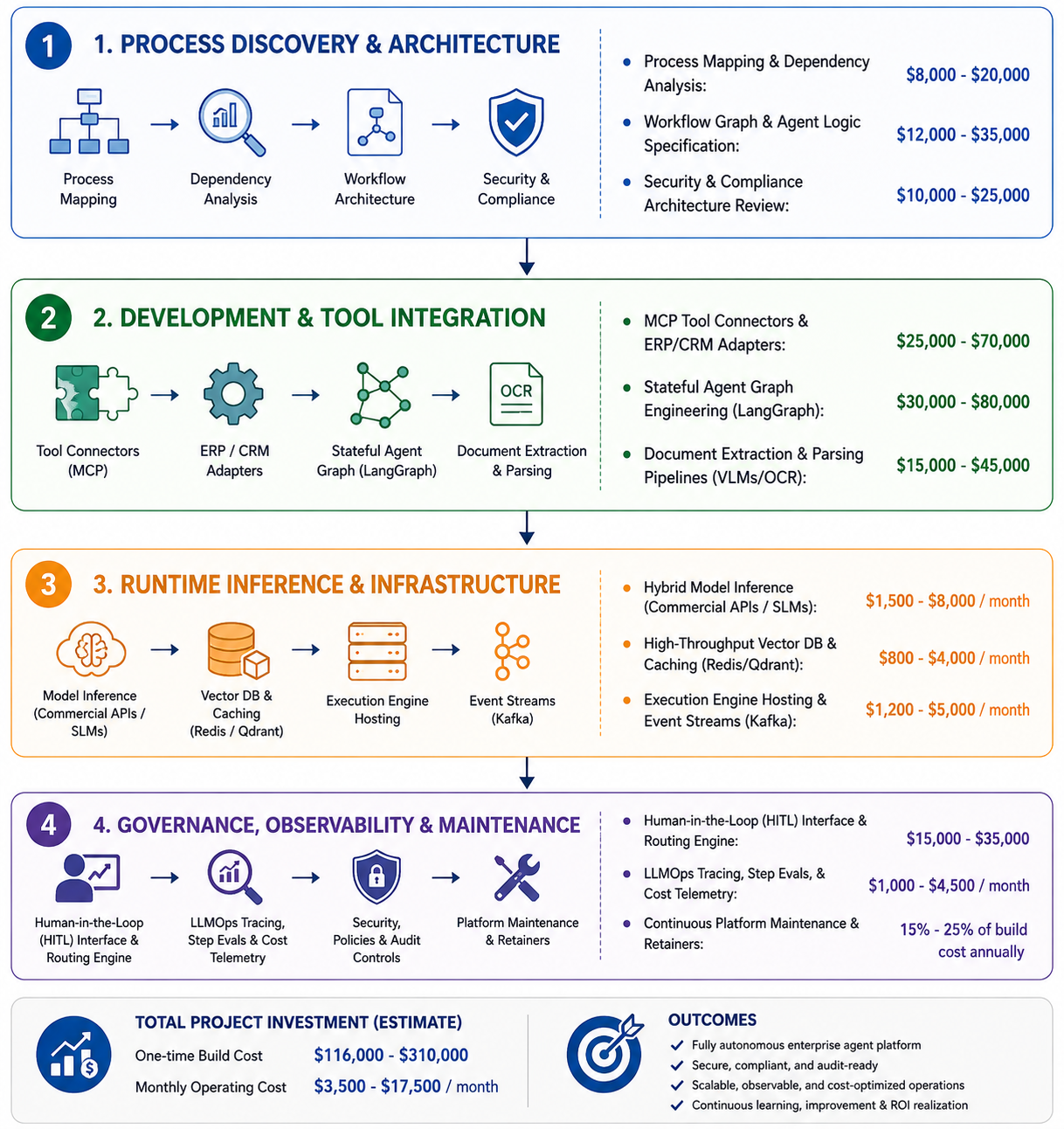
1. AI Workflow Development and Integration Costs
Constructing reliable, production-ready AI workflows requires building modular execution graphs rather than static scripts. Upfront CapEx covers setting up state machines, writing Model Context Protocol (MCP) tool bindings, building custom legacy ERP/CRM adapters, and engineering secure data ingestion channels.
2. Document Processing and Data Ingestion Costs
Parsing unstructured business documents, such as multi-page invoices, contracts, and shipping receipts, requires visual layout processing. Expenses include Vision-Language Model (VLM) tokens, layout-aware OCR engines, and automated JSON schema transformation steps that convert raw context into structured database inputs.
3. AI Compute, Inference and Pricing Models
Inference expenditure varies based on workflow commercial models:
Pay-Per-Resolution Pricing: Platforms (such as Salesforce Agentforce) charge flat rates per successful outcome (e.g., ~$2.00 per resolution, $0 on failure). This aligns costs directly with business value for high-volume customer-facing tasks.
Consumption-Based Token Pricing: Pay-as-you-go API calls or Flex Credits per million tokens/credits. Highly cost-effective for variable internal workflows, though requiring strict token caps to avoid budget overruns.
Self-Hosted Open Source (vLLM/SLM): Running lightweight fine-tuned models on private cloud GPUs (e.g., NVIDIA L4 or A100 instances) provides fixed monthly infrastructure overhead, significantly lowering per-transaction costs at scale.
4. AI Governance, Security and LLMOps Costs
OpEx includes continuous system monitoring and human oversight engines. Building custom Human-in-the-Loop (HITL) review portals, implementing inline PII scrubbers, and maintaining trace telemetry across multi-step agent executions are required to satisfy enterprise security audits.
Ready to Build a More Cost-Effective AI Workflow?

AI Workflow Automation Cost: In-House vs. Software Engineering Partner
Enterprise technology leaders face a core strategic decision: building internal AI workflow engineering capacity from scratch or engaging a specialised engineering partner.
Cost & Execution Parameter | In-House Internal Development | Specialised AI Engineering Partner (e.g., Zignuts) |
|---|---|---|
Upfront Initial Investment | $150,000 – $300,000+ | $35,000 – $110,000 |
Time-to-Production | 6 to 12 months | 2 to 4 months |
Long-Term Architectural Debt | High; internal teams may rely on point-to-point wrappers that break when upstream APIs change. | Lower dependency on point-to-point integrations through decoupled, provider-agnostic state graphs. |
LLMOps & Cost Optimisation Maturity | Basic token logging and higher risk of unmonitored agent loops. | Semantic caching, circuit breakers, dynamic SLM/LLM routing, and hard token caps. |
Security & Governance Readiness | Custom implementation required for HITL portals and compliance guardrails. | Governance architectures aligned with OWASP Top 10 for LLMs and NIST AI RMF guidelines. |
AI Workflow Automation Cost by Project Complexity
Enterprise AI workflow automation costs scale based on process complexity, integration depth, and execution volume.
Tier 1: Single-Workflow AI Automation Cost
Scope: Automating a single operational process, such as inbound customer support email classification, document metadata extraction, and CRM record updates.
Initial Build Investment: $15,000 – $35,000
Monthly Infrastructure & Inference OpEx: $800 – $2,500 / month
Key Cost Factors: Cloud API token consumption, basic OCR parsing, standard webhook integrations, and lightweight error logging.
Tier 2: Multi-System AI Workflow Automation Cost
Scope: Autonomous processing of multi-format supplier invoices, two-way ERP matching, automated discrepancy handling, and human escalation routing.
Initial Build Investment: $45,000 – $95,000
Monthly Infrastructure & Inference OpEx: $3,000 – $8,000 / month
Key Cost Factors: Vision-LLM extraction tokens, real-time CDC data sync, custom MCP tool connectors, dedicated Human-in-the-Loop review interfaces, and step-level evaluation logging.
Tier 3: Enterprise AI Workflow Automation Cost
Scope: Cross-departmental operational platform orchestrating autonomous agent chains across logistics, claims processing, and core systems of record with dynamic routing.
Initial Build Investment: $120,000 – $280,000+
Monthly Infrastructure & Inference OpEx: $10,000 – $25,000 / month
Key Cost Factors: Self-hosted open-source models, private GPU clusters, multi-tenant AI gateways, hybrid vector/keyword retrieval, and continuous automated CI/CD evaluation pipelines.
Ready to Build a More Cost-Effective AI Workflow?
How to Reduce and Control AI Workflow Automation Cost
Technology leaders can maintain budget control over enterprise AI automation deployments by implementing four engineering frameworks:
1. Control Agent Loops and Execution Costs
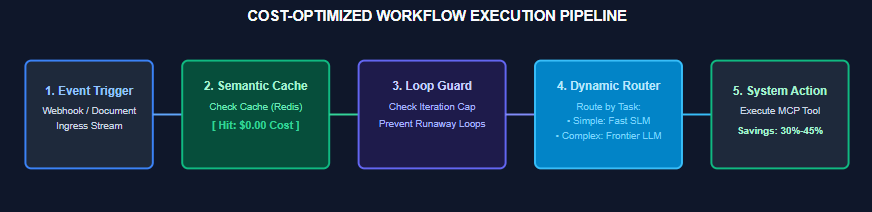
To prevent runaway agent loops from consuming thousands of dollars in tokens during system failures, install explicit loop counters and circuit breakers within the state graph engine. If an autonomous agent exceeds 5 execution iterations without reaching a definitive state, the workflow pauses and routes the transaction to a dead-letter queue (DLQ) for human review.
2. Use Dynamic Model Routing to Optimize AI Costs
Not every workflow sub-task requires high-cost frontier foundation models. Implement dynamic intent classification at the gateway level. Standard tasks like data formatting, classification, or extraction can be directed to lightweight Small Language Models (SLMs) or self-hosted open-source instances, reserving frontier LLMs exclusively for complex reasoning.
3. Reduce Token Costs with Context Compression and Hybrid Search
Passing uncompressed multi-page documents to LLMs inflates input token costs. Use layout-aware chunking combined with hybrid vector-keyword search to isolate and pass only the exact text passages required for the current execution step.
AI Agent Loop Costs: The Hidden Production Risk
Unbounded autonomous workflow agents represent a major operational financial risk. When an agentic process encounters an unexpected API schema update or a missing payload field, it can enter a recursive retry cycle. An unthrottled agent executing 40 reasoning calls per transaction can burn through thousands of dollars in API credits in hours. Production platforms require strict step-level token limits, execution time-outs, and automated escalation circuits.
How Zignuts Helps Optimize AI Workflow Automation Cost
Managing enterprise AI workflow automation costs requires more than controlling API usage. The right architecture, efficient integrations, and appropriate governance controls can help businesses keep operational expenses predictable as automation scales.
As a specialised software engineering partner, Zignuts supports businesses in building secure, scalable, and cost-conscious AI workflow platforms across four key areas:
Cost-Optimized AI Gateway Engineering
AI gateways can be designed with semantic caching, dynamic model routing, token limits, and multi-provider failover to reduce unnecessary model usage and improve cost control.
Stateful Agent Workflow Development
Resilient agent workflows can be built using stateful orchestration and Model Context Protocol (MCP) integrations, enabling structured and controlled interactions with enterprise systems.
Unstructured Data Ingestion
Document processing pipelines can combine Vision-Language Models, layout-aware parsing, and automated schema validation to handle complex business documents efficiently.
Governance, HITL & LLMOps Telemetry
Human-in-the-Loop workflows, security guardrails, and execution monitoring provide greater visibility into AI operations while helping manage operational risks and usage costs.
By combining reusable integration patterns with practical engineering practices, Zignuts helps businesses build AI workflow automation that can scale without unnecessary architectural complexity or operational overhead.
AI Workflow Automation Cost: Planning the Next Step
Managing enterprise AI workflow automation costs in 2026 requires moving beyond basic token calculations and taking a complete platform engineering approach. Structured AI gateways, dynamic model routing, circuit-breaker safeguards, and disciplined LLMOps controls can help businesses scale automation while keeping operational costs predictable.
If your engineering team is evaluating AI workflow automation costs, modernising legacy RPA infrastructure, or planning secure multi-agent workflows, contact us today to discuss your requirements and explore a practical implementation roadmap.

Utkrishti Mishra
Business Analyst Intern | Exploring data, processes, and business strategies to turn insights into smarter decisions and impactful solutions.