


Custom AI Development Cost: 2026 Overview
Custom AI development in 2026 can range from a focused proof of concept costing tens of thousands of US dollars to an enterprise AI platform requiring several hundred thousand dollars or more. Current published estimates show a wide market spread because the term "custom AI" covers everything from a narrow API-powered feature to a governed, highly integrated enterprise platform.
For most organizations, the model itself is not the largest cost driver. Data preparation, integration, security, evaluation, infrastructure, observability, and post-launch operations can materially change the budget.
The right question is therefore not simply "What does AI cost?" but "What level of AI capability do we need, and what total cost of ownership supports the business case?"
What Is the Custom AI Development Cost in 2026?
There is no universal price for custom AI because project scope varies dramatically. Recent 2026 market estimates place focused AI proofs of concept around $15,000 to $80,000, production AI applications commonly in the $60,000 to $500,000 range depending on complexity, and enterprise AI platforms from roughly $400,000 to $1 million or more. Other published estimates are lower or higher, which reinforces the need to treat these numbers as planning ranges rather than fixed rates.
A practical budgeting framework is to separate projects into four levels: proof of concept, AI MVP, production AI application, and enterprise AI platform. Each level adds engineering depth, operational controls, integration requirements, and risk-management overhead.
Project Type | Indicative 2026 Range | Typical Scope | Budget Pressure |
|---|---|---|---|
Proof of Concept | $15K–$80K | Validate feasibility and business value | Low to medium |
AI MVP | $40K–$150K+ | Working product with core AI workflow | Medium |
Production AI Application | $100K–$500K+ | Integrated, secure, monitored solution | High |
Enterprise AI Platform | $400K–$1M+ | Multi-system, governed, scalable platform | Very high |
These ranges are synthesized from publicly published 2026 estimates and should be treated as indicative planning ranges rather than guaranteed vendor pricing. The variation across published estimates shows why scope definition matters more than relying on a generic industry average.
Factors That Determine Custom AI Development Cost
Use-case complexity: A document classifier is fundamentally simpler than an agent that reasons across systems and executes business actions.
Cost Driver | What Drives Cost Up | Impact |
|---|---|---|
Use-case complexity | Multi-step reasoning, agents, business actions | High |
Data readiness | Cleaning, labeling, migration, fragmented sources | High |
Model strategy | Fine-tuning, multiple models, specialized hosting | Medium–High |
RAG/knowledge systems | Ingestion, indexing, retrieval evaluation, permissions | Medium–High |
Integrations | ERP, CRM, legacy systems, external APIs | High |
Security & governance | SSO, RBAC, encryption, auditability | Medium–High |
Scale & reliability | High traffic, low latency, HA, multi-region | Medium–High |
Data readiness: Clean, structured data reduces effort. Fragmented, duplicated, poorly labelled, or access-restricted data increases discovery and engineering work.
Model strategy: Using an existing foundation model may be more economical than training or fine-tuning a model, but the right choice depends on accuracy, privacy, latency, and task requirements.
RAG and knowledge systems: Retrieval pipelines add ingestion, chunking, embeddings, indexing, retrieval evaluation, permissions, and monitoring.
Integrations: ERP, CRM, HRMS, payment, document, identity, and legacy-system integrations often create more engineering work than the AI layer itself.
Security and governance: Enterprise SSO, role-based access, encryption, audit trails, data controls, and model governance add design and implementation effort.
Scale and reliability: Higher user volumes, lower latency targets, high availability, disaster recovery, and multi-region deployment increase infrastructure and engineering requirements.
Ready to Plan Your Custom AI Project?

Custom AI Development Cost by Project Type
1. AI Proof of Concept Development Cost
A proof of concept is designed to answer a business or technical question: can the proposed AI workflow achieve sufficient accuracy, usability, and value to justify a production build? Published 2026 estimates commonly place PoCs in the tens-of-thousands-of-dollars range.
The budget typically covers discovery, a limited data set, model or API integration, a basic workflow, evaluation, and a go/no-go recommendation. Production-grade security, extensive integrations, and large-scale infrastructure should generally be excluded unless they are necessary to validate feasibility.
2. AI MVP Development Cost
An AI MVP moves beyond technical validation into a usable product. It may include a web or mobile interface, authentication, a core AI workflow, database integration, analytics, basic monitoring, and a controlled deployment.
The biggest budget risk is allowing an MVP to become a production platform without explicitly changing the scope. A narrow MVP can validate the business case before the organization commits to enterprise-grade architecture.
3. Production AI Application Development Cost
Production AI requires stronger controls around reliability, security, data access, evaluation, observability, failure handling, and integration. A customer-facing AI assistant, document-processing system, recommendation engine, or AI copilot can fall into this category.
At this level, the AI model is only one component. The application around it becomes a major part of the investment.
4. Enterprise AI Platform Development Cost
Enterprise platforms can span departments, applications, data sources, and AI capabilities. They may require SSO, granular permissions, data residency controls, auditability, model routing, evaluation frameworks, observability, high availability, and integration with legacy systems.
This is where budgets can reach several hundred thousand dollars or more. The program should be managed as a business transformation initiative rather than simply as a software feature.
How Each Development Stage Affects Custom AI Development Cost
Discovery and feasibility: Business requirements, use-case selection, technical feasibility, data assessment, success metrics.
Development Stage | Typical Work Included | Why It Affects Cost |
|---|---|---|
Discovery | Use-case definition, feasibility, success metrics | Reduces uncertainty before build |
Data engineering | Extraction, cleaning, transformation, labeling | Poor data creates rework |
Architecture & model selection | API, open-source, RAG, fine-tuning, agents | Determines technical complexity |
AI & app development | Models, prompts, backend, frontend, workflows | Core engineering effort |
Integration | CRM, ERP, identity, databases, APIs | Enterprise systems add dependencies |
Testing & evaluation | Accuracy, safety, hallucination, and regression testing | AI needs specialized QA |
Deployment | Cloud, CI/CD, secrets, monitoring | Moves the system into production |
Optimization | Monitoring, updates, cost tuning, support | Creates recurring operating cost |
Data engineering: Data extraction, cleaning, transformation, labelling, access controls, pipelines, and quality checks.
Architecture and model selection: Choosing APIs, open-source models, fine-tuning, RAG, agents, or hybrid approaches.
AI and application development: Prompts, orchestration, model integration, backend services, frontend, business rules, and workflows.
Integration: Connecting CRM, ERP, databases, identity systems, document repositories, and other enterprise services.
Testing and evaluation: Functional testing plus AI-specific evaluation for accuracy, hallucinations, relevance, safety, and regression.
Deployment: Cloud infrastructure, CI/CD, secrets management, networking, observability, and production rollout.
Post-launch optimization: Monitoring, model updates, prompt improvements, cost optimization, incident handling, and feature evolution.
Ready to Plan Your Custom AI Project?
Custom AI vs. Pre-Built AI: Cost Comparison
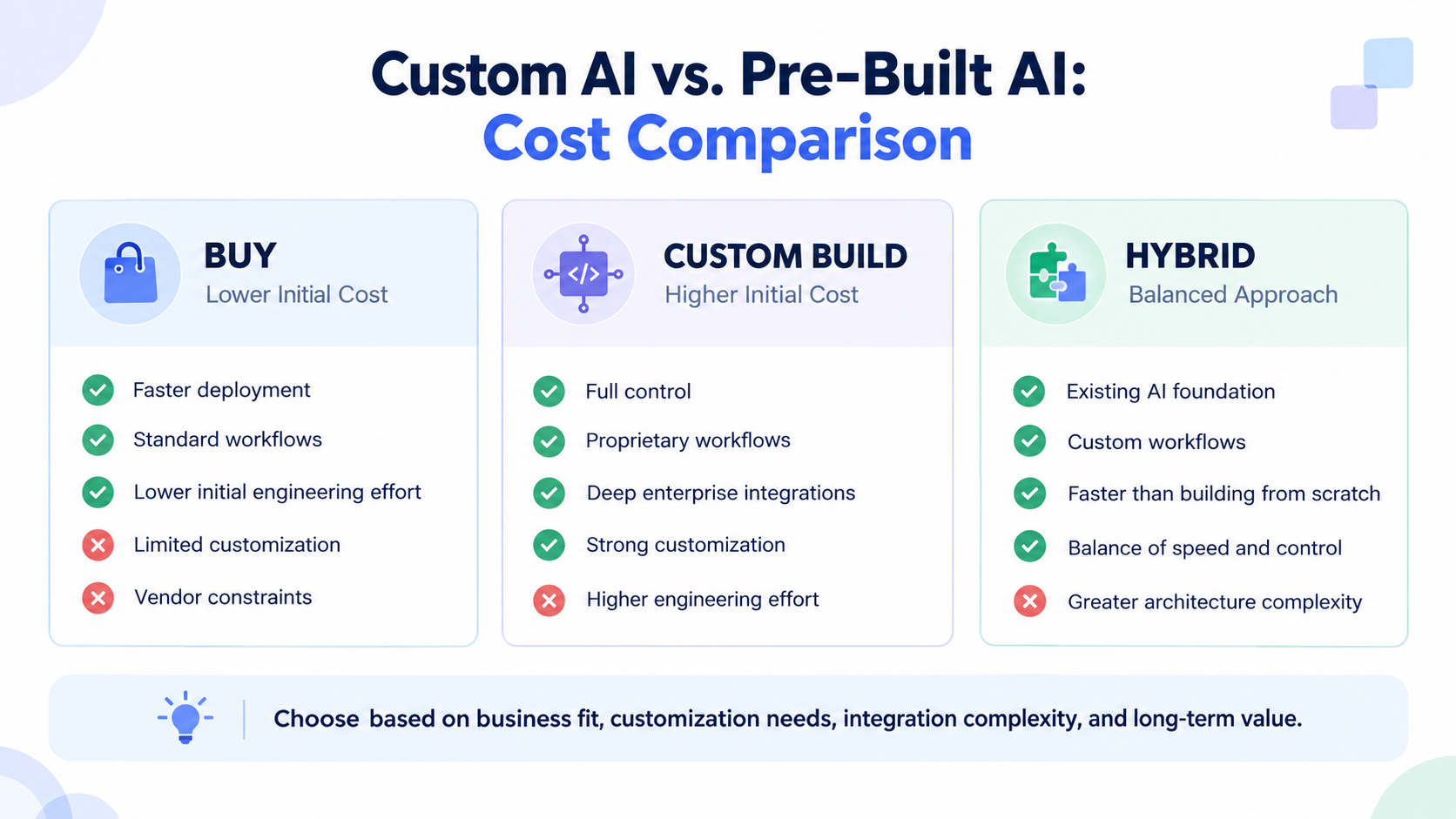
Buying an existing AI product is usually cheaper when the business problem is generic, and the organization can accept the vendor's workflows, data model, security posture, and product roadmap.
Custom development becomes more compelling when the AI needs to work with proprietary data, differentiate a customer experience, automate a unique workflow, integrate deeply with internal systems, or meet requirements that an off-the-shelf product cannot satisfy.
A third option is often the most practical: customize an existing foundation model or AI service rather than building a model from scratch. This can reduce development effort while preserving control over the application and business workflow.
Hidden Costs That Increase Custom AI Development Cost
Data cleaning, migration, annotation, and access management
Cloud compute, storage, networking, and GPU usage
Foundation-model or API consumption
Vector databases and retrieval infrastructure
Security testing and governance
AI evaluation and quality assurance
Human review for sensitive or low-confidence outputs
Monitoring, logging, tracing, and incident management
Model and prompt optimization
Third-party integration and licensing
Post-launch support and maintenance
Cost Category | One-Time / Recurring | Examples |
|---|---|---|
Data | Both | Cleaning, labeling, pipelines, access |
Model/API usage | Recurring | Inference and API consumption |
Infrastructure | Recurring | Compute, storage, networking |
Security | Both | Testing, controls, governance |
Monitoring | Recurring | Logs, traces, evaluation |
Maintenance | Recurring | Model updates, prompts, support |
This distinction is increasingly important in 2026. Current industry commentary notes that the economics of enterprise AI extend beyond token prices to infrastructure, memory, networking, energy, cooling, and operational efficiency. As AI workloads become more sophisticated, inference and runtime architecture can become meaningful components of total cost.
How Enterprise Requirements Affect Custom AI Development Cost
A prototype can operate with a limited user group and a small data set. An enterprise system may need to serve thousands of users, connect to multiple systems, maintain strict access boundaries, and provide audit evidence for business and security teams.
SSO and enterprise identity management
Role-based and attribute-based access controls
Encryption and secure secrets management
Audit logging and traceability
Data residency and regional deployment
High availability and disaster recovery
API gateways and rate limiting
Model evaluation and governance
Legacy system interoperability
Production monitoring and SLA support
Custom AI Development Cost by Technology Approach
Third-party AI APIs: Usually the fastest route to market. Development costs can be lower, but recurring usage costs become important at scale.
Approach | Best Fit | Cost Profile | Main Trade-off |
|---|---|---|---|
Third-party AI APIs | Fast product development | Lower initial | Recurring usage costs |
Open-source models | Control and deployment flexibility | Medium | Hosting and optimization overhead |
Fine-tuning | Specialized task/domain behavior | Medium–High | Data and training effort |
RAG | Proprietary knowledge retrieval | Medium | Retrieval and evaluation complexity |
Agentic AI | Multi-step automation | Medium–High | Orchestration and guardrails |
Hybrid | Complex enterprise workflows | Medium–High | Architecture complexity |
Open-source models: Can increase control and reduce dependence on one provider, but introduce hosting, optimization, security, and operational responsibilities.
Fine-tuned models: Useful when a base model needs stronger performance for a specific domain or task. Costs include data preparation, training, evaluation, and hosting.
RAG systems: Often practical for enterprise knowledge use cases because proprietary information can be retrieved at runtime without retraining the foundation model.
Agentic AI: Can automate multi-step workflows but requires orchestration, tool permissions, evaluation, guardrails, and careful handling of failure modes.
Hybrid architectures: Combine multiple models, deterministic business rules, retrieval, APIs, and human review. They can be more complex, but may offer a better balance of cost and reliability.
Ready to Plan Your Custom AI Project?
How to Calculate Custom AI Development ROI
A credible AI business case should connect the investment to measurable operational or commercial outcomes. A simple starting point is:
AI ROI = Financial Benefits Generated − Total AI Investment
Benefit Area | Example KPI | Illustrative Calculation |
|---|---|---|
Labour efficiency | Hours saved | Hours saved × fully loaded labour cost |
Revenue growth | Additional conversions | Incremental revenue attributable to AI |
Faster processing | Cycle-time reduction | Value of capacity released |
Quality | Error reduction | Avoided rework, refunds, or losses |
Customer experience | Retention/support cost | Incremental retention or reduced support cost |
Risk reduction | Incidents/exceptions avoided | Expected cost avoided |
Financial benefits can include reduced manual effort, faster processing, additional revenue, lower support costs, improved conversion, fewer operational errors, improved retention, or reduced risk. The calculation should include both one-time development costs and recurring operating costs.
For example, if an AI workflow reduces a repetitive process by 2,000 staff hours per year, the business case should value those hours using the organization's fully loaded cost and then compare the benefit against development, infrastructure, support, and model-usage costs. The example is a planning method, not a guaranteed AI outcome.
Custom AI Development Timeline in 2026
Proof of concept: Approximately 4–10 weeks depending on data and technical uncertainty.
AI MVP: Often around 2–4 months for a focused product.
Production application: Commonly 3–8+ months depending on integrations and production requirements.
Enterprise AI platform: Often 8–18+ months when multiple systems, governance, and rollout phases are involved.
These are planning ranges synthesized from published 2026 estimates. They should be adjusted after discovery because data readiness and integration dependencies can change the schedule significantly.
How to Reduce Custom AI Development Cost Without Sacrificing Quality
Start with one high-value workflow instead of an organization-wide AI platform.
Run a feasibility assessment before committing to full production development.
Use an existing foundation model when it meets the required quality and governance criteria.
Use RAG when the core requirement is grounded access to proprietary information rather than model retraining.
Define evaluation criteria before development so the team knows what "good enough" means.
Separate MVP requirements from enterprise requirements and phase the rollout.
Design reusable AI services and integration components instead of duplicating functionality.
Track inference and infrastructure costs from the first production pilot.
Ready to Plan Your Custom AI Project?
When Should You Invest in Custom AI Development?
Build custom AI when:
Approach | Best Fit | Relative Initial Cost | Trade-off |
|---|---|---|---|
Buy | Generic, mature capability | Low | Less differentiation and control |
Customize | Existing product needs adaptation | Low–Medium | Vendor limitations may remain |
Build | Unique strategic workflow | Medium–High | More engineering ownership |
Hybrid | Complex enterprise capability | Medium–High | Greater architecture complexity |
The workflow creates meaningful competitive differentiation.
The business relies on proprietary data or processes.
Existing products cannot meet the required workflow or integration needs.
The AI must be deeply embedded into an existing product or operating model.
The expected business value justifies the development and operating investment.
Prefer buying or configuring an existing product when:
The problem is generic and already well served by mature products.
The organization does not need differentiated workflows.
Customization would cost more than the expected business value.
The main requirement is experimentation rather than a strategic production capability.
How to Choose a Custom AI Development Partner
A clear discovery and estimation methodology
AI architecture and product-engineering capability
Data engineering and integration expertise
Security and enterprise architecture understanding
Experience with evaluation and monitoring
Transparent separation of development, infrastructure, and recurring AI costs
A phased delivery approach that reduces technical and commercial risk
Post-launch support and optimization capability
Custom AI Development Cost: Final Considerations
Custom AI development cost in 2026 depends on much more than the AI model itself. Use-case complexity, data readiness, integrations, security, infrastructure, evaluation, scalability, and ongoing maintenance all influence the overall investment. Defining these requirements early helps businesses create realistic budgets and avoid unexpected development and operational costs.
The right approach is to start with a clearly defined business use case, validate feasibility through a focused proof of concept or MVP, and then scale the architecture based on actual business requirements. Whether you are planning a new AI application, modernizing an existing system, or building an enterprise AI platform, contact us today to discuss your requirements and explore a practical approach to custom AI development.

Deep Gondaliya
Business Analyst | Turning business challenges into clear insights, practical solutions, and meaningful improvements that help teams move forward.