SSO platform development is the work of building the systems that let a user authenticate once with an identity provider (IdP) and then access many applications, called service providers (SPs) or relying parties, without signing in again. As part of Enterprise Security Software Development, it covers protocol support (SAML 2.0 and OpenID Connect), session and logout handling, user provisioning, multi-factor authentication, per-customer federation, and token security. The login redirect is the easy part. The hard parts are sessions that end cleanly, enterprise customers with different identity systems, and tokens that cannot be replayed. This guide explains the design decisions and the standards behind them.
Key Takeaways for SSO Platform Development
Support two protocols: SAML 2.0 because enterprise applications still ask for it, and OpenID Connect (OIDC) for new web, mobile, and API work. OAuth 2.0 alone is not a sign-in protocol.
Single logout is the weakest part of most SSO designs: Prefer OIDC Back-Channel Logout where you can, and plan for partial logout where you cannot.
SSO handles sign-in; SCIM handles the user lifecycle. Without provisioning, deactivated users keep accounts in downstream apps.
Follow RFC 9700 for OAuth security and validate every token claim, especially audience and issuer.
In our view, most teams should buy or adopt the core IdP and build the tenant model, provisioning, and integration layers around it.
Ready to Build a Secure, Scalable SSO Platform?

SAML 2.0 vs. OIDC vs. OAuth 2.0: Key Differences
These three are often mixed up, so define them first. OAuth 2.0 (RFC 6749, October 2012) is a framework for delegated access: it lets a client obtain limited access to an HTTP service. The RFC requires the authorization server to verify the resource owner's identity but leaves the method out of scope, so OAuth by itself does not define how a user signs in or how an application learns who they are (IETF RFC 6749).
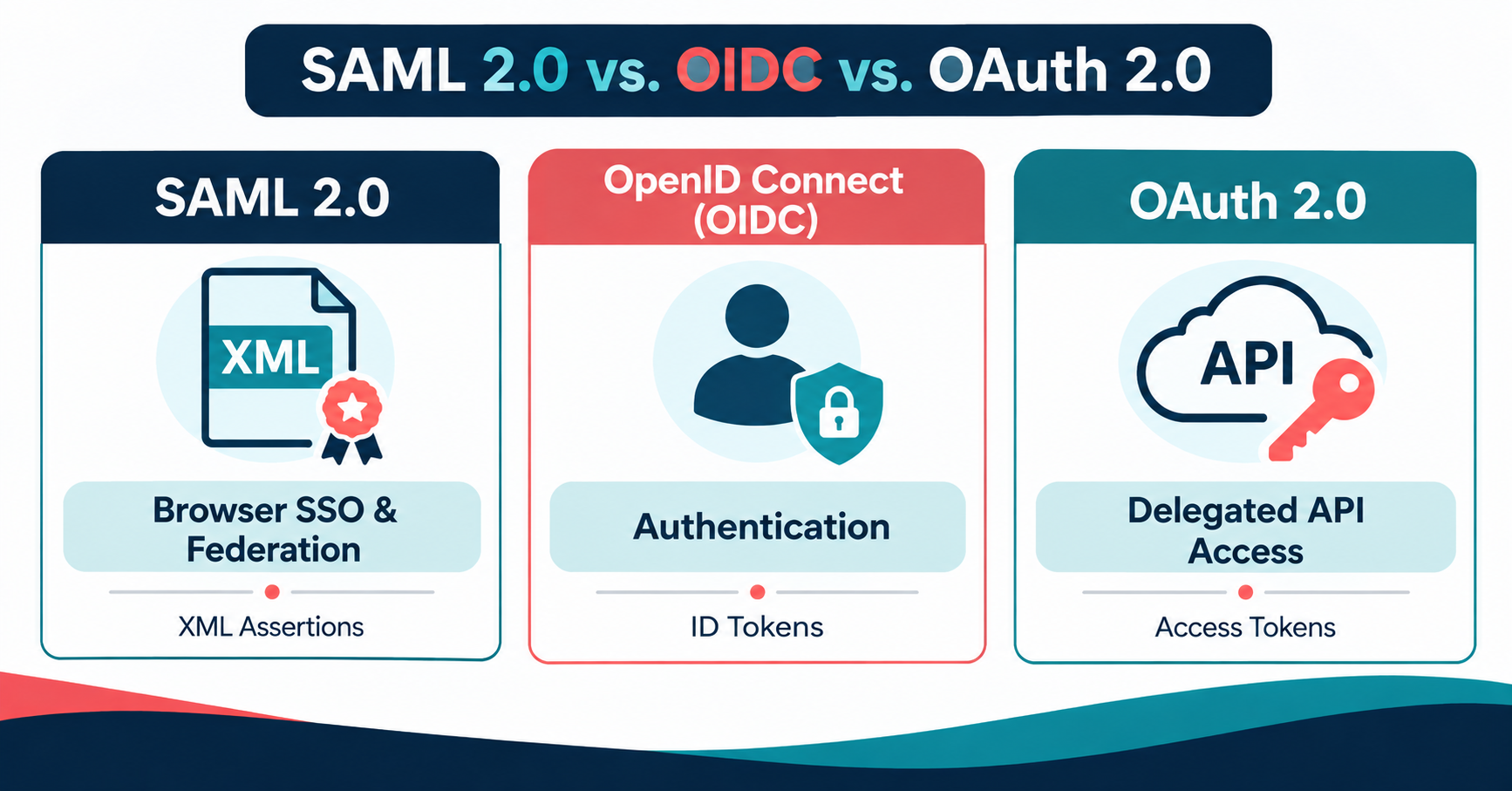
OpenID Connect (OIDC): Adds an identity layer on top of OAuth 2.0. Its ID Token must carry the claims iss, sub, aud, exp, and iat, and the client must reject a token whose aud does not contain its own client_id (OpenID Connect Core 1.0).
SAML 2.0: An XML-based standard whose core specifications date from March 2005. It defines assertions, protocols, and bindings (HTTP Redirect, HTTP POST, and Artifact for browser SSO), plus a Single Logout profile (OASIS SAML 2.0 Technical Overview).
Aspect | SAML 2.0 | OIDC | OAuth 2.0 alone |
|---|---|---|---|
Purpose | Browser SSO and federation | Authentication on top of OAuth | Delegated API access |
Message format | XML assertions | JSON Web Tokens | Opaque or JWT access tokens |
Typical clients | Enterprise web apps, legacy SaaS | Web, mobile, SPAs, APIs | APIs, third-party integrations |
Logout | Single Logout profile | Front-channel and back-channel specs | Token revocation only |
Why you support it | Customers' IdPs and older SPs expect it | Simpler for new development | Needed alongside OIDC for APIs |
The table's "typical clients" and "why you support it" rows are our summary, not a cited finding. We see supporting both protocols as close to mandatory. An SSO platform that sells to enterprises will meet SAML requirements in procurement, and one that serves modern applications will need OIDC. Design an internal identity model that both protocols read from, so adding a protocol does not mean duplicating logic.
SSO Platform Architecture: Understanding IdP and SP Roles
Every SSO deployment has two roles. The IdP authenticates the user and issues assertions or tokens. The SP trusts the IdP and creates a local session from what it receives. Your platform can play either role, and often both: it is the IdP for your own applications and an SP that accepts logins from each customer's corporate IdP.
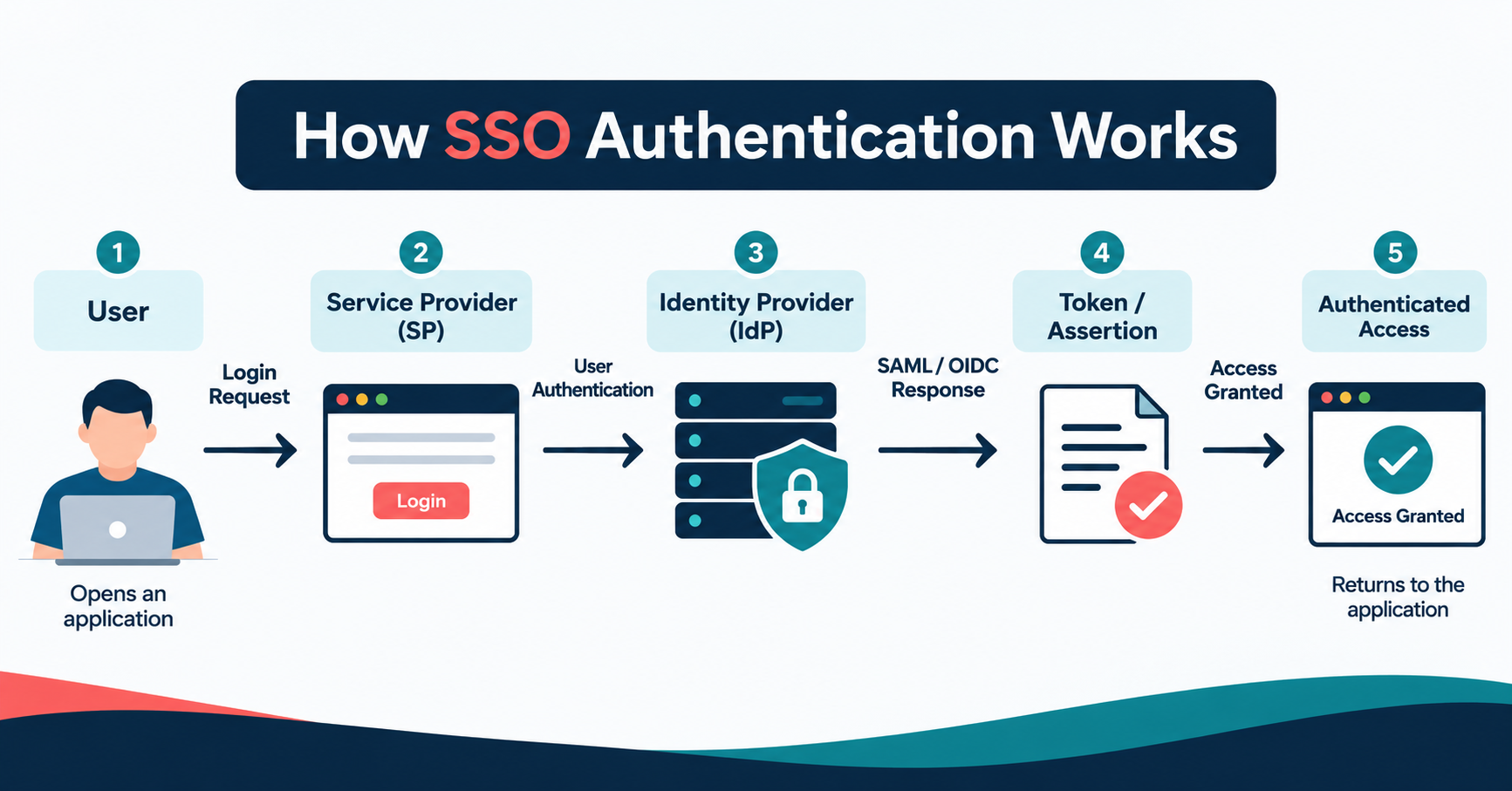
SAML defines two starting points:
SP-initiated SSO: The user visits the SP, which redirects them to the IdP.
IdP-initiated SSO: The user starts at the IdP, which sends an assertion to the SP (OASIS).
Our reasoning: SP-initiated flows are easier to secure because the SP can tie each response to a request it made; treat IdP-initiated login as an opt-in feature with extra checks.
A practical component list for the IdP side:
Authentication service: Credential and MFA checks, risk-based step-up.
Protocol endpoints: SAML SSO and logout endpoints, OIDC authorization, token, discovery, and JWKS endpoints.
Session store: One record per user session, with the list of applications that received a token or assertion.
Key management: Signing keys with rotation and overlap.
Directory and tenant store: Users, groups, tenants, and each tenant's federation settings.
Admin and audit layer: Application registration, policy, and logs.
On the SP side, a thin integration library should handle redirect, validation, and session creation so each application does not reimplement them.
Worked example: Suppose a customer's employee opens your product at app.example..com placeholder domain. The app sees no session and redirects them to your sign-in page. The page identifies the customer from the email domain and sends an OIDC or SAML request to that customer's corporate IdP. The corporate IdP authenticates the employee and returns a response.
Your platform then:
Validates the signature, issuer, audience, and expiry.
Maps the claims to a local user.
Creates its own session.
Issues tokens to the app.
Two separate trust relationships exist here: customer IdP to your platform, and your platform to your applications. Keeping them separate lets you change one without touching the other. No real system is described.
Ready to Build a Secure, Scalable SSO Platform?
Session Management and Single Logout in SSO Platforms
SSO creates several sessions at once: one at the IdP and one in every application. Ending them together is the hard problem.
OIDC uses its own terms: the OpenID Provider (OP) is the IdP, and the Relying Party (RP) is the SP. It offers two logout mechanisms, both final specifications:
OIDC Back-Channel Logout: Final specification from December 2023, incorporating errata set 1. The OP sends a signed logout token, a JWT, by HTTP POST directly to each RP's registered logout URI. The token must include
iss,aud,iat,exp,jti, and aneventsclaim, plussub,sid, or both, and must not contain anonce. The spec encourages short expiry, preferably within two minutes. Its stated limits are that the RP's logout URI must be reachable from the OP, and that RPs must build their own way to end the identified session (OpenID Back-Channel Logout 1.0).OIDC Front-Channel Logout: Final specification from September 2022. The OP renders each RP's logout URI in an iframe so the RP can clear its state. The spec itself warns that some browsers block third-party content by default, which can stop the RP from clearing its login state, and it notes that Back-Channel Logout is not known to be affected (OpenID Front-Channel Logout 1.0).
SAML's Single Logout profile can use several bindings and aims to end a user's sessions at nearly the same time (OASIS). Its practical reliability depends on every SP implementing it correctly.
Design advice, based on our reasoning rather than a cited source:
Session tracking: Store the SID for every session and every application that received a token, so you know whom to notify.
Back-channel notification: Use back-channel notification where the SP is a server application you control.
Partial logout: Accept that logout may be partial. Keep access tokens short-lived and make applications re-check session state for sensitive actions.
Logout scope: Decide separately what "logout" means: ending only the app session, the IdP session, or both. Show the user which one happened.
Logging: Log every logout attempt and its result per application, so a failed notification is visible.
User Provisioning and Lifecycle Management with SCIM
SSO answers "who is signing in." It does not create or remove accounts in each application. SCIM does. It is defined by RFC 7643 (schema) and RFC 7644 (protocol), both from September 2015. The RFC index lists RFC 7644 as updated by RFC 9865 and RFC 9967, so read those before implementing (IETF RFC 7644).
RFC 7644 defines the following resources, endpoints, methods, and capabilities:
Resources:
/Usersand/Groups.Discovery endpoints:
/ServiceProviderConfig,/ResourceTypes, and/Schemas.HTTP methods: GET, POST, PUT, PATCH, and DELETE.
Other capabilities: Filtering, pagination with
startIndexandcount, an optional/Bulkendpoint, and theapplication/scim+jsonmedia type.
The RFC treats PATCH and /Bulk as optional for servers, so your client should handle servers that lack them (IETF RFC 7644).
For an SSO platform, decide which side of SCIM you implement:
SCIM server: Your product receives users from customers' IdPs. Customers will ask for this in security reviews.
SCIM client: Your platform pushes users to downstream applications, for example, from an HR system such as those covered in our enterprise HRMS software development guide.
Design points:
Make operations idempotent.
Treat deactivation as a first-class event that also ends sessions and revokes tokens.
Map groups to roles in a configurable way per tenant.
Expose a sync log the customer's admin can read.
Ready to Build a Secure, Scalable SSO Platform?
Integrating MFA and Passkeys into an SSO Platform
Put authentication strength in the IdP, not in each application. That gives one place to enforce MFA, step-up for sensitive actions, and policy by tenant or application.
Passkeys fit naturally. The FIDO Alliance describes a passkey as an authentication credential based on FIDO standards, built on WebAuthn and CTAP, and describes passkeys as phishing-resistant. It also distinguishes two types:
Synced passkeys: Move between a user's devices through a cloud service.
Device-bound passkeys: Stay on one device, such as on a security key.
WebAuthn, the browser API behind passkeys, is a W3C standard. Checked 2026-11-03, the Level 3 page header reads "W3C Recommendation, 25 August 2026" and the Level 2 page reads "W3C Recommendation, 8 April 2021" (FIDO Alliance; Level 3; Level 2).
For regulated customers, the difference matters. Per NIST SP 800-63B-4, as summarized from its syncable authenticators appendix, syncable authenticators may be offered for applications seeking up to AAL2 and require an activation factor such as a PIN or biometric. We could not load the page directly, so we confirm this in the appendix (NIST SP 800-63B-4). Customers needing higher assurance may require device-bound authenticators.
Build the surrounding flows, not just the sign-in:
Enrollment.
Adding a second passkey.
Account recovery.
A fallback that is not weaker than the method it backs up.
We think recovery design decides whether passkeys improve security in practice.
When SSO happens at a customer's IdP, MFA happens there too. Your platform should read the authentication context the IdP reports (acr and amr claims in OIDC and SAML AuthnContext) and decide whether it satisfies your policy or requires step-up.
Multi-Tenant SSO and Enterprise Identity Federation
If you sell to businesses, each customer brings its own IdP. The platform needs a tenant model where federation is configuration, not code.
Per tenant, store:
The connection type (SAML or OIDC) and its metadata: entity ID, endpoints, signing certificates, or JWKS URI.
Verified email domains used to route users to the right connection.
Attribute and claim mappings to your user model.
Policy: whether local passwords are allowed, MFA requirements, and session lifetime.
Provisioning settings, including a SCIM token if enabled.
Pitfalls to design against (our reasoning):
Cross-tenant leakage. Include the tenant in every lookup key. A user ID from one IdP must never match a user from another IdP just because the strings are equal. Key identities on issuer plus subject, not email alone.
Domain takeover. Require proof of domain ownership before routing a domain to a tenant's IdP.
Certificate expiry. SAML signing certificates expire. Support multiple certificates per connection and alert admins before expiry.
Self-service setup. Provide a metadata import, a test-login button, and readable errors, because setup problems are a likely source of support load.
SSO Token Security: Validation and Protection Best Practices
RFC 9700, the OAuth 2.0 Security Best Current Practice (BCP 240), is the baseline. Among its requirements:
Public clients must use PKCE.
Authorization servers must use exact string matching for redirect URIs.
Clients should not use the implicit grant.
Refresh tokens for public clients must be sender-constrained or rotated.
Access tokens should be audience-restricted to a specific resource server (IETF RFC 9700).
Sender-constraining can use DPoP (RFC 9449), where the client proves possession of a private key so a stolen token alone is not enough (IETF RFC 9449).
SAML needs equal care. The SAML 2.0 Profiles specification says that in the Web Browser SSO profile:
Assertions in a response must be signed when the HTTP POST binding is used (Section 4.1.3.5).
The service provider must verify any signatures present.
The Bearer Recipient must match the assertion consumer service URL it was delivered to.
NotOnOrAftermust not have passed.InResponseTomust equal the original request ID unless the response is unsolicited (Section 4.1.4.3).Bearer assertions must carry an
AudienceRestrictionidentifier naming the service provider (OASIS SAML 2.0 Profiles).
Our own addition, not drawn from that text: use a maintained SAML library for XML signature validation and make sure the signature covers the exact assertion you then read, since XML signature wrapping attacks target code that validates one element and consumes another.
A validation checklist for any token or assertion your platform consumes:
Verify the signature with a key from a trusted source, and reject the none algorithm.
Match the issuer exactly to the configured value.
Confirm your own identifier is in the audience.
Check expiry and, where relevant, not-before, with a small clock tolerance.
Check the nonce (OIDC) or request ID (SAML) for the flow you started.
Reject replays by tracking token or assertion IDs for their lifetime.
Write a negative test for each step. Audience and issuer checks are easy to skip, so test them first.
Ready to Build a Secure, Scalable SSO Platform?
Build vs. Buy vs. Extend: Choosing the Right SSO Platform Approach
The guidance below is our reasoning; we did not find an analyst source on SSO build-versus-buy that we could verify and quote.
Option | Choose it when | Main risk |
|---|---|---|
Buy or adopt an IdP | SSO is a feature, not your product | Lock-in; limits on custom tenant or policy logic |
Build the IdP | Identity is your product or needs are unusual | Years of security maintenance and standards churn |
Extend | You need custom tenant models, provisioning, or workflows | Integration seams between components |
Questions to ask: Does the team have protocol and cryptography expertise and a plan to patch for years? How many customer IdPs, and of which types, must you support? Who handles support when a customer's SAML setup fails? Writing your own XML signature validation or token signing is rarely wise. Spend custom effort on tenant onboarding, provisioning, session policy, and the admin experience. For the wider picture, see our guides to enterprise IAM software development and, for customer-facing sign-in, CIAM platform development.
SSO Platform Testing: Protocol, Security, and Tenant Isolation
Protocol conformance: run your OIDC and SAML endpoints against reference tools and real IdPs, not only your own client.
Negative security tests: wrong audience, wrong issuer, expired token, replayed assertion, altered signature, mismatched redirect URI, missing PKCE.
Logout tests: verify that back-channel tokens end the right session and that failures are logged.
Provisioning tests: create, update, deactivate, group change, and retries after failure, using filters and pagination on large sets.
Tenant isolation tests: two tenants with the same email and subject strings must stay separate.
Resilience: test applications when the IdP is slow or down, and rehearse signing key rotation.
SSO Platform Migration: A Step-by-Step Approach
Migration is where SSO projects tend to stall, because every application and every customer connection is a dependency. The steps below are our recommendation.
Inventory applications, protocols, attributes consumed, and each customer connection.
Normalize identifiers. Decide the stable user key before moving anyone. Changing the sub or NameID an application sees can create duplicate accounts.
Run old and new side by side. Route a small group or one application through the new platform first.
Migrate credentials carefully. Password hashes can sometimes be imported or verified lazily at first login; passkeys are tied to the relying party and generally need re-enrollment. Confirm both for your own setup.
Move applications in waves, hardest and highest-risk first, with a rollback path per wave.
Retire the old platform only after logs show no remaining traffic.
Ready to Build a Secure, Scalable SSO Platform?
SSO Platform Development: A Phased Implementation Plan
This sequence is our recommendation; durations depend on scope.
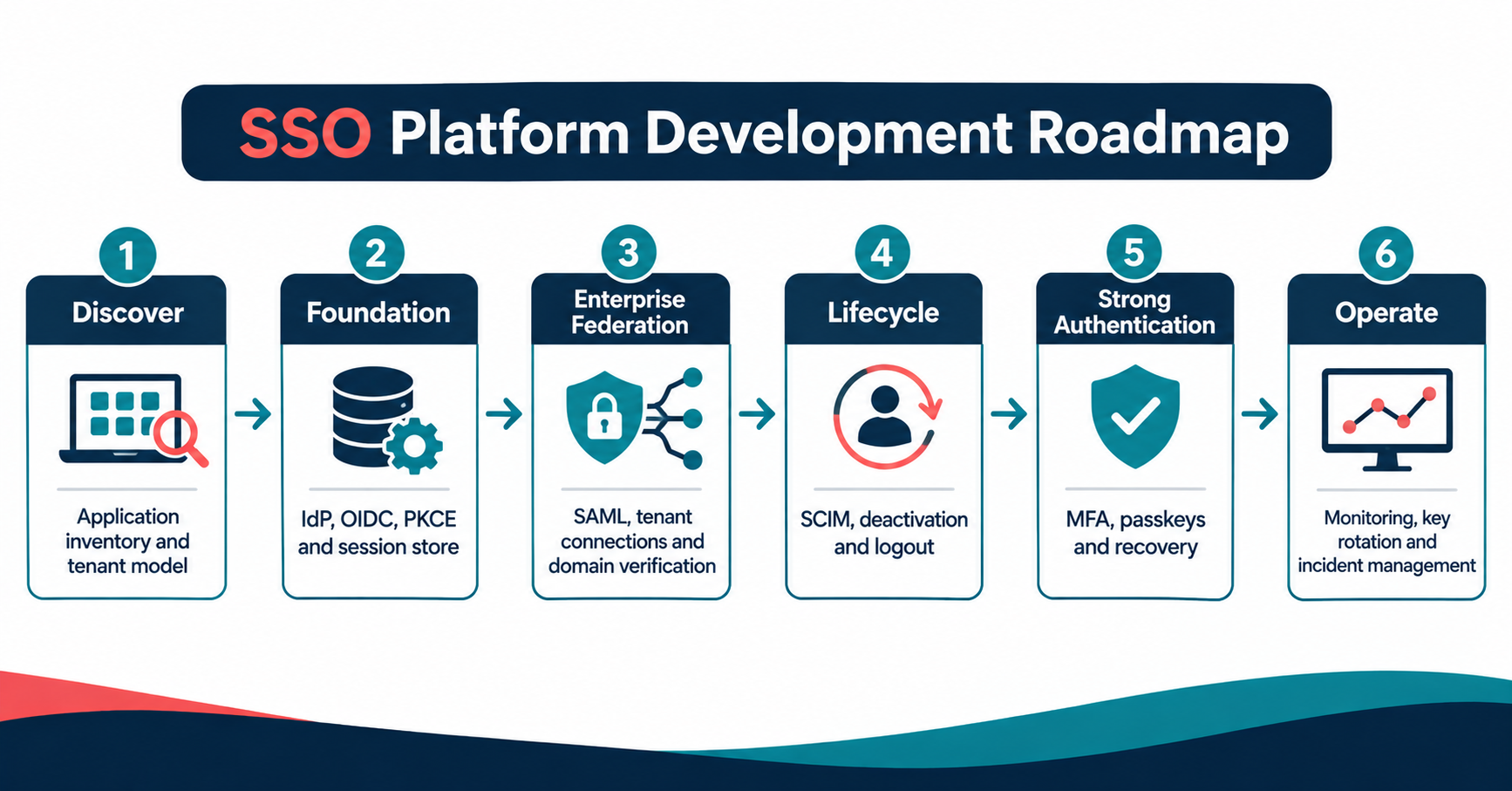
Discover: application and protocol inventory, tenant model, assurance targets, build/buy decision.
Foundation: IdP or adopted product, OIDC with PKCE, key management, session store, one pilot application.
Enterprise federation: SAML SP support, per-tenant connections, domain verification, self-service setup.
Lifecycle: SCIM, deactivation that ends sessions, logout notification.
Strong authentication: MFA policy, passkeys, step-up, recovery.
Operate: monitoring, certificate and key rotation, standards tracking, incident runbooks.
Conclusion: Building a Secure and Scalable SSO Platform
Building a secure and scalable SSO platform requires more than connecting applications through a single login. It involves establishing trust through SAML and OIDC, managing user sessions and provisioning through SCIM, and supporting multiple customer identity providers through a flexible tenant model. Following established standards, validating token claims, and planning for reliable logout helps create a secure and maintainable platform.
If you are planning an SSO project, start by reviewing your applications, protocols, and customer identity requirements. Explore our enterprise IAM guide to understand the broader identity management landscape, and contact us today to discuss your requirements and how our enterprise security software development expertise can help turn your SSO goals into a practical delivery plan.

Deep Gondaliya
Business Analyst | Turning business challenges into clear insights, practical solutions, and meaningful improvements that help teams move forward.