
When a Fortune 500 healthcare provider initiated a core platform modernization effort, the initial architectural plan looked bulletproof on paper: migrate a 15-year-old monolithic system into 120 independent microservices running on managed Kubernetes. Eighteen months and $4.2 million later, the organization faced severe cascading RPC failures, distributed tracing deadlocks, and an infrastructure bill that had tripled. The team had inadvertently replaced a simple monolith with a distributed monolith, accumulating massive technical debt without achieving true operational agility. This scenario highlights why Software Architecture Consulting plays an important role when legacy core systems reach scaling bottlenecks and engineering leaders seek to redesign systems for long-term scalability, security, and cloud efficiency.
However, choosing an enterprise software architecture consulting partner in 2026 requires looking beyond surface-level technology trends. It demands:
Evaluating complex legacy domain logic.
Establishing clear domain-driven design (DDD) boundaries.
Enforcing strict governance across multi-cloud infrastructure.
Assessing architectural discipline and modernization methodology.
Evaluating the partner's track record in delivering maintainable, high-throughput systems to ensure long-term ROI.
Enterprise Architecture Modernization: Strategies and Trade-Offs
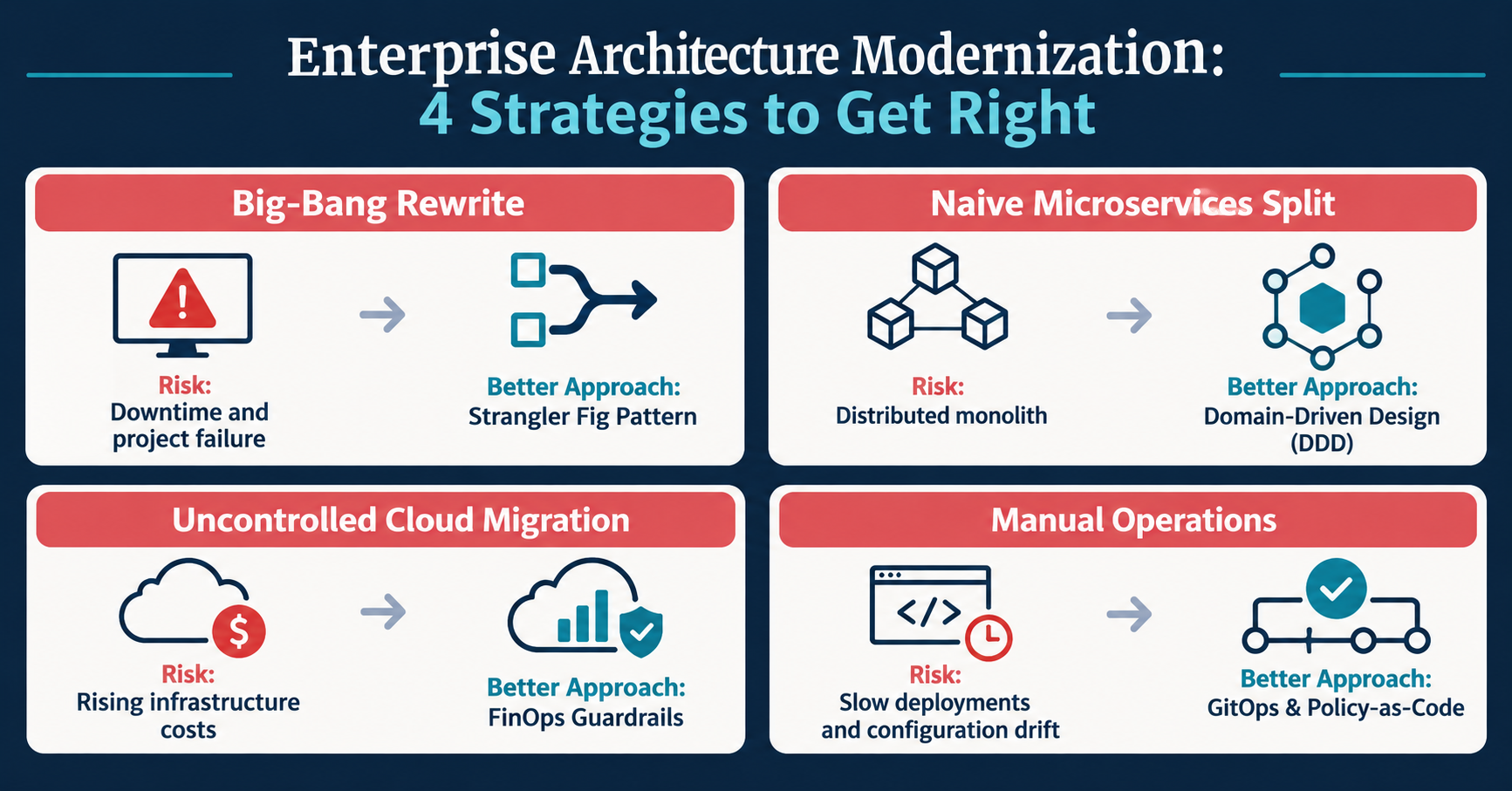
Architectural Strategy | Primary Risk & Anti-Pattern | Strategic Engineering Pattern | Business & Capital Impact |
|---|---|---|---|
Big-Bang Rewrite | Complete system downtime and high project failure rates exceeding 70%. | Strangler Fig Pattern: Incremental boundary extraction around core domains. | Protects revenue-critical workflows while modernizing underlying infrastructure. |
Naive Microservice Split | Distributed monoliths with high network latency and complex transactional logic. | Domain-Driven Design (DDD): Event-driven boundaries using Kafka or NATS. | Lowers operational coupling and improves fault tolerance under peak loads. |
Unbounded Cloud Migration | Uncontrolled resource consumption and inflated cloud infrastructure bills. | FinOps Architecture Guardrails: Strict memory/CPU quotas and spot instance pools. | Predictable monthly cloud expenditure with optimized unit economics. |
Manual Operations Model | Slow deployment velocity and configuration drift across staging and production. | Declarative GitOps & Policy-as-Code: Automated compliance scans via OPA/Kyverno. | Enables zero-downtime releases while enforcing continuous audit compliance. |
Key Dimensions for Evaluating Enterprise Architecture Maturity
Evaluating enterprise architecture maturity involves assessing how a consulting partner defines system boundaries, maintains architectural governance, manages data architecture, and transfers knowledge to internal teams.
1. System Boundary Definition
Avoid consulting approaches that split services arbitrarily based on database schemas or organizational silos. Instead, look for an enterprise architecture partner who defines event-driven domain boundaries through formal EventStorming sessions.
2. Governance & Quality Standards
Static PDF architectural decision records (ADRs) can quickly become outdated and fail to reflect ongoing system changes. Choose a partner who integrates automated architecture fitness functions directly into CI/CD pipelines to enforce architectural standards continuously.
3. Data Architecture
A shared, monolithic database accessed simultaneously by multiple microservices can create dependencies across system boundaries. Look for a partner who follows the database-per-service pattern, supported by event sourcing or CQRS read models.
4. Knowledge Transfer
Avoid vendor dependency where the core architectural rationale remains undocumented and internal teams lack the knowledge to maintain the system. A reliable enterprise architecture partner should provide pair architecture sessions, interactive C4 Model diagrams, and clear, hands-on offboarding.
Ready to Build a Scalable Enterprise Architecture?

How to Evaluate an Enterprise Software Architecture Consulting Partner
Evaluating an enterprise software architecture consulting partner requires scrutinizing their approach to system complexity, domain boundaries, and long-term maintainability. Modern architecture consulting is not about drawing static diagrams: it is about building resilient, evolutionary platforms that scale cleanly with business growth.
Engineering leaders must evaluate prospective partners across four critical operational dimensions:
1. Domain Extraction: Incremental Modernization vs. Full System Rewrites
A consulting partner advocating for a complete, from-scratch system rewrite is often ignoring business continuity risks. Top-tier software architects utilize proven evolutionary patterns, such as the Strangler Fig pattern, to systematically isolate and extract domain logic into independent microservices or modular monoliths without interrupting live business operations.
2. Architecture Fitness Functions for Continuous Governance
Traditional enterprise architecture often relies on sluggish, manual Architecture Review Boards (ARBs) that stall deployment pipelines. Modern consulting firms replace manual gatekeeping with automated Architecture Fitness Functions: code-level tests (using frameworks like ArchUnit or NetArchTest) that enforce architectural rules, code coupling limits, and dependency directions automatically inside CI/CD pipelines.
3. Data Architecture Strategy: Event-Driven Design vs. Shared Databases
A common failure in microservice implementations is retaining a single, monolithic database behind multiple independent services. A competent consulting firm establishes strict data isolation boundaries, employing patterns like CQRS (Command Query Responsibility Segregation) and Event Sourcing to decouple read/write paths and prevent database contention.
4. Managing Technical Debt and Long-Term Maintainability
Adding unnecessary distributed technology stacks (such as multi-region service meshes or complex orchestration layers) to simple domain problems introduces unsustainable operational overhead. Look for consulting partners who prioritize simplicity, using the C4 model to document architecture clearly across Context, Containers, Components, and Code.
Enterprise Architecture Evaluation: Red Flags and Best Practices
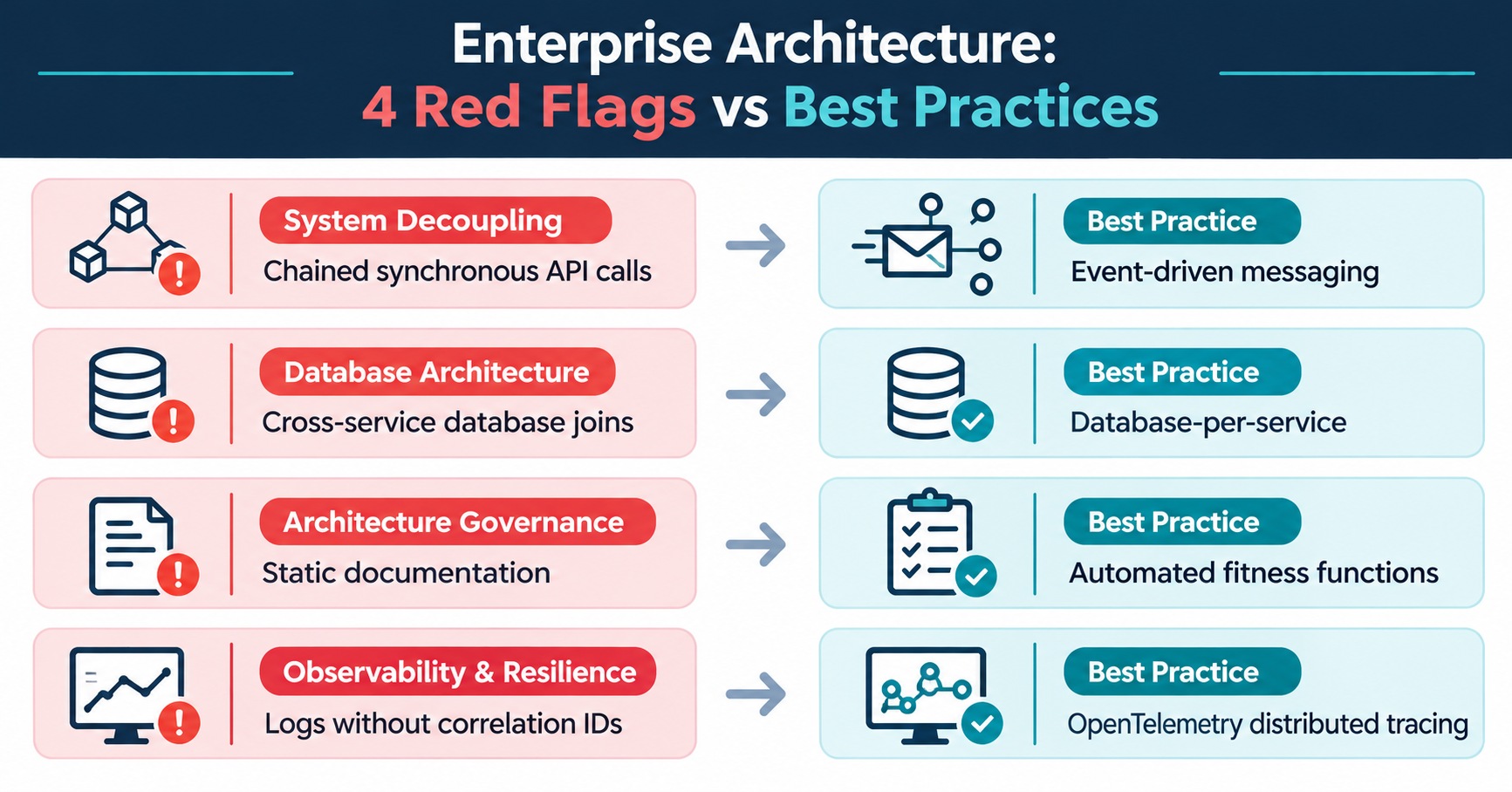
Evaluation Area | Major Architectural Red Flags (Avoid) | Strategic Enterprise Standards (Look For) |
|---|---|---|
System Decoupling | Tight synchronous REST/gRPC calls chaining multiple microservices sequentially. | Asynchronous, event-driven messaging pipelines using Kafka, RabbitMQ, or NATS. |
Database Architecture | Direct cross-domain database joins across microservice boundaries. | Database-per-service pattern with transactional outbox patterns for consistency. |
Architectural Governance | Static architectural PDFs stored in obscure wikis with zero pipeline enforcement. | Automated fitness functions preventing circular dependencies and invalid cross-module imports. |
Observability & Resilience | Monolithic log files without correlation IDs or distributed tracing headers. | OpenTelemetry integration with unified trace propagation across all service boundaries. |
Ready to Build a Scalable Enterprise Architecture?
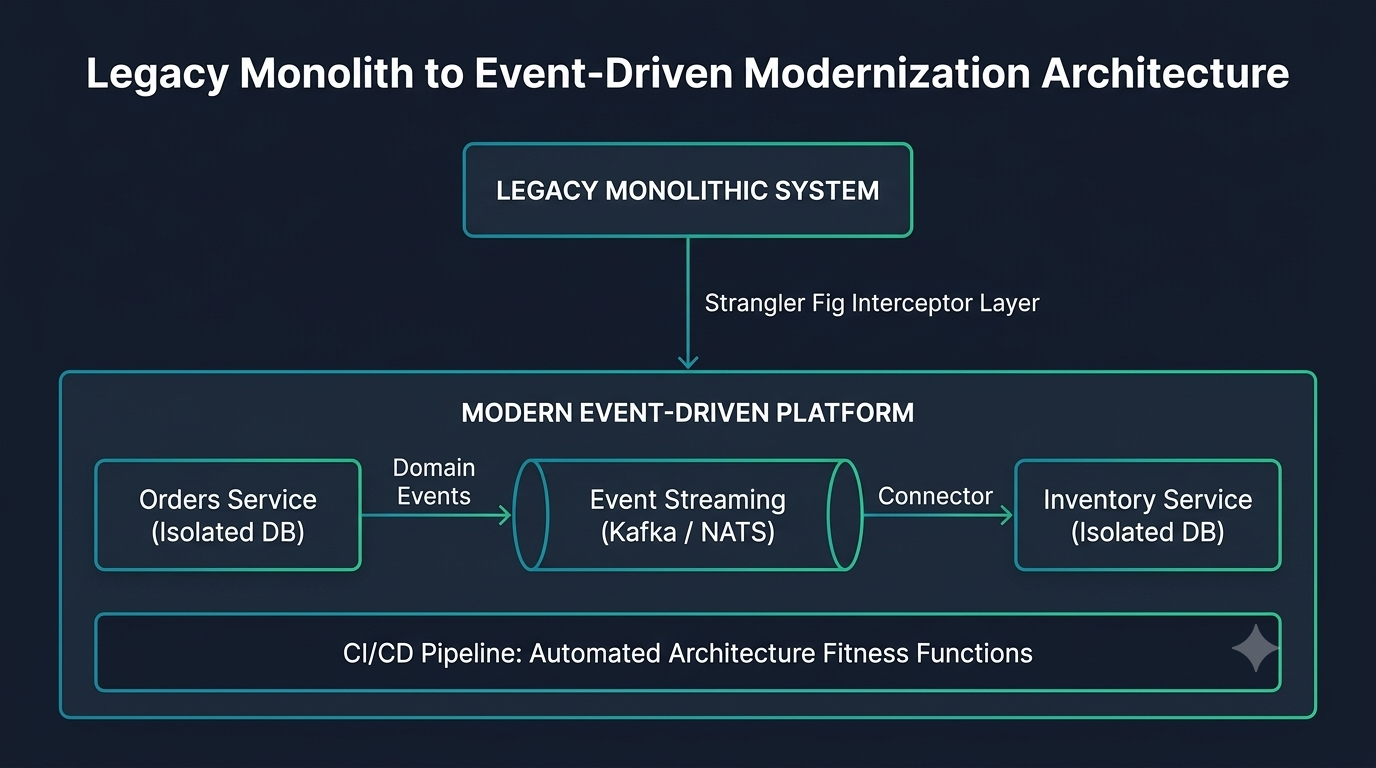
From Legacy Monolith to Event-Driven Architecture
The Hidden Production Trap
Distributed transactions using two-phase commits (2PC) across microservices introduce severe latency bottlenecks and availability risks. Leading enterprise architects enforce eventual consistency models using the Saga Pattern to manage distributed workflows safely.
Real-World Example: Modernizing a Legacy Core for Greater Scalability
An enterprise logistics platform was experiencing daily database locks and transaction timeouts during peak order processing windows due to an aging monolithic core.
Our architectural consulting team applied Domain-Driven Design (DDD) to isolate the core order-matching engine, implementing the Strangler Fig pattern to migrate traffic incrementally to an asynchronous event-driven platform.
The Measurable Impact:
Peak transaction throughput increased by 850% with zero downtime during the 4-month transition.
System-wide P99 response latency dropped from 2.4 seconds to under 180 milliseconds.
Cloud compute costs decreased by 42% through optimized, domain-specific resource allocation.
Complete architectural autonomy handed over to the internal team with fully automated fitness functions enforced in CI/CD.
10 Questions to Ask Before Choosing an Enterprise Architecture Consulting Partner
Before engaging an enterprise architecture consultancy, executive leadership should conduct a thorough technical audit. These questions help distinguish experienced enterprise software architects from traditional IT staff augmentation agencies.
1. Domain & System Modeling
Question: How do you discover and define system boundaries when decoupling a legacy enterprise monolith?
What to look for: The partner should use collaborative Domain-Driven Design (DDD) practices, such as Event Storming and Context Mapping, to align code with business subdomains.
2. Governance & Quality
Question: How do you ensure our internal developers do not violate architectural decisions six months down the road?
What to look for: Automated Architecture Fitness Functions, using tools such as ArchUnit or NetArchTest, that fail CI/CD builds when architectural regressions occur.
3. Data Consistency
Question: How do you handle complex distributed transactions across newly extracted microservices?
What to look for: An approach that avoids two-phase commits (2PC) in favor of asynchronous event-driven Saga patterns, transactional outboxes, and eventual consistency.
4. Documentation Standards
Question: What framework do you use to document system architecture for internal engineering teams?
What to look for: The C4 Model (Context, Containers, Components, Code) combined with Architecture Decision Records (ADRs) committed directly to Git.
5. Knowledge Transfer
Question: How do you ensure our in-house engineering team can maintain and evolve the architecture after off-boarding?
What to look for: Paired architecture sessions, hands-on domain modeling workshops, interactive runbooks, and a formal enablement phase before project completion.
Ready to Build a Scalable Enterprise Architecture?
Enterprise Architecture Modernization: A Four-Phase Implementation Plan
To maximize return on investment and reduce modernization risks, follow a structured four-phase approach that takes your enterprise architecture from initial assessment to full operational handover.
Phase 1: Architecture Audit & Domain Discovery (Weeks 1-3)
Start by understanding the existing system architecture and identifying areas that need improvement. Map legacy domain dependencies, analyze database query bottlenecks, and conduct Event Storming sessions with stakeholders to understand business workflows and define domain boundaries.
Expected outcome: A clear Context Map, a documented architectural decision log, and a quantified baseline of existing technical debt.
Phase 2: Target Platform & Governance Design (Weeks 4-7)
Define the target architecture based on the findings from the initial assessment. Establish C4 architecture models, design event-driven messaging contracts, and implement CI/CD architecture fitness functions to enforce design standards and prevent architectural regressions.
Expected outcome: A modern architectural blueprint supported by automated quality checks and governance guardrails.
Phase 3: Strangler Fig Extraction (Weeks 8-14)
Begin modernizing the legacy system incrementally using the Strangler Fig pattern. Deploy interceptor proxy layers, extract high-value bounded contexts, and migrate data using transactional outbox patterns. This allows new services to operate alongside the existing system during the transition.
Expected outcome: Core domain microservices running in production alongside legacy systems, with zero downtime during the transition.
Phase 4: Enablement & Operational Handover (Weeks 15-16)
Prepare internal teams to manage and maintain the modernized architecture independently. Conduct paired operations training, finalize C4 documentation, and transfer complete repository ownership to internal Site Reliability Engineering (SRE) teams.
Conclusion: Choosing the Right Enterprise Software Architecture Consulting Partner
Successful enterprise architecture modernization starts with clear business domains, well-defined system boundaries, and practical modernization strategies. The right approach improves scalability, maintainability, and operational efficiency without adding unnecessary complexity.
Choosing the right enterprise software architecture consulting partner can help reduce technical debt, modernize legacy systems, and improve system performance. Contact us today to discuss your requirements and build a scalable, resilient enterprise platform.