

Executive Summary
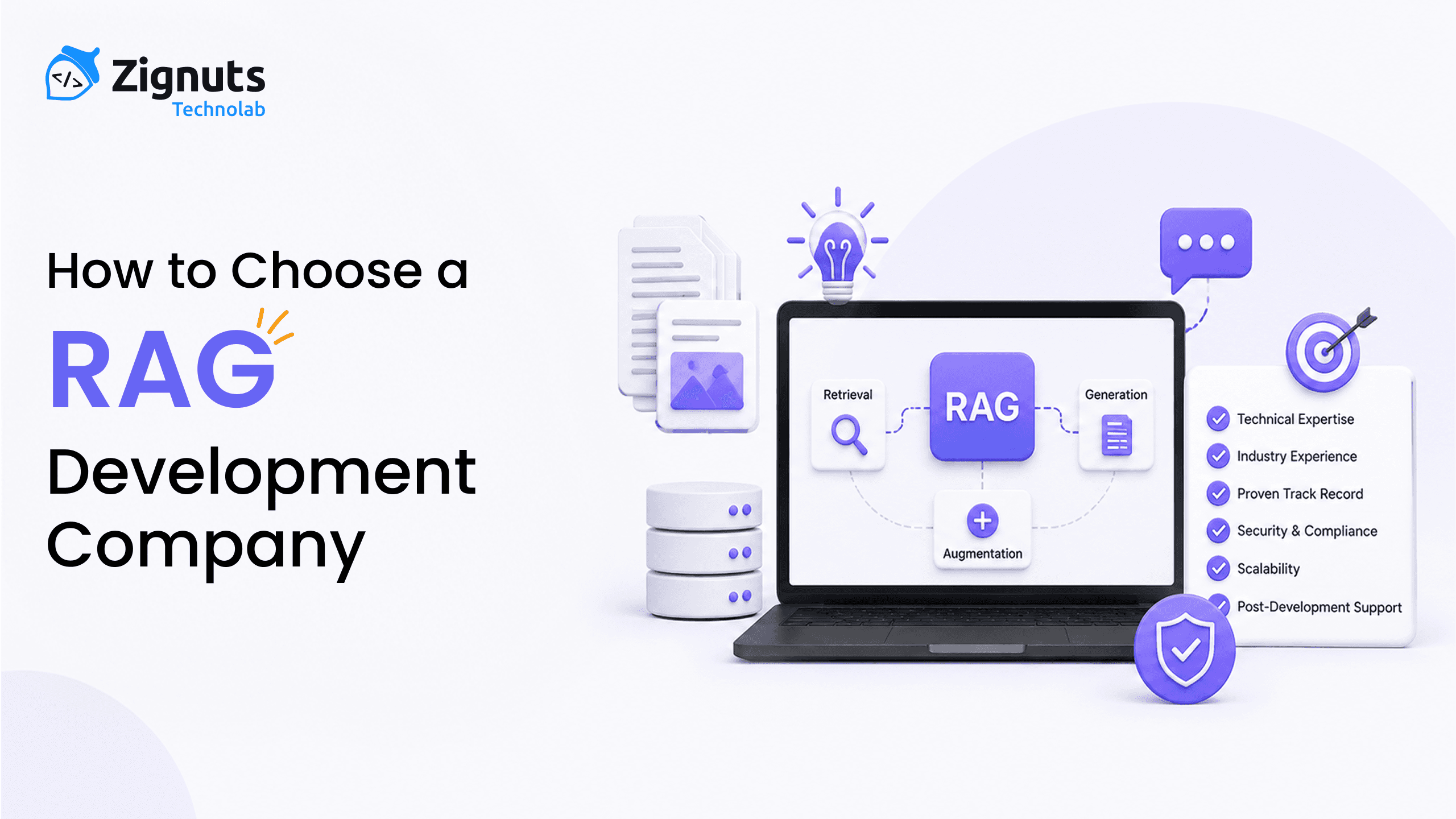
Choosing a RAG development company in 2026 requires vetting vendors as full-lifecycle information retrieval and systems engineering partners rather than prompt-writing agencies. RAG Development Services can support production-grade Retrieval-Augmented Generation through a multi-stage architecture that includes deep layout-aware document parsing, hybrid dense-sparse retrieval combining vector embeddings with BM25 keyword search, cross-encoder reranking, semantic prompt caching, and automated evaluation harnesses such as RAGAS or DeepEval.
Many naive RAG implementations struggle to progress beyond the pilot stage because vector similarity alone cannot reliably resolve exact entity matches, complex tabular data, multi-hop document reasoning, or row-level RBAC data governance. Technical leaders must evaluate partners across seven architectural pillars, demand production-tested case studies, and enforce full IP code ownership with zero black-box lock-in.
Why Naive RAG Fails in Enterprise Environments
For enterprise technology executives, 2026 represents a critical turning point in enterprise AI adoption. Building an internal search assistant or domain-specific copilot is no longer a research curiosity; it is a foundational enterprise capability. Grounding Large Language Models on private corporate knowledge bases promises to eliminate hallucinations, empower knowledge workers, and unlock immense institutional productivity.
Yet, selecting the right RAG development company has become a treacherous challenge. The market is flooded with software shops offering superficial 'wrapper RAG': agencies that connect an off-the-shelf vector database to a standard LLM API using basic text-splitter scripts. While these prototypes impress in clean sales demos, they fail when exposed to the messy reality of enterprise data.
Production enterprise corpora do not consist of clean paragraphs. They contain scanned PDFs with complex tables, multi-column research reports, domain-specific acronyms, regulatory citations, and strict access control lists. A naive RAG pipeline that splits text by character count severs table rows, blinds the model to exact product SKUs, and causes hallucination cascades.
Industry research and production benchmarking studies indicate that many naive RAG implementations struggle to progress beyond the pilot stage. Building a reliable enterprise RAG engine is an advanced software engineering discipline spanning data engineering, neural information retrieval, state graph routing, and security governance. Technical decision-makers must look past polished demo pitch decks to evaluate true systems engineering capability.
Why Vector-Only RAG Fails in Enterprise Search
Vector similarity search cannot reliably distinguish between "Contract signed on October 14, 2025" and "Contract draft terminated on October 14, 2025" because both statements can map to similar dense vector coordinates. In high-stakes enterprise domains like legal, finance, and healthcare, deploying vector-only search without lexical BM25 filtering and metadata scoping can create significant retrieval and governance risks.
Ready to Build Production-Ready RAG?

7 Technical Criteria for Evaluating a RAG Development Company
To filter out superficial agencies and identify production-grade engineering partners, enterprise technical leaders should evaluate candidates against seven concrete architectural pillars.
1. Multimodal Document Parsing & RAG Ingestion
Raw text extractors strip away headers, tables, charts, and document structure. A competent RAG development company builds layout-aware multimodal parsing pipelines using vision-based OCR, document parsing tools, or custom vision-language models that transform unstructured PDFs and spreadsheets into structured Markdown or semantic tree hierarchies.
Ask prospective vendors: How do you handle complex financial tables spanning multiple pages? If they rely on basic character-count chunking, their system may fail on enterprise financial reports.
2. Hybrid Search and Dense-Sparse Retrieval
Production retrieval requires a hybrid strategy. Dense embeddings capture broad semantic meaning, while sparse inverted indexes such as BM25 or SPLADE capture exact product codes, customer IDs, and specific acronyms.
Top-tier developers use Reciprocal Rank Fusion (RRF) or learned alpha-weighting to merge candidate pools, ensuring both conceptual relevance and exact-keyword accuracy.
3. Cross-Encoder Reranking and Context Compression
First-stage retrieval prioritizes recall by pulling a broad candidate set of 50 to 100 passages. Second-stage cross-encoder rerankers prioritize precision by evaluating the user query and each candidate chunk jointly.
Adding cross-encoder reranking can reduce irrelevant context before prompt generation, helping improve retrieval precision and reduce recurring token expenses.
4. GraphRAG for Multi-Hop Enterprise Retrieval
Standard chunk retrieval can struggle with complex questions requiring global synthesis across hundreds of documents, such as comparing supply chain risks across multiple suppliers against historical compliance audits.
RAG development firms can implement Knowledge Graph RAG (GraphRAG), extracting entity-relationship graphs into graph database systems to enable multi-hop relationship path traversal and hierarchical community summarization.
5. Automated RAG Evaluation and CI/CD Testing
Never evaluate production RAG systems only by manually typing queries into a playground UI. Production RAG engineering requires automated synthetic evaluation frameworks integrated directly into CI/CD deployment pipelines.
Vendors should demonstrate how their system measures key evaluation dimensions such as Faithfulness, Answer Relevancy, and Context Recall.
6. RAG Cost Optimization, FinOps & Semantic Caching
Without architectural cost governance, token expenses can scale unpredictably. A mature engineering partner can implement semantic prompt caching to intercept repeated queries and reduce unnecessary model calls.
In addition, teams can implement multi-tier model routing by dispatching smaller language models for query classification and metadata extraction while reserving more capable models for final synthesis.
7. Enterprise Security, RBAC & RAG IP Ownership
An enterprise RAG system must enforce row-level Role-Based Access Control (RBAC), filtering vector search results so employees only retrieve documents they are explicitly authorized to view through their enterprise identity and access-control systems.
Ensure the development partner clearly defines ownership and transfer rights for data pipelines, indexing scripts, prompt assets, infrastructure code, and other custom deliverables to avoid proprietary black-box lock-in.
Production Enterprise RAG Architecture: What to Look For
When interviewing candidate RAG engineering teams, ask them to diagram their complete production data flow. A robust enterprise system should clearly separate concerns across five distinct architectural stages.
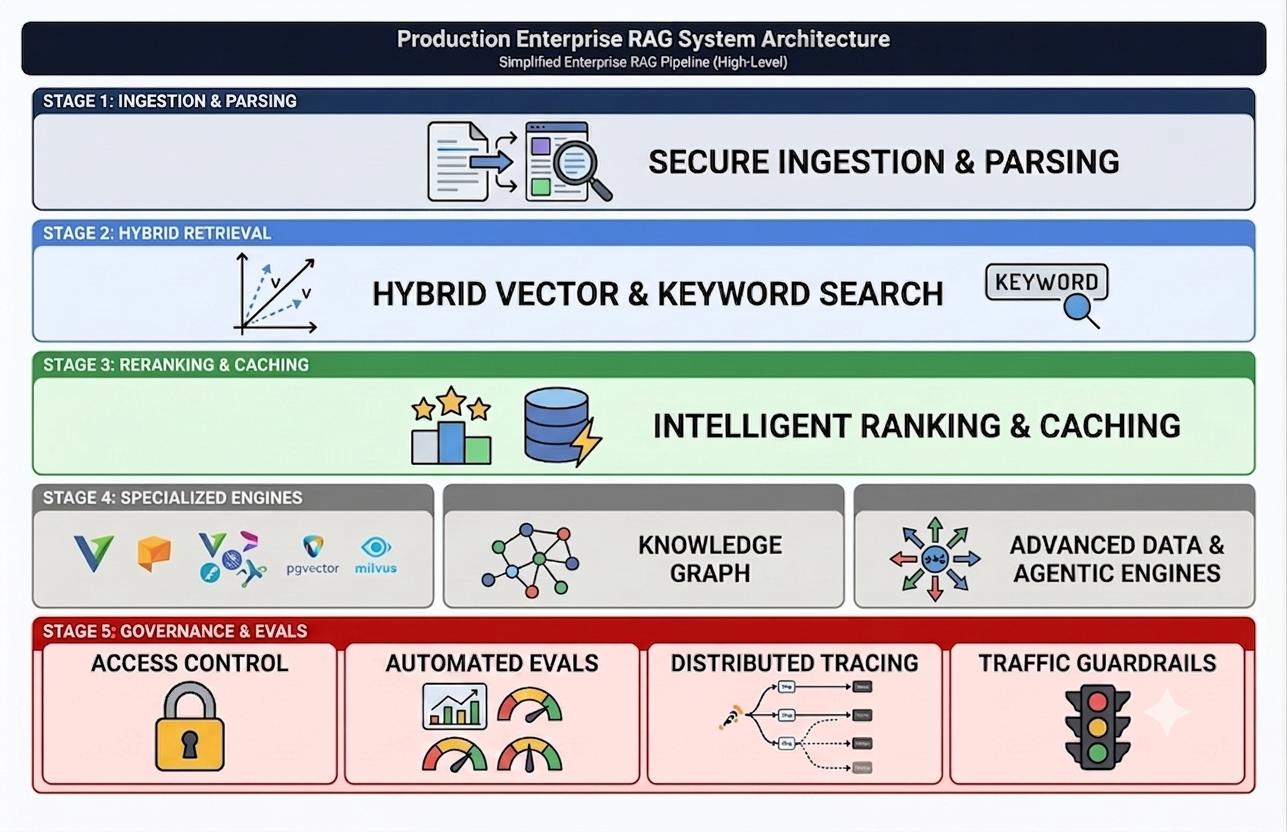
Production Enterprise RAG System Architecture Blueprint - A 5-stage distributed pipeline spanning Multimodal Ingestion, Hybrid Dense-Sparse Search, Cross-Encoder Reranking, Knowledge Graph Traversal, and Continuous Evals.
Ready to Build Production-Ready RAG?
RAG Development Company RFP Evaluation Framework
To objectively compare agency proposals and reduce the influence of sales presentations, procurement and engineering teams can apply a structured evaluation rubric during technical due diligence.
Evaluation Domain | Weight | Key Technical Due Diligence Verification Criteria | Critical Red Flag Warning |
|---|---|---|---|
1. Ingestion & Chunking Rigor | 20 Pts | Layout-aware document parsing, semantic chunking, and parent-child document schemas. | Using naive fixed character splits. |
2. Hybrid Retrieval & Ranking | 25 Pts | Unified dense and BM25 sparse search with Reciprocal Rank Fusion and cross-encoder reranking. | Relying exclusively on vector similarity search without keyword or metadata filtering. |
3. Security, RBAC & Compliance | 20 Pts | Row-level metadata filtering, private VPC deployment, PII masking, and applicable security controls. | Embeddings stored in a shared environment without appropriate access controls. |
4. Automated Eval Harnesses | 15 Pts | Continuous automated regression evaluations measuring Faithfulness, Answer Relevancy, and Context Recall. | Testing exclusively through manually entered questions in a web playground. |
5. FinOps & Latency Controls | 10 Pts | Semantic prompt caching, model routing, and context pruning. | Streaming excessive raw unranked tokens into expensive reasoning models for every query. |
6. Full IP & Code Ownership | 10 Pts | Transfer of data pipelines, indexing scripts, prompt assets, and private cloud deployment code. | Proprietary black-box vendor platform lock-in with ongoing platform fees. |
6 Red Flags When Choosing a RAG Development Company
During vendor discovery calls, watch out for these six common red flags that may indicate a team lacks production engineering maturity.
Vendor Red Flag | What the Vendor Claims | The Production Failure Risk |
|---|---|---|
1. Vector-Only Evangelism | "Vector search is all you need; embeddings understand everything." | Potential failure on exact part numbers, contract IDs, and financial metrics. |
2. Fixed-Character Chunking | "We split documents every 1,000 characters to keep things fast." | Table corruption, severed clauses, and degraded contextual accuracy. |
3. Omission of Rerankers | "Reranking adds too much latency; top-5 vector matches are sufficient." | Potential precision loss and irrelevant passages entering generation prompts. |
4. Playground-Only Testing | "We test sample queries and verify answers look accurate." | Limited regression protection when models or data change. |
5. Ignored Access Governance | "We will ingest all company files so the AI knows everything." | Potential data exposure when confidential information is not properly partitioned. |
6. Proprietary Black Box | "Use our proprietary hosted RAG cloud and pay per query." | Potential loss of data sovereignty, vendor lock-in, and unpredictable subscription fees. |
Ready to Build Production-Ready RAG?
RAG Development Company Engagement Models: Discovery, Co-Development & Staff Augmentation
Selecting the right commercial model is just as critical as choosing the technical stack. The table below outlines common engagement structures across cost predictability, delivery velocity, and operational risk.
Engagement Model | Optimal Use Case | Cost Predictability | Delivery Velocity | Strategic Risk Profile |
|---|---|---|---|---|
Fixed-Price Architecture & PoC | Corpus audit, feasibility validation, and initial 3- to 5-week prototype development. | High | High | Validates retrieval accuracy before committing to a larger build. |
Dedicated Co-Development Squad | Full-scale production build, multi-source ingestion, and enterprise ERP/CRM integration. | High | Maximum | Combines senior architecture expertise with internal teams while supporting knowledge and IP transfer. |
Staff Augmentation (T&M) | Filling niche skills such as adding a retrieval engineer to an existing mature AI team. | Medium | Medium | Requires strong internal technical leadership and project management. |
RAG Development Company Case Studies and Engineering Experience
A credible enterprise RAG engineering partner should demonstrate relevant outcomes across regulated and high-throughput environments. Below are four production implementations that showcase practical RAG and AI engineering experience.
Real-World Implementation Spotlight: AI Legal Research Assistant
Business Challenge: Legal practitioners and corporate compliance teams needed faster and more reliable ways to query statutory codes, case precedents, and complex agreements.
Engineered Solution: A domain-specific Hybrid RAG engine paired dense vector embeddings with BM25 keyword search, contextual citation graphs, domain-specific embeddings, and hallucination verification guardrails.
Business & ROI Impact: The implementation improved document retrieval and supported faster audit workflows while reducing unnecessary context in retrieval pipelines.
Real-World Implementation Spotlight: Build and Deploy AI Agents Platform
Business Challenge: Enterprise technology teams needed a more structured way to orchestrate custom multi-agent workflows across disconnected internal services.
Engineered Solution: A modular AI agent deployment platform featured visual DAG state orchestration, standardized LLM routing pipelines, persistent vector memory stores, and containerized tool execution sandboxes.
Business & ROI Impact: The platform was designed to improve agent deployment workflows, reduce unnecessary infrastructure overhead, and support reusable orchestration patterns.
Real-World Implementation Spotlight: AI-Driven Productivity Tools
Business Challenge: Distributed enterprise teams faced context switching, unstructured communication, and institutional knowledge scattered across email, documents, and collaboration channels.
Engineered Solution: Context-aware workplace copilots were deployed with real-time NLP summarization, semantic vector retrieval pipelines, and automated action-item extraction.
Business & ROI Impact: The solution supported unified institutional knowledge discovery and more efficient information retrieval across distributed teams.
Real-World Implementation Spotlight: AI Health App Development
Business Challenge: A digital health provider required an intelligent clinical triage assistant capable of working with sensitive patient information while following healthcare data governance requirements.
Engineered Solution: The solution included encrypted data exchange pipelines, PII de-identification filters, FHIR/HL7 interoperability interfaces, role-based access control, and audit logging.
Business & ROI Impact: The architecture incorporated security and governance controls into the application and integration layers to support responsible handling of sensitive healthcare data.
Ready to Build Production-Ready RAG?
5 Steps to Choose the Right RAG Development Company
To transition from vendor evaluation to successful execution, engineering leaders should follow this five-step operational roadmap:
Benchmark Your Data Corpus: Audit your enterprise documents. Identify whether your corpus is dominated by unstructured prose, complex tables, scanned PDFs, or relational databases.
Run a Structured Technical Due Diligence Call: Provide candidate vendors with the 100-point scorecard. Require their lead architect to explain ingestion, chunking, cross-encoder reranking, and evaluation methodologies.
Mandate a Paid 3-Week Discovery & Architecture Sprint: Before committing to a multi-month build, fund a focused discovery phase to deliver a comprehensive Technical Architecture Document (TAD), cost model, and working proof of concept.
Establish Synthetic Evaluation Baselines Early: Ensure the vendor defines golden test datasets and accuracy metrics before writing production orchestration logic.
Secure Complete IP and Code Transfer: Guarantee that all source code, vector schemas, data pipelines, and CI/CD configurations reside within your organization's private repositories.
Conclusion
Choosing a RAG development company requires more than comparing AI demos or basic vector search implementations. Enterprise RAG needs a reliable architecture that combines document ingestion, hybrid retrieval, reranking, evaluation, security, cost optimization, and clear IP ownership.
Before selecting a development partner, evaluate how well they understand your data, retrieval requirements, security model, integration landscape, and long-term operational needs. A structured technical evaluation, proof of concept, and clear ownership terms can help reduce implementation risks and establish a stronger foundation for production deployment.
Whether you are planning a new enterprise RAG system, modernizing an existing retrieval pipeline, or evaluating RAG development partners, contact us today to discuss your requirements and explore a practical approach to building a secure, scalable RAG solution.

Mukund Patil
Business Enthusiast | Exploring ideas, trends, and opportunities, turning curiosity into meaningful insights and discovering smarter ways to make an impact.