

Introduction
Retrieval-Augmented Generation (RAG) has become one of the most important techniques in modern AI applications. It helps Large Language Models (LLMs) access external knowledge instead of relying only on what they learned during training.
Traditional RAG works by breaking documents into chunks, converting them into vector embeddings, and retrieving the most relevant pieces when a user asks a question.
This approach works well for many use cases, but as AI applications become more complex, their limitations are becoming clear.
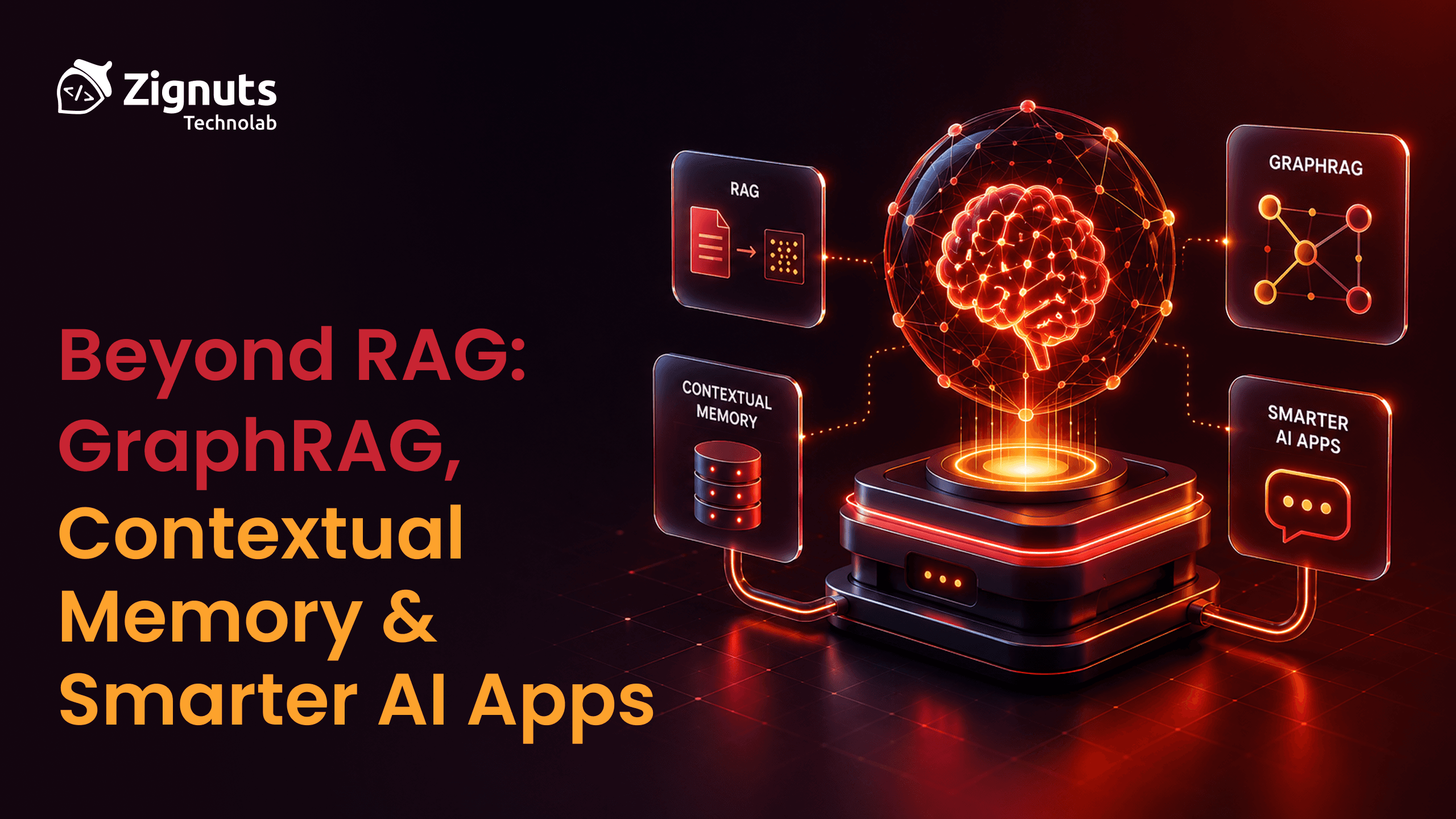
Today, the industry is moving beyond basic vector search toward two major innovations:
GraphRAG – helping AI understand relationships between information.
Contextual Memory – helping AI remember users, conversations, and events over time.
Together, these technologies are shaping the next generation of AI systems.
The Problem with Traditional RAG
Standard RAG is built on semantic similarity.
When a user asks a question, the system finds document chunks that appear semantically similar and sends them to the LLM.
While effective, this approach suffers from a major problem: context blindness.
Common issues include:
False Positives
The system retrieves information that looks similar but is not actually relevant.
False Negatives
Important information is missed because it uses different wording.
Poor Multi-Hop Reasoning
Traditional RAG struggles when information is spread across multiple documents and needs to be connected.
No Native Aggregation
If a user asks: "What is the total value of all invoices from last year?"
Vector search can retrieve invoice documents, but it cannot perform calculations or aggregations on its own.
These limitations led to the rise of more advanced architectures.
Enter GraphRAG
GraphRAG introduces structure into the retrieval process.
Instead of treating documents as isolated chunks, GraphRAG converts knowledge into a network of:
Nodes → Entities
Edges → Relationships between entities
This creates a knowledge graph that AI can navigate.
Rather than simply asking:
"Which chunk is most similar?"
The system can ask:
"How are these entities connected?"
This enables deeper reasoning and better retrieval.
How GraphRAG Works
1. Extract Entities and Relationships
The system scans documents and identifies:
People
Organizations
Products
Events
Relationships
These become nodes and edges in a knowledge graph.
2. Build Communities
Large graphs quickly become difficult to navigate.
GraphRAG uses clustering techniques such as:
Leiden
Louvain
These algorithms group related entities into communities.
For example:
AI Community
LLMs
RAG
Embeddings
Vector Databases
Finance Community
Invoices
Revenue
Fiscal Year
Payments
3. Create Community Summaries
Once communities are identified, the LLM generates summaries for each cluster.
These summaries become a powerful abstraction layer that helps the system understand large datasets at a high level.
Local Search vs Global Search
GraphRAG introduces two retrieval modes.
Local Search
Best for highly specific questions.
Example:
"Who manages Project Phoenix?"
The system searches around the relevant entity and its immediate connections.
Global Search
Best for broad questions.
Example:
"What are the major challenges discussed across all engineering reports?"
Instead of reading thousands of documents, the system analyzes community summaries and generates a dataset-wide understanding.
DRIFT Search: The Next Step
Real-world questions often require both a broad understanding and detailed facts.
This is where DRIFT Search comes in.
DRIFT stands for:
Dynamic Reasoning and Inference with Flexible Traversal
The process works like this:
Generate a hypothetical ideal answer.
Use it to find relevant communities.
Create follow-up questions.
Explore deeper graph connections.
Combine everything into a final answer.
This approach allows GraphRAG to balance:
High-level insights
Detailed evidence
Multi-hop reasoning
Benchmark results showed that DRIFT Search produced:
More comprehensive answers
Greater diversity of insights
Better supply chain and root-cause analysis
( Compared to standard graph retrieval methods.)
Ready to Build Smarter, Memory-Driven AI Applications?

Is GraphRAG Always Better?
Surprisingly, no.
Research shows that GraphRAG is not universally superior to traditional RAG.
Traditional RAG Wins When:
Questions require simple factual lookups
Information exists in a single document
Speed is critical
Example:
"What is our refund policy?"
Vector search can answer this very efficiently.
GraphRAG Wins When:
Information is spread across multiple sources
Relationships matter
Multi-hop reasoning is required
Large-scale summarization is needed
Example:
"How have international shipping policies changed over the past two fiscal years?"
This requires connecting multiple documents and understanding relationships.
The Rise of Contextual Memory
While GraphRAG solves knowledge retrieval, it does not solve another major challenge:
AI forgets.
Most LLMs are stateless.
Once a conversation exceeds the context window, the model loses access to earlier information.
This creates problems such as:
Forgetting user preferences
Repeating questions
Losing long-term goals
Breaking multi-session workflows
To solve this, AI systems need memory.
What Is Contextual Memory?
Contextual memory is more than storing conversation history.
A true memory system:
Extracts important information
Stores it permanently
Updates outdated facts
Retrieves relevant memories when needed
The goal is to make AI behave consistently across weeks or months of interactions.
Why Memory Matters for AI Agents
Modern AI is moving beyond chatbots.
Agents are expected to:
Work over weeks or months
Remember user goals
Track project progress
Maintain context across sessions
Without memory, these workflows eventually fail.
With memory, AI can become a persistent digital collaborator.
The Future: GraphRAG + Contextual Memory
The most powerful AI systems will combine both technologies.
GraphRAG Answers:
"What does the organization know?"
It structures company knowledge and enables reasoning across large datasets.
Contextual Memory Answers:
"What do I know about this user?"
It tracks preferences, history, goals, and previous interactions.
Together, they create a unified architecture:
Enterprise Knowledge + User Memory + LLM Reasoning = Next-Generation AI Applications
What This Means for Your AI Apps
If you're building AI products today, traditional vector RAG is no longer the end goal.
The industry is moving toward systems that can:
Understand relationships between information
Perform multi-hop reasoning
Remember users over time
Adapt to changing facts
Maintain long-term context
For simple search applications, traditional RAG may still be enough.
But for enterprise assistants, autonomous agents, customer support systems, and knowledge platforms, GraphRAG and contextual memory are quickly becoming essential components.
Conclusion
RAG is no longer just about vector search; it's evolving into a smarter, more connected intelligence layer. GraphRAG enables AI to understand deep relationships and reason across complex, multi-source knowledge bases, while contextual memory ensures AI systems remember users, goals, and history over the long term. Together, they move AI from a stateless question-answering tool to a persistent, reasoning collaborator capable of handling real-world enterprise challenges. Whether you're building autonomous agents, customer support systems, or knowledge platforms, adopting these technologies is no longer optional; it's the competitive edge. Ready to build smarter AI applications? Contact Zignuts today, and let's bring your next-generation AI vision to life.

Ekta Trivedi
A Node.js enthusiast focused on building scalable, high-performance applications that power the next generation of web technologies