

AI Workflow Automation Services: From Task Automation to Intelligent Workflows
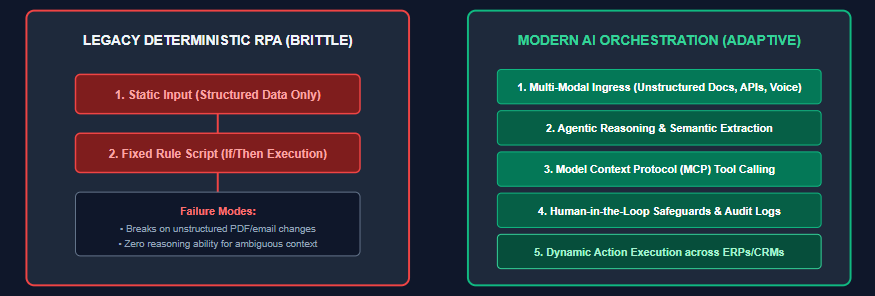
Enterprise process automation in 2026 has undergone a fundamental transformation. For over a decade, organisations relied on legacy Robotic Process Automation (RPA) and rigid linear workflow tools to automate routine tasks. While effective for predictable, rule-based operations, traditional automation breaks down when confronted with unstructured data, ambiguous business context, or dynamic decision-making. AI Workflow Automation Services address this gap by combining intelligent automation with AI-driven decision-making for more complex enterprise processes.
The emergence of enterprise AI workflow automation services bridges this critical gap. Modern AI automation shifts the focus from rigid, deterministic scripts to intelligent, agentic orchestration. Instead of merely executing a pre-programmed sequence of if/then steps, AI-driven workflows utilise Large Language Models (LLMs), Small Language Models (SLMs), and autonomous agents to reason through complex tasks, interpret multi-format unstructured documents, and execute multi-system business actions.
However, transitioning from static task automation to dynamic AI orchestration introduces significant architectural challenges. Technology leadership must ensure system reliability, prevent non-deterministic agent loop failures, maintain strict data security compliance, and enforce human oversight on high-risk operations. Successfully deploying enterprise AI workflow automation requires a robust, decoupled platform architecture capable of orchestrating stateful intelligent agents across legacy ERPs, CRMs, and core systems of record.
Ready to Automate Your Business Workflows?

Core Capabilities of AI Workflow Automation Services
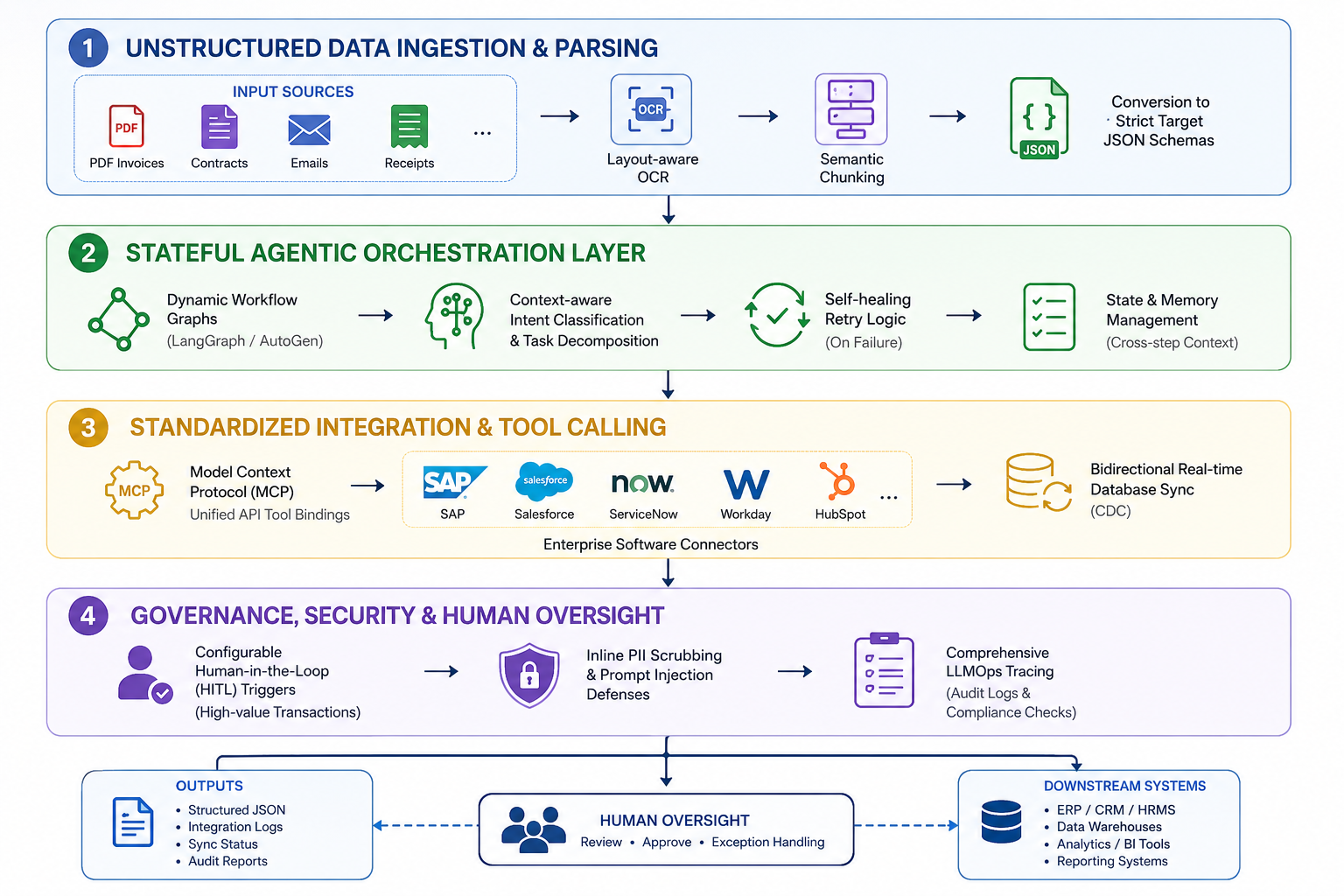
Building resilient AI workflow automation requires implementing specialised engineering capabilities across four distinct functional layers:
1. Unstructured Data Processing & Extraction for AI Workflows
In modern enterprise environments, over 80% of actionable business data resides in unstructured formats such as contracts, purchase orders, customer support threads, and claims documentation. AI workflow automation services utilize specialized Vision-Language Models (VLMs) and layout-aware extraction pipelines to parse complex documents, convert raw context into structured JSON, and map values directly into target system schemas without manual human intervention.
2. Stateful Agentic Workflow Orchestration
Unlike rigid linear workflows, intelligent automation services deploy stateful multi-agent systems. These autonomous agents evaluate task objectives, break complex multi-step processes into sub-tasks, execute parallel queries, and dynamically handle unexpected edge cases. By utilising graph-based execution engines (such as LangGraph), workflows can pause, preserve execution state, solicit clarification, or retry failed integration calls automatically.
3. Standardized Tool Calling with Model Context Protocol (MCP)
Connecting non-deterministic AI models to deterministic enterprise systems requires safe, standardised interfaces. Modern AI workflows utilise open standards like the Model Context Protocol (MCP) to bind AI agents to enterprise APIs, SQL databases, and internal microservices. This ensures that tool invocation is strictly typed, validated, and logged across core platforms like SAP, Salesforce, ServiceNow, and custom SaaS products.
4. Human-in-the-Loop Governance for AI Workflow Automation
Complete autonomy can introduce severe business risks when executing irreversible or high-value actions. Enterprise AI workflow services incorporate policy-driven HITL guardrails. If an autonomous agent encounters low confidence scores during extraction, calculates a transaction above a designated financial threshold, or prepares an external financial transfer, the workflow automatically routes the request to human operators for review before proceeding with system writes.
Ready to Automate Your Business Workflows?
How AI Workflow Automation Services Work in an Enterprise Environment
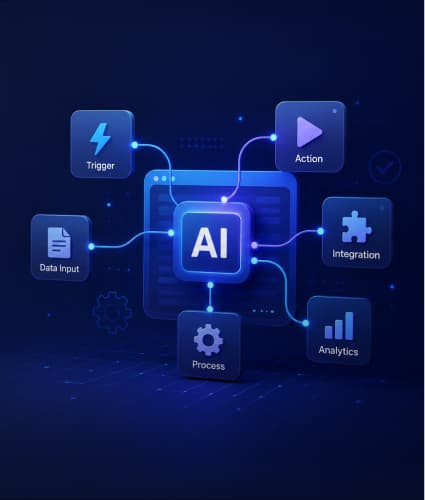
Enterprise AI workflow automation typically connects business inputs, AI reasoning, workflow orchestration, enterprise systems, and human review into a controlled execution pipeline. Instead of treating AI as an isolated feature, the workflow coordinates multiple components to complete a business process from intake to final action.
A typical enterprise workflow can follow these stages:
Input & Data Ingestion: Collect information from emails, documents, forms, applications, APIs, and business systems.
AI Processing & Understanding: Use LLMs, VLMs, or specialised models to classify content, extract information, interpret context, or determine the next action.
Workflow Orchestration: Maintain workflow state, coordinate agents and tools, manage dependencies, and handle retries or exceptions.
Enterprise System Execution: Connect with ERP, CRM, databases, SaaS platforms, and internal APIs through controlled integrations.
Validation & Human Review: Apply business rules, confidence thresholds, approval policies, and Human-in-the-Loop controls before sensitive actions.
Monitoring & Audit: Track workflow execution, model behaviour, tool calls, failures, token usage, and business outcomes for ongoing optimisation.
This section gives readers a clear end-to-end picture of how the technology described throughout the article actually works.
Enterprise Use Cases for AI Workflow Automation Services
AI workflow automation services drive operational efficiency and cost reduction across core business units:
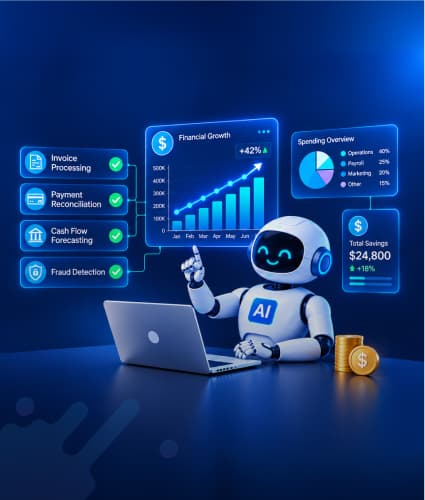
1. AI Workflow Automation for Financial Operations & Accounts Payable
Process: Autonomous processing of global supplier invoices across varied formats, multi-currency conversions, and tax regulations.
Workflow Automation: Vision-LLMs extract line items from incoming PDFs, validate values against purchase orders in ERP systems (e.g., SAP), perform two-way/three-way matching checks, flag discrepancies for human review, and schedule batch payments automatically upon validation.
2. AI Workflow Automation for Customer Support & Ticket Resolution
Process: Processing high-volume tier-1 and tier-2 customer inquiries across email, portal messages, and chat channels.
Workflow Automation: Intelligent agents analyse inbound ticket sentiment, parse attachments, query internal knowledge bases (via RAG), fetch customer account status from CRM systems, execute account modifications, and formulate personalised response drafts or complete end-to-end resolutions.
3. AI Workflow Automation for Insurance Claims & Underwriting
Process: Multi-step intake, validation, and risk assessment of commercial insurance claims.
Workflow Automation: Dynamic workflows collect loss documentation, run automated fraud-detection checks against historical claims data, cross-reference coverage policy rules, calculate preliminary payout amounts, and route complex cases directly to specialised adjusters with pre-filled summary briefs.
4. AI Workflow Automation for Supply Chain & Purchase Order Fulfillment
Process: Managing supplier communications, order confirmation tracking, and inventory fulfilment updates.
Workflow Automation: AI workflows monitor incoming logistics emails, extract tracking numbers and estimated delivery dates, update ERP supply chain records in real time, generate inventory re-order alerts when stock falls below thresholds, and notify account managers of potential delays.
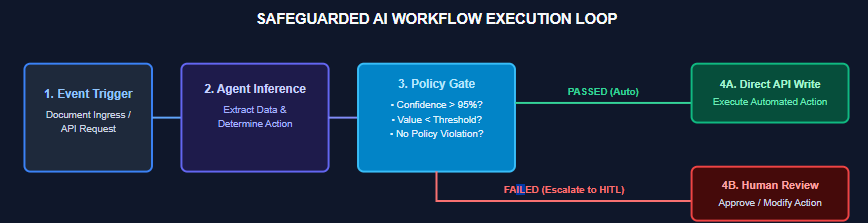
Preventing Runaway Agent Loops in AI Workflow Automation
A critical operational risk in enterprise AI workflow automation is the unbounded agent loop. When an autonomous workflow encounters an unexpected schema change or a non-responsive downstream API, a basic agent loop can repeatedly retry the action, consuming thousands of reasoning tokens per minute and sending flooding requests to internal services. Production workflow architectures must incorporate strict loop execution caps, exponential backoff circuits, maximum step token limits, and automated dead-letter queues (DLQs) to prevent resource exhaustion and runaway cloud expenses.
Ready to Automate Your Business Workflows?
Enterprise AI Workflow Automation Engineering Approach
Building, deploying, and scaling enterprise-grade AI workflow automation requires strong platform engineering, secure system integration, and reliable orchestration practices. A well-designed approach should address both the intelligence of AI agents and the operational requirements of enterprise systems.
Key engineering capabilities include:
Custom Stateful Workflow Orchestration: Designing stateful agent systems with graph-based engines such as LangGraph and standardised Model Context Protocol (MCP) tool bindings for reliable multi-system execution.
Unstructured Data Extraction Pipelines: Building document processing pipelines with Vision-Language Models, multi-page layout parsing, and automated JSON schema validation for complex business documents.
Enterprise Integration & API Adapters: Connecting AI workflows with legacy ERPs, CRMs, relational databases, and microservices through secure APIs and event-driven messaging architectures such as Kafka and RabbitMQ.
LLMOps, Security & Guardrail Infrastructure: Implementing PII sanitisation, rate limiting, token usage monitoring, and Human-in-the-Loop review workflows aligned with recognised AI security and governance practices.
A structured engineering approach helps organisations reduce integration complexity, improve workflow reliability, and deploy AI automation with appropriate security, monitoring, and governance controls.
AI Workflow Automation Services: Getting Started
Enterprise AI workflow automation services allow modern organisations to transform complex, document-heavy operational bottlenecks into streamlined, intelligent processes. By deploying stateful agent engines, standardised tool integrations, and appropriate governance guardrails, technology executives can improve workflow efficiency while maintaining system reliability and data security.
If your engineering leadership team is evaluating AI workflow automation services, replacing legacy RPA scripts, or architecting secure multi-agent systems, contact us today to discuss your requirements and explore a practical roadmap for implementing AI workflow automation.

Utkrishti Mishra
Business Analyst Intern | Exploring data, processes, and business strategies to turn insights into smarter decisions and impactful solutions.