

Enterprise AI architecture is no longer just about choosing an LLM and connecting it to an application.
A production AI system may need to connect models, enterprise data, vector databases, APIs, business systems, workflow engines, security controls, observability platforms, and human approval processes.
That makes architecture one of the most important decisions an organization makes when moving AI from experimentation into production.
A useful enterprise AI architecture should answer five questions:
Where does enterprise data come from?
Which AI model or models should process it?
How does the AI interact with business systems?
How are security, governance, and reliability enforced?
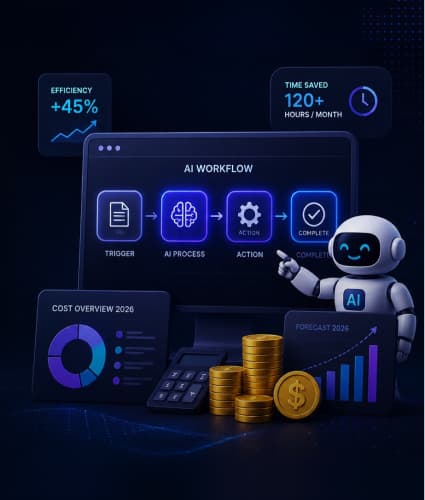
How does the organization measure cost and business value?
This becomes increasingly important as AI investment grows. Deloitte's 2026 AI infrastructure research found that 86% of surveyed organizations expect their AI infrastructure budgets to increase over the next three years, with average budgets expected to more than triple.
The same research highlights model selection, token consumption, workload placement, cost transparency, governance, and operational resilience as increasingly important architectural decisions.
At the same time, IBM reports that only 25% of AI initiatives are currently delivering their expected ROI and only 16% have scaled enterprise-wide.
The implication is important:
Enterprise AI architecture should be designed for business value, security, operational control, and scale from the beginning, not added after an AI prototype starts working.
Ready to Build an Enterprise AI Architecture That Scales?

Enterprise AI Architecture at a Glance
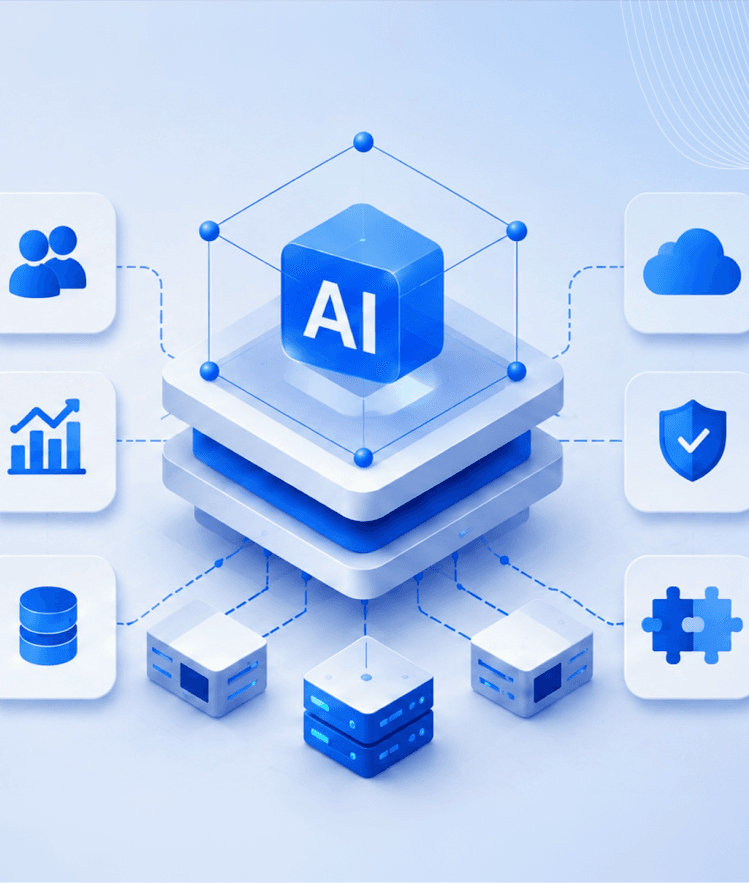
A modern enterprise AI system can be viewed as a set of connected layers.
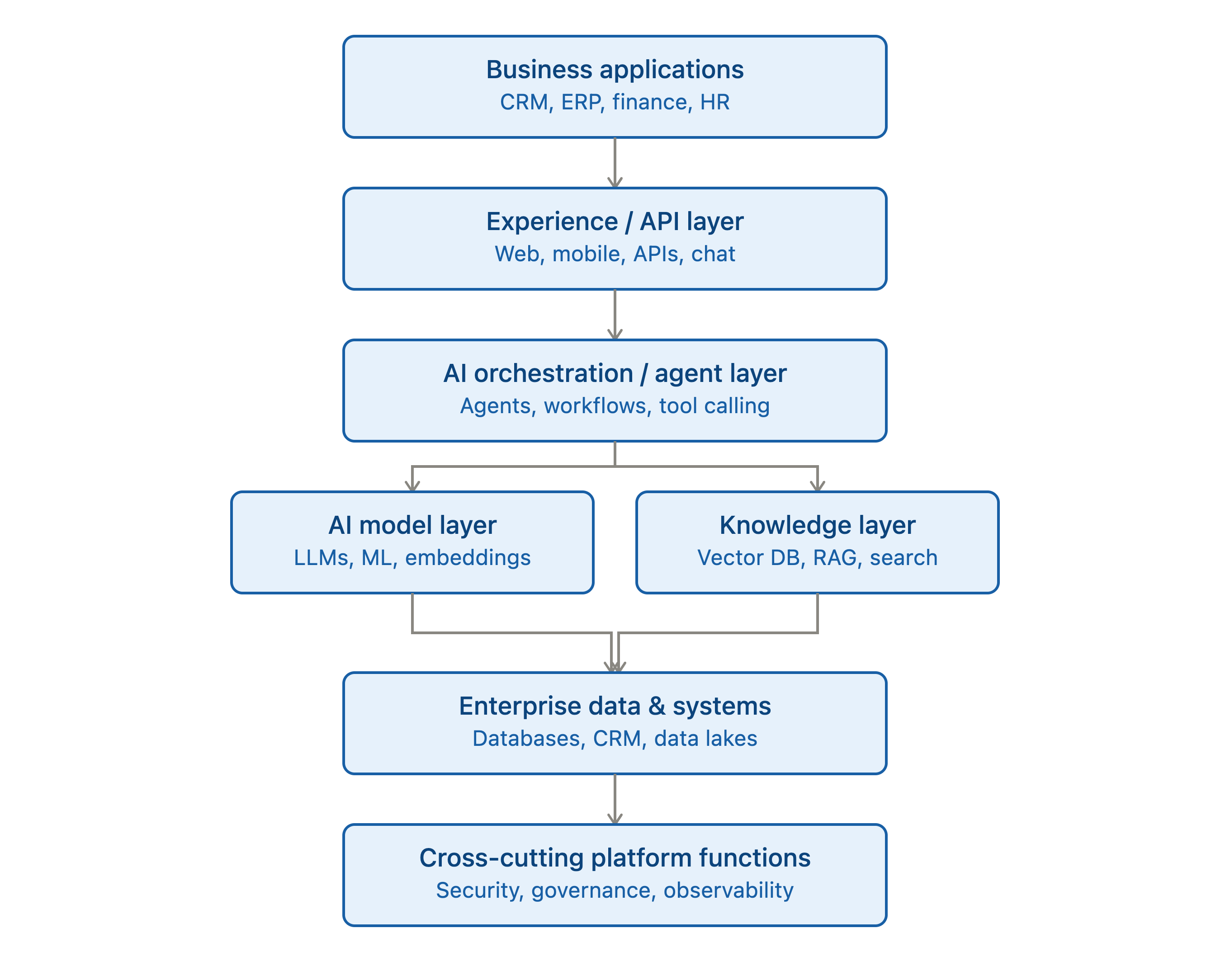
This is not a single technology stack.
It is an architectural model that allows organizations to choose different technologies for different requirements.
What Is Enterprise AI Architecture?
Enterprise AI architecture is the design of the software, data, infrastructure, AI models, integrations, security controls, and operational systems required to deploy AI reliably across an organization.
Unlike a simple AI application, enterprise architecture must account for:
Architecture Concern | Enterprise Requirement |
|---|---|
Data | Secure access to internal and external data |
Models | Appropriate model selection and routing |
Knowledge | RAG, vector search, enterprise search |
Integration | APIs, ERP, CRM, SaaS and legacy systems |
Orchestration | Workflows, agents and tool execution |
Security | Authentication, authorization and isolation |
Governance | Policies, auditability and risk controls |
Reliability | Retries, fallbacks and failure handling |
Scalability | Traffic, data and inference growth |
Observability | Logs, metrics, traces and AI evaluation |
Cost | Token, compute, storage and infrastructure control |
Human oversight | Approval and escalation mechanisms |
The architecture should not be designed around the model alone.
The model is one component in a larger system.
Ready to Build an Enterprise AI Architecture That Scales?
Why Enterprise AI Architecture Is Different From Traditional Application Architecture
Traditional cloud applications generally focus on:
Application servers
Databases
Networking
Authentication
Storage
Scaling
AI applications introduce additional concerns.
Traditional Application | Enterprise AI Application |
|---|---|
Application logic | Application + AI reasoning |
SQL database | SQL + vector/semantic retrieval |
Fixed APIs | APIs + tool calling |
Deterministic outputs | Probabilistic outputs |
Standard monitoring | Application + model monitoring |
Static releases | Model + prompt + data + code versioning |
Fixed compute | Dynamic inference workloads |
Conventional caching | Semantic + response caching |
Traditional testing | Software + AI evaluation |
User permissions | User + model/tool permissions |
This does not mean traditional architecture becomes irrelevant.
It means AI capabilities must be added without weakening the reliability and security principles already expected from enterprise software.
The 8 Core Layers of Enterprise AI Architecture
1. Experience and Application Layer
This is where users interact with the AI system.
Examples include:
Web applications
Mobile applications
Enterprise portals
Internal dashboards
Customer-support interfaces
Chat interfaces
APIs
Embedded AI features
The application layer should not contain all AI logic.
A better architecture separates the user experience from AI orchestration and model services.
This makes it easier to change models or workflows without rebuilding the entire product.
2. AI Orchestration Layer
The orchestration layer controls what happens after a request reaches the AI system.
It may handle:
Model routing
Prompt execution
Tool calling
Workflow state
Agent execution
Retries
Fallbacks
Human approval
Context management
API coordination
For a simple application, this might be a lightweight backend service.
For a complex enterprise system, it may become a dedicated orchestration layer.
Example
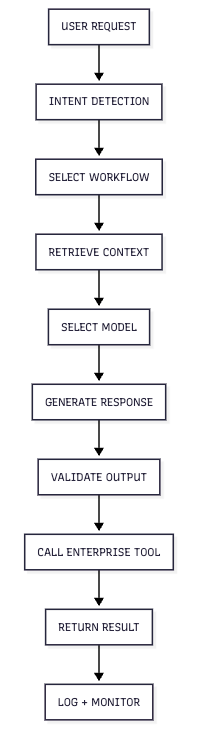
The orchestration layer is particularly important when multiple AI models or business systems are involved.
3. AI Model Layer
The model layer contains the models used to perform AI tasks.
Depending on the application, this can include:
Small language models
Embedding models
Vision models
Speech models
Classification models
Recommendation models
Specialized machine learning models
The important architectural decision is not:
"Which is the best AI model?"
It is:
"Which model is appropriate for each workload?"
A simple classification task may not require the same model used for complex reasoning.
Model Routing Example
Task | Potential Model Strategy |
|---|---|
Simple classification | Smaller/low-cost model |
Summarization | Cost-efficient LLM |
Complex reasoning | Higher-capability model |
Embeddings | Dedicated embedding model |
Image analysis | Vision model |
High-volume inference | Optimized/self-hosted model |
Sensitive workload | Approved/private deployment |
This model-routing approach can reduce unnecessary inference costs.
4. Enterprise Knowledge and RAG Layer
Most enterprise AI applications cannot rely solely on a model's pretrained knowledge.
They need access to company-specific information.
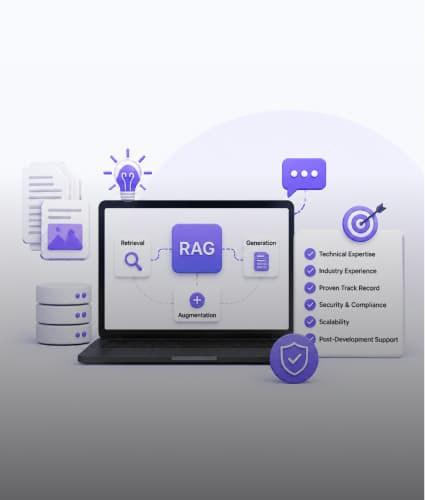
This is where Retrieval-Augmented Generation, or RAG, becomes important.
A basic RAG architecture looks like:
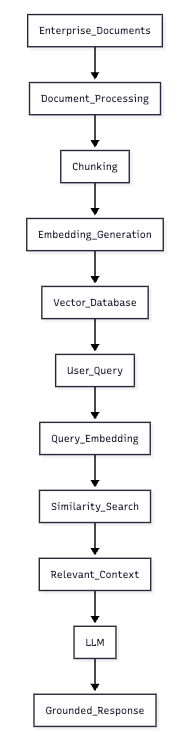
The architecture may include:
Document stores
Embedding models
Vector databases
Metadata filtering
Hybrid search
Reranking
Access-control filtering
Citation/provenance systems
The key enterprise consideration is authorization.
If an employee cannot access a document through the normal enterprise system, the AI system should not expose that document simply because it exists in a vector database.
Ready to Build an Enterprise AI Architecture That Scales?
5. Data and Integration Layer
Enterprise AI becomes useful when it can work with existing business systems.
Typical integrations include:
ERP
HR systems
Finance systems
Data warehouses
Data lakes
Ticketing platforms
Document repositories
Communication systems
Internal APIs
Legacy applications
A useful architecture treats these systems as authoritative sources rather than duplicating all business data inside the AI platform.
Example
A sales AI assistant may need:
CRM → customer information
ERP → order history
Knowledge base → product information
Analytics platform → customer behavior
LLM → reasoning and response generation
The AI layer connects these systems without necessarily replacing them.
6. Security and Governance Layer
Security should not be added after the AI system is built.
It should span the entire architecture.
Important controls include:
Identity management
Authentication
Authorization
Role-based access control
Network isolation
Encryption
Secrets management
Data classification
Audit logging
Model access controls
Tool permissions
Prompt-injection defenses
Data-loss prevention
NIST's AI Risk Management Framework organizes AI risk management around four functions:
Govern → Map → Measure → Manage
The framework is designed to incorporate trustworthiness considerations into the design, development, deployment, and evaluation of AI systems.
This is particularly relevant for enterprise architecture because governance should operate throughout the AI lifecycle rather than only during deployment.
7. Observability and LLMOps Layer
Traditional application monitoring is not enough for AI systems.
An AI system can be technically available while producing poor outputs.
Enterprise AI observability therefore needs to monitor both infrastructure and AI behavior.
Infrastructure Metrics
CPU
GPU utilization
Memory
Network
Availability
Error rate
AI Metrics
Token consumption
Model latency
Model errors
Output quality
Retrieval quality
Hallucination rate
Tool-call failures
Human escalation
Cost per request
Business Metrics
Workflow completion
Customer satisfaction
Revenue influenced
Processing time
Employee productivity
Cost reduction
Zignuts' AI infrastructure service specifically describes observability using Prometheus, Grafana, and OpenTelemetry, including tracking latency, token usage, and error rates.
Ready to Build an Enterprise AI Architecture That Scales?
8. Infrastructure and Deployment Layer
The infrastructure layer determines where AI workloads actually run.
Possible environments include:
The choice depends on:
Data sensitivity
Regulatory requirements
Latency
GPU availability
Existing cloud commitments
Scalability requirements
Operational capability
Deloitte's recent AI infrastructure research highlights hybrid deployment as one option for managing large AI workloads and cloud economics, particularly as compute and data requirements grow.
Zignuts describes support for AWS, Azure, Google Cloud, and on-premises environments, alongside autoscaling and infrastructure designed around workload and data-residency constraints.
A Reference Enterprise AI Architecture
A practical architecture can be represented as follows
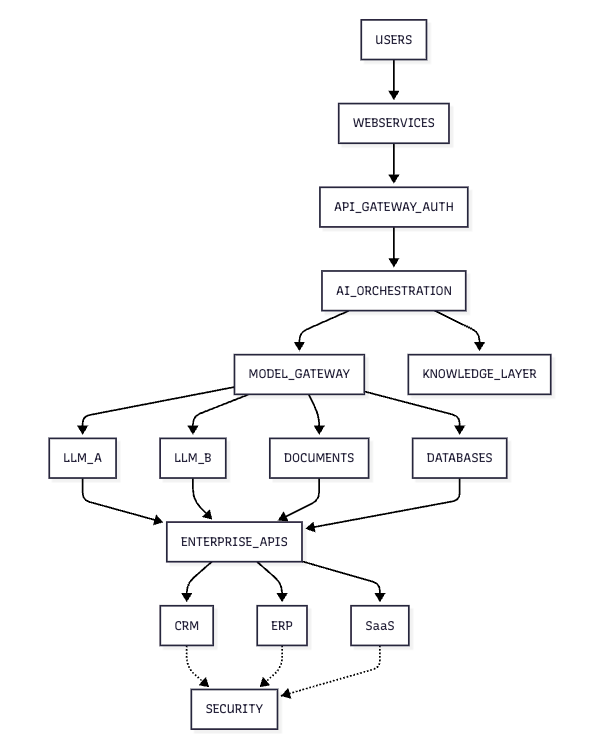
This architecture is intentionally modular.
An enterprise can replace one model, vector database, cloud service, or orchestration component without necessarily redesigning the entire platform.
Monolithic vs Modular AI Architecture
One of the biggest architecture decisions is how tightly AI components should be coupled.
Approach | Advantages | Risks |
|---|---|---|
Monolithic AI application | Faster initial development | Harder to scale and replace components |
Modular architecture | Easier evolution | Higher initial engineering complexity |
Multi-model architecture | Model flexibility | More routing and evaluation complexity |
Single-model architecture | Simpler operations | Higher vendor/model dependency |
Cloud-managed AI | Faster implementation | Vendor and cost dependency |
Self-hosted models | Greater control | Higher infrastructure responsibility |
Hybrid architecture | Flexibility | More operational complexity |
There is no universal winner.
The correct choice depends on business requirements.
Single LLM vs Multi-Model Architecture
A single-model architecture can be appropriate when:
The workload is narrow.
One model satisfies quality requirements.
Vendor dependency is acceptable.
Model switching is unlikely.
A multi-model architecture becomes more useful when different tasks require different capabilities.
Example
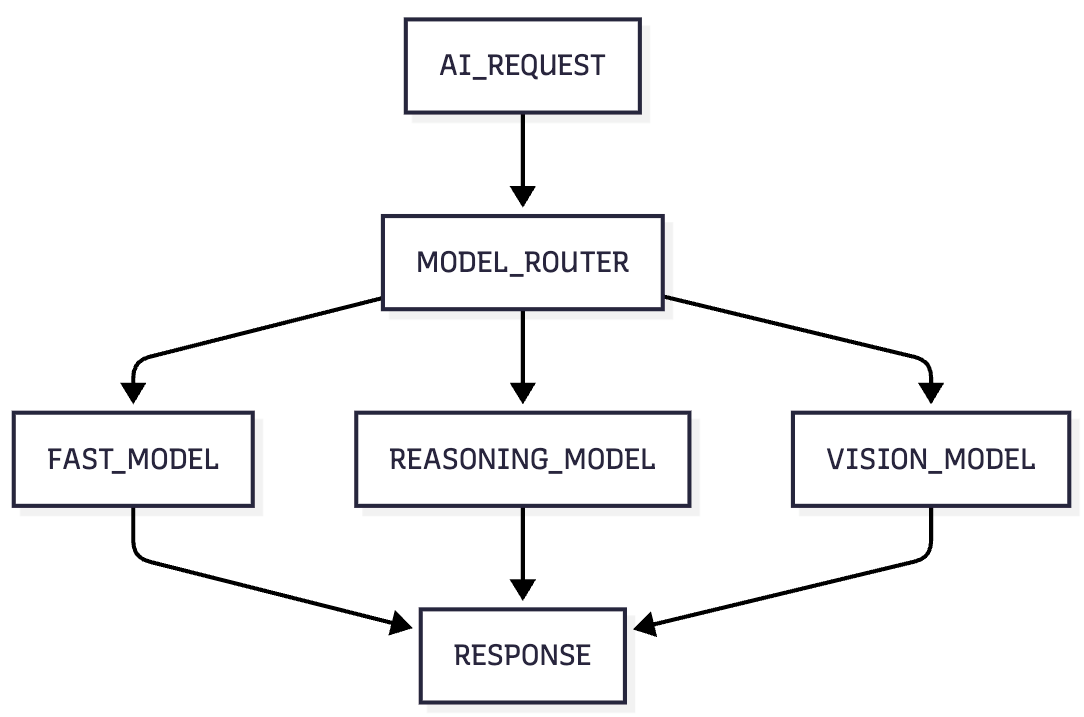
Zignuts' AI workflow automation platform provides a real-world example of a multi-model architecture: the documented platform integrated 35+ LLMs into a unified environment and enabled users to compare models for task selection.
This is useful evidence for the architectural principle, but the specific architecture should still be selected based on the requirements of each enterprise implementation.
Ready to Build an Enterprise AI Architecture That Scales?
RAG vs Fine-Tuning vs Model Training
Enterprise teams often confuse these approaches.
Requirement | RAG | Fine-Tuning | Custom Model Training |
|---|---|---|---|
Add company knowledge | Strong fit | Limited fit | Usually unnecessary |
Frequently changing information | Strong fit | Weak fit | Expensive |
Change model behavior/style | Moderate | Strong fit | Strong fit |
Domain-specific language | Strong | Strong | Strong |
Need current documents | Strong | Weak | Weak |
Build specialized prediction model | Weak | Moderate | Strong |
Implementation complexity | Lower | Medium | High |
A useful rule is:
Use RAG when the model needs access to changing enterprise knowledge.
Use fine-tuning when model behavior needs to change consistently.
Build or train specialized models when the business problem genuinely requires a dedicated model.
Where AI Agents Fit Into Enterprise Architecture
AI agents should be treated as an orchestration capability rather than as a replacement for the entire application architecture.
A controlled agent can:
Understand a request.
Determine which tools are required.
Retrieve relevant information.
Execute approved actions.
Evaluate the result.
Continue or escalate.
Agent Architecture
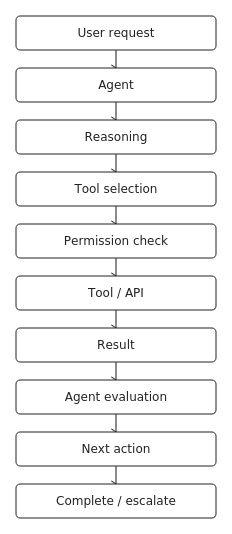
The critical component is the permission boundary.
An agent should not automatically have unrestricted access to every enterprise system.
IBM's current guidance on AI agents specifically recommends an open orchestration layer that can integrate multiple agents and avoid excessive vendor lock-in.
Ready to Build an Enterprise AI Architecture That Scales?
Enterprise AI Architecture and MCP
Model Context Protocol, or MCP, can be used as a standardized way for AI systems to interact with tools and data sources.
Conceptually:
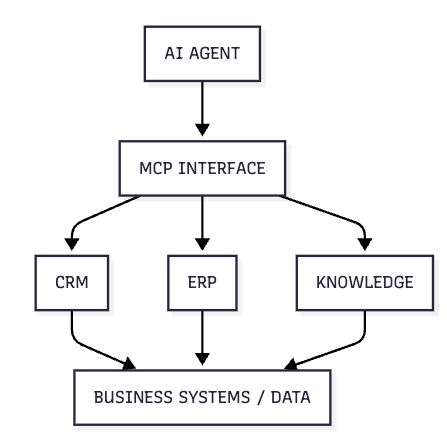
The architectural advantage is separation between the reasoning system and the tool interface.
However, enterprises should still apply authentication, authorization, monitoring, and tool-level permissions.
MCP does not remove the need for enterprise security architecture.
Data Architecture for Enterprise AI
Data quality often determines AI quality.
A strong architecture should define:
Data Sources
Databases
Documents
APIs
SaaS systems
Data lakes
Event streams
Data Processing
Validation
Cleaning
Classification
Chunking
Embedding
Metadata enrichment
Data Access
Role-based filtering
Tenant isolation
Attribute-based access
Data masking
Audit logging
Data Retrieval
Keyword search
Hybrid search
Reranking
Metadata filtering
The AI layer should not bypass enterprise data governance simply because the data is being accessed through an AI interface.
Security Architecture for Enterprise AI
Security should be applied at multiple levels.
Layer | Security Control |
|---|---|
User | Authentication |
Application | Authorization |
API | Rate limits and access policies |
Data | Encryption and classification |
RAG | Document-level permissions |
Model | Approved model access |
Tools | Tool-specific authorization |
Infrastructure | Network isolation |
Operations | Monitoring and audit logs |
Governance | Policies and risk management |
Example Secure Request Flow
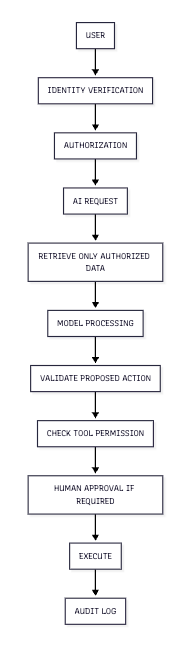
This is particularly important for finance, healthcare, legal, insurance, government, and other regulated environments.
Ready to Build an Enterprise AI Architecture That Scales?
AI Architecture Failure Handling
A production AI system should assume that things will fail.
Examples:
Model timeout
API timeout
Invalid model output
Retrieval failure
Database failure
Rate limit
External service outage
Malformed document
Low-confidence result
A resilient architecture should therefore include:
Failure | Possible Response |
|---|---|
Model timeout | Retry or fallback model |
Invalid output | Validation + retry |
API failure | Retry with backoff |
Retrieval failure | Alternative search |
Low confidence | Human escalation |
Rate limit | Queue/throttle |
Service outage | Fallback path |
Duplicate execution | Idempotency controls |
Zignuts' AI infrastructure approach includes workflow orchestration for ingestion, inference, retries, and error logging, alongside monitoring and alerting.
AI Architecture and Cost Optimization
Architecture directly affects AI operating cost.
The cost equation is broader than model pricing.
Total AI Cost = Model + Compute + Storage + Network + Data + Monitoring + Engineering + Human Review
Important cost levers include:
Model Routing
Use expensive models only when required.
Caching
Avoid repeating identical or semantically similar model calls where appropriate.
Batching
Batch workloads that do not require real-time processing.
Smaller Models
Use smaller models for simpler tasks.
Retrieval Optimization
Reduce unnecessary context sent to models.
Autoscaling
Scale infrastructure according to demand.
Zignuts describes semantic caching using Redis or GPTCache, autoscaling for bursty workloads, and infrastructure audits aimed at reducing redundant model calls and over-provisioned resources.
Ready to Build an Enterprise AI Architecture That Scales?
How Much Can Enterprise AI Architecture Affect ROI?
Architecture itself does not guarantee ROI.
But poor architecture can make a successful AI use case economically unattractive.
Deloitte's 2025 AI ROI research found that most respondents reported satisfactory ROI on a typical AI use case within two to four years, while only 6% reported payback in under one year.
IBM's research found that enterprises that fully account for technical debt in AI business cases project up to 29% higher ROI than those that do not.
That means architecture should be included in the business case.
Example
Consider an enterprise AI workflow that processes 1 million requests annually.
If the architecture sends every request to an expensive model with large context windows, costs can rise rapidly.
A more efficient architecture might:
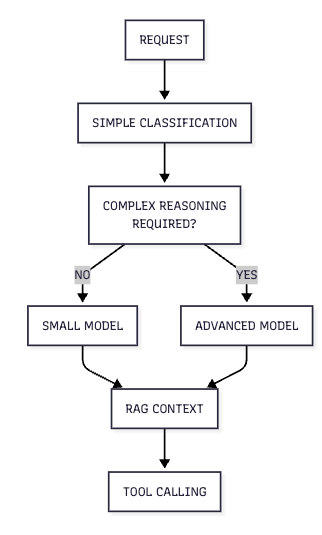
The goal is not to minimize AI usage.
The goal is to use the right amount of AI for each task.
Enterprise AI Architecture Maturity Model
Organizations can assess their architecture using five stages.
Stage | Architecture | Typical State |
|---|---|---|
1. Experiment | Standalone AI API | Prototype |
2. Application | AI integrated into product | Production feature |
3. Platform | Shared AI services | Multiple AI use cases |
4. Enterprise | Governance + orchestration + reusable infrastructure | Organization-wide AI |
5. Intelligent Enterprise | Agents + workflows + real-time enterprise context | AI embedded in operations |
Most organizations should not jump directly from Stage 1 to Stage 5.
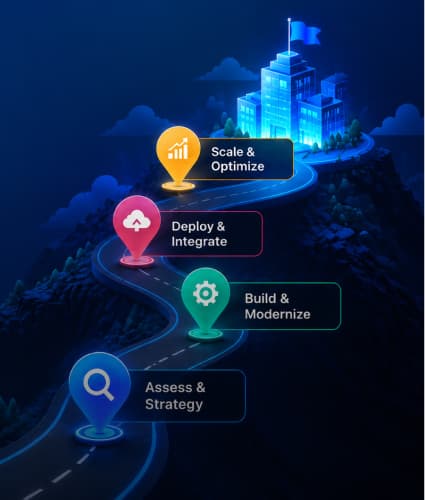
A controlled progression reduces technical and organizational risk.
How to Design Enterprise AI Architecture Step by Step
Step 1: Define the Business Outcome
Start with the business problem.
Examples:
Reduce support handling time.
Improve lead qualification.
Reduce document-processing cost.
Accelerate financial reporting.
Improve employee productivity.
Do not start with:
"We need an AI agent."
Step 2: Map the Existing Workflow
Document:
Inputs
Systems
Manual steps
Outputs
Exceptions
Approval points
This reveals where AI actually adds value.
Step 3: Classify Each Task
For every workflow step, determine whether it should be:
Rule-based
AI-assisted
Human-controlled
This prevents unnecessary AI complexity.
Step 4: Identify Data Requirements
Determine:
What data is required?
Where does it live?
Who can access it?
How frequently does it change?
Is RAG required?
Is real-time access necessary?
Step 5: Select Models
Evaluate:
Quality
Cost
Latency
Context requirements
Privacy
Tool calling
Availability
Benchmark models against your actual workload.
Step 6: Design Security
Define:
Identity
Roles
Data boundaries
Tool permissions
Audit requirements
Security should be part of the architecture rather than a later checklist.
Step 7: Design Observability
Track:
Infrastructure + AI + Workflow + Business,
not just server uptime.
Step 8: Build a Measurable Pilot
Choose a bounded workflow.
Establish a baseline.
Measure:
Cost
Time
Accuracy
Error rate
Human effort
Business outcome
Then compare the automated workflow against the baseline.
Step 9: Prepare for Scale
Before expanding, evaluate:
Model throughput
Database capacity
Vector search performance
API limits
Cost per transaction
Failure recovery
Enterprise AI Architecture Checklist
Business
Business outcome clearly defined
Baseline metrics documented
ROI measurement established
Workflow owner identified
Data
Data sources identified
Data permissions defined
Data quality assessed
RAG requirements evaluated
AI
Model requirements defined
Model evaluation completed
Model routing considered
AI outputs validated
Integration
Enterprise APIs identified
CRM/ERP integrations mapped
Tool permissions defined
Legacy systems considered
Security
Authentication implemented
Authorization implemented
Data encryption defined
Audit logging enabled
Operations
Monitoring implemented
AI evaluation established
Cost tracking enabled
Failure handling designed
Rollback/fallback strategy defined
Scalability
Autoscaling considered
Model throughput tested
Database capacity evaluated
API rate limits considered
Peak workload tested
Ready to Build an Enterprise AI Architecture That Scales?
Common Enterprise AI Architecture Mistakes
Building Around One Model
AI models change quickly.
An architecture that cannot accommodate model changes can become expensive technical debt.
Treating RAG as the Entire AI Architecture
RAG solves knowledge retrieval.
It does not solve authorization, workflow orchestration, business logic, monitoring, or enterprise integration.
Giving Agents Excessive Permissions
Agents should have the minimum permissions necessary to perform their tasks.
Ignoring Data Architecture
Poor data quality produces poor AI outcomes.
Treating AI Monitoring Like Traditional Monitoring
A healthy server does not guarantee a healthy AI system.
Ignoring Cost During Architecture Design
Inference cost can become a major operating expense at scale.
Building Too Much Infrastructure Too Early
Not every company needs a complex multi-agent platform.
Architecture should match the maturity and economics of the use case.
Zignuts' Practical Experience With Enterprise AI Architecture
Zignuts' documented AI infrastructure capabilities span model serving, vector databases, orchestration, observability, autoscaling, security, caching, and CI/CD. The company describes support across AWS, Azure, Google Cloud, and on-premises environments.
This aligns closely with the architectural requirements of production AI systems.
Zignuts' AI workflow automation platform provides another concrete example. The platform integrated more than 35 LLMs, supported 20+ workflow triggers and actions, and had more than 2,000 registered users.
The documented engineering challenges included scalability and performance optimization, integrating multiple LLMs, workflow automation, and emerging AI technologies.
The architectural lesson is important.
A production AI platform is not simply:
Application + LLM API
It becomes:
Application + orchestration + models + knowledge + integrations + infrastructure + security + observability + workflow controls
That is the difference between an AI demo and an enterprise AI system.
Enterprise AI Architecture: Build vs Buy
Organizations should also decide which components to build and which to adopt.
Component | Build When | Buy/Adopt When |
|---|---|---|
LLM | Specialized requirement | General-purpose intelligence |
Vector DB | Unique requirements | Standard retrieval |
Orchestration | Complex proprietary workflow | Standard automation |
Authentication | Unique enterprise requirements | Mature identity platform available |
Monitoring | Specialized AI evaluation | Standard observability sufficient |
Agent framework | Strong customization needed | Standard agent patterns sufficient |
Data platform | Core business differentiator | Commodity requirement |
AI infrastructure | Scale/control requirements | Managed service meets needs |
The goal is not to build everything.
It is to build the components that create strategic differentiation and adopt mature infrastructure where possible.
The Future of Enterprise AI Architecture
Enterprise AI architecture is moving toward more modular and composable systems.
Future architectures are likely to combine:
Foundation Models
RAG and Enterprise Knowledge
AI Agents
Workflow Orchestration
Tool Connectivity
Enterprise APIs
Human Governance
AI Infrastructure
The important shift is from isolated AI applications toward AI becoming an operating layer across existing enterprise systems.
But that does not mean enterprises should immediately deploy autonomous agents everywhere.
The more AI can act, the more important architecture becomes.
More autonomy requires:
Better permissions
Better monitoring
Better evaluation
Better failure handling
Better governance
Better auditability
Ready to Build an Enterprise AI Architecture That Scales?
Key Takeaways
Enterprise AI architecture is much larger than an LLM integration.
A production architecture needs application, orchestration, model, knowledge, data, integration, security, infrastructure, and observability layers.
RAG is a knowledge architecture, not a complete enterprise AI architecture.
AI agents should operate through controlled tools and explicit permissions.
Multi-model architectures can provide flexibility, but they also increase operational complexity.
Model selection should consider quality, latency, cost, privacy, and workload requirements.
Security and governance should span the entire AI lifecycle.
AI observability must measure model and business performance in addition to infrastructure health.
Architecture directly affects AI operating cost and scalability.
Enterprise AI should be designed around measurable business outcomes rather than technology adoption alone.
Conclusion
Enterprise AI architecture is ultimately about creating a reliable bridge between AI capabilities and real business systems.
The model is only one component.
The architecture around that model determines whether the system can securely access enterprise data, interact with business applications, handle failures, scale with demand, control costs, and produce measurable business outcomes.
Current enterprise research makes the need for disciplined architecture increasingly clear. AI infrastructure spending is expected to grow significantly, yet many organizations are still struggling to turn AI initiatives into scaled, measurable value.
The organizations that succeed will not necessarily be those using the most models.
They will be the organizations that build the right architecture around the right business problems.
A practical enterprise AI architecture should therefore be:
Modular enough to evolve.
Secure enough for enterprise data.
Observable enough to manage.
Scalable enough for production demand.
Flexible enough to support changing models.
Cost-conscious enough to generate sustainable ROI.
Controlled enough to keep humans accountable for high-impact decisions.
Zignuts approaches AI application infrastructure as a production engineering concern, covering model serving, vector databases, orchestration, monitoring, security, autoscaling, caching, and CI/CD rather than treating infrastructure as an afterthought.
For enterprises moving from AI pilots to production systems, the right architecture can reduce implementation risk, avoid unnecessary technical debt, and create a foundation that supports additional AI use cases over time.
The objective is not to build the most complicated AI architecture.
It is to build the simplest architecture that can reliably deliver the business outcome today while remaining capable of evolving tomorrow.

Divyesh Patel
A passionate problem solver driven by the quest to build seamless, innovative web experiences that inspire and empower users.