

Customer operations generate enormous amounts of unstructured language every day.
Customers send emails, open support tickets, start chats, leave reviews, make phone calls, ask questions through websites, and describe problems in their own words.
For years, businesses have relied on human teams to read, classify, route, summarize, and respond to this information.
Natural Language Processing (NLP) is changing that.
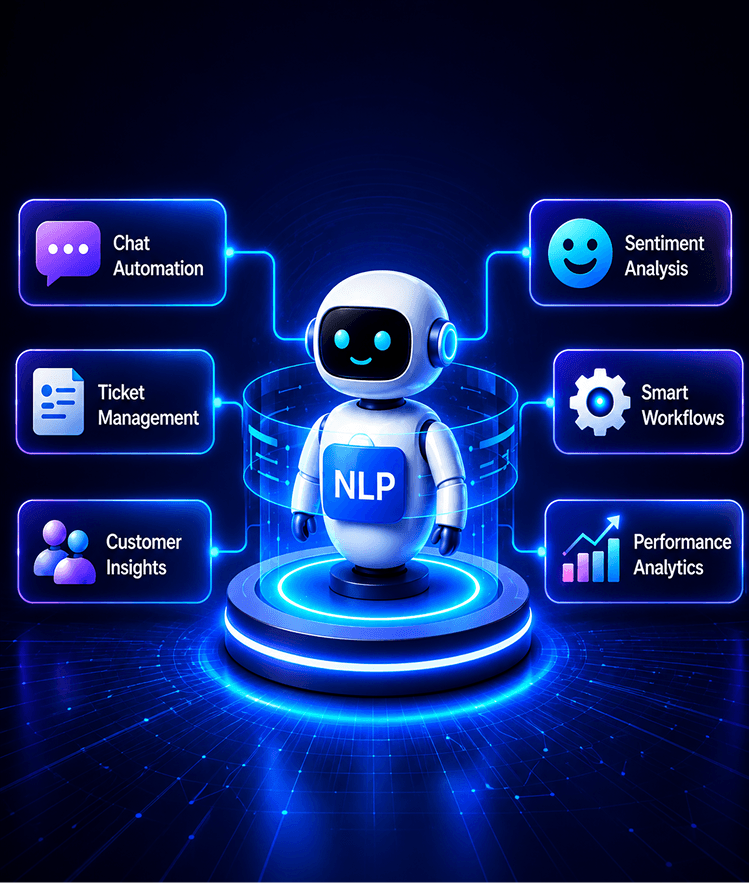
Modern NLP systems can understand customer intent, classify requests, extract information, analyze sentiment, retrieve relevant knowledge, summarize conversations, recommend next actions, and increasingly trigger business workflows.
How NLP Fits Into Customer Operations
A traditional customer operation may look like:
Customer ↓ Email / Chat / Call / Review ↓ Human Agent Reads Request ↓ Classifies Issue ↓ Searches Knowledge Base ↓ Checks CRM / Account ↓ Responds ↓ Updates Ticket ↓ Escalates if Necessary ↓ Reports on Outcome |
NLP can automate or assist many of these steps:
Customer ↓ Email / Chat / Call / Review ↓ NLP Understanding ↓ Intent + Entities + Sentiment ↓ Retrieve Customer Context ↓ Retrieve Knowledge ↓ Generate / Recommend Response ↓ Execute Approved Workflow ↓ Update CRM / Ticket ↓ Human Escalation When Required ↓ Analytics + Continuous Improvement |
The result is not necessarily a fully autonomous support operation.
A more practical approach is:
Automate repetitive work → assist human agents → escalate complex cases.
What Is NLP in Customer Operations?
Natural Language Processing is a branch of AI that enables computers to process and understand human language.
In customer operations, NLP can process:
Customer emails
Support tickets
Live chat
Call transcripts
Reviews
Surveys
Social media messages
Knowledge-base content
Internal agent notes
It can then identify:
NLP Capability | What It Does |
|---|---|
Intent classification | Determines what the customer wants |
Entity extraction | Identifies names, orders, products, dates, etc. |
Sentiment analysis | Detects positive, negative, or neutral sentiment |
Topic classification | Groups conversations by issue |
Summarization | Condenses long interactions |
Semantic search | Finds relevant information by meaning |
Language detection | Identifies the customer's language |
Response generation | Creates draft or automated responses |
Conversation analysis | Identifies patterns across interactions |
Information extraction | Converts unstructured text into structured data |
NLP can therefore transform unstructured conversations into information that downstream systems can use.
Automate Customer Operations with NLP

Why Businesses Are Moving Beyond Traditional Chatbots
Traditional chatbots generally depend on:
Keyword ↓ Rule ↓ Predefined Response |
Modern NLP-based systems can work more like:
Customer Message ↓ Intent Detection ↓ Context Understanding ↓ Customer History ↓ Knowledge Retrieval ↓ Response / Action |
This makes the interaction more flexible.
For example, a customer might write:
"My payment went through yesterday but my account still says I haven't paid."
A keyword-based system might recognize "payment."
An NLP system can potentially identify:
Intent: Payment status issue
Entity: Customer account
Time: Yesterday
Potential problem: Payment recorded externally but not reflected internally
Sentiment: Frustration
The system can then retrieve the relevant account information and determine whether the issue can be resolved automatically or should be escalated.
1. Automating Customer Intent Classification
One of the simplest and most valuable NLP applications is automatically determining why a customer is contacting the company.
A support inbox might contain:
"I want to cancel my subscription."
"Where is my order?"
"I was charged twice."
"I can't log into my account."
"Can I change my delivery address?"
"The product arrived damaged."
NLP can classify these requests automatically.
Example
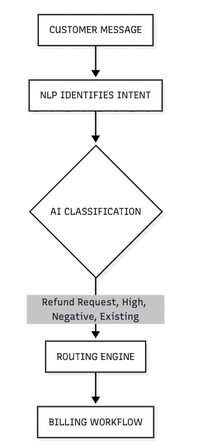
This eliminates manual first-level classification for many repetitive requests.
2. Intelligent Ticket Routing
Once the system understands the request, it can route the case automatically.
Customer Intent | Destination |
|---|---|
Password reset | Self-service |
Order status | Order system |
Billing issue | Finance support |
Technical problem | Technical support |
Cancellation | Retention team |
Fraud concern | Risk team |
Complaint | Priority support |
Complex enterprise issue | Senior agent |
The routing decision can also consider:
IBM describes AI-powered smart routing as one of the ways NLP and AI can help customer-service teams respond more effectively, including identifying frustrated customers and directing them toward appropriate support.
3. Sentiment Analysis and Customer Emotion Detection
Not every customer message has the same urgency.
Compare:
"Can you tell me when my order will arrive?"
with:
"I've contacted support three times and nobody has fixed this. I want my money back."
Both are customer-support requests.
But the second message requires a different operational response.
NLP-based sentiment analysis can identify signals such as:
Positive
Neutral
Negative
Frustrated
Angry
Urgent
IBM describes sentiment analysis as a way to analyze customer feedback across support tickets, surveys, reviews, calls, and other interactions.
Automated Escalation
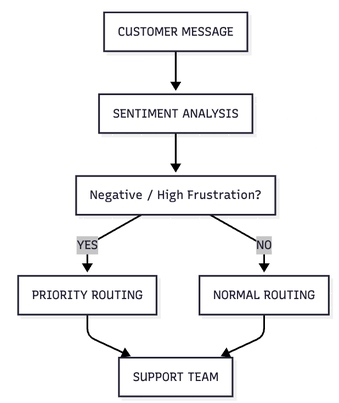
However, sentiment models are not perfect. Sarcasm, context, spelling errors, and cultural differences can make sentiment interpretation difficult, so human validation and ongoing evaluation remain important.
4. Automating Customer Email Processing
Email remains a major source of customer-operation workload.
A traditional process may require employees to:
Open email.
Read the message.
Identify the issue.
Search for customer information.
Assign a category.
Forward the email.
Draft a response.
Update the CRM.
NLP can automate much of this.
Incoming Email ↓ Language Detection ↓ Intent Classification ↓ Entity Extraction ↓ Customer Identification ↓ Knowledge Retrieval ↓ Response Recommendation ↓ CRM Update ↓ Send / Human Approval |
This creates a more structured workflow around an otherwise unstructured inbox.
5. AI-Powered Customer Self-Service
One of the biggest NLP use cases is helping customers solve problems without contacting a human agent.
Traditional self-service:
Search FAQ → Open article → Read → Try solution
NLP-powered self-service:
Ask question → Understand intent → Retrieve answer → Personalize response
For example:
Customer:
"I changed my phone and now I can't receive the login code."
The system can identify:
Intent: Authentication problem
Context: Phone number/device changed
Potential action: Account verification workflow
Instead of sending the customer to a generic FAQ page, the system can guide them through the relevant process.
IBM reports that mature AI adopters in customer service have reported lower average inbound call-handling time and higher customer satisfaction, although such figures should be treated as organizational benchmarks rather than guaranteed outcomes for every implementation.
6. NLP + RAG for Customer Support
NLP becomes significantly more useful when combined with Retrieval-Augmented Generation (RAG).
Instead of asking an LLM to answer from general knowledge:
Customer Question ↓ LLM ↓ Answer |
An enterprise system can use:
Customer Question ↓ Intent Detection ↓ Knowledge Retrieval ↓ Relevant Documents ↓ Customer Context ↓ LLM ↓ Grounded Response |
The knowledge layer could contain:
Product manuals
Support documentation
Pricing information
Policies
Troubleshooting guides
Shipping policies
Internal procedures
Product specifications
This reduces the need for the model to rely solely on its pretrained knowledge.
Automate Customer Operations with NLP
7. Automatically Summarizing Customer Conversations
Long customer conversations create another operational problem.
An agent may need to read:
20 emails + 10 chat messages + previous ticket notes
before understanding what happened.
NLP can generate:
Customer Issue
Payment charged twice.
Previous Actions
Customer contacted support twice.
Current Status
Refund not yet processed.
Sentiment
Frustrated.
Recommended Next Step
Verify duplicate transaction and initiate refund if confirmed.
This allows a new agent to understand the case quickly.
NLP-based summarization can also be applied to:
Call transcripts
Chat sessions
Email threads
Support tickets
CRM notes
8. Agent Assist: Helping Human Support Teams
The most effective customer-operations architecture does not always replace agents.
It can make them faster.
During a live conversation:
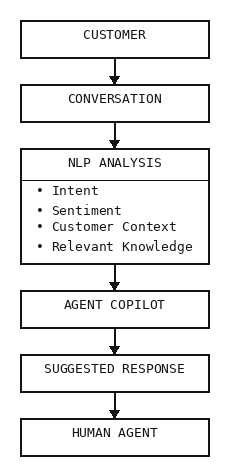
AI can provide:
Suggested replies
Relevant documentation
Customer history
Next-best actions
Conversation summaries
Policy reminders
Escalation recommendations
IBM describes this human + AI model as an increasingly important customer-service pattern, where AI provides real-time suggestions, summarizes previous conversations, and assists agents while humans handle more nuanced interactions.
9. Voice NLP for Contact Centers
NLP is not limited to text.
Voice conversations can be converted into text and analyzed in real time.
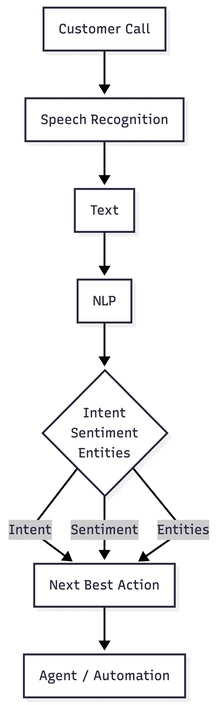
Intelligent IVR
Automatic call routing
Real-time transcription
Call summarization
Sentiment detection
Agent assistance
Quality monitoring
Instead of:
"Press 1 for billing. Press 2 for technical support."
Customers can describe their problem naturally.
IBM identifies voice recognition and smarter IVR as an important customer-service use case for AI and NLP.
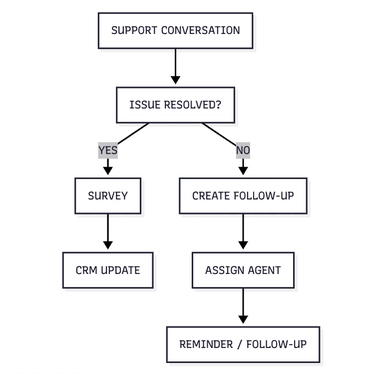
10. Automating Customer Follow-Ups
Customer operations do not end when the conversation ends.
Businesses often need to:
Send confirmation emails
Request additional information
Send surveys
Provide case updates
Schedule callbacks
Remind customers
Follow up on unresolved issues
NLP can understand the conversation and trigger the appropriate workflow.
Example
11. Extracting Structured Data From Customer Messages
Customers rarely provide information in a perfectly structured form.
A customer might write:
"Hi, I ordered the black X200 headphones last Friday, order #48291, but the left side stopped working yesterday."
NLP can extract:
Field | Extracted Value |
|---|---|
Product | X200 headphones |
Color | Black |
Order ID | 48291 |
Purchase timing | Last Friday |
Problem | Left side not working |
Failure timing | Yesterday |
Intent | Product issue |
The structured information can then be passed to the CRM, ticketing platform, or warranty system.
This is one of the most practical ways NLP connects unstructured customer communication with structured business processes.
Automate Customer Operations with NLP
12. Customer Complaint Detection
Businesses can use NLP to automatically identify complaints across channels.
Sources can include:
Support tickets
Reviews
Social media
Surveys
Chat
Emails
Call transcripts
The system can classify:
Complaint → Topic → Severity → Product → Sentiment → Customer → Recommended action
This enables businesses to identify recurring problems instead of treating every complaint as an isolated ticket.
13. Finding the Root Causes Behind Customer Complaints
NLP can analyze thousands of customer conversations and identify recurring patterns.
For example:
Issue | Mentions | Sentiment | Trend |
|---|---|---|---|
Payment failures | 1,240 | Negative | ↑ |
Delivery delays | 980 | Negative | ↑ |
Login problems | 720 | Mixed | → |
Product setup | 510 | Neutral | ↓ |
Refund delays | 430 | Negative | ↑ |
The value is not simply knowing that customers are unhappy.
The business can identify why they are unhappy.
That can feed into:
Product improvements
Operations
Documentation
Engineering
Finance
Customer success
14. NLP for Customer Churn Signals
Customer language can contain early indicators of dissatisfaction.
Examples:
"I'm thinking of cancelling."
"This has happened again."
"I'm considering another provider."
"This is becoming too expensive."
"Nobody is helping me."
NLP can identify these signals and flag the account for intervention.
Customer Interaction ↓ NLP Analysis ↓ Sentiment + Intent + History ↓ Churn Risk Signal ↓ Customer Success Team ↓ Proactive Intervention |
This changes customer operations from purely reactive support toward proactive customer retention.
IBM similarly describes the shift toward using customer sentiment and interaction data to identify problems before they escalate.
15. Multilingual Customer Operations
Global businesses may receive customer requests in many languages.
NLP can help with:
Language detection
Translation
Intent classification
Multilingual search
Response generation
Sentiment analysis
For example:
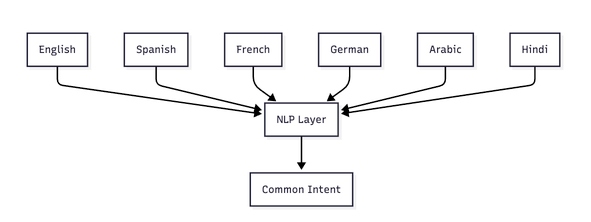
However, multilingual systems should be evaluated separately because accuracy and cultural nuance can vary significantly between languages.
16. Quality Monitoring Across Customer Operations
NLP can analyze conversations after they happen.
Instead of managers manually reviewing a small sample of conversations, AI can analyze a much larger proportion of interactions.
Possible checks include:
Was the customer's issue resolved?
Was the correct policy followed?
Was required information provided?
Was the tone appropriate?
Was escalation handled correctly?
Were prohibited statements made?
Did the agent miss an important issue?
This can create a continuous quality-assurance loop.
17. NLP + AI Agents for Customer Operations
NLP becomes even more powerful when combined with AI agents.
A chatbot might:
Answer a question.
An AI agent can potentially:
Understand → Retrieve → Decide → Execute → Verify → Update
For example:
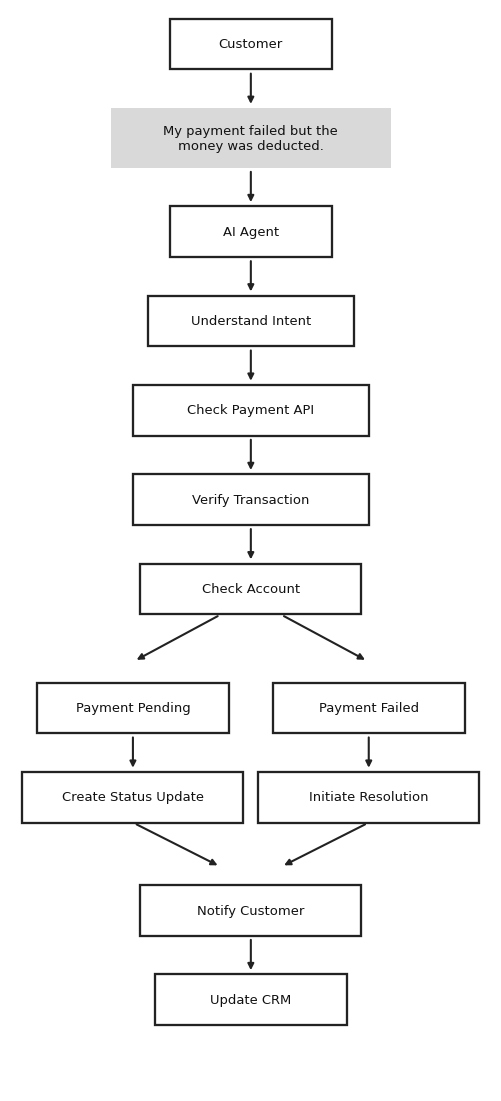
Zignuts describes its AI-agent approach around systems that can reason, use tools, complete multi-step tasks, integrate with existing systems, and operate within guardrails and human-in-the-loop controls.
NLP vs Chatbots vs AI Agents
These concepts are often mixed together.
Technology | Primary Role |
|---|---|
NLP | Understands and processes language |
Chatbot | Provides conversational interaction |
RAG | Retrieves relevant knowledge |
LLM | Generates and reasons over language |
AI Agent | Uses AI + tools to execute multi-step tasks |
Workflow Automation | Executes predefined business processes |
They can work together.
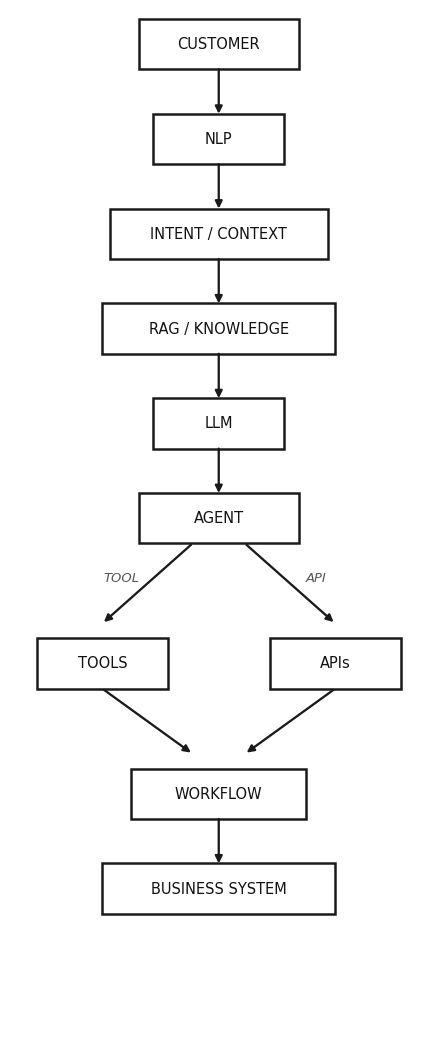
Automate Customer Operations with NLP
The NLP Customer Operations Architecture
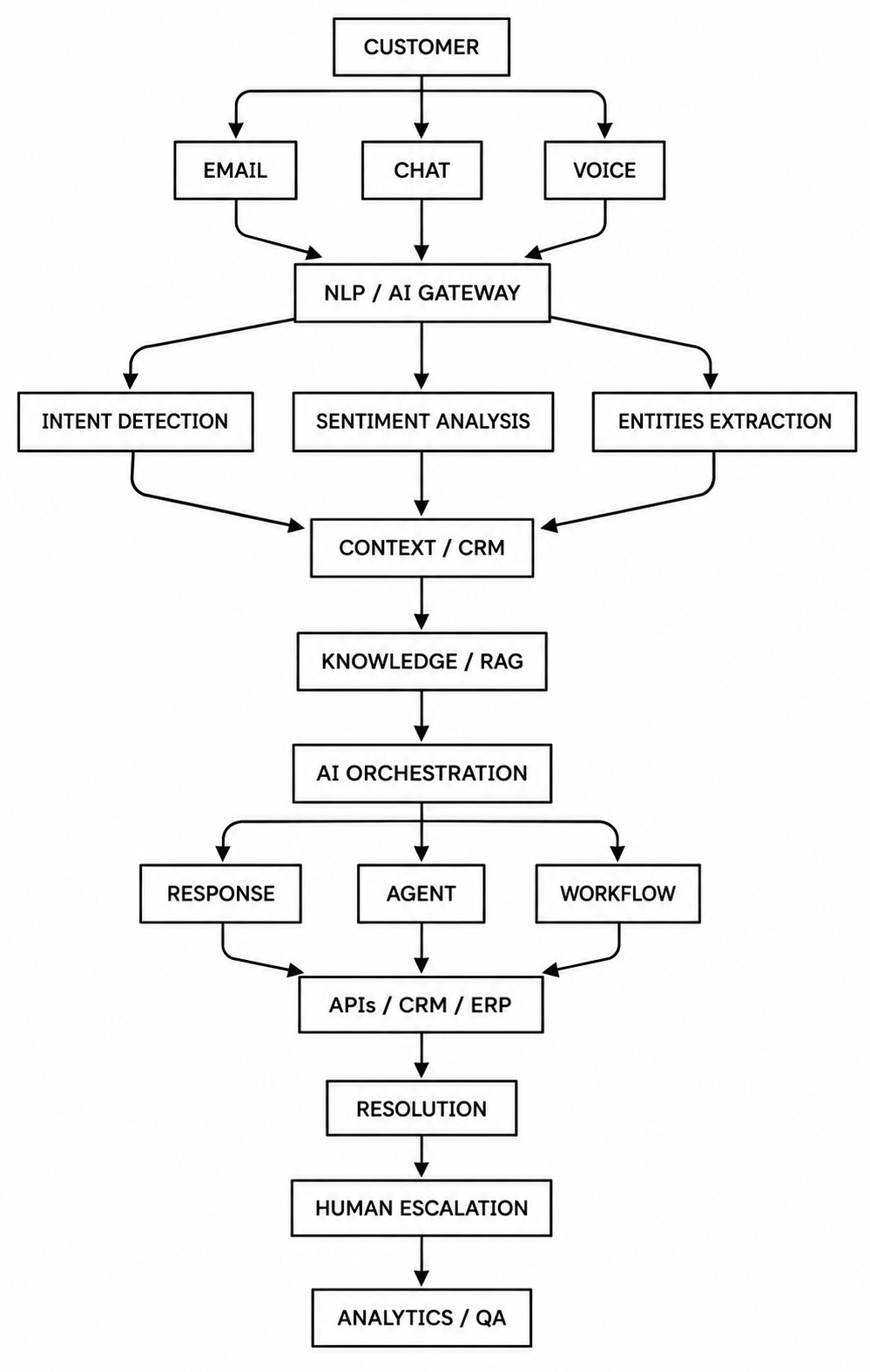
The architecture should be designed around the organization's existing systems rather than forcing every customer operation into a new standalone AI platform.
How Businesses Should Prioritize NLP Automation
Not every customer operation should be automated immediately.
A practical prioritization framework is:
Workflow | Volume | Complexity | Automation Potential |
|---|---|---|---|
Password reset | High | Low | Very High |
Order status | High | Low | Very High |
FAQ | High | Low | Very High |
Appointment scheduling | Medium | Medium | High |
Refund request | Medium | Medium | High |
Technical troubleshooting | Medium | High | Medium |
Complaint handling | Medium | High | Human + AI |
Fraud investigation | Low | Very High | Human-led |
Sensitive account decisions | Low | Very High | Human-led |
The best first use case is usually:
High volume + repetitive + clearly defined + measurable outcome.
How to Calculate NLP Automation ROI
Businesses should not measure success simply by saying:
"We automated 50% of tickets."
The better question is:
"What business value did the automation create?"
A simple framework:
Annual Benefit = Labor Savings + Faster Resolution Value + Reduced Contact Cost + Retention/Revenue Impact
Then:
ROI = (Annual Benefit − Annual AI Cost) ÷ Annual AI Cost × 100
AI cost should include:
Development
Model/API usage
Data processing
Monitoring
Maintenance
Human review
Security
Integrations
Example NLP ROI Model
Consider a company receiving:
200,000 customer interactions per year
Suppose: 40% are repetitive requests suitable for automation.
That gives: 80,000 potentially automatable interactions.
If the average human handling cost is: $4 per interaction
the theoretical workload value is: 80,000 × $4 = $320,000
If an NLP system safely automates 60% of those interactions: 48,000 interactions automated
The corresponding avoided handling workload is: 48,000 × $4 = $192,000
If the annual AI system cost is: $80,000
Then the illustrative net benefit is: $112,000
And: Illustrative ROI = 140%
This is an example, not a universal benchmark. Actual ROI depends on automation accuracy, escalation rates, labor economics, infrastructure costs, and whether automation actually reduces or redeploys support capacity.
Current Customer-Service AI Data
There is growing evidence that AI can improve customer-service productivity, although results vary significantly by implementation.
IBM cites National Bureau of Economic Research research showing that customer-support professionals given access to AI assistance experienced an average 14% productivity increase, with larger gains for less experienced workers.
IBM also reports that mature AI adopters in customer service have reported 17% higher customer satisfaction and 38% lower average inbound call-handling time. These figures describe reported outcomes among mature adopters, not guaranteed results for every business.
The more important lesson is that the value of NLP should be evaluated against a company's own baseline:
Current cost → AI-assisted cost → Automation rate → Escalation rate → Customer outcome
A Practical NLP Implementation Roadmap
Phase 1: Discover
Map:
Customer channels
Ticket volumes
Common intents
Existing workflows
Escalation patterns
Knowledge sources
Output
Automation opportunity map
Phase 2: Prioritize
Score use cases based on:
Volume × Repetition × Business value × Automation feasibility
Output
Top 1–3 NLP use cases
Phase 3: Data Preparation
Collect:
Historical tickets
Emails
Chat transcripts
FAQs
Knowledge articles
Call transcripts
Resolution data
Then clean and classify the data.
Phase 4: Build the NLP Layer
Implement the appropriate capabilities:
Intent classification
Entity extraction
Sentiment analysis
Semantic search
RAG
Summarization
Response generation
Phase 5: Integrate With Business Systems
Connect:
This is where NLP becomes operationally useful.
Phase 6: Human-in-the-Loop
Do not automate everything immediately.
Use: High Confidence ↓ Automate Medium Confidence ↓ AI Draft + Human Approval Low Confidence / Sensitive ↓ Human Agent |
This is particularly important for:
How to Measure NLP Performance
A production NLP system needs both AI and business KPIs.
Category | Metrics |
|---|---|
Intent | Classification accuracy |
Extraction | Entity accuracy |
Sentiment | Precision / recall |
RAG | Retrieval relevance |
Generation | Response quality |
Automation | Automation rate |
Escalation | Human escalation rate |
Operations | Average handling time |
Customer | CSAT / NPS |
Business | Cost per interaction |
Revenue | Retention / conversion |
Reliability | Error rate / latency |
The most important KPI depends on the use case.
For customer operations, one particularly useful metric is:
Resolution without unnecessary human intervention.
Common NLP Customer-Operations Mistakes
Automating Before Understanding the Workflow
AI cannot fix a poorly designed process.
First map the workflow.
Measuring Only Chatbot Deflection
A chatbot that prevents customers from reaching agents is not necessarily successful if customers simply repeat their question elsewhere.
Measure actual resolution.
Ignoring Human Escalation
Good automation knows when not to automate.
Using Generic Knowledge
Enterprise customer support often requires company-specific information.
RAG and enterprise data integration may be necessary.
Ignoring CRM Integration
A chatbot disconnected from customer history has limited context.
Treating Sentiment as Perfect
NLP can misunderstand sarcasm, ambiguity, slang, and cultural context.
Deploying Without Evaluation
Measure accuracy, escalation, hallucinations, latency, and business outcomes before expanding automation.
Automating Sensitive Actions Without Guardrails
High-impact actions should have explicit authorization and, where appropriate, human approval.
Zignuts' Practical AI Expertise
Zignuts' AI/ML development offering covers end-to-end AI/ML implementation and lists customer-experience and operational AI among its use cases. Its published case-study portfolio includes AI-powered recruitment, workflow automation, AI agents, AI-powered accounts receivable automation, and other business systems.
For customer operations specifically, Zignuts' chatbot development approach begins with business and use-case discovery, including support workflows, query volumes, escalation patterns, channel preferences, and existing system integrations. It describes conversational solutions that can understand user intent, integrate with databases, and support both rule-based workflows and generative AI agents.
This is an important architectural principle:
Customer-operation NLP should be designed around the existing business workflow, not around the chatbot interface alone.
Zignuts AI Workflow Automation Expertise
Zignuts' published AI workflow automation case study describes a platform with centralized AI model access, real-time LLM comparison, workflow automation, custom agents, and integrations around project-management and community functionality.
That experience is relevant to NLP-based customer operations because the next stage of conversational AI is increasingly moving from:
Understand → Respond
to:
Understand → Decide → Execute → Verify
For example:
Customer Message ↓ Understand ↓ Identify Intent ↓ Retrieve Customer Data ↓ Determine Action ↓ Execute Approved Workflow ↓ Verify Result ↓ Respond ↓ Update CRM |
This is where NLP, LLMs, AI agents, and workflow automation begin working together.
Automate Customer Operations with NLP
The Future of NLP in Customer Operations
The customer-service model is moving through several stages.
Stage 1 — Rules
Keyword → Rule → Response
Stage 2 — NLP
Language → Intent → Response
Stage 3 — Generative AI
Language → Context → Knowledge → Response
Stage 4 — Agentic AI
Language ↓ Reasoning ↓ Tools ↓ Actions ↓ Verification |
Stage 5 — Predictive Customer Operations
Customer Signals ↓ AI Detection ↓ Predict Need ↓ Proactive Action ↓ Customer Outcome |
IBM describes this broader shift as customer service moving from reactive support toward more proactive and predictive experiences, with AI analyzing sentiment, customer behavior, and interaction patterns to identify issues before they escalate.
The long-term opportunity is therefore not simply:
"Automate customer support."
It is:
"Build an intelligent customer-operations layer that understands customers and coordinates the right response."
Key Takeaways
NLP can turn unstructured customer conversations into structured business information.
Intent classification is one of the easiest NLP use cases to operationalize.
Sentiment analysis can help prioritize frustrated or high-risk customers.
NLP can automate email and ticket classification, routing, summarization, and information extraction.
RAG allows customer-service AI to use company-specific knowledge.
NLP-powered agent assist can increase human-agent productivity without fully replacing agents.
Voice NLP can modernize IVR and contact-center workflows.
AI agents can extend NLP from understanding language to executing approved business actions.
CRM and business-system integration is critical for meaningful automation.
The best first use cases are high-volume, repetitive, measurable workflows.
Businesses should measure actual resolution, cost, customer satisfaction, and business outcomes not just chatbot usage.
Human-in-the-loop controls remain important for sensitive or high-impact customer operations.
Conclusion
NLP is changing customer operations because it allows businesses to turn human language into actionable business data.
A customer says:
"My order arrived damaged and I need a replacement."
An intelligent system can potentially understand:
Intent: Replacement request
Entity: Order
Issue: Damaged product
Sentiment: Negative
Customer: Existing customer
Next action: Check order → Verify eligibility → Create replacement → Notify customer
That is much more valuable than simply generating a chatbot response.
The real opportunity comes when NLP connects with:
CRM + Knowledge Base + RAG + LLMs + AI Agents + APIs + Workflow Automation
The result is an intelligent operational layer that can understand customers, retrieve context, assist employees, automate repetitive work, and escalate cases when human judgment is required.
Current customer-service research already shows measurable productivity and satisfaction improvements among organizations using mature AI capabilities, but the results are not automatic.
The businesses that gain the most value will therefore not be those that simply deploy the biggest language model.
They will be the ones that identify the right customer workflows, connect NLP to reliable business data, integrate it with existing systems, establish human guardrails, and continuously measure the business outcome.
The future of customer operations is not human versus AI.
It is human expertise supported by AI that understands, routes, retrieves, recommends, and increasingly executes.