

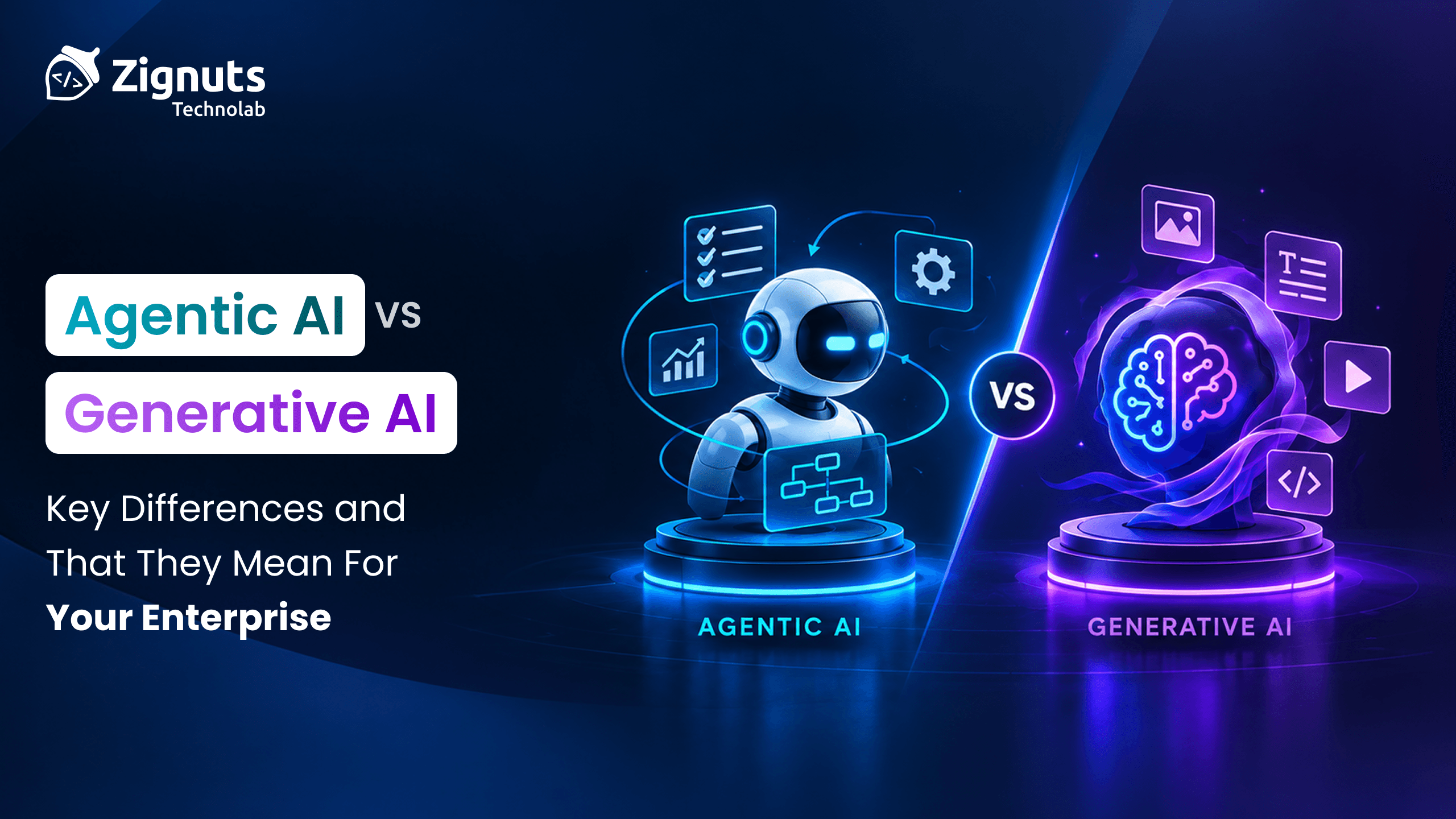
Generative AI creates content when you ask it to. Agentic AI pursues a goal and takes actions to reach it. That one difference changes how an enterprise budgets, governs, and measures each one.
Most large organizations now have generative AI in daily use: copilots that draft emails, summarize documents, and suggest code. The next wave of conversations is about agents, systems that update the CRM, reconcile invoices, or resolve IT tickets without a person prompting every step. In a demo, the two can look alike. In production, they carry different risks, need different integration work, and pay back in different ways.
This guide explains what each one is, the key differences, how they work together, and what they mean for your enterprise.
Generative AI produces content (text, code, images) in response to a prompt. A person decides what to do with it.
Agentic AI pursues a goal across multiple steps, uses tools and business systems, and acts with limited supervision.
It is not either/or. Most enterprise agents use a generative model as their reasoning layer.
Start where risk is low. Use generative AI where a human stays in the loop, and move to agents where the workflow is well defined, the systems expose APIs, and you can set guardrails.
What Is Generative AI?
Generative AI is software built on models, such as large language models and diffusion models, that generate new content from a prompt. That content can be text, code, images, audio, or structured data.
In an enterprise, it usually shows up as an assistant: a chatbot that answers policy questions, a tool that drafts proposals, or a coding aid inside the IDE. Paired with retrieval over your own documents (see our vector database guide), it can answer questions grounded in company knowledge.
Where it is strong: drafting, summarizing, translating, classifying, code assistance, and question answering over documents.
Where it stops: it is reactive. It waits for a prompt, answers, and stops. It has no goal of its own; it does not change anything in your systems, and its output can be wrong or invented, so a person has to review it.
What Is Agentic AI?
Agentic AI refers to systems that pursue a defined goal on their own. They break the goal into steps, choose tools such as APIs, databases, and internal apps, carry the steps out, check the results, and adjust, all within limits that people set.
The working pattern is a loop: goal, plan, act, observe, adapt, with memory carrying context between steps. A chatbot answers a question. An agent finishes a job.
Examples in an Enterprise Setting
Claims handling: reads a claim, checks it against the policy, requests missing documents, and routes it for approval.
Procurement: compares supplier quotes and raises purchase orders within a set spending limit.
IT service desk: resolves access requests by checking identity, applying permissions, and logging the change.
Order exceptions: spots a delayed shipment, finds an alternative, and updates the customer and the ERP.
Autonomy is a dial, not a switch. An agent can suggest actions for approval, act only within strict limits, or run end to end. Where you set the dial depends on the cost of a wrong action.
Agentic AI is also different from artificial general intelligence. Agents are narrow systems built for specific tasks; for the AGI question, see AGI vs AI: key differences.
Ready to Turn AI Into Business Results?

Agentic AI vs Generative AI: Key Differences
The core shift is from output to outcome. Generative AI gives you something to use; agentic AI does something for you.
Dimension | Generative AI | Agentic AI |
|---|---|---|
Core function | Creates content: text, code, images | Achieves goals by taking actions |
Trigger | A human prompt | A goal, a schedule, or an event |
Scope of work | One response or a short exchange | A multi-step workflow with planning and memory across steps |
Tool and system access | Usually none, or read-only retrieval | Calls APIs, databases, and business apps, and can write to them |
Autonomy | Low: a person decides what to do with the output | Ranges from supervised to high, within guardrails |
Main risk | Wrong or fabricated output | Wrong actions with real consequences, such as a bad payment or data change |
How you measure success | Output quality, time saved per task | Task completion rate, error and escalation rate, cycle time, cost per outcome |
Role of people | Reviewer and decision-maker | Supervisor and handler of exceptions |
How Generative and Agentic AI Work Together
Generative AI is usually the reasoning layer inside an agent, not a rival to it. The model interprets the goal, decides the next step, and drafts what is needed. The agentic system around it adds planning, memory, tool access, and guardrails, so those decisions turn into actions.
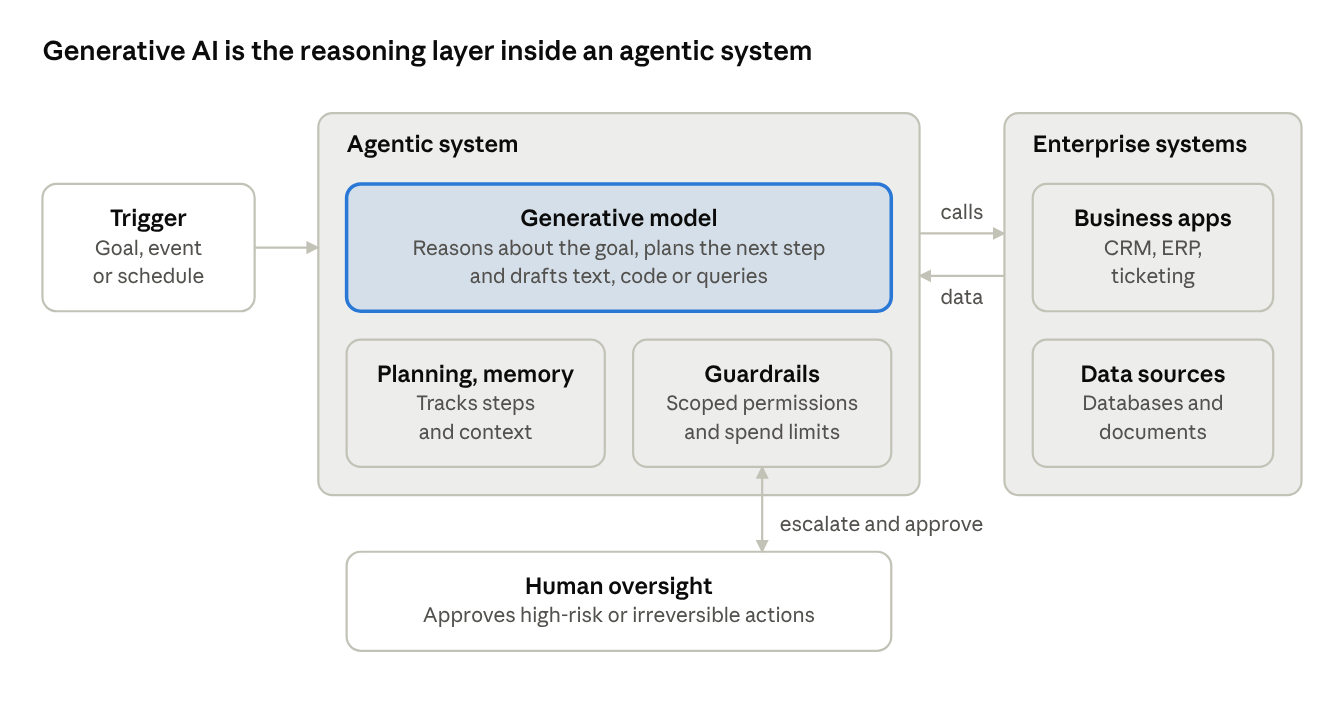
Agentic system architecture: generative model, memory, guardrails, and tools.
A trigger starts the agent, the model reasons, the agent calls your systems and reads the results, and people approve anything high-risk or irreversible.
Agents reach your systems through connectors, and standards such as the Model Context Protocol are making that easier (see AI agents vs MCP). Frameworks like LangChain and LangGraph help orchestrate the steps (see LangChain vs LangGraph).
What This Means for Your Enterprise
Moving from generative to agentic AI is not a model upgrade. It changes five things leaders have to plan for.
1. Value Moves from Task Speed to Process Outcomes
Generative AI saves minutes on individual tasks. Agents remove steps from a process, so the business case is cycle time, cost per case, and error rate, not hours saved per user.
2. Risk Moves from Content to Action
A generative assistant can give a wrong answer. An agent can act on one. Plan for least-privilege access, approval thresholds for high-value or irreversible actions, full audit logs, and a way to stop an agent quickly. Frameworks such as the NIST AI Risk Management Framework are a useful starting point for structuring this.
3. Integration and Data Readiness Become the Bottleneck
An agent is only as capable as the systems it can reach. Missing APIs, inconsistent data, and unclear permissions stall more agent projects than model quality. Our enterprise AI integration guide covers how to approach this.
4. Governance Needs an Owner
Someone must be accountable for what an agent does. That means agent identities and permissions, logs of every plan and tool call, test sets that run before each release, and a clear escalation path to a person.
5. Cost Behaves Differently
One agent run can involve many model calls, retries, and tool calls, so cost scales with workflow volume, not with seats. Set a budget per run, use smaller models for simple steps, and track cost per outcome from the first pilot.
Ready to Turn AI Into Business Results?
When to Choose Generative AI, Agentic AI, or Both
Match the technology to the shape of the work, not to the trend.
If Your Use Case Looks Like This | Start With | Why |
|---|---|---|
Drafting, summarizing, or answering questions over internal documents, with a person reviewing | Generative AI assistant | Low risk, fast to deploy, value from day one |
A repetitive workflow across three or more systems with a clear definition of done | Supervised agentic AI | Agents remove hand-offs between systems |
High-volume exceptions such as tickets, claims, or order issues | Agentic AI with escalation paths | Agents handle routine cases and pass on the hard ones |
Irreversible or regulated decisions such as payments, credit, or clinical choices | Generative AI with human approval | Let AI prepare the case; a person makes the call |
Fixed rules and predictable inputs | Traditional automation | Cheaper and more predictable than any model (see AI vs traditional algorithms) |
Siloed data, missing APIs, no test data | Foundations first | Fix integration and data before piloting an agent |
Four Questions to Ask Before Building an Agent
Can you write down the steps and a clear definition of "done"?
Do the systems it needs expose APIs and permissions you can scope?
What is the worst action it could take, and who approves that action?
How will you measure outcome and cost per run?
If you cannot answer all four, start with a generative AI assistant or fix the foundations first.
A Practical Roadmap for Enterprises
Assess readiness. Review workflows, data quality, integration points, security controls, and team skills. Our AI readiness assessment is built for this step.
Pick one workflow. Choose a process with a named owner, a measurable outcome, and reversible actions.
Pilot with a person in the loop. Begin with the agent suggesting actions, then acting with approval, then acting alone within strict limits.
Build guardrails and observability from day one. Scoped permissions, audit logs, evaluation sets, and spend limits belong in the first release, not a later one.
Scale on a shared platform. Reuse tool connectors, evaluation pipelines, and governance across agents instead of rebuilding them each time.
Conclusion: Build on Both, Govern for Action
Generative AI helps your people produce and understand more. Agentic AI helps your processes run with fewer hand-offs. The two are complementary, and the enterprises that benefit most treat autonomy as a dial they raise as controls, data, and trust mature.
Zignuts helps enterprises design, build, and run both generative and agentic AI systems, as an OpenAI, Anthropic (Claude), and AWS partner. If you are weighing where agents could remove the most friction in your business, explore our agentic AI services, check where you stand with the AI readiness assessment, or request a project estimate.

Deep Mistry
Digital Marketing Enthusiast | Diving into the world of trends, tools, and strategies, sharing discoveries that help create impactful online experiences.