

What Is Enterprise AI Integration?
Most enterprise technology initiatives do not fail at the proof-of-concept (PoC) stage. They fail when transitioning from isolated sandbox demonstrations into core systems of record. For enterprises looking to bridge this gap, AI Integration Services provide the specialised engineering foundation needed to move AI solutions from experimentation to secure, production-ready environments.
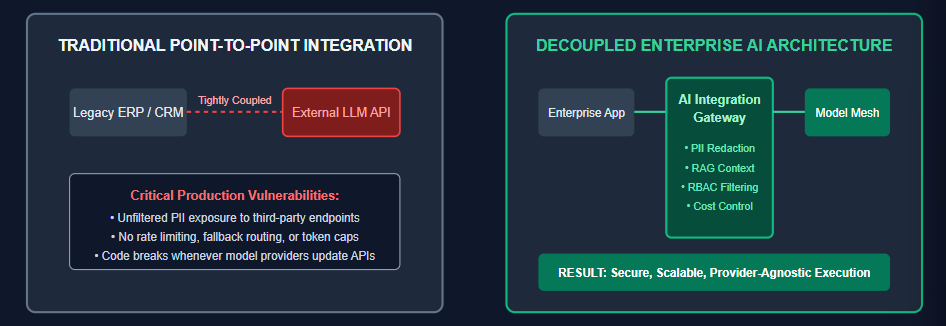
Adding an artificial intelligence API endpoint to a legacy enterprise resource planning (ERP) platform or customer relationship management (CRM) database appears straightforward in design documents. However, executing this integration securely across multi-tenant production environments introduces severe engineering challenges.
Traditional software integration relies on deterministic inputs and outputs.
Standard REST or gRPC microservices process predictable data schemas through explicit business logic.
Large language models (LLMs) and agentic workflows, by contrast, are non-deterministic.
They consume unstructured or semi-structured context, reason over probabilistic pathways, and generate variable responses.
When organisations connect non-deterministic AI models directly to legacy middleware, databases, and transactional APIs without built-in abstraction layers, standard software controls break down.
This can lead to:
System performance degradation due to unbounded latency spikes
Unpredictable scaling of cloud inference costs
Sensitive enterprise data exposure through prompt injection
Risks caused by permissive system access
Solving this gap requires specialised AI integration capabilities that can connect non-deterministic AI models with existing enterprise systems securely and reliably.
A production-ready enterprise AI integration does not simply wrap an external API around internal data. Instead, it constructs a resilient, decoupled infrastructure layer that bridges probabilistic foundation models with deterministic enterprise software systems.
Ready to Scale with Enterprise AI Integration Services?

Key Components of Enterprise AI Integration
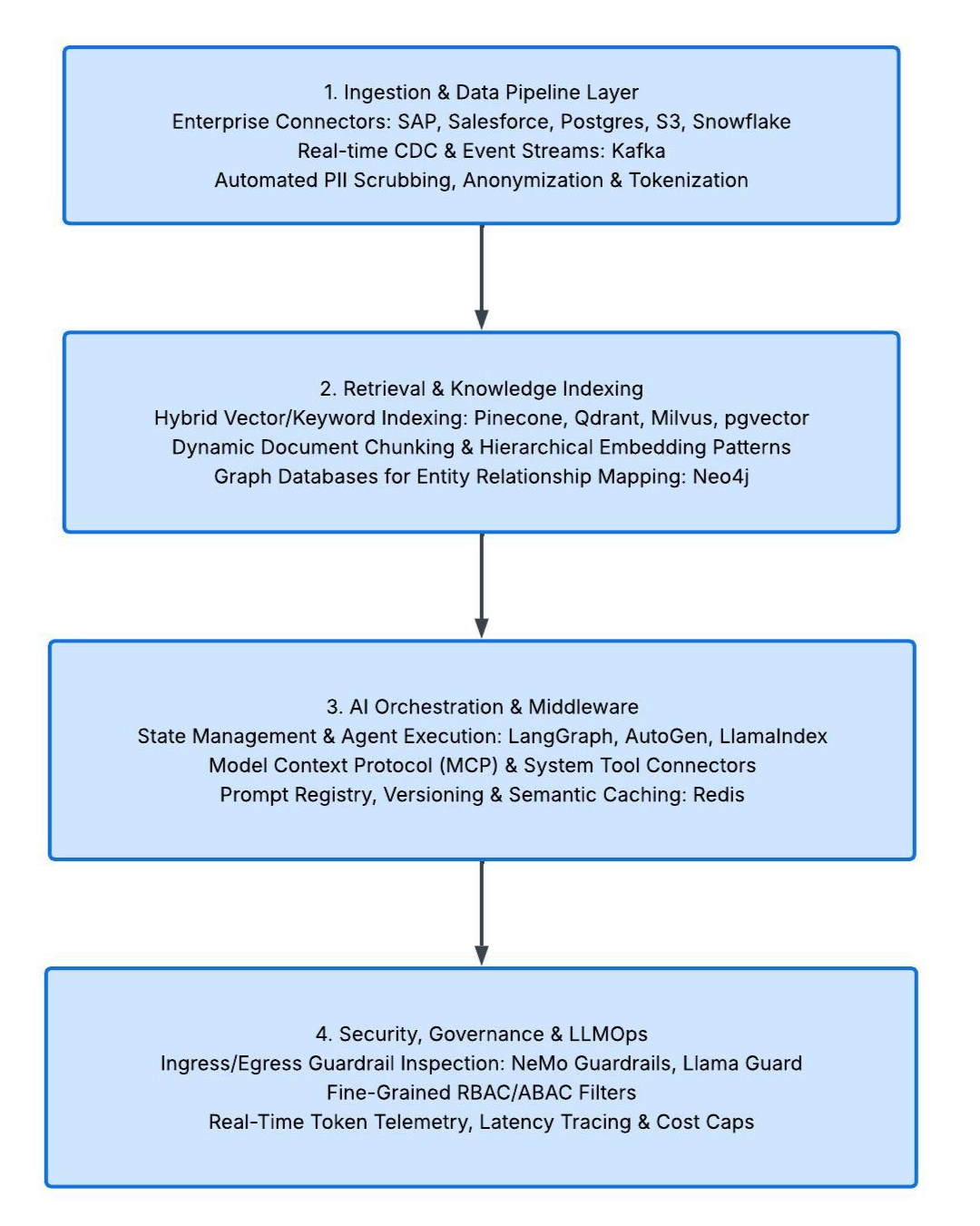
Connecting enterprise platforms to foundational models requires a structured multi-layered integration framework.
Skipping any single layer introduces:
Systemic technical debt
Operational latency
Security compliance failures
1. Data Integration and Context Pipelines for Enterprise AI
Foundation models are only as effective as the context provided to them.
Enterprise AI integration services establish continuous ETL/ELT pipelines that transform unstructured enterprise data into queryable formats without violating internal data sovereignty.
This process involves:
Real-time Change Data Capture (CDC) from operational relational databases
Streaming events through message buses like Apache Kafka
Executing automated chunking strategies
Rather than performing static bulk uploads, production systems index updates continuously, ensuring models access real-time information without re-indexing entire knowledge repositories.
2. RAG Architecture for Enterprise AI Integration
Retrieval-Augmented Generation bridges raw foundation models with proprietary corporate memory.
A production-grade RAG architecture uses hybrid retrieval mechanisms, combining:
Dense vector embeddings
Sparse keyword search (BM25)
This approach helps prevent retrieval failure modes.
By pairing semantic similarity search with exact keyword matching, the system handles the following accurately:
Technical terminology
Part numbers
Precise customer IDs
Dynamic context compression algorithms then prune non-essential metadata before constructing the final prompt payload.
This helps prevent inference cost explosion and mitigates output hallucination.
3. API Gateways for Enterprise AI Integration
An enterprise AI gateway serves as the central control plane for model traffic.
It provides:
Rate-limiting by application
Consumer token allocations
Dynamic fallback routing across multiple foundation model providers
Circuit-breaking logic during cloud outages
When an application requests a completion, the gateway evaluates:
Latency
Cost parameters
Provider availability
If a primary cloud LLM service experiences elevated latency or error rates, the gateway routes the payload to a backup provider or a self-hosted open-source model cluster without downtime.
4.LLMOps and Observability in Enterprise AI Integration
Standard logging tools monitor HTTP status codes and CPU utilisation, but fail to evaluate qualitative model performance.
Enterprise AI integration requires specialised LLMOps telemetry.
Integration platforms implement trace analytics across multi-step agent chains, tracking:
Input tokens
Model reasoning
External database function calls
Completion tokens
This end-to-end visibility allows platform teams to:
Identify latency bottlenecks
Track token spend across internal business departments
Monitor drift or accuracy degradation over time
In-House vs. Enterprise AI Integration Services
When evaluating enterprise AI initiatives, engineering leadership must determine whether to construct integration infrastructure internally or partner with a specialised software engineering firm.
Evaluation Metric | In-House Engineering Development | Specialized AI Integration Partner |
|---|---|---|
Initial Time to Market | 9 to 15 months (requires hiring, upskilling, and architectural trial-and-error). | 2 to 4 months (leverages pre-tested gateway modules, RAG scaffolding, and deployment frameworks). |
Architectural Risk | High risk of lock-in to single-provider SDKs, fragile prompt design, and unoptimized RAG logic. | Minimal; built on provider-agnostic gateway patterns, modular orchestration, and decoupled context layers. |
Security & Compliance | Requires manual development of PII scrubbers, prompt injection guards, and audit logging. | Pre-configured compliance frameworks aligned with NIST AI RMF, OWASP Top 10 for LLMs, and ISO 42001. |
LLMOps Maturity | Often limited to basic APM logging; lacks deep token tracing, cost allocation, and hallucination testing. | Production-grade tracing pipelines with end-to-end token monitoring, cost caps, and automated regression testing. |
Total Cost of Ownership | High ongoing operational overhead to maintain custom infrastructure and adapt to rapidly evolving AI SDKs. | Lower long-term costs due to optimised token routing, dynamic context compression, and standardised platform patterns. |
Partnering with an experienced integration firm allows internal software engineering teams to remain focused on core product features and business logic. The external partner constructs the specialised AI platform foundation, security guardrails, and gateway components once, allowing internal developers to consume AI infrastructure via standardised SDKs.
Ready to Scale with Enterprise AI Integration Services?
Enterprise AI Integration with ERP, CRM, and Business Systems
Deploying artificial intelligence across enterprise infrastructure requires tailored patterns for specific business application ecosystems:
1. Enterprise AI Integration with ERP Systems
Integrating AI into ERP platforms automates complex workflows such as invoice matching, supply chain risk prediction, and automated procurement approvals.
Architectural Pattern: Event-driven async processing using message queues (Kafka/RabbitMQ) paired with explicit human-in-the-loop review steps.
Security Control: Strict transactional boundaries. The AI integration service analyses incoming documents and generates proposed system actions, but writes back to the core ERP through validated REST/SOAP APIs only after meeting explicit confidence thresholds or obtaining supervisor sign-off.
2. Enterprise AI Integration with CRM Platforms
CRM integrations enhance customer-facing teams through automated call transcript summaries, intelligent ticket routing, dynamic quote generation, and next-best-action recommendations.
Architectural Pattern: Bidirectional API sync via Model Context Protocol (MCP) tool calling, linking CRM records directly to vector knowledge bases containing product documentation and historical support resolutions.
Security Control: Role-Based Access Control (RBAC) synchronization. The integration engine dynamically restricts retrieved knowledge context based on the authenticated user's permission level within the CRM, preventing lower-tier agents from viewing restricted contract details or internal account notes.
3. Enterprise AI Integration with Custom SaaS and Legacy Systems
For proprietary core applications running on SQL, NoSQL, or legacy mainframes, AI integrations unlock natural-language-to-SQL query capabilities and automated unstructured document processing.
Architectural Pattern: Read-replica query isolation with schema translation layers. Natural language queries translate into SQL statements executed against read-only database replicas to prevent performance degradation on primary transactional nodes.
Security Control: Deterministic SQL query validation and parameterization. Generated queries pass through AST (Abstract Syntax Tree) parsers to prevent destructive operations (DROP, DELETE, UPDATE) or unauthorized data retrieval before database execution.
Security, Governance and Compliance in Enterprise AI Integration
Deploying enterprise AI integrations requires strict compliance with modern cybersecurity guidelines and legal standards. Engineering teams must design systems to meet four core security frameworks:
1. OWASP Security Controls for Enterprise AI Integration
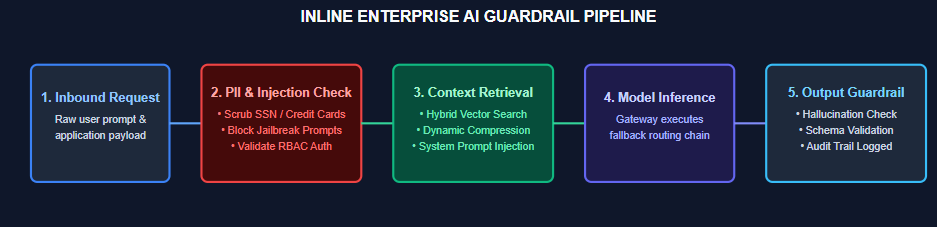
Enterprise integration architectures incorporate inline protections against major vulnerability vectors:
Prompt Injection Defence: Input sanitation engines isolate system prompts from untrusted user inputs, preventing malicious command execution.
Insecure Output Handling: AI outputs pass through schema validators before triggering downstream tool executions or database modifications.
Sensitive Information Disclosure: Automated redaction middleware masks personal identification numbers, access credentials, and protected health information (PHI) before forwarding context payloads to foundation model APIs.
2. NIST AI Risk Management for Enterprise AI Integration
The NIST AI RMF provides guidelines for mapping, measuring, and managing AI system risks. Integrations implement continuous measurement by running automated evaluation suites that test models against adversarial inputs, drift metrics, and bias benchmarks before software releases.
3. ISO 42001 and Security Standards for Enterprise AI Integration
ISO/IEC 42001 establishes parameters for enterprise AI management systems. Integration architectures fulfil these mandates by providing full traceability: every model decision, retrieved context document, prompt version, and user action is logged into immutable audit storage for forensic analysis.
Managing Latency and Accuracy in Enterprise AI Integration
Simple agentic workflows often chain multiple sequential LLM calls together. In test environments, a three-step chain returning responses in 2 seconds appears acceptable. In enterprise production under heavy load, network overhead, vector search execution, and multi-model reasoning compound quickly. A three-step agent chain can easily degrade to 15-second response times. Production integration design requires asynchronous event execution, response streaming, and parallel retrieval patterns to keep end-user latency within sub-second expectations.
How We Deliver Enterprise AI Integration Services
Transitioning AI initiatives from experimental sandbox environments to high-availability production environments requires specialised platform engineering expertise. Building reusable gateway layers, secure RAG pipelines, and agentic workflows consumes internal development bandwidth that could otherwise drive core product value.
As a dedicated software engineering partner, Zignuts helps enterprise technology leaders build and deploy production-grade AI integrations securely. Zignuts delivers scalable integration solutions across four primary architectural domains:
Custom Enterprise AI Gateway Development: Designing resilient API control planes featuring custom authentication integration, dynamic rate-limiting, cost allocation tracking, and automated multi-provider fallback chains.
Production RAG & Vector Knowledge Base Engineering: Constructing hybrid retrieval infrastructure, real-time CDC data pipelines, dynamic context pruning, and enterprise RBAC context filtering.
Agentic Workflow & Tool Integration: Implementing stateful agent orchestrations utilising Model Context Protocol (MCP), structured output validation, and human-in-the-loop review mechanisms.
LLMOps & Compliance Infrastructure: Setting up real-time telemetry pipelines, prompt management registries, evaluation suites, and security guardrails aligned with NIST and OWASP standards.
By leveraging pre-tested infrastructure patterns and deep software engineering expertise, Zignuts enables enterprise organisations to integrate artificial intelligence into legacy and modern cloud platforms reliably, accelerating delivery timelines while maintaining strict data security.
Enterprise AI Integration: Key Takeaways and Next Steps
Integrating artificial intelligence into enterprise software is not a matter of connecting simple API wrappers. It is a fundamental platform engineering discipline that demands robust gateway management, context pipeline design, inline security controls, and end-to-end observability.
If your enterprise technology team is preparing to integrate AI models into legacy platforms, upgrade existing RAG infrastructure, or deploy secure agentic workflows, we can assist. At Zignuts, we help enterprises build secure, production-ready AI integrations. Contact us today to schedule an architectural consultation and build your production integration roadmap.

Utkrishti Mishra
Business Analyst Intern | Exploring data, processes, and business strategies to turn insights into smarter decisions and impactful solutions.