



Have you ever noticed that Amazon keeps showing products that fit what you are browsing, while Netflix seems to know what you might want to watch next?
That experience is powered by recommendation systems .
Recommendation systems analyze user behavior, item information, context, and business signals to predict what a person is most likely to find useful or interesting.
But a modern recommendation system is much more than a " people who bought this also bought that " feature.
At Zignuts, we see recommendation systems as complete product capabilities. The model is only one part of the solution. Data pipelines , candidate generation, ranking, business rules, APIs , real-time processing, experimentation, monitoring, and product integration all determine whether recommendations actually improve the user experience.
Amazon and Netflix are useful examples because their publicly documented engineering work shows two different ways of solving recommendation problems at large scale. Amazon published research on item-to-item collaborative filtering, while Netflix has publicly discussed personalized ranking, homepage generation, candidate selection, diversity, contextual relevance, and experimentation. The exact production architectures used by both companies remain proprietary.
In this article, we explain how recommendation systems work, what we can learn from Amazon and Netflix , which recommendation algorithms are commonly used, and how we approach building production-ready recommendation systems at Zignuts.
What Are Recommendation Systems and How Do Recommendation Systems Work?
Recommendation systems are software systems that predict which products , content, services, or actions are most relevant to a particular user or situation.
A typical recommendation system follows a pipeline:
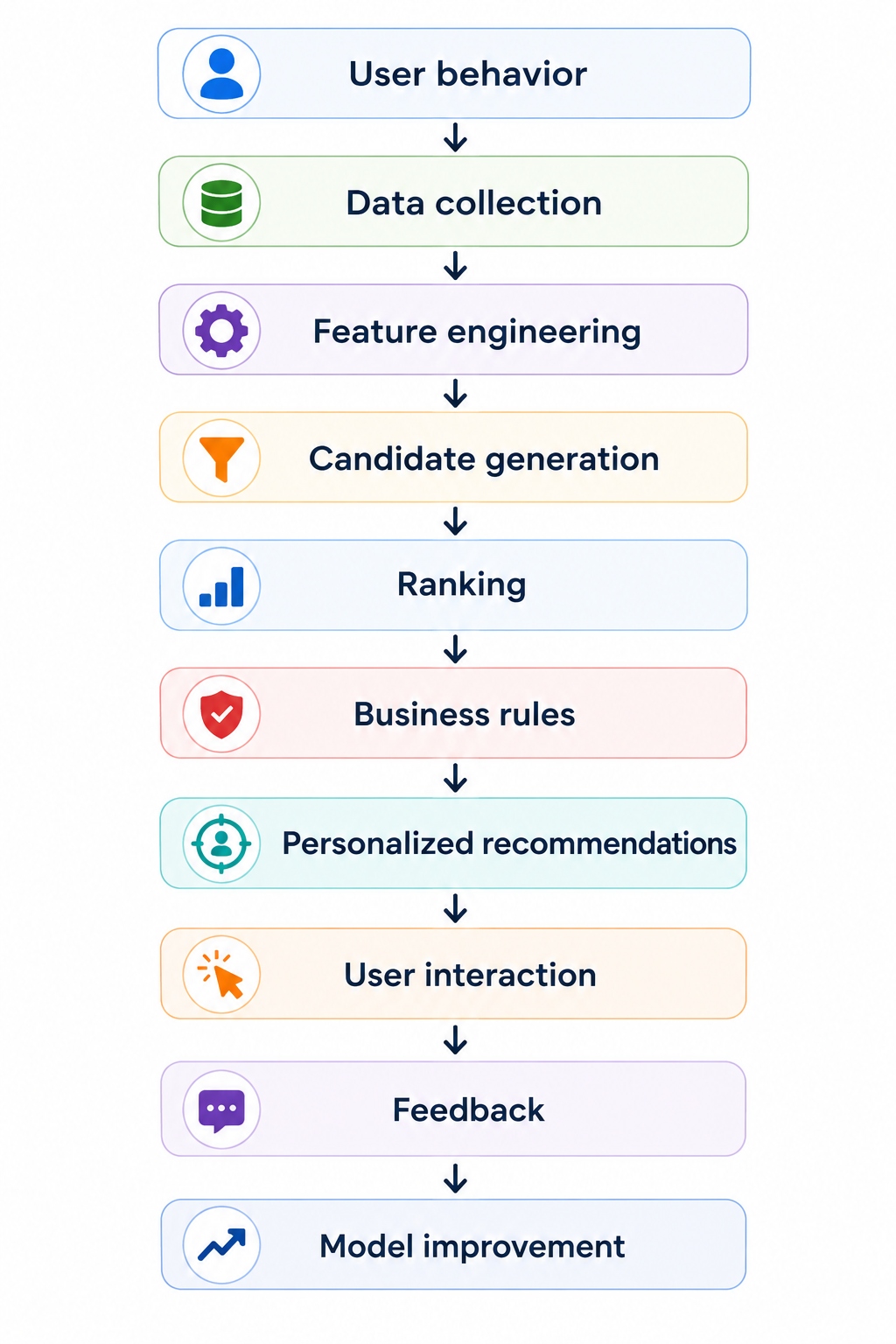
The core concept is simple.
We collect signals about what users do. We use those signals to estimate what they may want next. Then we place the most relevant recommendations into the product experience.
At Zignuts, we design recommendation systems around this complete flow rather than treating the machine learning model as the entire product.
How Amazon Recommendation Systems Actually Work
Amazon is one of the most recognizable examples of recommendation systems at scale.
One of Amazon's most influential publicly documented approaches is item-to-item collaborative filtering.
The idea is different from simply finding users who behave similarly.
Instead, the system focuses on relationships between items.
For example, imagine users frequently interact with:
Running shoes
Running socks
Sports watches
The system can identify relationships between those products based on large amounts of behavioral data.
When a customer views or purchases one item, the system can use those learned item relationships to identify other products that may be relevant.
Amazon's 2003 research paper, " Amazon.com Recommendations: Item-to-Item Collaborative Filtering, " describes this approach and explains how item-to-item recommendations can operate efficiently across a large catalog. Amazon recommendation research paper
The important idea is straightforward:
Recommendation systems can learn relationships between items from user behavior.
That principle remains highly relevant when we design recommendation systems today.
How Amazon Recommendation Systems Use Behavioral Data
Recommendation systems need signals.
Those signals can come from:
Product views
Searches
Clicks
Cart additions
Wish-list actions
Ratings
Browsing history
Categories
Product metadata
Recency
At Zignuts, we typically look at behavioral data as one of the most important foundations for personalized recommendations.
A single interaction can provide useful information. A sequence of interactions can provide much more.
For example:
User searches for laptops. ↓ User compares three laptop models. ↓ User views laptop accessories. ↓ User adds a laptop to the cart. |
The recommendation system now has multiple signals about the user's current intent.
This is more valuable than simply knowing that the user has visited the ecommerce platform before.
Inside Netflix & Amazon’s Recommendation Engines

How Amazon Recommendation Systems Use Item Relationships
Item relationships can be learned from customer behavior.
Suppose customers who interact with Product A frequently interact with Product B.
The relationship between A and B becomes a useful recommendation signal.
Over time, the recommendation system can build a network of item relationships.
This can support recommendation experiences such as:
Frequently bought together
Related products
Similar products
Customers also viewed
Customers also purchased
The important engineering consideration is scale.
A large catalog can contain millions of possible items.
The system cannot treat every product as an equally likely recommendation for every customer.
Candidate generation helps solve that problem.
How Amazon Recommendation Systems Generate Candidates
Candidate generation answers one question:
" What items could we reasonably recommend? "
Instead of ranking every product, the system first builds a smaller candidate set.
Candidates can come from:
Collaborative filtering
Item-to-item relationships
Content similarity
Recent activity
Popular products
Search signals
Semantic similarity
Business rules
At Zignuts, we use this separation because it allows recommendation systems to scale more effectively.
Candidate generation narrows the search space. Ranking then decides what should appear first.
That division also makes it easier to evolve the system.
We can improve candidate generation without completely rebuilding the ranking layer.
How Amazon Recommendation Systems Use Ranking
Candidate generation gives us possibilities.
Ranking determines priority.
A ranking model can evaluate factors such as:
User preferences
Recent behavior
Historical engagement
Item relevance
Context
Popularity
Availability
Business priorities
The output is an ordered list.
For example:
Candidate A → Score 0.91
Candidate B → Score 0.84
Candidate C → Score 0.76
Candidate D → Score 0.63
The scores themselves are not necessarily what the customer sees.
The important result is the ordering.
This is where learning-to-rank models can become particularly useful.
How Netflix Recommendation Systems Actually Work
Netflix demonstrates another important recommendation problem.
A streaming platform does not simply need to answer:
" Which movie should we recommend? "
It also needs to decide:
Which titles should appear?
Which content group should appear first?
How many rows should be shown?
Which titles should appear inside each row?
How much variety should the user see?
Should recently watched content be prioritized?
How should the experience change between devices?
Netflix has publicly described its personalized homepage architecture as a multi-stage process involving candidate generation, ranking, row selection, filtering, page construction, diversity, and device-aware constraints. Netflix Technology Blog: Learning a Personalized Homepage
That creates an important lesson.
Recommendation systems can personalize the experience, not just the individual recommendation.
How Netflix Recommendation Systems Use User Behavior
Netflix can use signals related to how members interact with content.
Examples include:
Watch history
Recent viewing
Search activity
Ratings
Content interactions
Genre preferences
Session behavior
Recent activity
The importance of a signal can vary.
Recent behavior may provide information about current intent. Long-term history can provide information about broader preferences.
This is why recommendation systems often combine short-term and long-term signals.
At Zignuts, we consider this distinction when designing personalized recommendation systems.
A user's historical preferences are useful. But current intent can be even more important in certain experiences.
Inside Netflix & Amazon’s Recommendation Engines
How Netflix Recommendation Systems Rank Content
Netflix has publicly described recommendation as a multi-stage ranking problem.
Candidate titles can first be identified. Those candidates can then be ranked for a particular user. The platform may also rank the rows containing those titles.
Then the final page experience needs to account for:
Relevance
Diversity
Freshness
Discovery
Device constraints
Content availability
Task-oriented experiences
This shows why recommendation ranking is not always a single score.
Multiple objectives can influence the final result.
At Zignuts, we use the same principle when recommendation systems need to balance user relevance with business or product constraints.
Netflix Recommendation Systems Do More Than Recommend Movies
This is one of the most useful lessons from Netflix.
Suppose a recommendation model identifies ten highly relevant titles.
That does not automatically create a good homepage.
The product still needs to decide how to organize those titles.
A recommendation system may therefore need to optimize:
What appears first
Which categories appear
Which recommendations repeat
How much variety is visible
Where unfinished content appears
How new content is introduced
How the experience changes across devices
Netflix's public engineering work highlights the importance of page-level optimization, filtering, deduplication, diversity, and personalization rather than treating every title as an isolated recommendation. Netflix Technology Blog: Learning a Personalized Homepage
For us, the broader takeaway is important:
The recommendation engine and the product experience should be designed together.
Netflix Recommendation Systems vs Amazon Recommendation Systems
Amazon and Netflix both use recommendation systems, but their optimization problems are different.
Recommendation System Area | Amazon Recommendation Systems | Netflix Recommendation Systems |
|---|---|---|
Primary objective | Product discovery and purchase decisions | Content discovery and viewing |
Main item type | Products | Movies and shows |
Major behavioral signals | Views, searches, carts, purchases | Viewing, search, ratings, interaction |
Core recommendation problem | Which products are related or relevant? | Which content and page experience are relevant? |
Candidate generation | Product relationships, behavioral signals, similarity | Content candidates, personalization signals |
Ranking | Product relevance and purchase intent | Content relevance, rows, and page placement |
Context | Shopping intent, product availability, catalog | Session, device, content, page structure |
Diversity | Product variety | Content variety and discovery |
Presentation | Product pages and recommendation modules | Personalized rows and homepage |
Main business objective | Product discovery and conversion | Engagement, discovery, and retention |
The lesson is not that Amazon has the " best " approach or Netflix has the " best " approach.
The lesson is that recommendation systems must match the product.
An ecommerce recommendation system and a streaming recommendation system may use similar machine learning concepts while optimizing very different outcomes.
What Algorithms Power Recommendation Systems?
There is no single recommendation algorithm that works for every business.
At Zignuts, we select recommendation approaches based on the available data, business objective, catalog size, latency requirements, explainability needs, and product experience.
Common approaches include:
Collaborative filtering
Content-based recommendation
Hybrid recommendation systems
Embedding-based recommendation
Learning-to-rank
Context-aware recommendation
Predictive models
LLM-assisted recommendation
The right architecture depends on the actual problem.
Collaborative Filtering Recommendation Systems
Collaborative filtering learns from interactions between users and items.
The underlying idea is:
Users with related behavior may have related preferences.
It can also work from item relationships.
Collaborative filtering is useful when interaction data is strong.
It becomes more difficult when there is little history.
That creates the cold-start problem.
At Zignuts, we may combine collaborative filtering with other approaches when new users, new products, or new content need useful recommendations immediately.
Content-Based Recommendation Systems
Content-based recommendation systems use item attributes.
A product might contain:
Category
Brand
Description
Price
Specifications
A movie might contain:
Genre
Actors
Director
Description
Keywords
The system can compare the content profile of items with the user's known preferences.
This can be especially useful when rich metadata exists.
It can also help with new items that do not yet have strong behavioral data.
Hybrid Recommendation Systems
Hybrid recommendation systems combine multiple approaches.
For example:
Collaborative filtering
Content similarity
Behavioral signals
Context
Business rules
At Zignuts, we often consider hybrid recommendation systems when a single algorithm cannot adequately represent the full recommendation problem.
Hybrid systems can also help address cold-start issues.
A new product may have no purchase history.
But it may already have rich product metadata.
The content layer can provide an initial recommendation signal while behavioral data grows over time.
Embedding-Based Recommendation Systems
Embeddings represent users, products, content, or other entities as vectors.
These vectors can capture semantic or behavioral relationships.
That allows us to search for items that are mathematically close to a user's interests or another item.
Embedding-based recommendation systems can support:
Similar product discovery
Semantic content matching
Personalized search
Related content
Knowledge recommendations
Intent-aware recommendations
At Zignuts, we use embeddings and vector search when semantic relationships provide useful information beyond traditional categories or keyword matching .
A vector database can then make similarity retrieval efficient across larger datasets.
Learning-to-Rank Recommendation Systems
Learning-to-rank models focus on ordering candidates.
Suppose candidate generation produces 100 possible recommendations.
The ranking model can determine which ten deserve the highest positions.
Features can include:
User behavior
Item relevance
Recency
Context
Historical engagement
Semantic similarity
Popularity
Business signals
This separation gives the system flexibility.
We can improve candidate generation while keeping the ranking layer stable.
We can also experiment with different ranking models without changing the whole application .
Inside Netflix & Amazon’s Recommendation Engines
Recommendation Systems and the Cold-Start Problem
Cold start occurs when the system has insufficient historical data.
There are three common situations.
A new user has no history. A new product has no interactions. A new piece of content has no engagement.
The recommendation system still needs to produce useful results.
We can address this with:
Popular content
Metadata
Content-based recommendations
Context
Onboarding preferences
Embeddings
Business rules
Hybrid models
At Zignuts, we consider cold-start strategy during architecture planning rather than waiting for it to become a production problem.
Recommendation Systems Need Context
User preferences are not static.
A person's intent can change during a single session.
Context can include:
Time
Location
Device
Session
Recent activity
Search query
Availability
Price
At Zignuts, we include contextual signals when real-time intent can materially change the recommendation.
For example, a user who usually browses formal clothing may temporarily be shopping for running gear.
The system should be able to recognize the current session intent instead of relying only on long-term history.
Recommendation Systems and Real-Time Personalization
Some recommendation systems can operate in batch mode.
Others need real-time processing.
Batch recommendations can be calculated periodically.
Real-time recommendations react to current behavior.
Consider an ecommerce session:
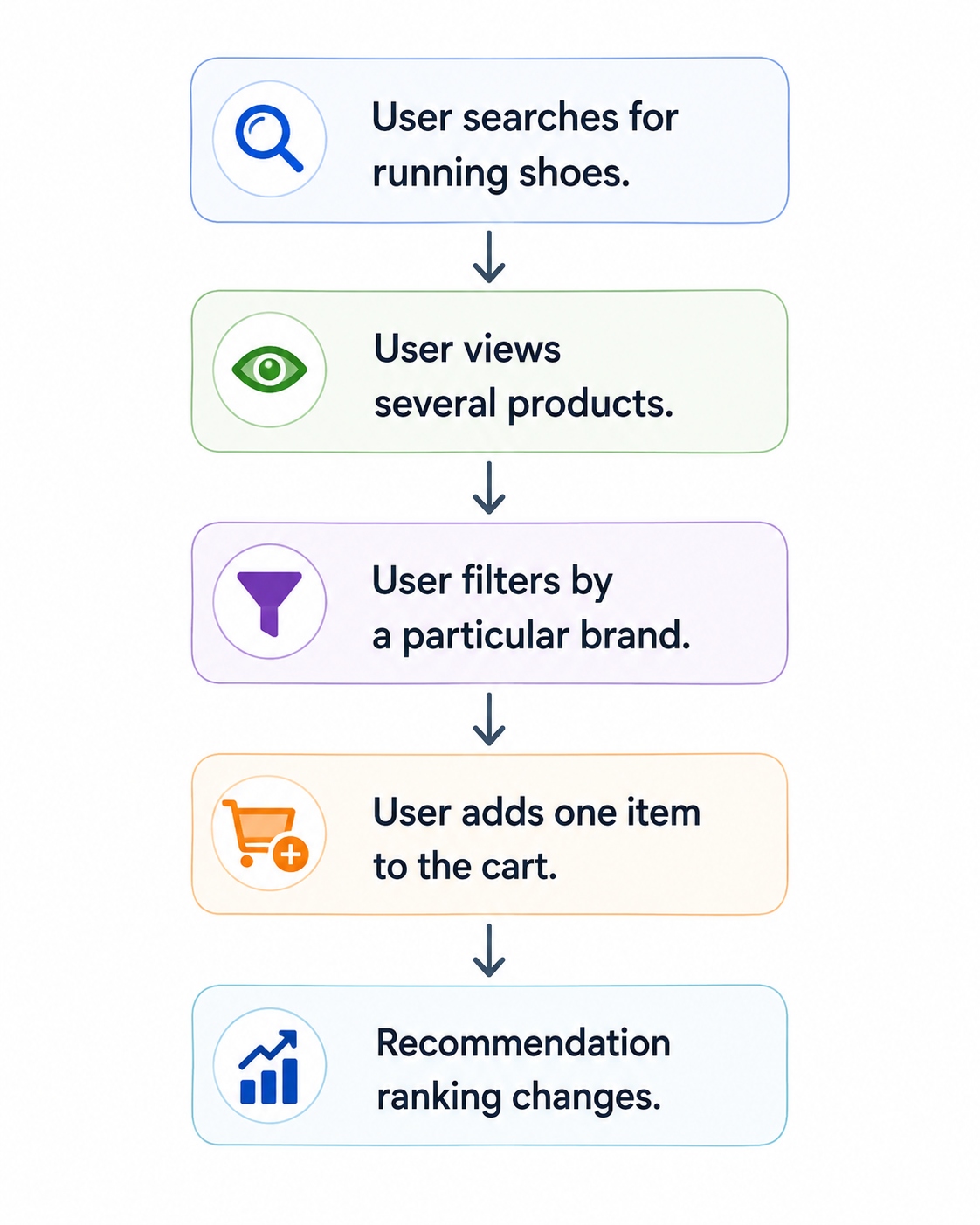
At Zignuts, we design real-time recommendation pipelines when the business requires fast response to changing user intent. These architectures can include event streaming, online features, low-latency APIs, caching, and real-time inference.
For applications without strict latency requirements, batch recommendation can be simpler and more cost-efficient.
The architecture should follow the business need.
Recommendation Systems and Business Rules
Machine learning should not necessarily control every recommendation.
Business rules still matter.
A recommendation system may need to prevent:
Out-of-stock products
Restricted content
Unavailable services
Already consumed content
Regulated products
Excluded categories
Certain business-specific combinations
We therefore treat business rules as another layer of the recommendation architecture.

At Zignuts, our recommendation architectures can include rule-based constraints, auditability, privacy controls, and human override mechanisms when the use case requires them.
This gives product and business teams greater control.
Recommendation Systems and Ranking Diversity
A common mistake is to show only the highest-scoring items.
That can produce repetitive recommendations.
Imagine a user who likes action movies.
The model could technically rank ten action movies at the top.
But showing ten nearly identical titles may not create a good discovery experience.
A better recommendation system can balance:
Relevance
Diversity
Freshness
Novelty
Discovery
Business objectives
Netflix has publicly discussed these trade-offs in its personalization engineering work. Netflix Technology Blog: Learning a Personalized Homepage
At Zignuts, we consider ranking diversity when the product experience benefits from exploration rather than repetitive recommendations.
Recommendation Systems and A/B Testing
Recommendation quality cannot be validated only through offline metrics.
A model may perform well against historical data and still create a poor live experience.
That is why experimentation matters.
Depending on the product, we can evaluate:
Click-through rate
Conversion rate
Average order value
Watch time
Engagement
Dwell time
Assisted revenue
A/B testing allows teams to compare a baseline recommendation strategy with a new approach.
For example:
Existing recommendation model vs New ranking model
The result is measured against the business objective.
At Zignuts, we consider experimentation an important part of recommendation system optimization because model quality and product impact are not always the same thing.
Recommendation Systems Architecture for Enterprise Applications
A production recommendation system can include several services.
A simplified architecture looks like this:
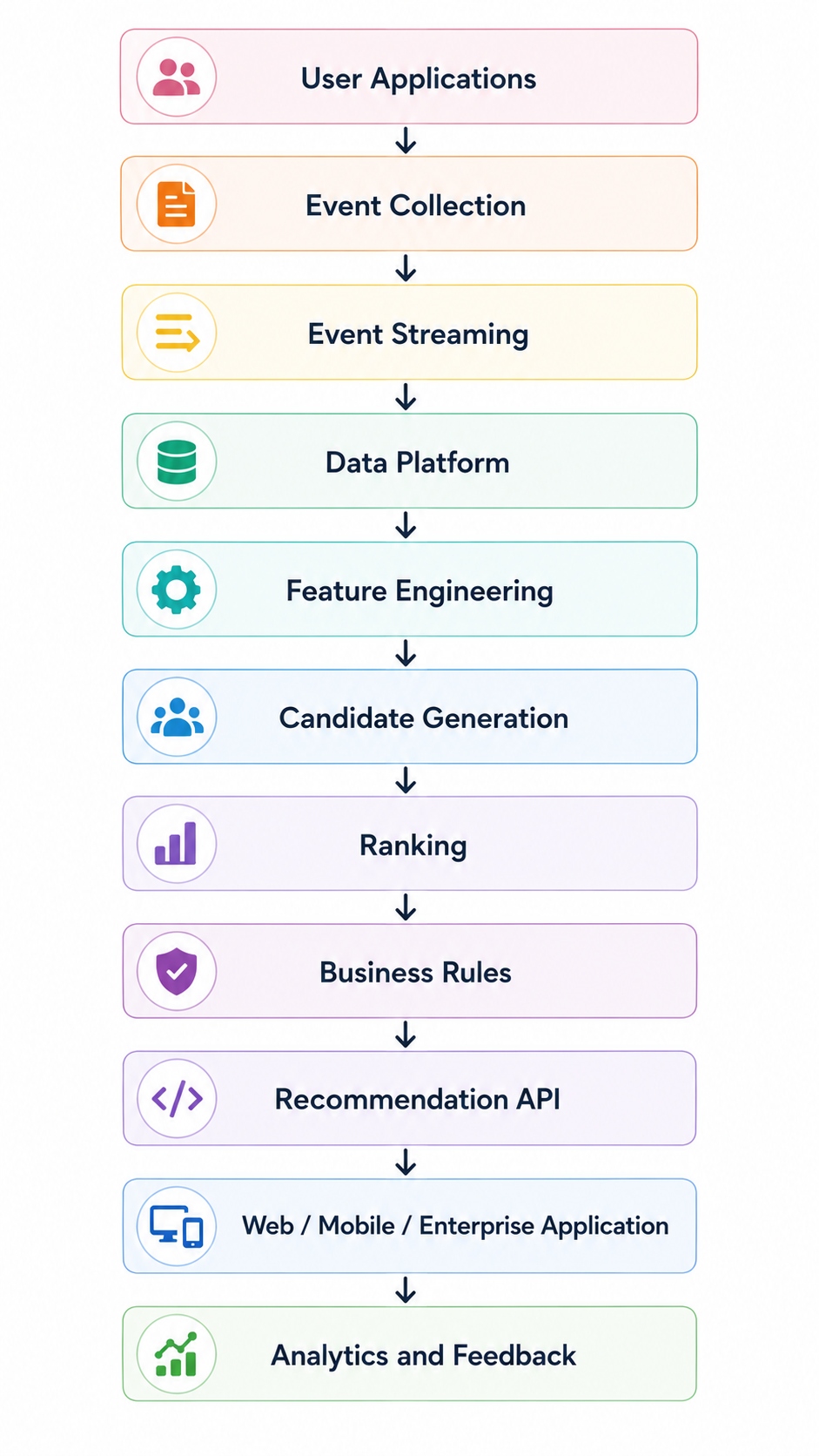
Data warehouses
Feature stores
Vector databases
Caching
Message queues
API gateways
Model registries
Monitoring
Experimentation systems
Identity and access management
At Zignuts, our recommendation system architectures can be integrated with ecommerce platforms, CRM systems, CMS platforms, internal business applications, analytics platforms, and data warehouses.
The exact architecture depends on scale and latency.
A smaller SaaS application should not automatically adopt infrastructure designed for a massive marketplace.
Recommendation Systems and Vector Databases
Vector databases are especially useful when recommendations depend on semantic similarity.
Traditional databases are excellent for structured data.
But semantic recommendation often requires the system to compare representations rather than only exact fields.
Embeddings make that possible.
For example, a product description can be converted into an embedding.
A user's interests can also be represented as embeddings.
The system can then retrieve products that are semantically similar.
At Zignuts, we use vector search when the business problem requires semantic matching, personalized search, similar-item discovery, or content recommendation.
This can extend traditional recommendation approaches rather than replacing them.
Recommendation Systems and AI Recommendation Engines
Modern AI creates new possibilities for recommendation systems.
AI models can help with:
Content understanding
Intent detection
Semantic matching
Recommendation explanations
Natural-language search
Conversational recommendations
Preference understanding
However, not every recommendation problem needs an LLM.
Traditional recommendation models can be more efficient for large-scale ranking.
Embeddings can be better for semantic similarity.
Learning-to-rank can be better for candidate ordering.
LLMs can be valuable for understanding complex content and natural-language intent.
At Zignuts, we choose the technology based on the role it needs to play.
We do not add an LLM simply because a recommendation system is an AI project .
Netflix's recent public research shows this area continuing to evolve. Netflix has published work on foundation models for personalized recommendation and LLM-powered personalization experiences. Netflix Technology Blog: Foundation Model for Personalized Recommendation
The likely direction is not replacing every recommender with one model.
It is combining stronger representations, retrieval, ranking, personalization, and foundation models where each component adds value.
Recommendation Systems for Ecommerce
Ecommerce recommendation systems can reduce product discovery friction.
Customers may know exactly what they want.
Or they may be exploring.
Recommendation systems can support:
Similar products
Frequently bought together
Recently viewed products
Personalized products
Cross-sell recommendations
Upsell recommendations
Product bundles
Personalized search
Offer recommendations
At Zignuts, we design ecommerce recommendation systems around the business KPI rather than treating recommendation as a standalone feature.
Potential objectives include:
Higher conversion
Higher average order value
Better product discovery
Higher repeat purchases
Improved customer retention
The recommendation strategy should reflect the actual business objective.
Recommendation Systems for Media and Entertainment
Media platforms face a different challenge.
There can be far more content than a user has time to consume.
Recommendation systems help reduce that discovery problem.
They can support:
Personalized homepages
Content recommendations
Similar-content recommendations
Continue watching
Personalized feeds
Playlists
Search ranking
Content discovery
Netflix is a strong example because personalization can extend from individual titles to the organization of the entire homepage. Netflix Technology Blog: Learning a Personalized Homepage
That principle can also apply to other digital content platforms.
Inside Netflix & Amazon’s Recommendation Engines
Recommendation Systems for SaaS and Enterprise Platforms
Recommendation systems are not limited to consumer applications.
We can use recommendation systems inside SaaS and enterprise products to suggest:
Next-best actions
Relevant documents
Knowledge resources
Training content
Workflows
Features
Customer actions
Operational decisions
At Zignuts, we consider recommendation engines for SaaS, fintech , healthcare, education, logistics, manufacturing, retail, media, travel, and other data-rich applications where users need help deciding what to do next.
In these environments, the recommendation may not be a product or movie.
It may be a business action.
How to Build Recommendation Systems for a Business
At Zignuts, we start recommendation system projects with the business outcome.
Step 1: Define the Recommendation Objective
First, define what the recommendation should improve.
Do we want:
Higher conversion?
Better engagement?
Higher retention?
Higher average order value?
Better content discovery?
Lower search friction?
More efficient workflows?
The objective determines the model and measurement strategy.
Step 2: Identify the Available Data
We review:
User profiles
Behavioral events
Transactions
Catalog data
Content metadata
Search history
Ratings
Context
Business rules
Data availability strongly influences architecture.
Step 3: Solve Data Readiness
Before model development, we validate:
Event tracking
Identity resolution
Catalog quality
Metadata completeness
Data pipelines
Consent requirements
Feature availability
The goal is to make sure the model receives reliable signals.
Step 4: Select the Recommendation Approach
Depending on the use case, we may consider:
Collaborative filtering
Content-based recommendation
Hybrid models
Embeddings
Learning-to-rank
Context-aware recommendation
Predictive models
LLM-assisted recommendation
We choose the simplest architecture that can reliably solve the problem.
Step 5: Build Candidate Generation
Candidate generation creates a manageable set of potentially relevant items.
This reduces computation.
It also creates a clean separation between retrieval and ranking.
Step 6: Build the Ranking Layer
The ranking layer decides what should appear first.
We can incorporate:
User preference
Context
Recency
Relevance
Diversity
Business constraints
Availability
Product signals
Step 7: Add Business Rules
We add rules where the machine learning model should not make the final decision.
This creates predictable controls around:
Availability
Restrictions
Business priorities
Content eligibility
Step 8: Integrate the Recommendation System
The recommendation engine needs to connect to the product.
We can expose recommendations through APIs or event-driven workflows and integrate them into:
Web applications
Mobile applications
Ecommerce platforms
CMS platforms
Enterprise software
Analytics systems
Step 9: Test With Real Users
Offline metrics are useful.
Production experiments are essential.
We compare recommendation strategies and measure business impact.
Step 10: Monitor and Improve
After deployment, we monitor:
Recommendation relevance
Model performance
API latency
Prediction failures
Drift
Business KPIs
Experiment results
Then we improve the system continuously.
Common Recommendation Systems Mistakes
Mistake 1: Optimizing Only for Clicks
A click does not necessarily represent business value.
The correct KPI depends on the product.
Mistake 2: Ignoring Cold Start
New users and new items require dedicated strategies.
Mistake 3: Showing Repetitive Recommendations
High relevance can still create a poor experience if the output lacks variety.
Mistake 4: Ignoring Business Rules
A technically relevant recommendation may still be unavailable, restricted, or commercially inappropriate.
Mistake 5: Building Without A/B Testing
Recommendation systems should be validated using real product outcomes.
Mistake 6: Treating the Model as the Whole System
The model is only one component.
Data, APIs, infrastructure, product integration, experimentation, and monitoring all matter.
Recommendation Systems Security, Privacy, and Governance
Recommendation systems process behavioral information.
Depending on the application, that data can reveal:
Preferences
Purchasing behavior
Viewing behavior
Interests
Search activity
Location
Personal context
At Zignuts, we consider security and governance during recommendation architecture design.
Controls may include:
Authorization
Encryption
Access control
Audit logging
Data retention
Privacy controls
Model governance
Bias review
Human override
The exact requirements depend on the industry and use case.
Security should be part of the architecture from the beginning.
Recommendation Systems and MLOps
Recommendation systems change over time.
Users change. Products change. Content changes. Catalogs change. Business priorities change.
This can cause model performance to drift.
At Zignuts, our recommendation-system approach can include:
Model versioning
Data pipelines
Feature management
Model registries
Automated deployment
Monitoring
Drift detection
Retraining
The goal is to make recommendation systems maintainable after launch.
A recommendation engine should be treated as a continuously operating software system.
Inside Netflix & Amazon’s Recommendation Engines
Recommendation Systems and Explainability
Personalized recommendations can be difficult to trust when users do not understand why something was shown.
Simple explanations can help.
Examples include:
Because you viewed similar products
Because you watched related content
Based on your recent activity
Popular with similar users
Similar to items you purchased
Explainability can also help internal teams investigate unexpected recommendations.
At Zignuts, we consider explainability especially important when recommendations affect sensitive workflows, financial decisions, healthcare experiences, or other high-impact use cases.
Recommendation Systems and Business Value
The value of a recommendation system should be measurable.
Depending on the product, we can measure:
Conversion rate
Average order value
Revenue per visitor
Engagement
Watch time
Retention
Customer lifetime value
Product discovery
Search efficiency
Workflow completion
The right metric depends on the business objective.
A recommendation system that increases clicks but reduces conversions may not be successful.
A recommendation engine should therefore optimize for the outcome the business actually cares about.
How We Build Recommendation Systems at Zignuts
At Zignuts, we build recommendation systems as part of the broader product and software architecture.
We work across the complete lifecycle:
Business KPI definition
Data readiness
User journey analysis
Event tracking
Recommendation strategy
Candidate generation
Ranking
Personalization
API development
Application integration
MLOps
Experimentation
Monitoring
Continuous optimization
Our recommendation-system capabilities include product recommendations, content recommendations, personalized recommendations, hybrid recommendation engines, real-time personalization, embeddings, vector search, learning-to-rank, and AI-powered recommendation platforms.
We also consider the engineering requirements surrounding the model.
A recommendation engine needs reliable APIs.
The data pipeline needs observability.
The model needs versioning.
The application needs predictable latency.
Business teams may need rule controls.
The system needs to be measurable .
The architecture needs to scale with the product.
This is why we do not treat recommendation system development as simply a machine learning task.
It is a product engineering and data engineering problem as well.
Lessons We Apply From Recommendation System Case Experience
Our broader experience building data-intensive software platforms reinforces several principles that are directly relevant to recommendation systems.
In our supply chain visibility work, we have worked with real-time operational data, predictive alerts, integrations, and centralized decision workflows. That experience reinforces the importance of turning model outputs into operational actions rather than leaving them inside isolated analytics screens.
In our AI-powered fleet management work, we worked with GPS tracking, predictive maintenance, route optimization , driver analytics, dispatch workflows, and IoT connectivity. The key lesson is similar: intelligence becomes more valuable when it is connected to the workflow that acts on it.
Our work on AI-powered financial operations also reinforces the importance of integrating AI with business processes, data sources, and operational controls.
For recommendation systems, we apply the same engineering mindset.
The recommendation needs to reach the user at the right moment.
The result needs to be relevant.
The workflow needs to be reliable.
The system needs to be measurable.
And the model needs to improve over time.
What Is the Future of Recommendation Systems?
Recommendation systems are moving beyond simple collaborative filtering.
Modern recommendation platforms can combine:
Behavioral signals
Context
Embeddings
Vector search
Real-time events
Learning-to-rank
Predictive models
Business rules
Foundation models
The goal is not to use every technology.
The goal is to use the right technology for the right layer.
Netflix's published research on foundation models for personalization demonstrates how recommendation systems are evolving toward richer representations and broader personalization capabilities . Netflix Technology Blog: Foundation Model for Personalized Recommendation
We expect recommendation systems to become increasingly contextual.
Instead of simply learning:
"This user likes these items."
Systems will increasingly understand:
"What is this user trying to accomplish right now?"
That distinction can make personalization much more useful.
Inside Netflix & Amazon’s Recommendation Engines
Key Takeaways About Recommendation Systems
Recommendation systems predict what users may find relevant and turn those predictions into personalized experiences.
Amazon's publicly documented item-to-item collaborative filtering approach shows how product relationships can be learned from customer behavior.
Netflix's public engineering work shows that recommendation can involve the personalization of an entire content experience, including candidate selection, ranking, rows, diversity, and page layout .
Modern recommendation systems can combine collaborative filtering, content-based models, hybrid approaches, embeddings, vector search, learning-to-rank, contextual signals, and AI.
Candidate generation and ranking should usually be designed as separate layers for scalability .
Cold-start handling should be considered from the beginning.
Real-time recommendation systems are useful when current intent can change quickly.
Business rules remain important even when machine learning is involved.
A/B testing connects recommendation quality with actual business outcomes.
MLOps and monitoring are critical because user behavior, products, and business objectives change.
The best recommendation system is not the most complicated system.
It is the one that creates measurable value for the users and the business.
Conclusion: How Recommendation Systems Actually Create Personalization
Amazon and Netflix demonstrate two different ways of solving recommendation problems at scale.
Amazon's published research shows the effectiveness of item-to-item relationships for product recommendations.
Netflix's public engineering work shows how personalization can extend beyond individual content recommendations into ranking, page construction, diversity, context, and the overall user experience .
The common foundation is data.
User interactions create signals.
Models transform those signals into predictions.
Candidate generation narrows the possibilities.
Ranking determines priority.
Business rules add control.
Experiments measure impact.
Feedback improves the system.
At Zignuts, we follow the same broader principle when we build recommendation systems.
We do not begin by asking which algorithm is most impressive.
We begin by asking what the business needs the recommendation system to improve.
Then we design the data architecture, recommendation strategy , ranking logic, APIs, application integration, infrastructure, monitoring, and experimentation around that objective.
That approach allows us to build recommendation systems that are not only technically capable but also useful inside real products.
For an ecommerce platform, that may mean better product discovery and conversion.
For a media platform, it may mean better content discovery and engagement.
For a SaaS platform, it may mean better next-best actions and workflow recommendations.
For an enterprise platform, it may mean helping users make faster and more informed decisions.
The technology will continue to evolve.
But the principle remains the same:
The best recommendation is the one that helps the right user discover the right thing at the right time.

Deep Mistry
Digital Marketing Enthusiast | Diving into the world of trends, tools, and strategies, sharing discoveries that help create impactful online experiences.