A well-architected EHR system can still fall short during implementation, and this distinction matters more than many organizations initially realize. The technical quality of the underlying system, data model, interoperability capabilities, and compliance posture creates the foundation for success.
Whether that foundation delivers results depends largely on the implementation process: how well the organization prepares, how thoughtfully the rollout is planned, how effectively staff is trained, and how quickly issues are addressed in the weeks following go-live.
Many EHR implementation challenges are caused not by the system itself, but by underestimating the organizational change involved, rushing staff training, or trying to introduce too many changes during a single go-live event.
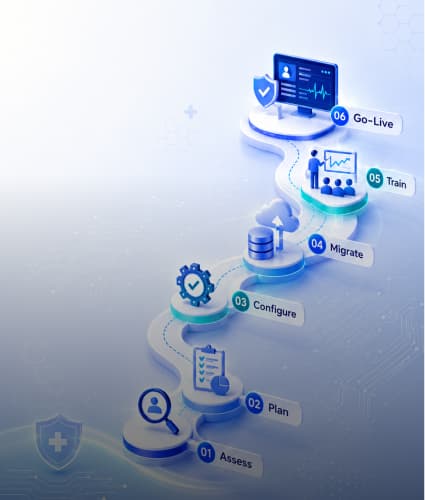
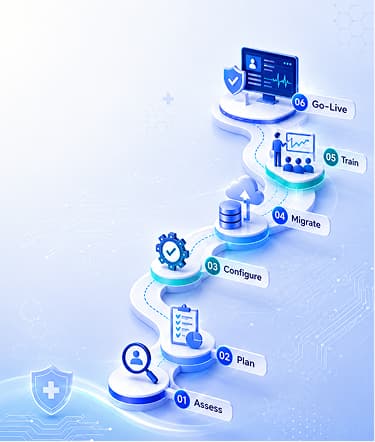
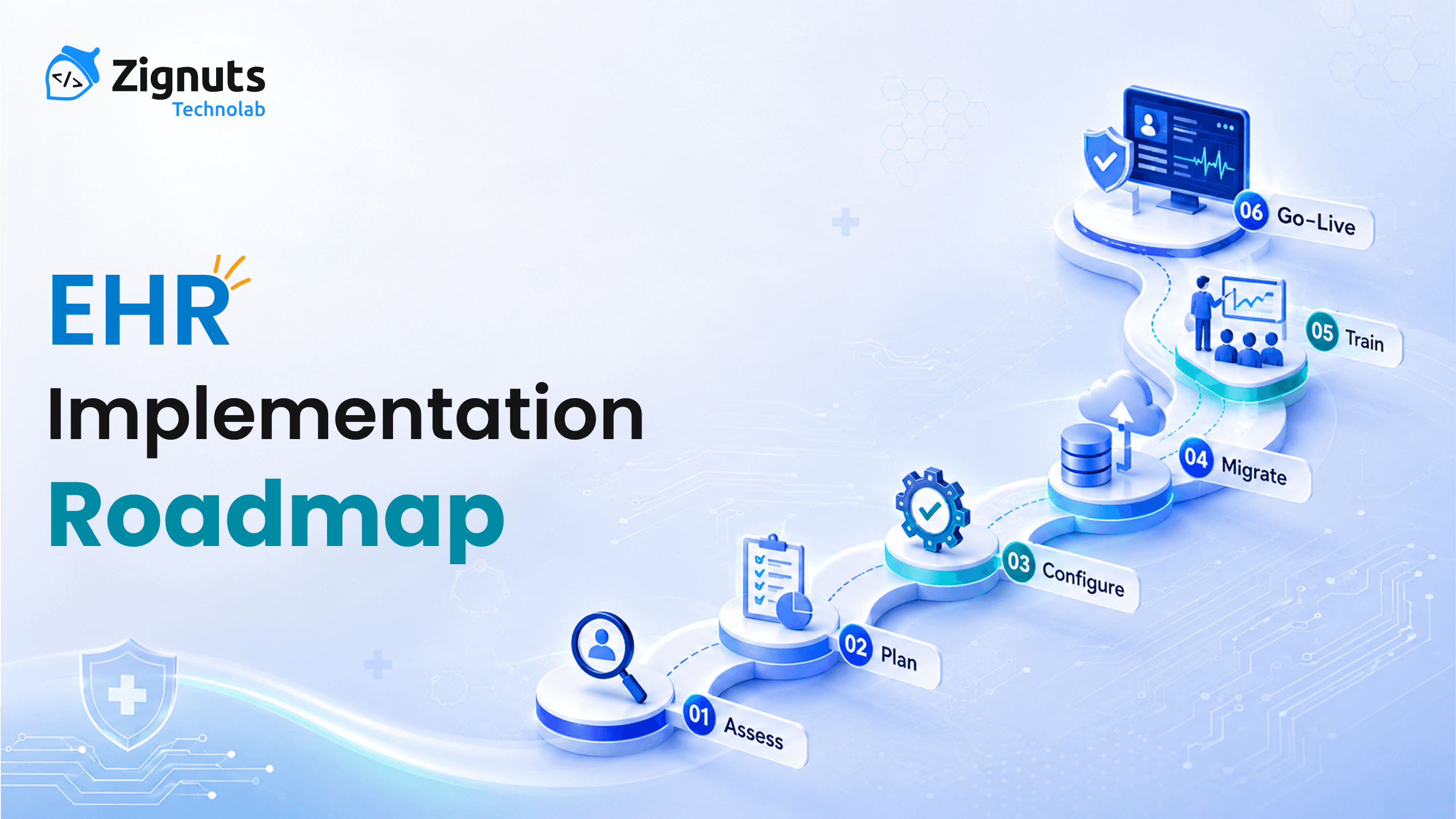
These project management and change management challenges can often be reduced through a structured implementation roadmap that prepares teams for each stage of the transition.
This guide focuses specifically on the Healthcare EHR implementation process, from pre-implementation readiness through post-go-live stabilization. It is designed for organizations rolling out a new EHR, whether they are implementing a custom-built system or an established vendor platform.
Where underlying architecture and data modeling decisions are relevant, they are covered at a summary level rather than repeated in depth, since those topics are addressed separately in our architecture-focused guide.
EHR Implementation Roadmap: Pre-Implementation Readiness
The work that happens before any system configuration begins has a disproportionate effect on how smoothly the rest of the implementation goes, and skipping or rushing this phase is one of the more common sources of downstream difficulty.
Organizational readiness assessment involves honestly evaluating whether the organization has the leadership commitment, staffing capacity, and change management maturity to support a major EHR implementation, which is a substantial undertaking that draws significantly on clinical and administrative staff time well beyond the technical implementation team. An organization that underestimates this commitment at the outset frequently finds itself understaffing the implementation relative to what it actually requires.
Key Areas for EHR Implementation Readiness
Organizational readiness: Evaluate leadership commitment, staffing capacity, and change management maturity before implementation begins.
Current-state workflow documentation: Map how clinical and administrative processes actually work today, rather than relying only on policy documentation.
Stakeholder alignment: Secure genuine buy-in from clinical leadership, department heads, and frontline staff representatives.
Success criteria: Establish specific and measurable goals such as improved documentation efficiency, better interoperability with a partner organization, or support for a new clinical service line.
Current-state workflow documentation gives the implementation team an accurate baseline for configuration. Actual clinical practice frequently differs from official process documentation in ways that matter for system design.
Stakeholder alignment is foundational to the change management work that follows. An implementation that begins without this alignment tends to encounter resistance later, after workflows and training have already been designed without adequate input from the people who will use the system daily.
Defining success criteria gives the project a clear reference point for evaluating decisions throughout implementation and for measuring success after go-live.
EHR Implementation Readiness Checklist
Area | What to Assess | Expected Outcome |
|---|---|---|
Leadership commitment | Executive sponsorship and decision-making capacity | Clear ownership and support |
Staffing capacity | Clinical and administrative time required | Realistic resource plan |
Current workflows | How work actually happens today | Accurate baseline for configuration |
Stakeholder alignment | Clinical leaders, department heads, frontline staff | Early buy-in and fewer late objections |
Success criteria | Measurable implementation goals | Defined basis for post-go-live evaluation |
Ready to Plan Your EHR Implementation?

EHR Implementation Governance and Project Structure
A defined governance structure, established before detailed planning begins, determines how decisions get made throughout the implementation, particularly the inevitable trade-off decisions between competing priorities that arise during any project of this scope.
Key Governance Roles for EHR Implementation
Implementation steering committee: Typically includes clinical leadership, IT leadership, and representatives from major clinical and administrative departments. It provides decision-making authority for significant scope, timeline, and workflow trade-offs.
Clinical champions: Respected clinicians from key departments who participate directly in workflow design and configuration decisions and help build peer buy-in.
Decision-making authority: Clearly define who approves clinical order sets, resolves cross-department workflow disagreements, and has final authority over the go-live date.
Implementation project management: Maintain a dedicated project management function distinct from both the technical development team and clinical leadership to coordinate workstreams, risks, blockers, and timelines.
Role / Structure | Primary Responsibility | Why It Matters |
|---|---|---|
Steering committee | Major scope, timeline, and workflow decisions | Prevents decision stalls |
Clinical champions | Workflow design and peer adoption | Builds clinical credibility |
Decision owners | Approve specific clinical/configuration choices | Creates accountability |
Implementation PM | Coordinates workstreams, risks, and blockers | Keeps the program synchronized |
EHR Implementation Phase 1: Planning and Configuration
This phase translates the clinical workflows documented during readiness assessment into actual system configuration, and it is where much of the detailed, department-specific implementation work happens.
Key EHR Configuration Priorities
Specialty-specific configuration: Configure clinical templates, documentation forms, and workflows according to the needs of individual departments and specialties. A generic configuration applied uniformly across departments rarely serves all of them well.
Order set design: Build structured order groupings for common clinical scenarios using established evidence-based order sets where available, followed by clinical review and refinement.
Role-based access configuration: Set up permissions and views according to actual staff roles, responsibilities, and scope-of-practice variations.
Clinical decision support: Configure alerts, reminders, and guideline-based prompts deliberately rather than relying on default sensitivity settings. Clinical input is important for reducing alert fatigue while retaining meaningful safety signals.
Workstream | Focus | Validation Requirement |
|---|---|---|
Specialty configuration | Templates, forms, department workflows | Direct clinician review |
Order sets | Common clinical scenarios | Evidence-based starting point and clinical refinement |
Role-based access | Permissions and views by role | Validate against actual responsibilities |
Clinical decision support | Alerts, reminders, prompts | Calibrate for safety and alert fatigue |
Ready to Plan Your EHR Implementation?
EHR Implementation Phase 2: Data Migration and Validation
Data migration deserves its own dedicated phase within the implementation timeline, sequenced carefully relative to the rest of the rollout, even though the detailed mechanics of migration planning are covered in more depth in the broader EHR development guide.
Key EHR Data Migration and Validation Steps
Migration timing: Sequence migration carefully relative to go-live. Migrating too early risks data becoming stale, while migrating too close to go-live can leave insufficient time for validation.
Validation checkpoints: Use multiple checkpoints throughout the migration timeline rather than relying on one final validation step.
Clinical validation: Have clinicians review representative migrated records for clinical accuracy and completeness.
Exception handling: Define how records or data elements that cannot be automatically migrated will be identified, reviewed, and resolved.
Clinical involvement is particularly important because purely technical validation can confirm that data transferred successfully without confirming that the migrated information makes clinical sense.
Control Point | Purpose | Recommended Practice |
|---|---|---|
Migration timing | Avoid stale or late-migration data | Sequence relative to cutover carefully |
Validation checkpoints | Catch issues early | Use multiple checkpoints, not one final check |
Clinical review | Verify clinical meaning | Review representative migrated records |
Exceptions | Handle data that cannot map automatically | Resolve deliberately; do not silently drop |
EHR Implementation Phase 3: Integration Testing
Interoperability connections need thorough end-to-end testing before go-live, not just unit-level testing of individual integration components, since the real risk in interoperability failures often emerges from how systems interact under realistic conditions rather than in isolated testing.
Key EHR Integration Testing Priorities
End-to-end testing: Test complete data flows across labs, pharmacies, imaging systems, health information exchanges, and other connected systems.
Realistic data volumes and edge cases: Test unusual and high-volume scenarios rather than relying only on clean, ideal test data.
Failure mode testing: Verify how the EHR behaves when an integrated system is unavailable or returns an error.
External coordination: Coordinate testing with the teams responsible for connected internal or external systems.
Testing Area | What to Test | Failure Risk Addressed |
|---|---|---|
End-to-end flow | Full data path across connected systems | Interface failures hidden by unit tests |
Realistic volumes | High-volume and unusual data | Performance and edge-case failures |
Failure modes | Unavailable or erroring external systems | Poor degradation or unclear fallback |
External coordination | Joint testing with connected-system teams | Issues missed by isolated testing |
Ready to Plan Your EHR Implementation?
EHR Implementation Training and Change Management
Training and change management are frequently under-resourced relative to their actual importance in determining whether an EHR implementation succeeds, given how directly they affect whether staff can and will use the new system effectively from day one.
Key EHR Training and Change Management Steps
Role-specific training: Tailor training to the workflows each role actually performs rather than delivering generic, one-size-fits-all sessions.
Super-user programs: Train a group of staff within each department to a deeper level of system proficiency so they can provide peer support during and after go-live.
Hands-on practice: Use a realistic training environment that reflects the configured system staff will actually use.
Resistance management: Acknowledge that a new EHR changes established habits and can temporarily reduce efficiency. Provide genuine channels for clinicians to raise concerns and have them addressed.
Component | Approach | Expected Benefit |
|---|---|---|
Role-specific training | Train each role on its actual workflows | Higher relevance and proficiency |
Super-user program | Department-level advanced users | Immediate peer support |
Hands-on practice | Realistic configured training environment | Smaller gap between training and live use |
Resistance management | Acknowledge disruption and provide feedback channels | Better trust and adoption |
EHR Implementation Go-Live Strategy
The approach to go-live itself, how much of the organization transitions at once and how, is one of the more consequential decisions in the implementation roadmap.
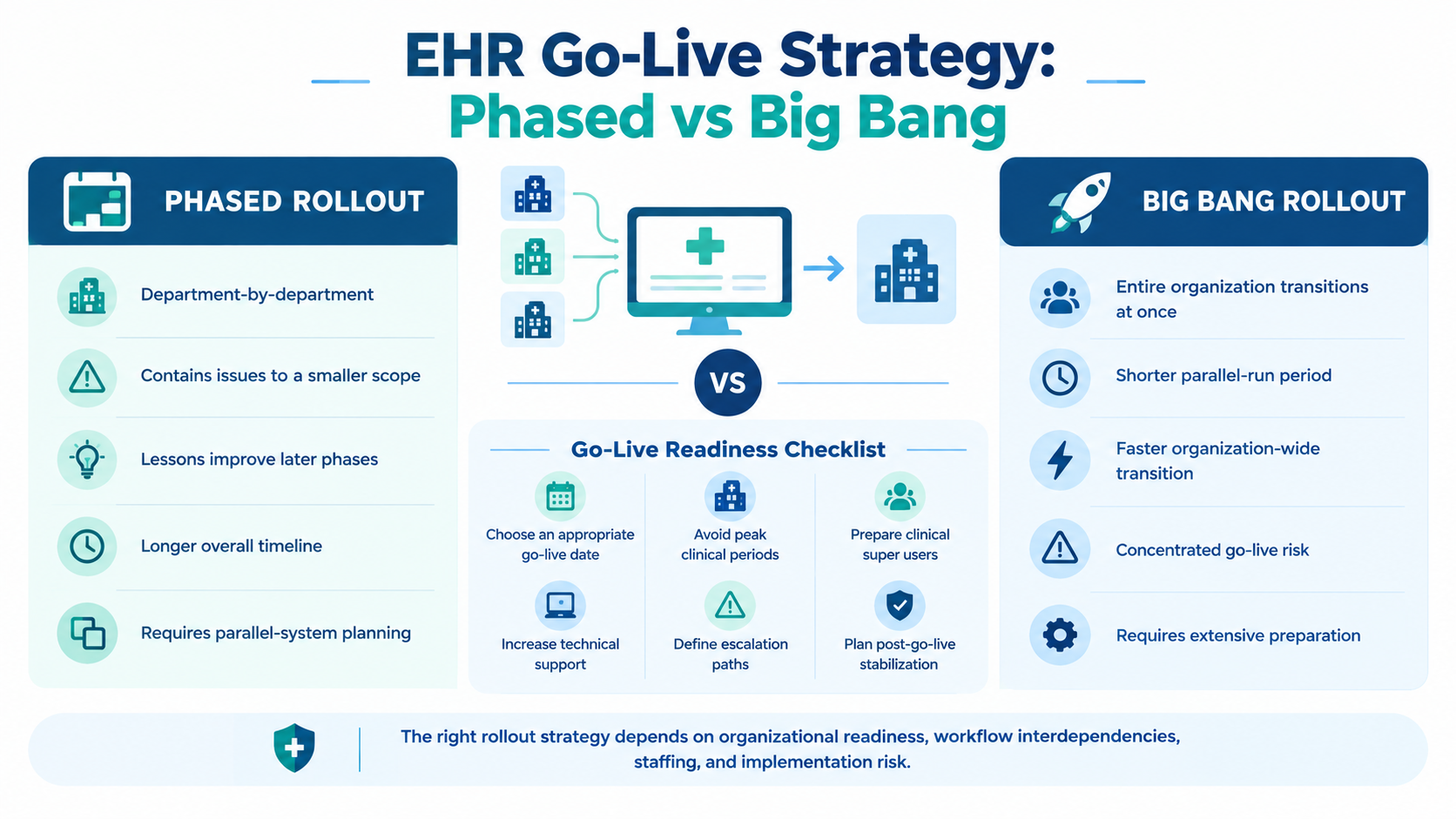
Phased EHR Rollout
Implement the new EHR department by department or facility by facility.
Contain the impact of issues to a smaller scope.
Use lessons learned from earlier phases to improve later phases.
Account for the longer overall timeline and complexity of running legacy and new systems in parallel.
Big Bang EHR Rollout
Transition the entire organization at once.
Reduce the duration of running two systems in parallel.
Consider this approach where department interdependencies make phasing impractical.
Prepare for concentrated risk during a single go-live event.
Key EHR Go-Live Planning Considerations
Choose a go-live date that avoids unusually high clinical volume or reduced staffing.
Consider the organization's clinical calendar and major holidays.
Provide additional technical and clinical super-user support during the go-live period.
Define the elevated support period before go-live and extend it when actual stabilization needs require it.
Approach | Advantages | Risks / Trade-Offs | Best Fit |
|---|---|---|---|
Phased rollout | Contains issues; lessons improve later phases | Longer timeline; parallel systems | Organizations able to sequence departments or facilities |
Big bang | Shorter parallel-run period; simpler transition state | Concentrated go-live risk | Smaller organizations or highly interdependent workflows |
EHR Implementation: Post-Go-Live Stabilization
The weeks immediately following go-live are a distinct phase of the implementation that deserves its own deliberate plan, not an assumption that the project is complete once the system is live.
Key EHR Stabilization Priorities
Issue triage: Establish a clear and fast path for reporting problems and prioritize them according to clinical impact.
Workaround monitoring: Watch for staff avoiding intended workflows because of usability problems, insufficient training, or established habits.
Rapid-cycle configuration adjustments: Create a defined process for making minor configuration changes in response to real usage feedback.
Support duration: Extend elevated support based on actual stabilization needs rather than ending support on a fixed date regardless of conditions.
Area | Required Action | Success Signal |
|---|---|---|
Issue triage | Fast reporting and clinical-impact prioritization | Issues resolved quickly |
Workarounds | Monitor deviations from intended workflows | Root causes addressed |
Configuration | Make rapid-cycle minor adjustments | System improves from real feedback |
Support staffing | Extend elevated support based on actual need | Support tapers as stability improves |
Ready to Plan Your EHR Implementation?
How to Measure EHR Implementation Success
Evaluating whether an implementation succeeded requires looking beyond basic technical uptime to metrics that reflect whether the system is actually working well for the organization and its patients.
Key EHR Implementation Success Metrics
Adoption metrics: Track actual system usage against intended workflows, including workaround behavior.
Clinical safety indicators: Monitor safety-related events potentially linked to the transition, such as medication errors or missed results.
Documentation time and clinician workload: Compare documentation burden with the prior system.
User satisfaction: Collect structured feedback from clinical and administrative staff at defined intervals.
Original success criteria: Revisit the goals defined during readiness assessment.
Metric | What It Measures | Why It Matters |
|---|---|---|
Adoption | Use of intended workflows and workaround levels | Shows genuine system adoption |
Clinical safety | Safety-related events potentially linked to transition | Checks implementation-related risk |
Documentation time | Time spent documenting versus prior system | Measures clinician burden |
User satisfaction | Structured staff feedback after go-live | Shows confidence and usability |
Success criteria | Original goals from readiness assessment | Closes the implementation loop |
Common EHR Implementation Risks and Mitigation Strategies
Underinvesting in change management relative to technical implementation is one of the most consistent patterns behind struggling EHR implementations, since organizations often allocate the majority of project resources to technical configuration and integration while treating training and change management as smaller, later-stage activities.
Key Risks in EHR Implementation
Underinvested change management: Can contribute to low adoption and increased workarounds. Mitigate by funding change management comparably to technical work.
Limited clinical involvement: Can produce workflows and templates that do not match actual clinical practice. Use ongoing clinical participation and clinical champions.
Insufficient post-go-live support: Can reduce staff confidence during the transition. Scale support according to actual stabilization needs.
Schedule pressure: Can turn unresolved pre-go-live issues into production problems. Go-live decisions should be made deliberately through governance.
Weak migration validation: Can result in incomplete or inaccurate patient data. Use technical validation plus clinical review before cutover.
Risk | Likely Consequence | Mitigation |
|---|---|---|
Underinvested change management | Low adoption and workarounds | Fund change management comparably to technical work |
Limited clinical involvement | Poor workflow fit | Use ongoing clinical participation and champions |
Insufficient support period | Loss of confidence after go-live | Scale support to actual stabilization needs |
Schedule pressure | Pre-go-live issues become production issues | Governance should make deliberate go-live decisions |
Weak migration validation | Incomplete or inaccurate patient data | Use technical plus clinical validation before cutover |
EHR Implementation Roadmap: Key Takeaways
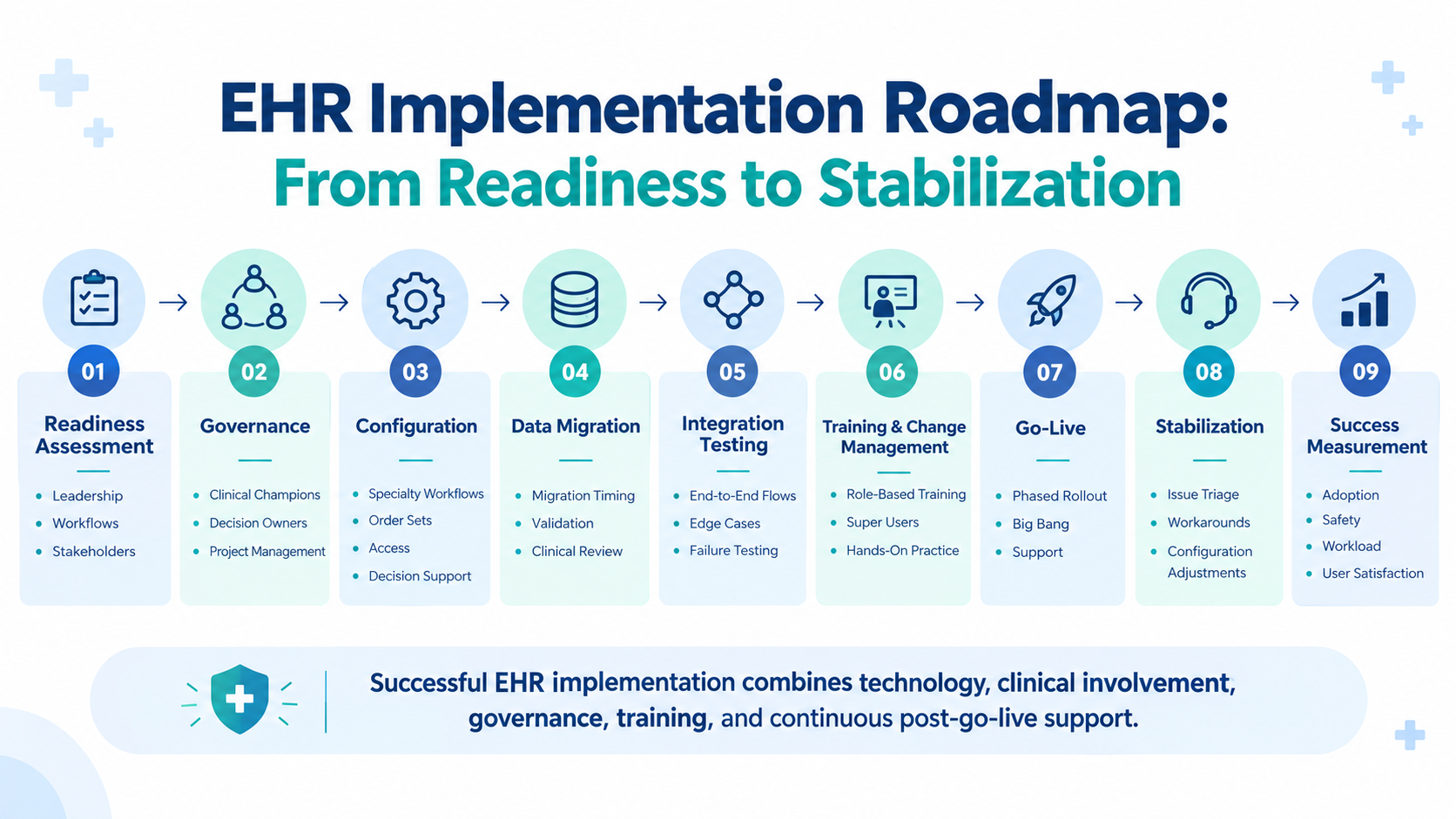
EHR implementation success depends as much on project management, governance, and change management as it does on the technical quality of the underlying system.
Readiness assessment and stakeholder alignment before formal implementation begins meaningfully affect how smoothly the rest of the project proceeds, and are worth the investment even though they can feel like a delay to the more visible technical work.
Clinical champions and genuine clinical involvement in configuration decisions are consistently associated with better adoption outcomes than configuration driven primarily by technical or administrative perspectives alone.
Training and change management deserve investment comparable to technical implementation work, given their direct effect on whether staff actually adopt the system as designed rather than reverting to workarounds.
The post-go-live stabilization period is a distinct phase requiring its own deliberate support plan, issue triage process, and monitoring for workaround behavior, not an assumption that the project concludes at go-live.
Conclusion
EHR implementation is fundamentally an organizational change process supported by technology, not simply a technical deployment followed by staff training. We believe successful implementations require the same level of attention to governance, clinical involvement, training, change management, and post-go-live support as they do to system configuration and data migration. A technically sound EHR environment can only deliver its intended value when teams are prepared, supported, and confident in using it.
At Zignuts, we combine technical expertise with a practical understanding of implementation and change management to help healthcare organizations build and integrate digital healthcare applications. From initial planning and workflow alignment to implementation, integration, and post-go-live stabilization, we help teams navigate each stage with a structured approach.
Planning an EHR or healthcare application project? Contact us today to discuss your requirements and explore how we can support your implementation journey.

Virang Kori
Business Analyst | Analyzing business needs, processes, and data to uncover insights, improve efficiency, and support smarter business decisions.