

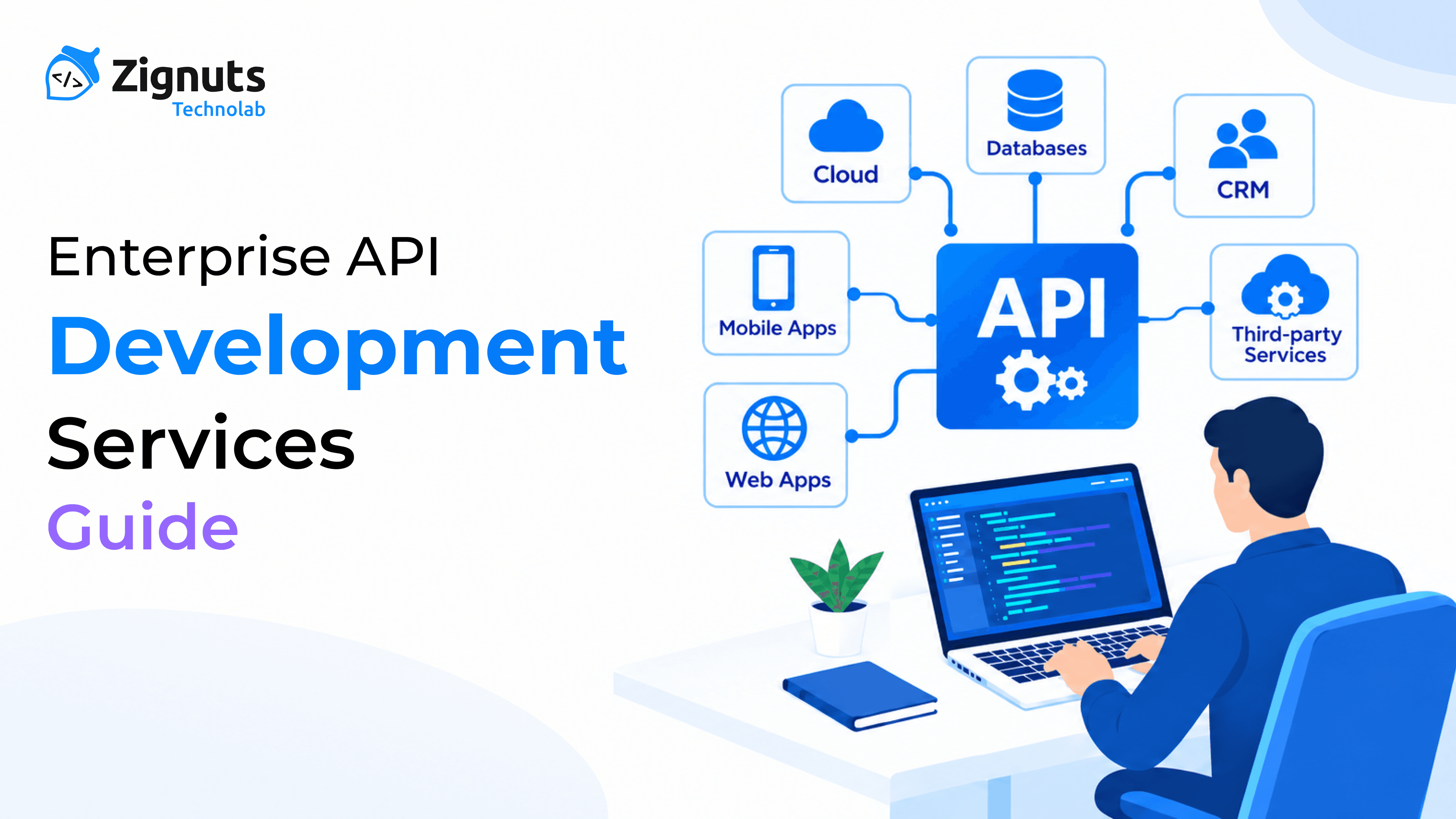
Enterprise API Development Services: Overview and Key Considerations
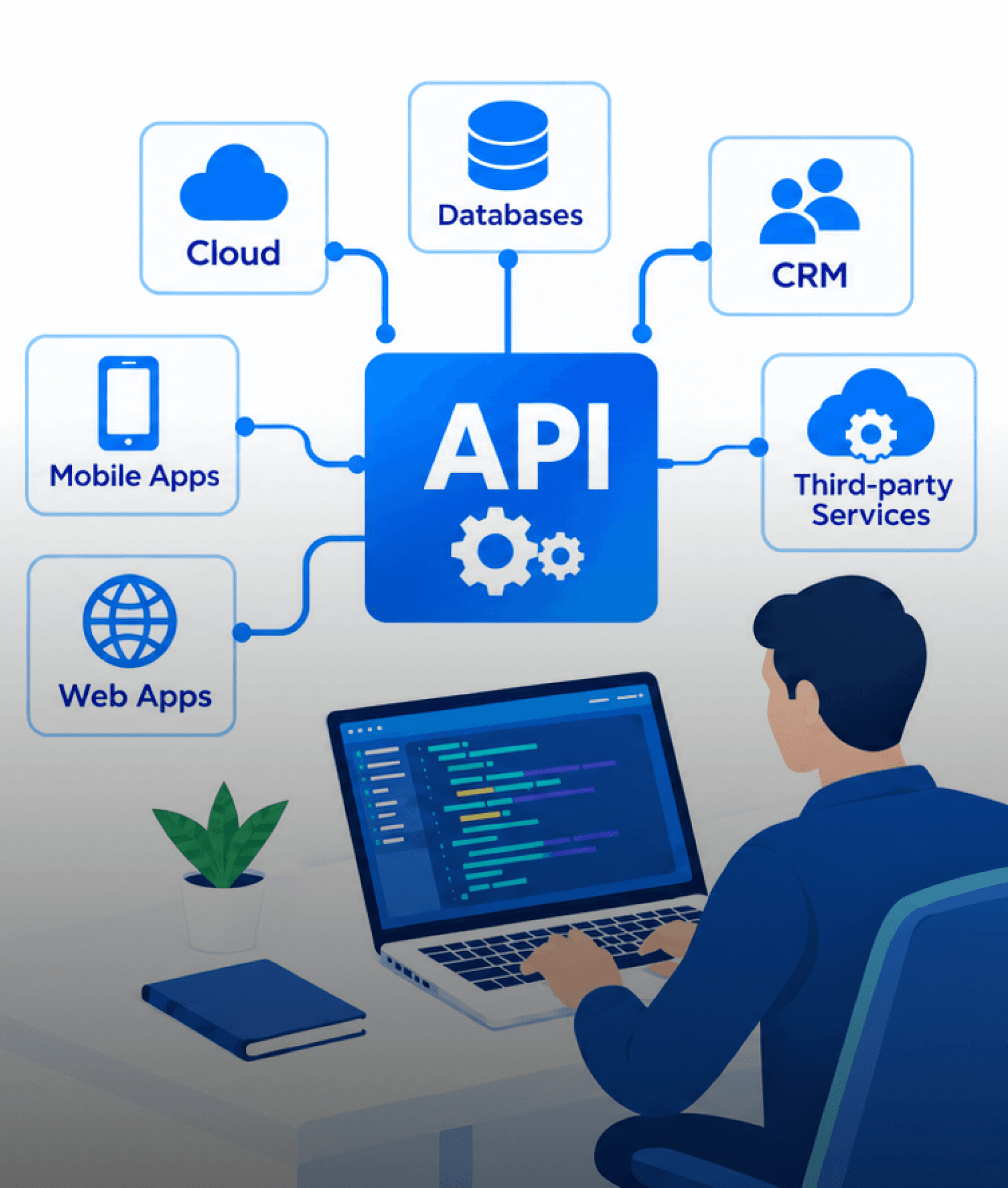
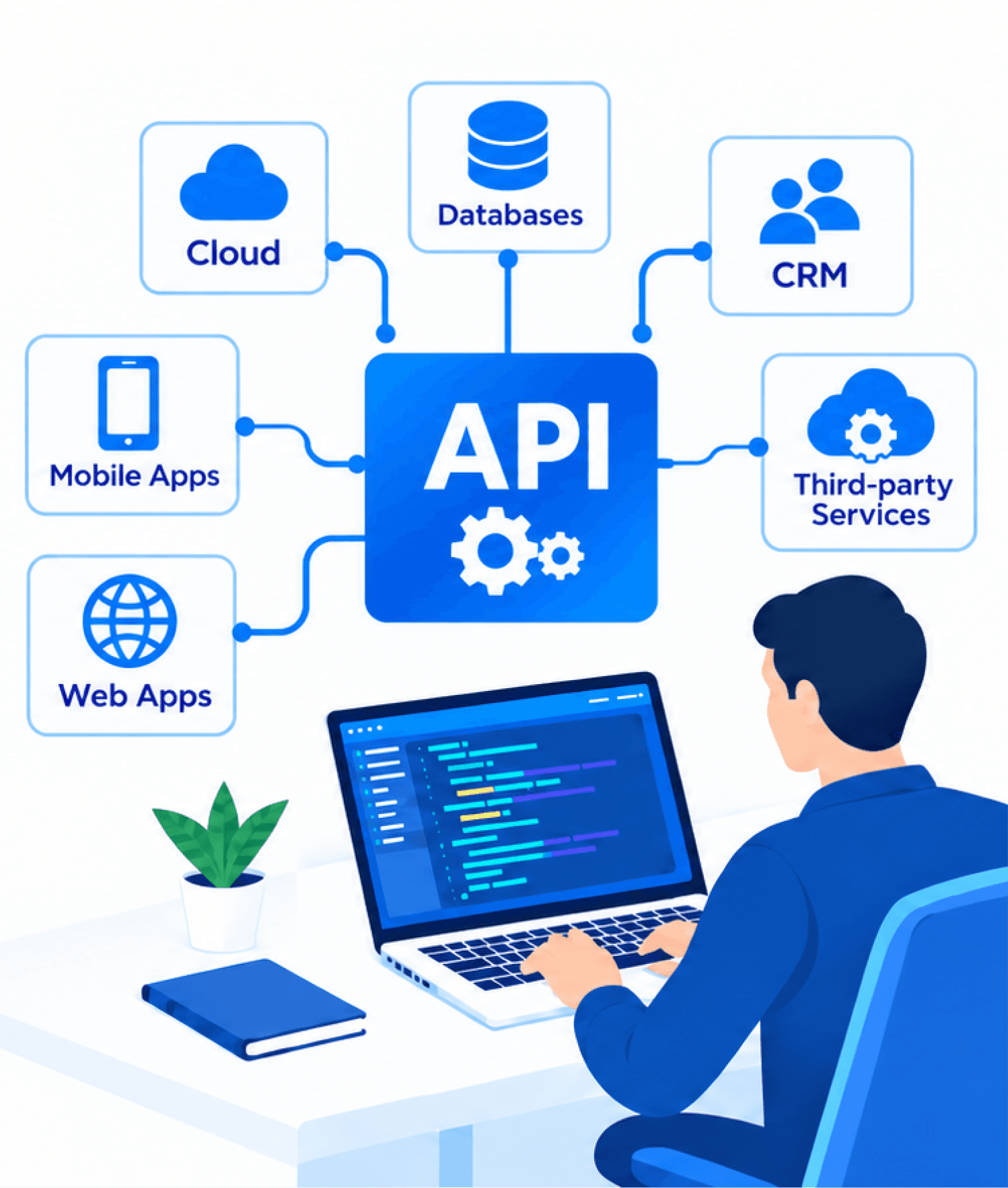
Enterprise API development goes beyond creating endpoints. It involves engineering secure, reliable, and well-governed interfaces that allow applications, partners, data platforms, and business processes to exchange information efficiently. API Development Services help organizations build and manage these interfaces as long-term products with clearly defined consumers, contracts, security policies, lifecycle ownership, documentation, service-level objectives, and measurable usage.
A successful enterprise API strategy should consider:
Business and technical ownership: Define who manages each API, who uses it, and what business purpose it serves.
API design and technology: Evaluate REST, GraphQL, and other approaches based on consumer needs and system requirements.
Security and identity: Establish authentication, resource-level authorization, and clear data access boundaries.
Backward compatibility: Plan versioning and changes to avoid disrupting existing API consumers.
Integration and scalability: Account for vendor dependencies, connected systems, growing traffic, and future integrations.
Operational visibility: Implement monitoring, documentation, service-level objectives, and lifecycle management.
Partner selection: Choose a development partner that can address architectural decisions, integration risks, and long-term platform operations.
This guide combines practical engineering recommendations with selected survey findings. Survey percentages are attributed to their sources and represent reported respondent results, not universal adoption rates or guaranteed business outcomes.
Key Considerations for Enterprise API Development
Decision Area | What Good Looks Like |
|---|---|
Business fit | APIs solve a defined integration, product, automation, or partner-access problem. |
Contract & experience | Versioned schemas, useful examples, predictable errors, and accessible documentation. |
Security | Authentication plus resource-level authorization, validation, rate limits, secret hygiene, and audit trails. |
Reliability | Timeouts, bounded retries, idempotency where needed, graceful degradation, and observable SLOs. |
Governance | Ownership, inventory, lifecycle rules, deprecation policy, and automated quality checks. |
Partner selection | Evidence of design discipline, integration experience, transparent delivery controls, and knowledge transfer. |
Why Enterprise API Development Is Important for Businesses
APIs create controlled interfaces between systems that may not have been designed to work together. They allow businesses to connect applications, share data, integrate specialist SaaS tools, enable partner transactions, and make internal services available to approved systems. This makes API development both a technical discipline and a business decision that can influence integration costs, product capabilities, and long-term flexibility.
Key business benefits of enterprise API development include:
Simplifying system integration: Connect ERP platforms, SaaS tools, web and mobile applications, and partner systems through consistent interfaces.
Reducing the cost of change: Use contract-first design, compatibility checks, versioning, and clear ownership to limit the impact of API changes on connected applications.
Supporting new business opportunities: Enable partner integrations, new distribution channels, and product capabilities through well-designed APIs.
Reducing duplicated development: Reuse internal APIs across applications and services instead of building repeated point-to-point integrations.
Improving API governance: Establish clear ownership, documentation, security policies, and operational standards to keep APIs reliable and useful.
Encouraging API-first adoption: Postman’s 2025 State of the API survey found that 82% of respondents reported some level of API-first adoption, while 25% described their organizations as fully API-first. This distinction highlights that using APIs does not necessarily mean having a mature API product practice.
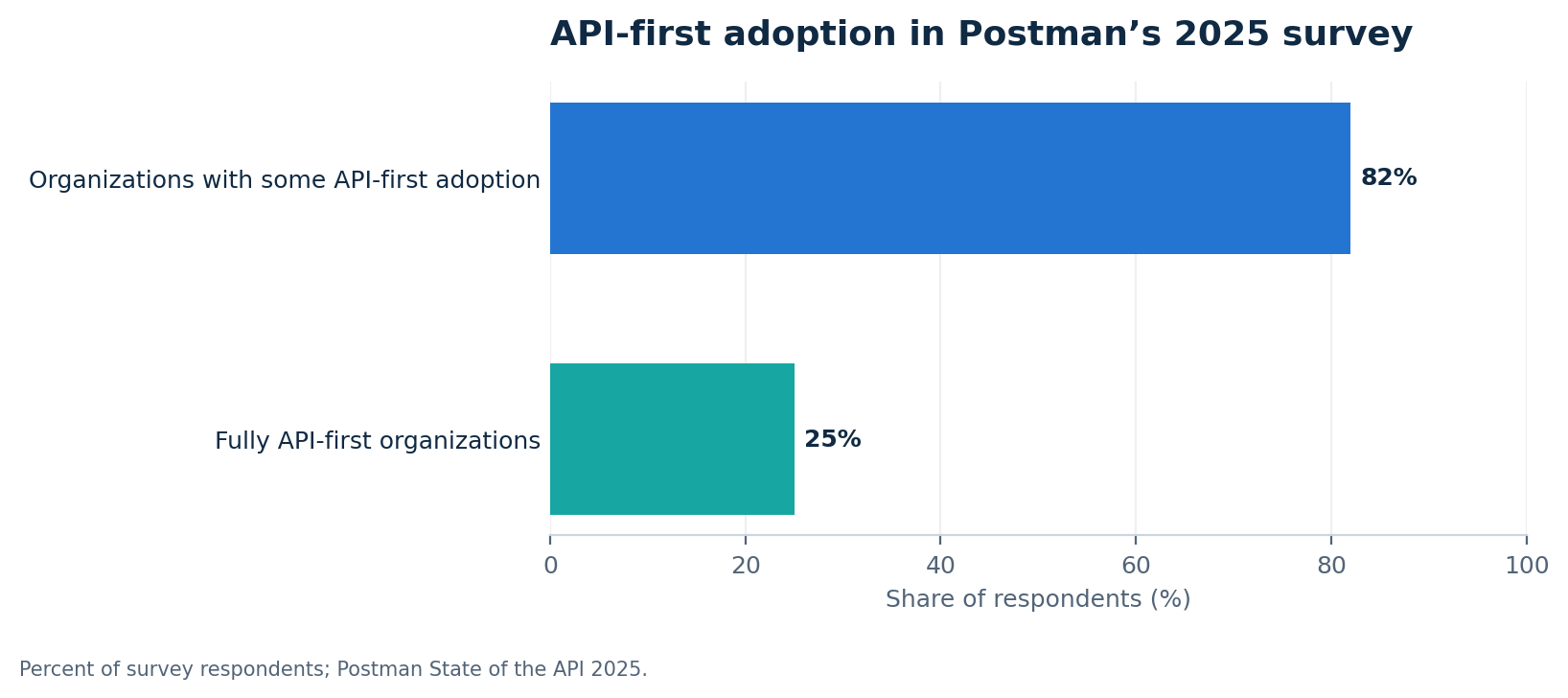
Key takeaway: 82% reported some level of API-first adoption, while 25% described their organizations as fully API-first. The distinction matters: using APIs is not the same as running a mature API product practice.
Ready to Build Reliable Enterprise APIs?

What Enterprise API Development Services Include
A complete service should cover the lifecycle from discovery to production operations. The exact scope depends on whether the organization is launching a new digital product, integrating legacy systems, exposing partner capabilities, or consolidating a fragmented API estate.
Core Services in Enterprise API Development
Service Area | Typical Work | Evidence to Request from a Partner |
|---|---|---|
API strategy & discovery | Use cases, consumers, domain boundaries, existing API inventory, success measures. | Prioritized use-case map, constraints, and decision log. |
API design | Resource modelling, schemas, error conventions, pagination, filtering, idempotency, versioning. | OpenAPI specification, examples, compatibility rules. |
API implementation | Business logic, adapters, orchestration, persistence, asynchronous processing. | Code review practices, tests, deployment pipeline. |
Integration & modernization | ERP/CRM/SaaS connectors, legacy wrappers, event-driven integration, data mapping. | Failure handling, reconciliation, retry and replay approach. |
Security & governance | Identity, scopes, object-level authorization, quotas, audit, policy checks. | Threat model, OWASP-aligned test plan, secrets process. |
Operations & evolution | Monitoring, SLOs, incident response, deprecation, documentation, support. | Dashboards, runbooks, ownership model, change policy. |
How to Choose the Right API Architecture and Style
No single API style is best for every enterprise workload. REST is a dependable default for resource-oriented HTTP interfaces; GraphQL can suit clients that need flexible, related data retrieval; gRPC is useful for strongly typed service-to-service communication where efficient binary protocols and streaming matter; event-driven interfaces fit asynchronous workflows where producers and consumers should be loosely coupled; SOAP may remain necessary in established enterprise or regulated integrations.
Approach | Often a Good Fit | Trade-offs to Evaluate |
|---|---|---|
REST / HTTP + JSON | Broad client compatibility, resource APIs, partner integrations. | Payload conventions, chatty clients, compatibility and pagination discipline. |
GraphQL | Client-specific data composition across related entities. | Query-cost controls, caching complexity, schema governance, authorization at field level. |
gRPC | Internal service communication, typed contracts, streaming and low overhead. | Browser and partner compatibility, tooling familiarity, operational debugging. |
Events/webhooks | Asynchronous business events, notifications, decoupled workflows. | Delivery retries, duplicate events, ordering, replay, signature verification. |
SOAP | Existing enterprise systems with WSDL contracts and established integrations. | Verbosity and legacy complexity; migration may not justify replacement. |
Decision rule: choose the simplest interface that satisfies consumer needs, security constraints, operational requirements, and expected change. Supporting multiple styles can be appropriate, but each additional style adds governance, tooling, and skills overhead.
Ready to Build Reliable Enterprise APIs?
Enterprise API Platform Architecture and Key Components
A reference architecture separates consumer access, edge policy, identity, domain services, data dependencies, and operational controls. This is an illustrative pattern, not a claim about any customer's deployed architecture. A real design should be shaped by data sensitivity, deployment environment, latency, team boundaries, and recovery requirements.
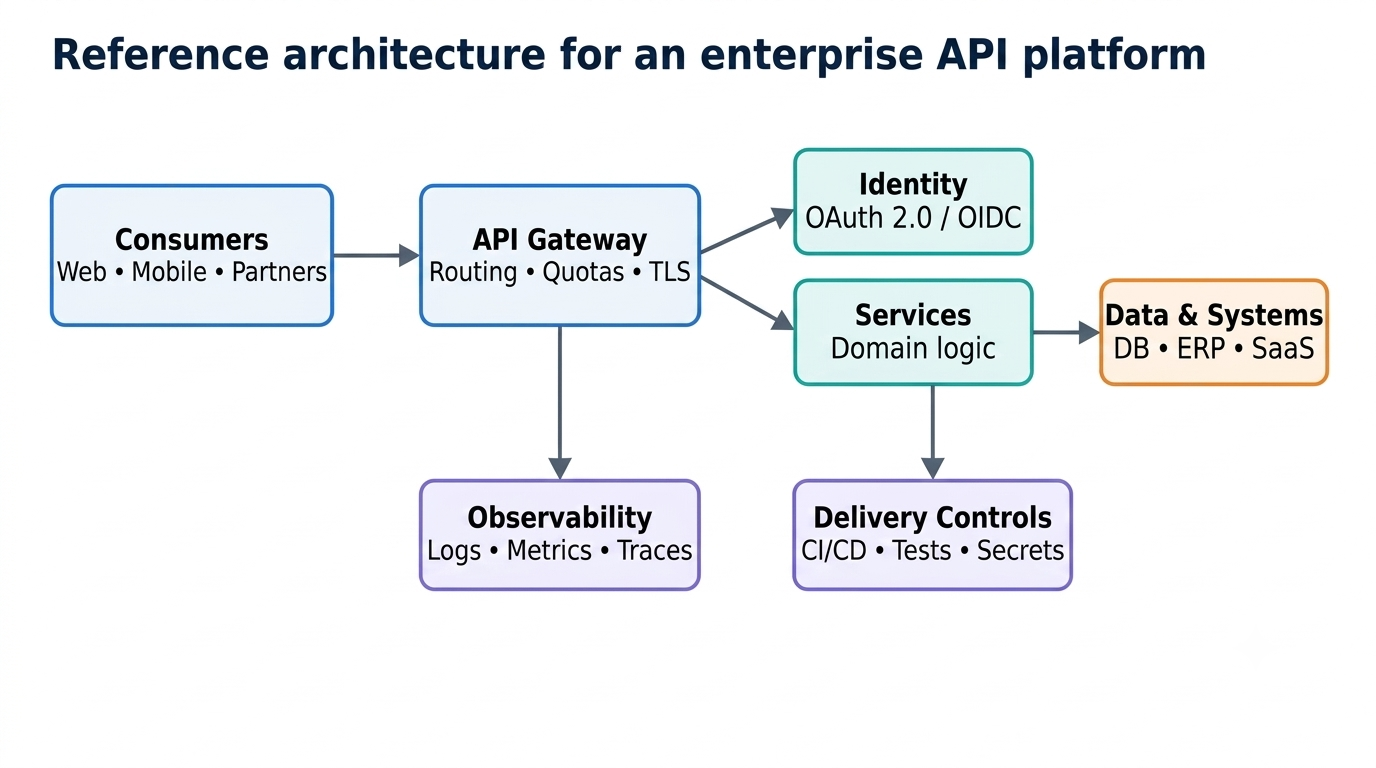
Key takeaway: The gateway is a policy enforcement point, not a substitute for authorization inside the service. Services must still verify that the caller can access the specific object and operation.
Key Architecture Decisions for Enterprise API Development
Gateway placement: central gateways help apply shared policies, but avoid turning them into a bottleneck or placing domain logic in gateway configuration.
Service boundaries: begin with clear domain ownership. Split into independently deployed services when scaling, deployment autonomy, or fault isolation justify the operational cost.
Data ownership: avoid letting multiple services write directly to the same tables without explicit ownership and consistency rules.
Synchronous versus asynchronous: synchronous calls are straightforward for immediate answers; queues and events help absorb bursts and isolate temporary downstream failures.
Caching: cache stable, frequently read data where freshness rules are clear. Include tenant and authorization context in cache keys where applicable.
Resilience: use timeouts, bounded retries with backoff, circuit breakers where useful, and idempotency keys for retryable operations that must not duplicate side effects.
The Enterprise API Development Lifecycle
A repeatable delivery lifecycle helps teams discover the right problem, agree on the contract before parallel implementation, test compatibility and security, and operate the interface after release.
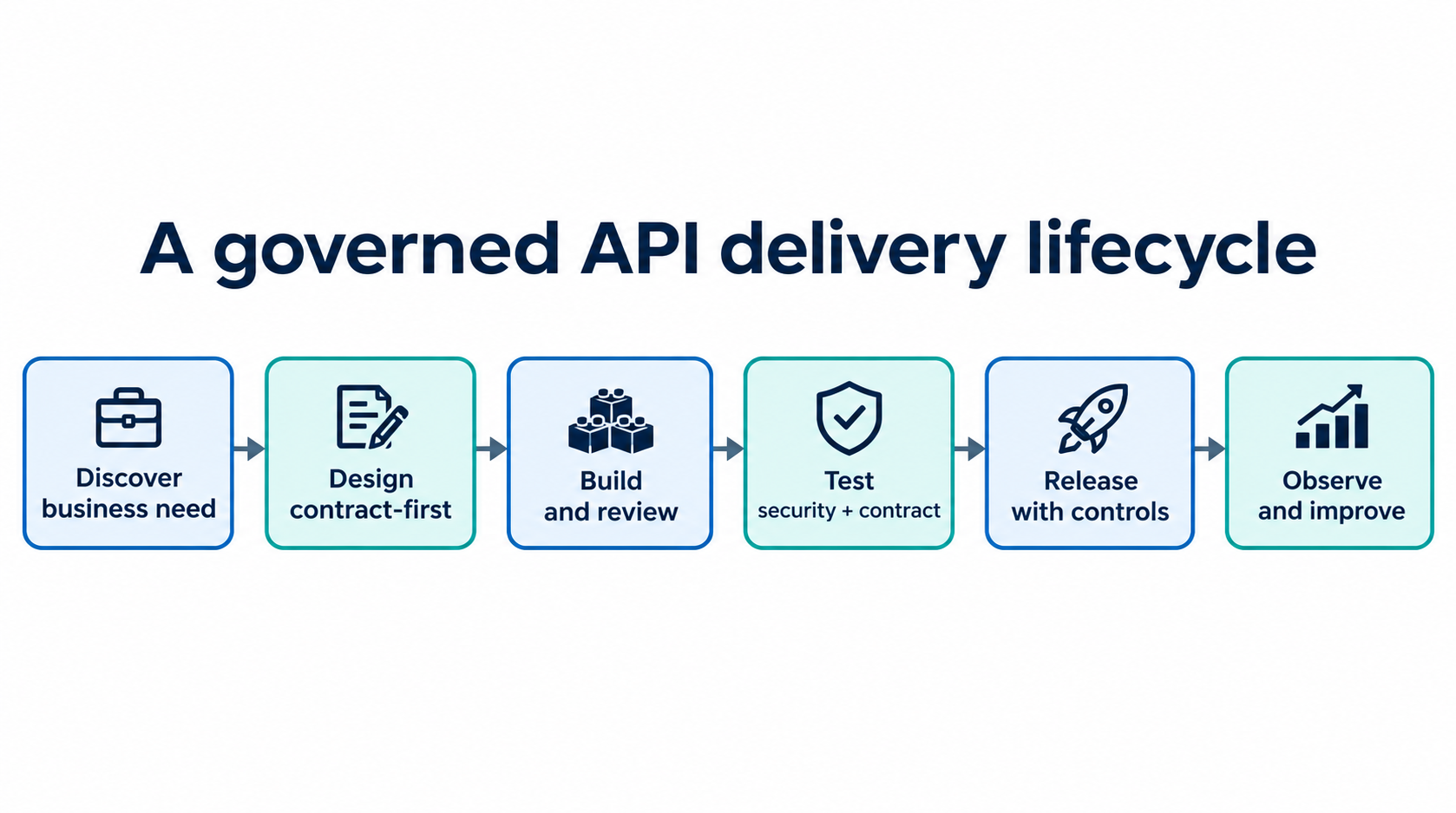
Key takeaway: Treat the API specification and automated checks as delivery artefacts. A release should be blocked when it breaks a supported contract or violates critical security controls.
Key Stages of the Enterprise API Development Process
Discovery: identify consumers, business outcomes, data classifications, dependencies, expected load, and failure consequences.
Design: publish a draft contract; agree on naming, schema, error formats, pagination, authorization model, and versioning.
Build: implement domain logic separately from transport concerns where practical; keep secrets out of source control.
Validate: run unit, integration, contract, authorization, negative, performance, and dependency-failure tests appropriate to risk.
Release: use environment promotion, reviewed configuration, rollback plans, and compatibility checks.
Operate: track latency percentiles, error rates, saturation, dependency health, adoption, and security signals; feed consumer issues into the roadmap.
Enterprise API Security: Essential Practices and Controls
API security must protect data and business actions even when a request is syntactically valid, and the caller is authenticated. OWASP’s API Security Top 10 highlights risks including broken object-level authorization, broken authentication, excessive resource consumption, broken function-level authorization, sensitive business-flow abuse, security misconfiguration, and improper inventory management.
Authentication answers who or what is calling. Authorization must additionally answer whether that identity can perform this operation on this specific resource in the current tenant and context. Many serious API failures happen when a server trusts an object identifier supplied by a client without checking ownership or permission.
Control | Implementation Guidance |
|---|---|
Identity | Use established OAuth 2.0 / OpenID Connect flows where appropriate; use short-lived credentials and rotate secrets. |
Object/function authorization | Check permissions server-side on every relevant operation and resource; test cross-tenant access explicitly. |
Input & output controls | Validate schema, constrain query complexity and payload size, avoid exposing internal fields, normalize errors. |
Abuse resistance | Apply per-identity and per-route rate limits, quotas, pagination caps, timeouts, and resource budgets. |
Sensitive workflows | Add step-up verification, transaction limits, anomaly detection, and human approval where business risk warrants. |
Inventory & lifecycle | Track public, partner, internal, deprecated, and shadow APIs; remove obsolete versions safely. |
Supply chain & dependencies | Pin and scan dependencies, validate third-party responses, and treat upstream data as untrusted. |
Audit & incident response | Log relevant actor, action, resource, correlation ID, and outcome without leaking secrets or sensitive payloads. |
Security reference: OWASP API Security Top 10 (2023). Use the official project guidance and map controls to the organization’s threat model and compliance obligations.
Ready to Build Reliable Enterprise APIs?
Enterprise API Trends and Industry Research
Industry surveys are useful signals about engineering priorities, but they are not universal forecasts. The following charts use separate findings from Postman’s 2025 State of the API report. Each has a different implication; the results should not be interpreted as causal proof that a particular API practice guarantees revenue or productivity.
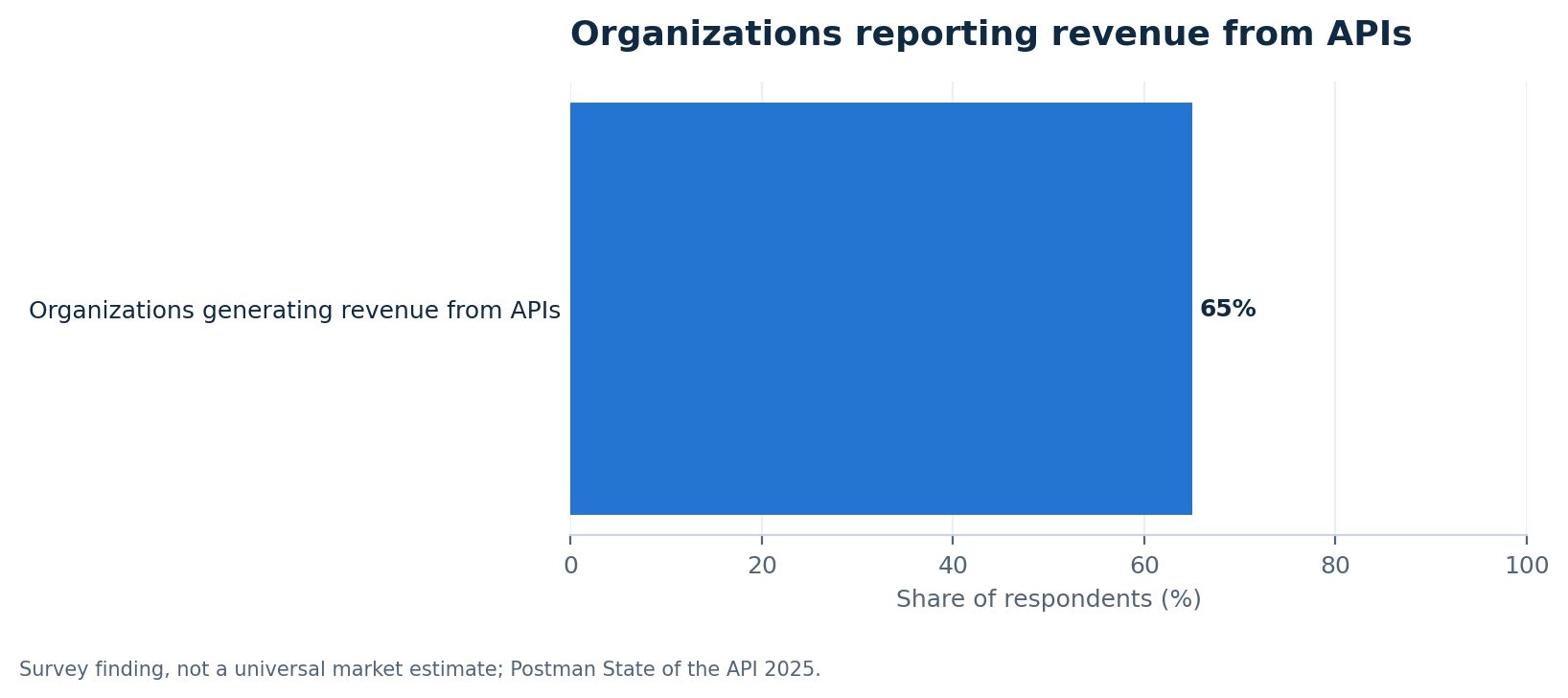
Key takeaway: API programs can be commercial assets, not only integration plumbing. Monetization still depends on product-market fit, reliable service, clear terms, developer experience, and support.
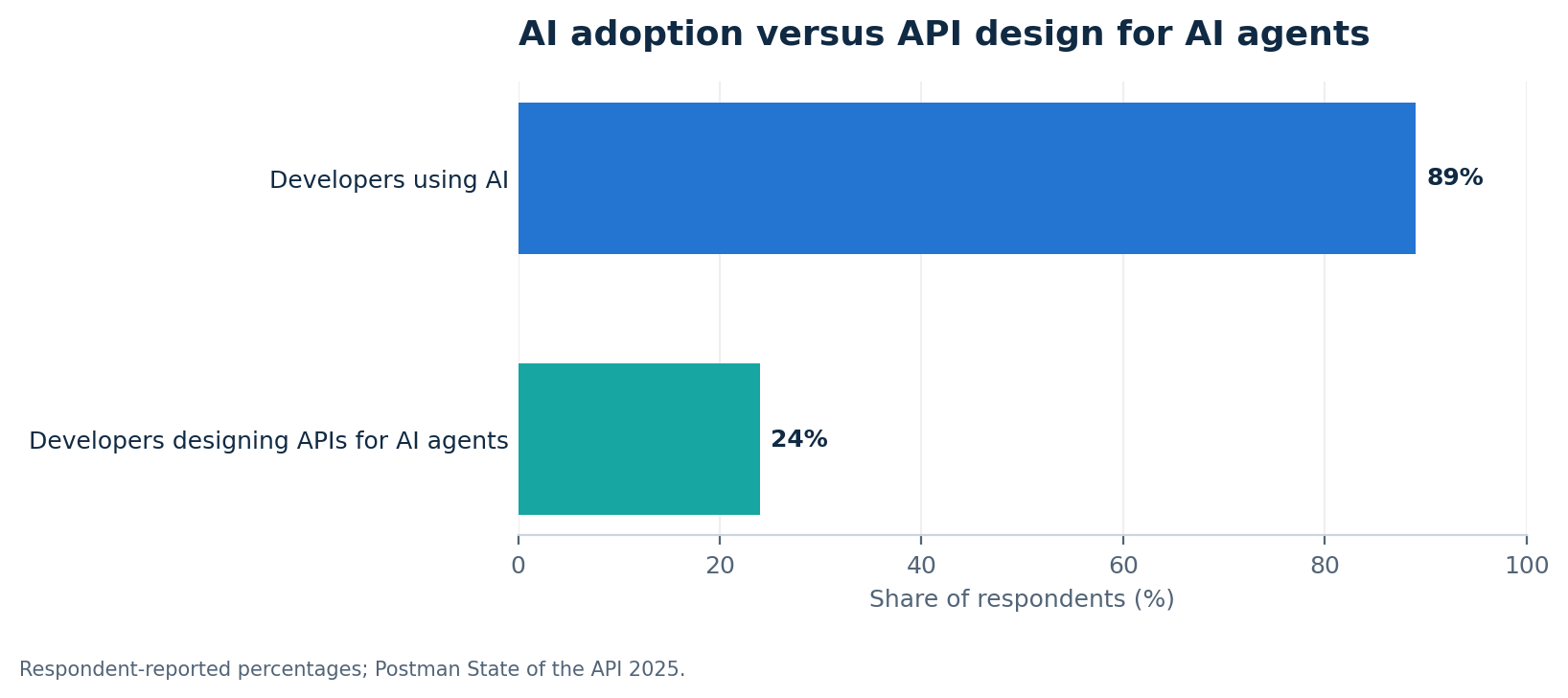
Key takeaway: AI-assisted development is more widespread than deliberate agent-ready API design in this survey. Machine-readable contracts, predictable errors, scoped credentials, and auditable tool access deserve explicit design attention.
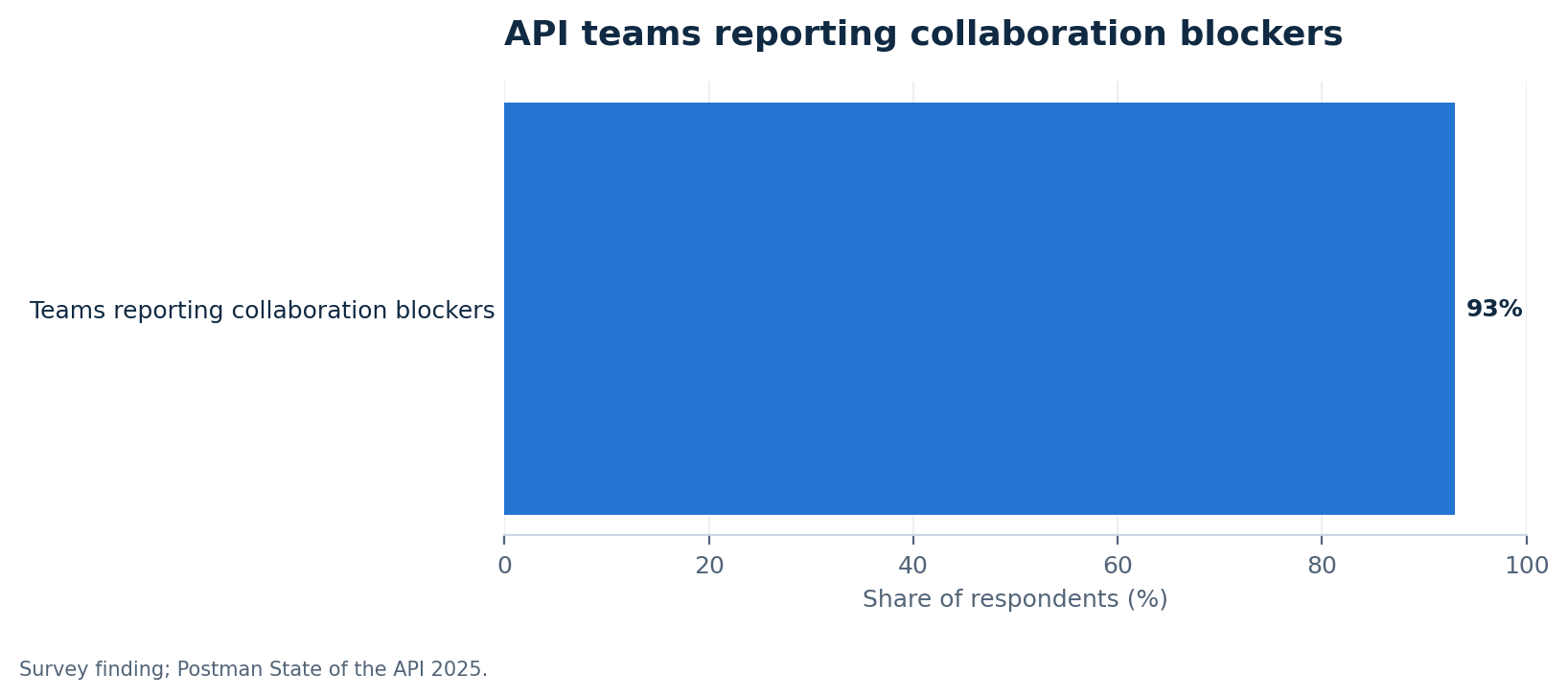
Key takeaway: Documentation, discovery, ownership, and shared standards are operational concerns. An API catalogue and contract workflow can reduce avoidable coordination friction, but outcomes should be measured locally.
Understanding the Limitations of API Industry Research
Postman’s figures are survey findings from respondents, not a census of every organization or an independently measured market share.
The 2025 report describes a global survey of more than 5,700 developers, architects, and executives. Different roles and organization sizes may have different experiences.
The charts do not predict the results an individual enterprise will achieve. Establish a baseline and measure local adoption, reliability, cost, and consumer satisfaction.
API Testing, Quality Assurance, and Observability
Testing should validate both the implementation and the promise made to consumers. Unit tests verify local logic; integration tests validate dependencies; contract tests detect incompatible schema or behavior changes; authorization tests probe forbidden access; performance tests exercise realistic load; resilience tests examine timeouts and dependency failures. No single test type replaces the others.
Enterprise API Production Readiness Checklist
OpenAPI or equivalent contract is versioned, reviewed, and published.
Positive, negative, authorization, and edge-case tests run in CI.
Breaking changes are detected before deployment; deprecation and migration windows are documented.
Latency, throughput, error rates, dependency health, and saturation are observable.
Logs include correlation identifiers and meaningful context while avoiding tokens, passwords, and unnecessary personal data.
Timeouts, retries, rate limits, idempotency, and downstream failure behavior are explicitly defined.
Runbooks cover rollback, credential rotation, incident escalation, and recovery.
API ownership, support channel, lifecycle state, and consumers are discoverable.
Track both technical and product measures: p95/p99 latency, availability against an agreed SLO, error budget consumption, change failure rate, mean time to restore, active consumers, successful calls by consumer, onboarding time, and deprecation progress. Select metrics that lead to action rather than producing dashboards without owners.
Build vs. Buy: Choosing the Right Enterprise API Development Approach
The build-versus-buy decision is best treated as a portfolio choice. Buying a mature commodity capability can shorten delivery and transfer some operational burden, while custom engineering may be justified when the workflow differentiates the business, proprietary rules are central, or existing products cannot satisfy security and integration needs. Composition-using an API management platform and established services around custom domain logic-is often a practical middle path.
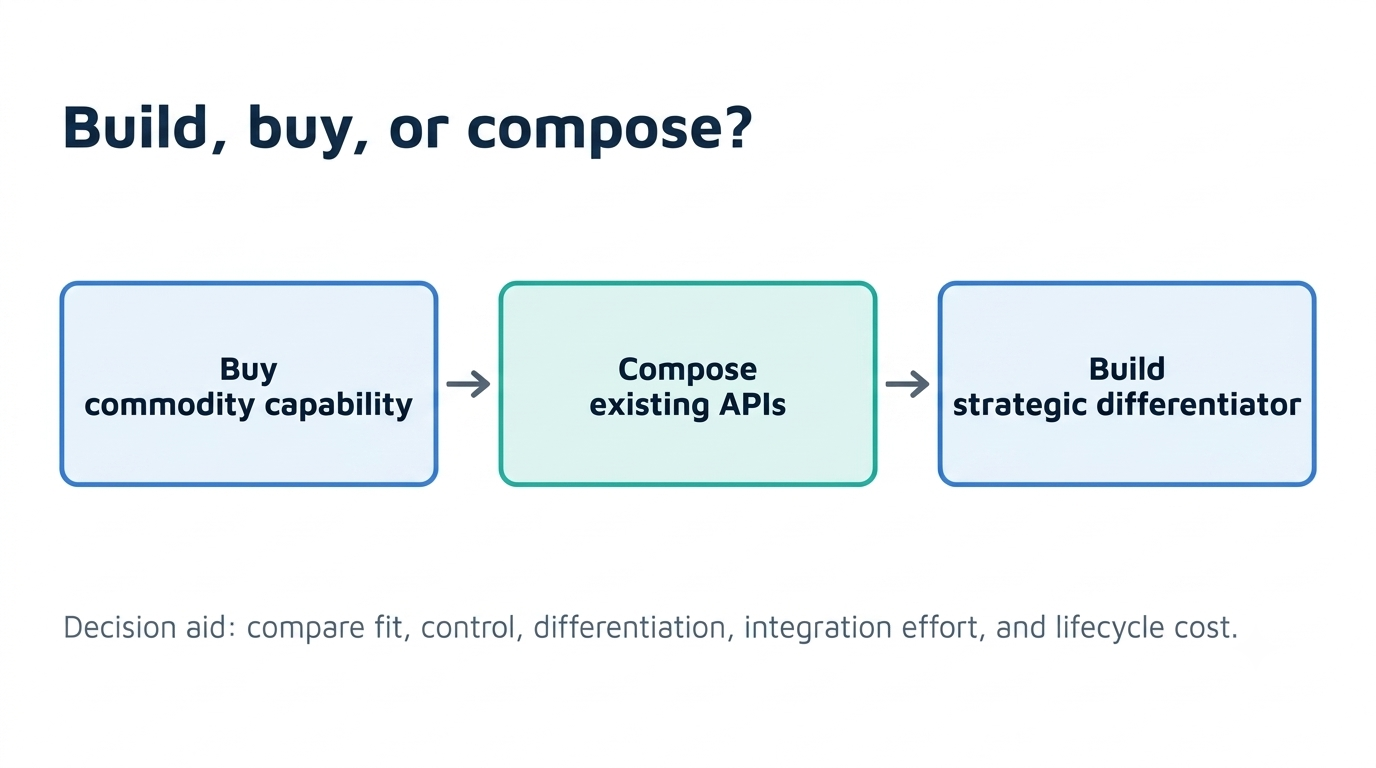
Key takeaway: Do not build commodity infrastructure simply because it is technically interesting. Compare lifecycle cost, control, differentiation, integration fit, portability, and the operational capability required to own the result.
Criterion | Questions to Resolve |
|---|---|
Differentiation | Is this capability a source of competitive advantage or a commodity requirement? |
Time to value | Can a commercial product satisfy the need within the required delivery window? |
Control & compliance | Are data residency, audit, customization, or regulatory requirements decisive? |
Integration fit | How well does the option fit identity, data models, legacy systems, and workflows? |
Total lifecycle cost | Include licenses, integration, migration, support, upgrades, skills, and exit costs. |
Exit & portability | Can contracts, data, and integrations be moved if a vendor or platform changes? |
Ready to Build Reliable Enterprise APIs?
Enterprise API Development Cost Factors and Planning
API project cost depends less on endpoint count alone than on the complexity behind each endpoint. A simple read-only endpoint over a clean data model differs materially from a financial transaction that must reconcile across legacy systems, enforce multi-tenant permissions, meet a strict availability target, and preserve audit evidence.
Cost Driver | Why It Changes Effort |
|---|---|
Domain complexity | Rules, exceptions, workflows, transaction integrity, and ownership boundaries. |
Integration landscape | Number and quality of upstream systems, authentication schemes, data mapping, and vendor limits. |
Security & compliance | Threat modelling, access reviews, auditability, privacy, retention, and evidence requirements. |
Reliability & scale | Traffic profile, latency targets, redundancy, load tests, disaster recovery, and support coverage. |
Migration & compatibility | Legacy behavior, consumers already in production, version support, and data reconciliation. |
Operations & governance | Monitoring, incident response, API catalogue, developer portal, documentation, and ongoing maintenance. |
Avoid accepting a fixed estimate before discovery has exposed dependencies and acceptance criteria. A credible proposal should state assumptions, exclusions, delivery stages, client responsibilities, third-party access needs, testing scope, and how changes will be handled. Where uncertainty is high, a time-boxed discovery or proof of concept can reduce risk before a larger commitment.
Enterprise API Development Considerations Across Industries
Industry | API Concerns to Prioritize |
|---|---|
Financial services / FinTech | Transaction integrity, idempotency, reconciliation, fraud controls, strong authorization, audit trails. |
Healthcare | Sensitive data, consent, minimum-necessary access, identity assurance, interoperability, auditability. |
Retail & commerce | Inventory and order consistency, payment boundaries, partner reliability, burst traffic, webhook verification. |
Manufacturing & logistics | ERP/warehouse integration, intermittent connectivity, event delivery, traceability, operational continuity. |
Education | Student-data privacy, institution-level tenant boundaries, roster synchronization, identity federation. |
SaaS platforms | Tenant isolation, per-tenant quotas, lifecycle/versioning, usage analytics, developer onboarding. |
These are design prompts, not claims that every organization in a sector has identical obligations. Confirm the applicable laws, standards, contractual duties, and risk tolerance for the specific geography and business model.
How to Choose an Enterprise API Development Partner
A capable partner should help the buyer make better decisions, not merely accept a list of endpoints. Evaluate the quality of its discovery, design rationale, security practices, integration approach, testing strategy, and transfer of operational knowledge. Ask for evidence that can be shared appropriately, and distinguish demonstrated experience from a proposed approach.
Evaluation Area | Questions to Ask |
|---|---|
Discovery & architecture | How will you identify consumers, dependencies, data ownership, and non-functional requirements? |
Contract-first delivery | Will you produce versioned specifications and consumer-facing examples before implementation? |
Security | How do you test object-level authorization, tenant isolation, abuse controls, and secrets management? |
Integration reliability | How do you handle upstream outages, retries, duplicate events, rate limits, and reconciliation? |
Delivery transparency | What are the milestones, assumptions, acceptance criteria, risks, and decision owners? |
Production readiness | What dashboards, alerts, runbooks, SLOs, and rollback mechanisms are included? |
Knowledge transfer | Will internal teams receive documentation, deployment instructions, architecture decisions, and handover sessions? |
When assessing a potential engineering partner for custom software and integration work, review its current service capabilities, relevant technology experience, case studies, and documented outcomes. Include specific claims in your evaluation only when they are supported by verified information and approved evidence.
Ready to Build Reliable Enterprise APIs?
Common Enterprise API Development Mistakes to Avoid
Treating an API as a one-off endpoint instead of a maintained product with consumers and ownership.
Choosing microservices before the domain boundaries, team model, and operational maturity justify them.
Assuming authentication is sufficient without resource-level and function-level authorization.
Using retries without timeouts, backoff, idempotency, or a clear policy for non-repeatable operations.
Publishing documentation that drifts from the actual contract.
Breaking consumers without versioning, change communication, migration support, or deprecation windows.
Logging complete payloads or credentials and thereby creating a secondary sensitive-data store.
Measuring only request volume instead of success, latency, reliability, adoption, and business outcomes.
Ignoring API inventory and allowing forgotten or shadow endpoints to remain exposed.
Treating survey statistics as promised results for a specific project.
Enterprise API Development Roadmap: Key Implementation Phases
Phase | Focus | Expected Artefacts |
|---|---|---|
1. Discover | Business outcomes, consumers, current-state inventory, data sensitivity, dependencies. | Use-case map, risk register, baseline measures. |
2. Design | Domain boundaries, interface style, contract, auth model, error and version policy. | Architecture decision record, API specification, threat model. |
3. Build a vertical slice | Implement one representative use case end-to-end, including failure paths. | Working API, automated tests, deployment and observability baseline. |
4. Validate | Security, contract, integration, performance, resilience, user acceptance. | Test evidence, resolved risks, operational readiness review. |
5. Roll out | Consumer onboarding, staged deployment, migration, communication. | Release plan, consumer documentation, rollback plan. |
6. Operate & evolve | SLOs, adoption feedback, incidents, lifecycle and deprecation. | Dashboards, runbooks, roadmap, governance review. |
The roadmap is intentionally phase-based rather than a universal calendar. Duration depends on scope, system access, dependencies, data quality, compliance obligations, and the availability of decision-makers.
Key Takeaways for Enterprise API Development
Treat APIs as products with ownership, consumers, lifecycle rules, and operational measures.
Choose interface styles based on the workload and consumer-not fashion.
Make authorization, contract compatibility, observability, and failure handling part of the initial design.
Use survey data as directional evidence, not a guarantee or a substitute for local baselines.
Evaluate delivery partners on decision quality, security discipline, transparency, and knowledge transfer.
Conclusion
Enterprise API development creates value when it turns complex system boundaries into dependable, secure, and understandable contracts. While the technical interface matters, long-term success also depends on clear ownership, effective governance, a good developer experience, and operational discipline. Start with a well-defined business use case, make the API contract explicit, test potential failure scenarios, and plan for the full API lifecycle before expanding adoption.
If you're planning to build, modernize, or integrate enterprise APIs, contact us today to discuss your requirements and explore an approach that aligns with your business goals, existing systems, and technical needs.

Hard Trivedi
Business Enthusiast | Exploring ideas, understanding business challenges, and turning insights into practical solutions that create meaningful value and growth.