

Why Enterprises Need Supply Chain Digital Twin Platforms
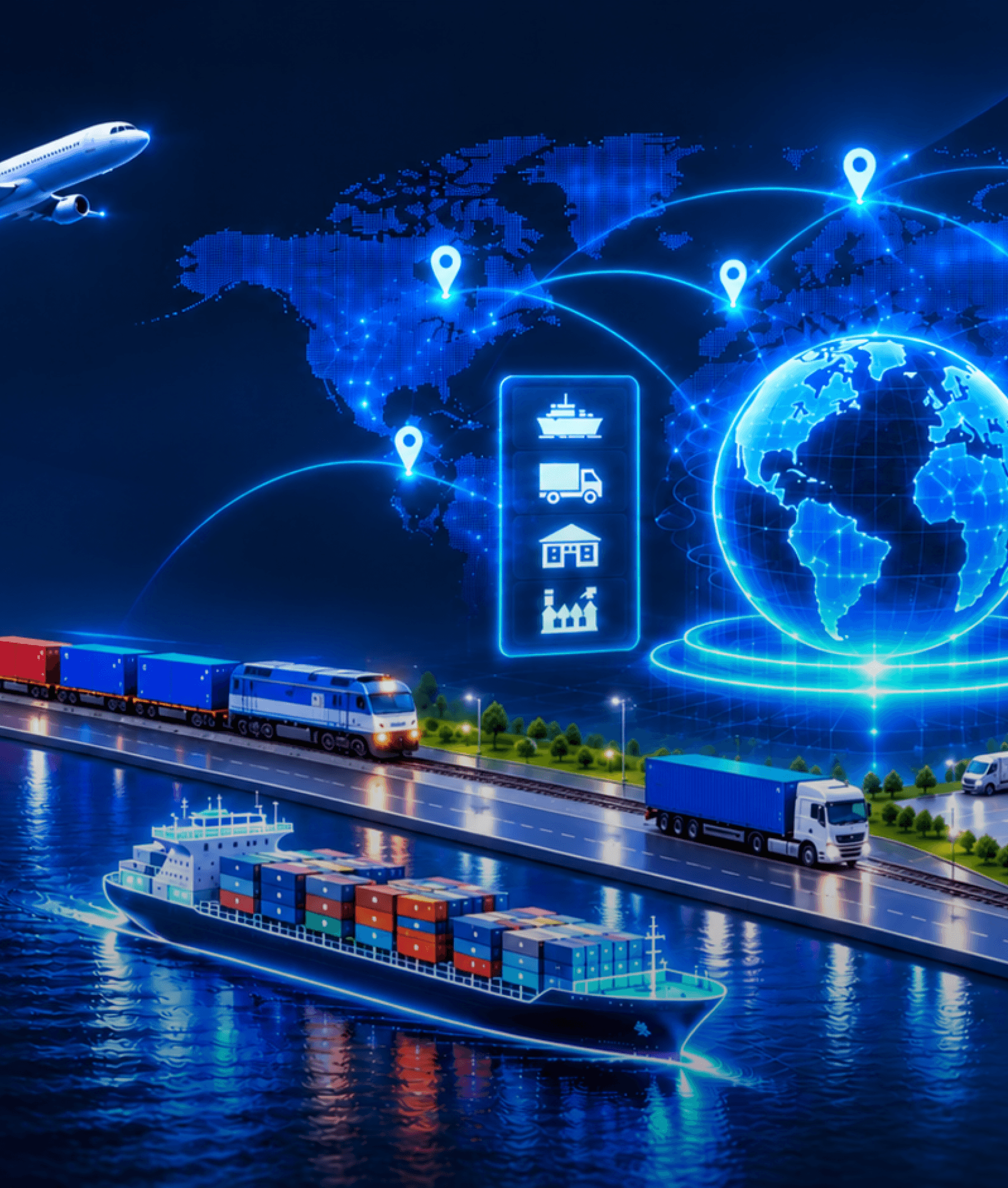
Global supply chains face growing uncertainty from fluctuating demand, transportation delays, supplier disruptions, and geopolitical risks. Traditional planning tools rely on static formulas and average lead times, making it difficult to anticipate complex disruptions before they affect operations. A Supply Chain Digital Twin acts as a continuously updated virtual representation of the physical supply chain, helping enterprises simulate different scenarios, evaluate potential outcomes, and make informed decisions before implementing changes. As part of modern Supply Chain Software Development, these platforms combine live operational data, advanced simulation, and predictive analytics to support more resilient supply chain operations.
Key capabilities and benefits include:
Virtual Scenario Testing: Test inventory changes, supplier switches, and distribution network restructuring before applying them to live operations.
Real-Time Data Synchronization: Connect operational systems and live telemetry to maintain an updated view of supply chain activities.
Stochastic Simulation: Model demand fluctuations, transportation delays, and supplier uncertainty instead of relying only on average values.
Predictive Insights: Identify potential bottlenecks, inventory shortages, and operational risks before they disrupt business activities.
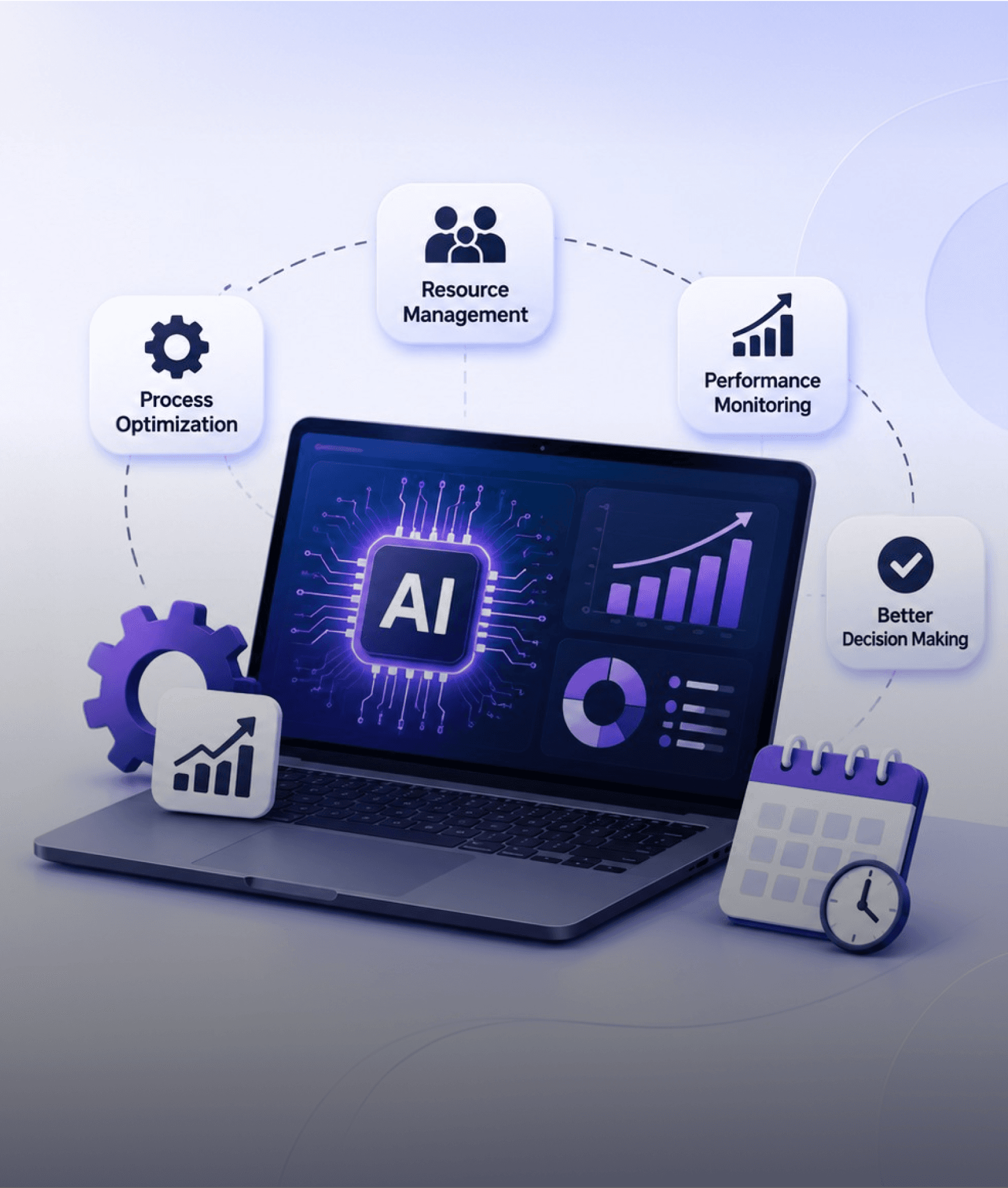
Smarter Decision-Making: Compare the cost, service, and working capital impact of different operational strategies.
Improved Resilience: Prepare for unexpected disruptions with data-driven responses and more flexible supply chain policies.
Key Insights Into Supply Chain Digital Twin Development
The Digital Twin Triad: A functional digital twin requires three continuously synchronized pillars: physical operational assets, a living graph digital thread, and an agent-based simulation kernel.
Beyond Track & Trace: While a Control Tower tells you what is happening right now, a Digital Twin tells you what will happen next week and tests the financial outcome of every corrective option in advance.
Working Capital Liquidity: Enterprises deploying living simulation models typically unlock 18% to 26% in trapped safety stock working capital while concurrently boosting line-item fill rates above 99%.
What Makes a Supply Chain Digital Twin Different From a Simulation Model or Control Tower?
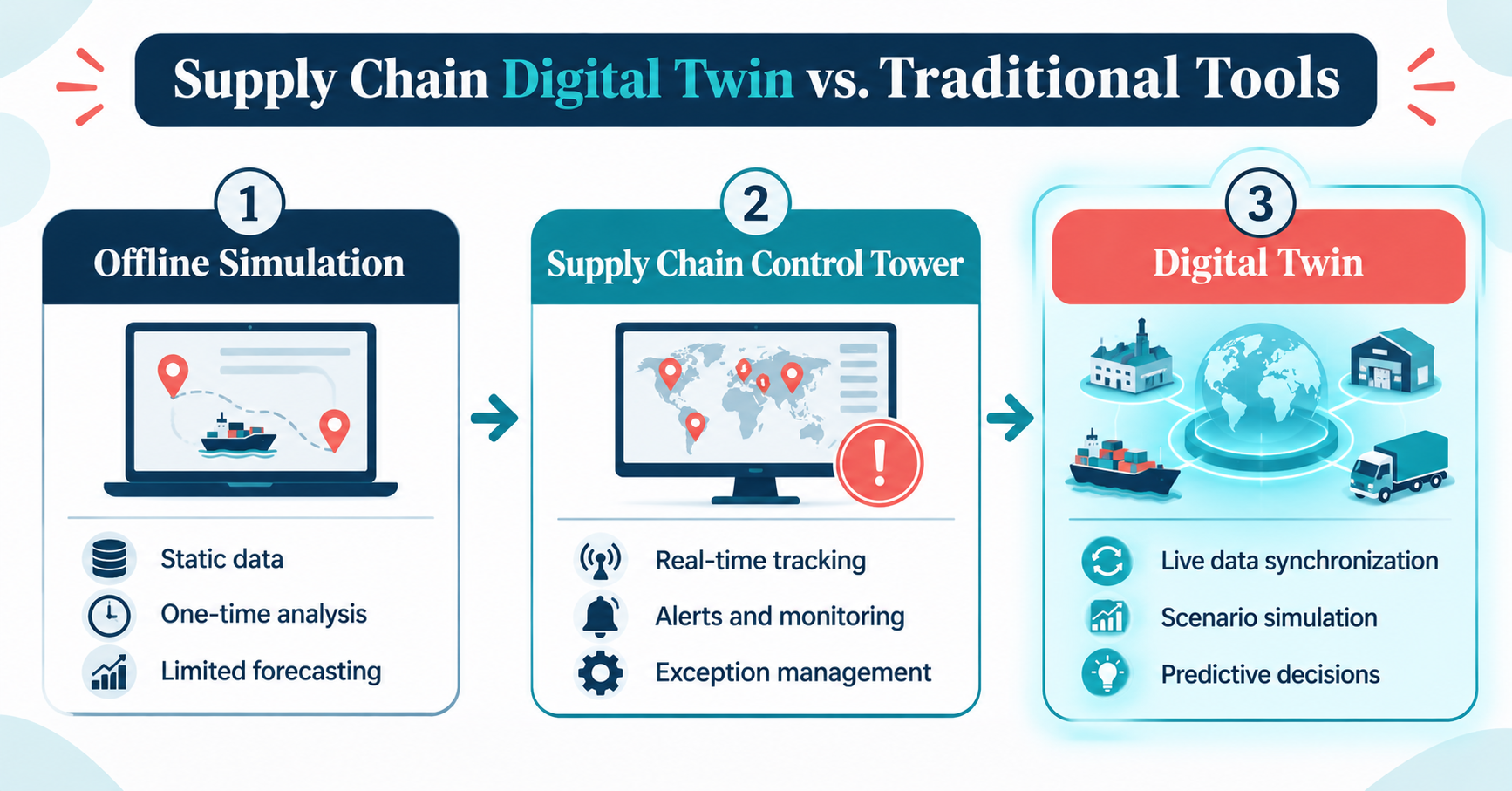
When technology leaders evaluate enterprise software vendors, marketing collateral frequently blurs the boundaries between basic reporting, discrete simulation, control towers, and digital twins.
To establish clarity across engineering and business teams, our team uses the following foundational distinction:
Supply Chain Digital Twin vs. Traditional Simulation and Control Tower Tools
Dimension | Offline Simulation Models (AnyLogic, Excel) | Supply Chain Control Tower | Living Supply Chain Digital Twin |
|---|---|---|---|
Primary Objective | Academic, one-off capex studies or plant layout design. | Real-time monitoring, milestone tracking, and exception alerts. | Dynamic stress-testing, stochastic forecasting, and closed-loop policy tuning. |
Data Synchronization | Manual data extraction; static snapshot frozen in time. | Unidirectional stream of operational milestones and telemetry. | Continuous bidirectional synchronization between physical reality and virtual state. |
Handling of Uncertainty | Deterministic averages or simplified probability curves. | Historical threshold comparisons (e.g., flag if delay exceeds 4 hours). | Stochastic Monte Carlo variations running non-linear probability distributions. |
Execution Capability | Static PDF report delivered to strategy consultants. | Manual dispatcher workflows or rule-based escalation alerts. | Closed-loop policy writeback into ERP/WMS parameters (dynamic safety stock re-tuning). |
Decision Horizon | Strategic 3 to 5-year macro studies. | Operational present (last 2 hours to next 48 hours). | Comprehensive tactical and strategic (next 2 hours, next 60 days, and next 5 years). |
A true digital twin does not merely mirror reality; it interrogates reality. It asks: "What is the probability of our assembly line shutting down if our primary supplier in Southeast Asia experiences a 10-day flood, and how much buffer inventory must we reposition today to guarantee zero operational interruption?"
The Bullwhip Effect in Supply Chains: A $32 Million Inventory Challenge
To understand why traditional planning systems fail in volatile environments, consider a real-world scenario observed in automotive manufacturing:
An automotive Tier-1 supplier observed a sudden 5% uptick in retail dealership demand for an electric vehicle crossover model. Traditional enterprise planning tools interpreted this signal linearly.
Because each tier in the supply chain added its own cautious safety padding:
The regional distribution centers placed a 12% larger order with the manufacturing plant to protect their local delivery KPIs.
The assembly plant, anticipating further volatility and factoring in rigid supplier batch minimums, placed a 24% larger purchase order with component suppliers.
The component suppliers, desperate to avoid contractual stockout penalties, ordered a 42% larger volume of specialized alloy stampings and microcontrollers from raw material vendors.
By the time this magnified demand wave traversed the multi-tier supply chain, retail consumer demand had normalized back to baseline.
The Result: The enterprise was left holding $32 million in specialized, obsolete component inventory that required twelve months of discounted write-downs and warehouse storage penalties.
How a Supply Chain Digital Twin Helps Prevent the Bullwhip Effect
Had the enterprise run a living digital twin, the platform's multi-echelon agent-based simulation kernel would have recognized the 5% retail bump as transient consumer seasonal variance rather than a structural demand shift.
By modeling the entire network as an interconnected behavioral graph, the digital twin would have simulated the upstream bullwhip effect across all five echelons in four minutes, recommending an incremental safety buffer adjustment of just 1.8% and preventing tens of millions of dollars in catastrophic inventory over-ordering.
Ready to Build Your Supply Chain Digital Twin?

Why Traditional Simulation Tools Struggle With Enterprise Supply Chain Complexity
For decades, industrial engineers used desktop discrete-event simulation (DES) packages to design factory layouts or calculate conveyor belt bottlenecks. However, when enterprises attempt to scale desktop DES packages across a global, multi-tier supply chain, they encounter three systemic architectural barriers:
The Stale Data Trap: Desktop simulation software relies on point-in-time data exports extracted from ERPs via CSV or batch queries. By the time an engineer finishes setting up the parameters and debugging the simulation run, the physical reality on the ground has changed completely. Vessels have sailed, port queues have doubled, and production yields have shifted.
Computational Bottlenecks: Traditional single-machine simulation engines execute events sequentially. Simulating 50,000 SKUs flowing through 500 nodes across 1,000 distinct multimodal transit corridors over 365 days requires days of compute time. Operations directors cannot wait 72 hours for an answer when a container ship is currently diverting around a geopolitical bottleneck.
The Static Agent Assumption: Standard planning models assume humans, logistics carriers, and suppliers act with mathematical consistency. In the real world, suppliers conceal delays until the last possible minute, freight forwarders drop lower-margin containers during port surges, and customs officers enforce localized clearance inspections.
Our team approaches digital twin engineering by combining Discrete-Event Simulation (DES) with Agent-Based Modeling (ABM) and distributed cloud compute clusters (such as Ray and Apache Spark), allowing the platform to simulate millions of autonomous, competitive actor interactions across the global supply chain in minutes.
Supply Chain Digital Twin Architecture: The Five Core Tiers
Engineering an enterprise-grade digital twin platform requires a decoupled, five-tier cloud-native architecture designed for high-throughput stream ingestion, spatial graph modeling, and parallelized simulation runtimes:
Five Core Layers of a Supply Chain Digital Twin Platform
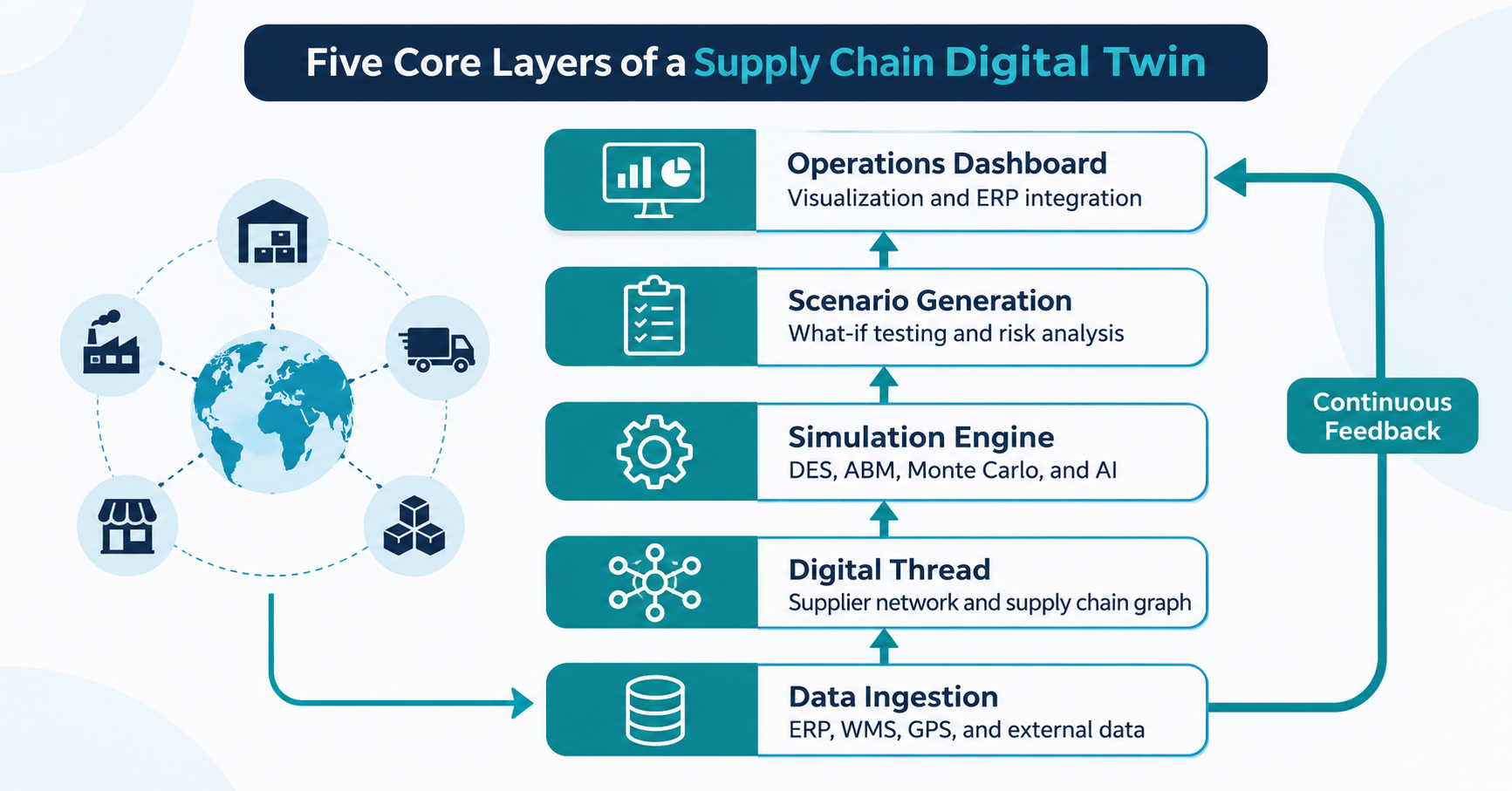
Tier 1: Multi-Source Supply Chain Data Ingestion
The ingestion tier continuously extracts state signals from disparate enterprise silos and translates them into an append-only event stream:
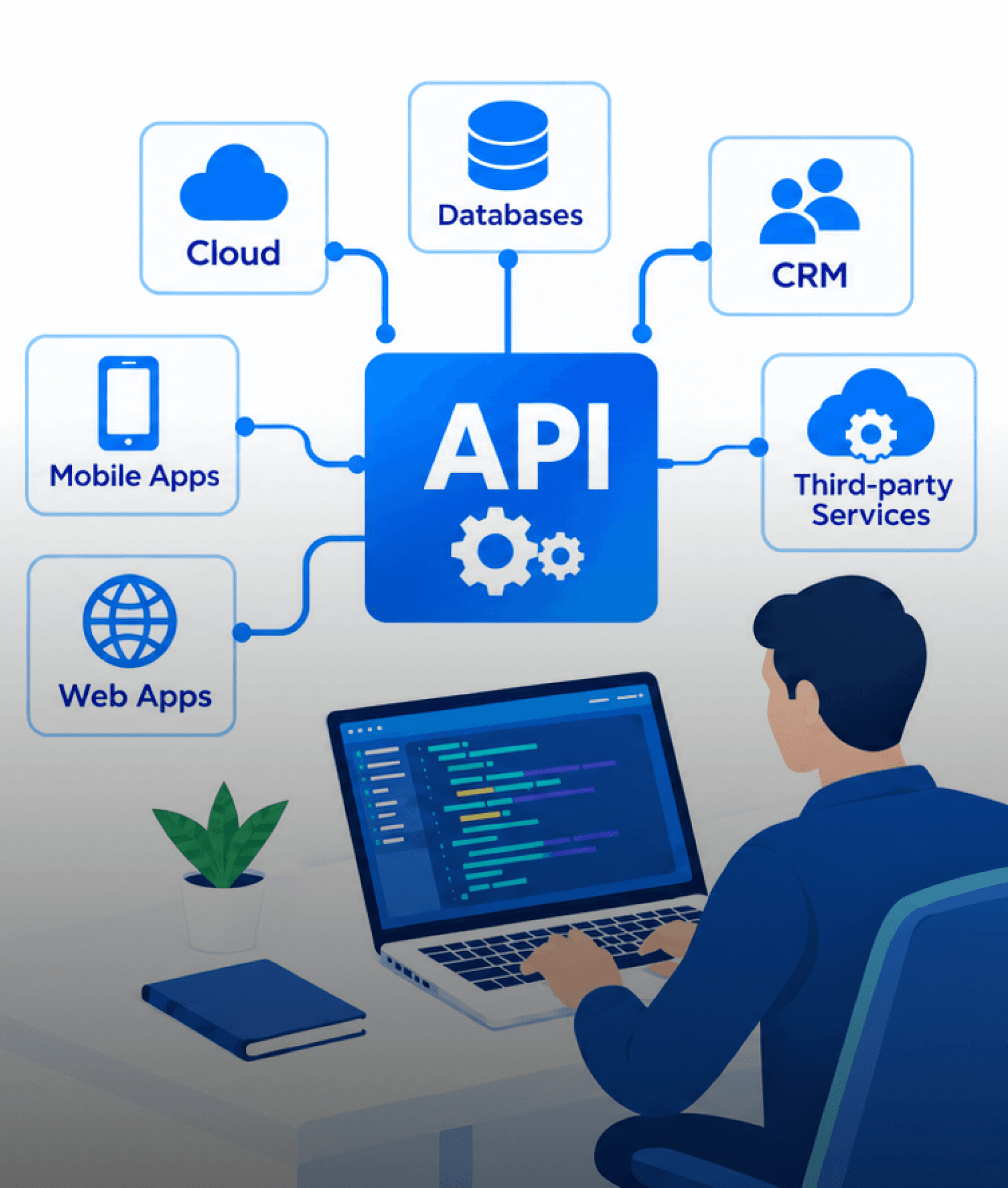
Core ERP & Production: SAP S/4HANA, Oracle NetSuite, and Microsoft Dynamics 365 for purchase orders, sales backlog, bills of materials, and financial contracts.
Execution & Warehouse: Manhattan Associates, Blue Yonder, and HighJump WMS for bin-level inventory counts, pick rates, and dock door schedules.
In-Transit Telemetry: Satellite AIS feeds (vessel position and draught), ADS-B (air cargo), and telematics GPS (drayage and long-haul trucking).
Macro Risk Feeds: Live weather APIs (NOAA), port dwell congestion indices, geopolitical risk trackers, and commodity spot price indices.
Tier 2: Digital Thread and Supply Chain Graph Architecture
Physical supply chains are not relational databases; they are complex, dynamic network graphs. Tier 2 unifies the physical topology into a stateful, in-memory graph model:
Property Graph Engine (Neo4j / Amazon Neptune): Models multi-tier supplier relationships, bills of materials (BOM) parent-child hierarchies, and alternate manufacturing routes as connected nodes and edges.
Spatial Routing Mesh (PostgreSQL + PostGIS): Manages geographic transit corridors, maritime choke-points, territorial waters, and geofenced warehouse boundaries.
In-Memory State Synchronizer (Redis Cluster): Caches live operational asset states (current container locations, inventory counts, production line speeds) to provide sub-second data hydration for simulation runs.
Tier 3: Hybrid Simulation Engine for Supply Chain Modeling
The computational brain of the platform. Rather than relying on a single simulation algorithm, the platform orchestrates four complementary simulation disciplines:
Discrete-Event Simulation (DES): Models deterministic queues, loading times, warehouse sorting throughput, and assembly line takt times.
Agent-Based Modeling (ABM): Simulates autonomous decision-makers (individual suppliers, carrier bidding behaviors, port terminal operators) with independent goals and constraints.
Monte Carlo Stochastic Engine: Injects thousands of probabilistic permutations across lead times, transit delays, equipment failure rates, and currency exchange fluctuations.
Reinforcement Learning (RL): Continuously explores non-obvious policy combinations to identify counter-intuitive inventory placement strategies that human planners would never spot.
Tier 4: Supply Chain Scenario Generation and Simulation
Tier 4 provides the testing arena where operations teams configure, inject, and evaluate business scenarios:
Scenario Parameter Matrix: Allows users to adjust independent variables (e.g., fuel surcharges increase by 25%, Rotterdam port capacity drops by 40%, Taiwan supplier lead times extend by 14 days).
Multi-Criteria Scoring Engine: Evaluates every simulation run against competing corporate priorities: total landed cost, carbon footprint (Scope 3 emissions), customer delivery SLA compliance, and working capital cash drag.
Tier 5: Digital Twin Operations Dashboard and ERP Integration
Interactive 3D Network Twin (Next.js + WebGL / Deck.gl): An intuitive visual workspace that renders the entire global supply chain as an interactive, explorable 3D twin.
Automated Policy Synchronization Engine: The critical return loop. Once operations leadership approves a simulated policy recommendation, the platform automatically pushes updated safety stock parameters, minimum order quantities (MOQ), and preferred alternate routing vendors directly into SAP or Oracle execution tables.
Ready to Build Your Supply Chain Digital Twin?
Four Essential Supply Chain Stress Tests for Enterprise Digital Twins
A digital twin should not sit idle waiting for a global crisis. Leading organizations run automated, scheduled stress-tests every weekend to discover hidden failure modes before they materialize.
Based on our implementation experience, high-performing enterprises continuously evaluate four core operational stress-testing arenas:
Four Key Areas for Supply Chain Risk and Resilience Testing
Arena 1: Maritime Disruptions and Geopolitical Supply Chain Risks
The Provocative Question: "What happens to our European Q3 operating profit if the Suez Canal or Strait of Hormuz is forced closed for 21 consecutive days?"
What the Digital Twin Simulates:
Re-routes all active container vessels around the Cape of Good Hope, calculating an extra 10 to 14 days of sailing time and $4,200 in additional bunker fuel costs per FEU (forty-foot equivalent unit).
Evaluates current buffer inventory across regional assembly plants to identify the exact hour component stockouts will occur.
Prescribes an optimal split: 80% container volume diverted around Africa, while 20% of critical high-margin components are transferred to dedicated chartered air freight.
Quantifiable Business Value: Prevents $24 million in factory shutdown penalties and preserves customer delivery commitments.
Arena 2: Supplier Insolvency and Single-Source Supply Chain Risks
The Provocative Question: "If our primary chemical resin manufacturer in Europe files for restructuring tomorrow, which finished product lines halt, and when?"
What the Digital Twin Simulates:
Traverses the multi-echelon bill of materials graph to identify every sub-component and finished SKU that depends on the affected resin formulation.
Analyzes current safety stocks across all tier-1 parts suppliers to calculate the exact operational runout date for 142 distinct commercial SKUs.
Evaluates pre-qualified secondary chemical suppliers, factoring in required regulatory recertification timelines and tooling setup costs.
Quantifiable Business Value: Eliminates single-point-of-failure vulnerabilities months before operational disruption occurs.
Arena 3: Supply Chain Network Redesign and Nearshoring Optimization
The Provocative Question: "Should we shift 35% of our component manufacturing from East Asia to Mexico? What is the true total landed cost and working capital impact?"
What the Digital Twin Simulates:
Simulates a multi-year landed cost model incorporating regional labor rates, cross-border tariffs (USMCA), rail transit lead times, and facility capital expenditures.
Models transit time compression from 42 days (ocean freight plus port dwell) down to 4 days (intermodal freight).
Quantifies the inventory working capital reduction resulting from shorter cash-to-cash cycles, revealing that $42 million in cash currently trapped in safety stock buffers can be returned to corporate treasury.
Quantifiable Business Value: Validates multi-million-dollar capex decisions with empirical certainty before breaking ground on new facilities.
Arena 4: Dynamic Safety Stock and Working Capital Optimization
The Provocative Question: "Are our static 30-day safety stock rules trapping millions in dead working capital while still failing to protect against volatile demand spikes?"
What the Digital Twin Simulates:
Replaces rigid static days-of-supply rules with dynamic probabilistic lead-time distributions calculated per SKU, lane, and season.
Identifies slow-moving, high-margin SKUs where buffer stock can be safely reduced by 22% without impacting customer service levels.
Identifies high-volatility, critical-path components where safety buffers must be dynamically increased to protect against chronic lane congestion.
Quantifiable Business Value: Reduces overall inventory holding costs by 18% to 26% while elevating line-item order fulfillment to 99.2%.
Can a Supply Chain Digital Twin Safely Automate ERP Policy Updates?
One of the most common concerns raised by Chief Information Officers and enterprise IT teams is the risk of autonomous system mutations: "Will the digital twin's algorithms run wild and place corrupt, unauthorized purchase orders into our live SAP system?"
The short answer is no, provided the architecture enforces strict tiered autonomy with human-on-the-loop governance.
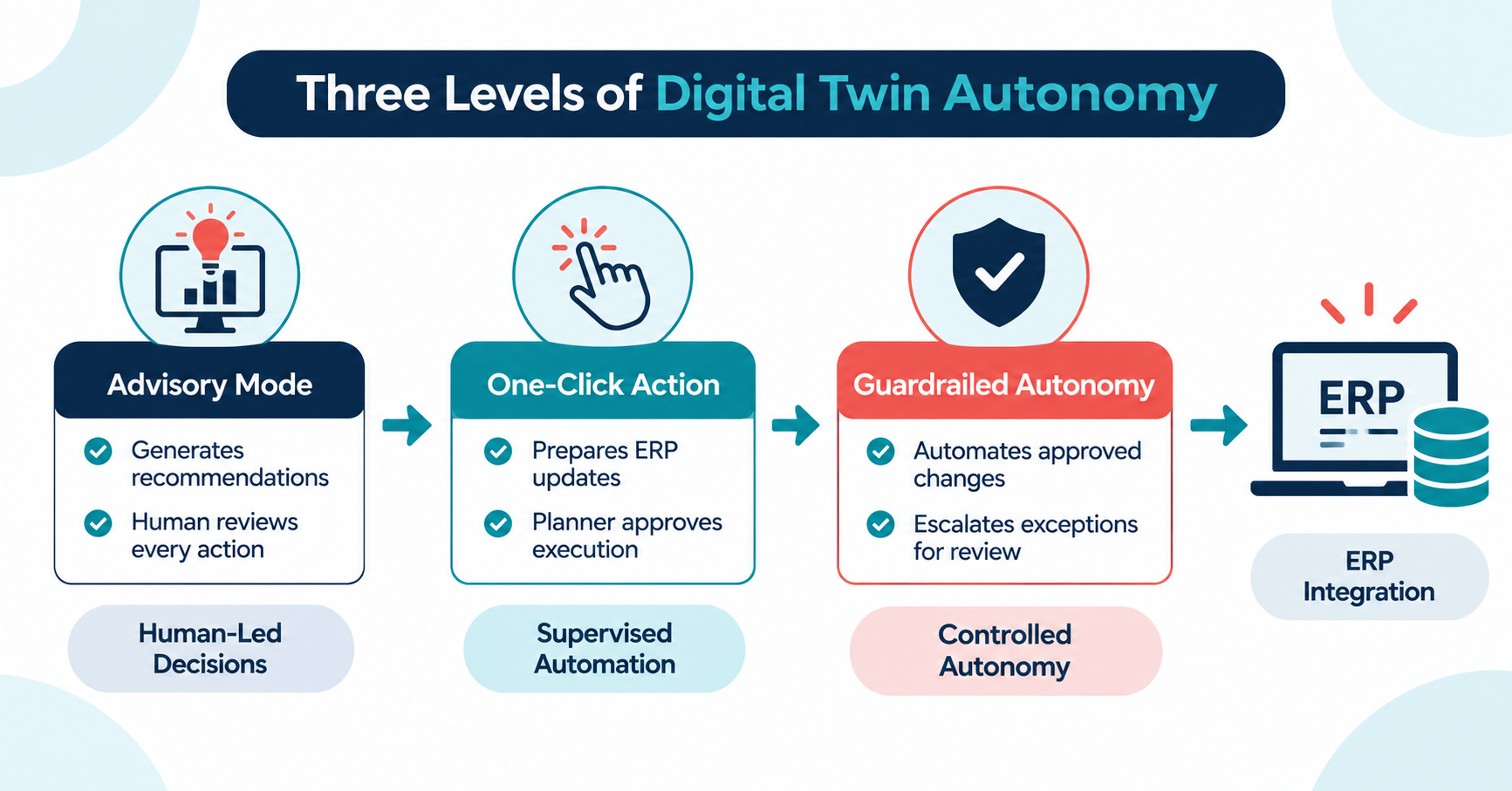
Our team designs custom digital twin platforms with three operational execution modes:
Three Levels of Autonomy in Enterprise Supply Chain Digital Twins
Autonomy Level | Operating Mode | System Action | Human Approval Requirement |
|---|---|---|---|
Level 1: Advisory Mode | Manual Oversight | Generates scenario reports and simulation rankings. | 100% human review; planner manually keys adjustments into ERP. |
Level 2: One-Click Action | Supervised Automation | System prepares the exact ERP configuration changes or PO updates. | Planner clicks "Approve Recommendation" in cockpit; system executes writeback. |
Level 3: Guardrailed Autonomy | Autonomous Self-Tuning | System automatically updates safety stock parameters within pre-approved thresholds (e.g., +/- 10% spend variance). | Fully autonomous; exceptions exceeding financial guardrails trigger human sign-off. |
By beginning in Advisory Mode during initial production deployment, enterprise teams build mathematical confidence in the model's accuracy. Over 6 to 9 months, organizations progressively graduate low-risk, repetitive parameters to Guardrailed Autonomy, liberating human planners to focus purely on strategic exceptions.
Ready to Build Your Supply Chain Digital Twin?
Supply Chain Digital Twin Implementation Roadmap and Development Cost
Developing an enterprise Supply Chain Digital Twin is a sophisticated software engineering undertaking. Organizations must avoid monolithic, multi-year research projects that fail to produce tangible operational wins.
Our team advocates a disciplined four-phase agile delivery blueprint spanning 8 to 10 months:
Supply Chain Digital Twin Development Phases, Timeline, and Budget
Implementation Phase | Timeline | Dedicated Agile Engineering Pod | Key Technical Milestones | Estimated Investment |
|---|---|---|---|---|
Phase 1: Data Foundation & Graph | 8 to 10 Weeks | 1 Lead Architect, 1 Senior BA, 2 Data Engineers, 1 Graph Specialist, 1 QA | Master SKU and BOM data cleansing, Neo4j graph dependency modeling, Kafka real-time ingestion mesh. | $50,000 - $70,000 |
Phase 2: Simulation Kernel Build | 9 to 11 Weeks | 1 Operations Research Lead, 2 Simulation Engineers, 2 Backend Developers, 1 QA | Discrete-event simulation kernel, Monte Carlo stochastic engine, PostGIS spatial network routing, Redis state cache. | $60,000 - $85,000 |
Phase 3: Scenario & What-If UI | 8 to 10 Weeks | 1 Tech Lead, 2 Fullstack Engineers, 1 Frontend GIS/WebGL Developer, 1 UI/UX Designer, 1 QA | 3D WebGL network twin dashboard, interactive what-if scenario builder, prescriptive cost vs SLA trade-off ranking. | $50,000 - $70,000 |
Phase 4: Closed-Loop Push & Scale | 7 to 9 Weeks | 1 Enterprise Integration Specialist, 2 Senior Backend Developers, 1 Security Specialist, 1 QA | Bidirectional SAP/Oracle writeback connectors, automated safety stock push, SOC 2 Type II security audit, production cutover. | $30,000 - $50,000 |
Total Comprehensive Build | 8 to 10 Months | Dedicated Cross-Functional Agile Pod | Full Enterprise-Grade Supply Chain Digital Twin Platform | $190,000 - $275,000 |
Key Engineering Lessons From Supply Chain Digital Twin Development
Throughout our experience architecting complex simulation engines, we have seen teams stumble over recurring technical hurdles.
Here is how our team approaches these challenges:
Lesson 1: Start With High-Value Supply Chain Components
The Mistake: Teams frequently attempt to build a 100% complete digital twin of every single low-value part, drowning the project in data cleaning and stalling launch by 18 months.
Our Approach: Follow the 80/20 Pareto principle. Focus initial graph modeling strictly on Class-A high-value components, single-source dependencies, and long-lead-time sub-assemblies. Expand to lower-tier parts only after the core model is generating live production value.
Lesson 2: Use Stochastic Models Instead of Average Lead Times
The Mistake: Using static average lead times (e.g., "Supplier transit time is 18 days") produces brittle, fragile simulation runs that fail when real-world congestion strikes.
Our Approach: Always model lead times, dwell queues, and supplier order processing as probabilistic statistical curves (such as Gamma or Log-Normal distributions) parameterized by historical real-world telemetry.
Lesson 3: Use Distributed Computing for Large-Scale Simulations
The Mistake: Running complex Monte Carlo runs with 10,000 iterations on a single monolithic database instance leads to database locks, system crashes, and furious operational users.
Our Approach: Decouple the simulation kernel from the operational database. We implement distributed compute clustering using Ray and Apache Arrow, parallelizing thousands of synthetic scenario iterations across cloud compute nodes to deliver answers in minutes.
Strategic Conclusion: The Resilient Enterprise of Tomorrow
In a global economy shaped by climate volatility, maritime chokepoints, and shifting geopolitical conditions, reacting to disruptions after they appear in ERP reports can lead to costly delays, excess inventory, and missed revenue. A custom Supply Chain Digital Twin helps enterprises move beyond reactive planning by modeling network complexity, testing disruption scenarios in a virtual environment, and evaluating operational decisions before implementation.
Our engineering team specializes in building high-throughput data pipelines, complex event processing engines, and AI-powered simulation platforms for mission-critical enterprise environments. Whether you want to evaluate a global network restructuring or develop a real-time digital twin from the ground up, we can help you plan the architecture, simulation capabilities, and engineering approach. Contact us today to discuss your supply chain requirements and explore how a custom digital twin platform can strengthen operational resilience and support better decision-making.

Mukund Patil
Business Enthusiast | Exploring ideas, trends, and opportunities, turning curiosity into meaningful insights and discovering smarter ways to make an impact.