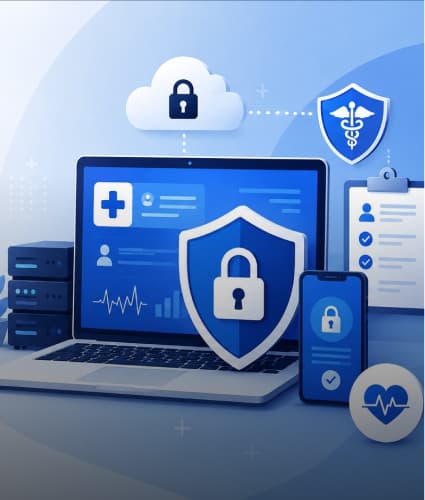
Healthcare software engineering across the United States, Canada, the United Kingdom, Australia, and Western Europe operates in highly regulated environments with significant cybersecurity risks. Healthcare organizations manage sensitive patient information, connected systems, clinical workflows, and third-party integrations, making software security an important part of the development lifecycle.
Modern digital health systems rely on:
Cloud-native microservices, mobile patient portals, and interoperable Electronic Health Record (EHR) APIs.
Connected devices and AI-enabled applications.
Security integrated into application architecture, development workflows, infrastructure, APIs, identity management, and ongoing monitoring, not just perimeter security or periodic vulnerability patching.
This guide outlines practical approaches to:
Healthcare software security best practices and Zero Trust patterns.
API security controls and software supply chain protection.
Global regulatory considerations and DevSecOps practices for building resilient healthcare platforms.
Zero Trust Architecture for Healthcare Software Security
Traditional network security often relies on the assumption that users or systems inside a trusted network can receive broader access. Modern cloud-native healthcare architectures increasingly follow a Zero Trust approach based on the principle of "Never Trust, Always Verify."
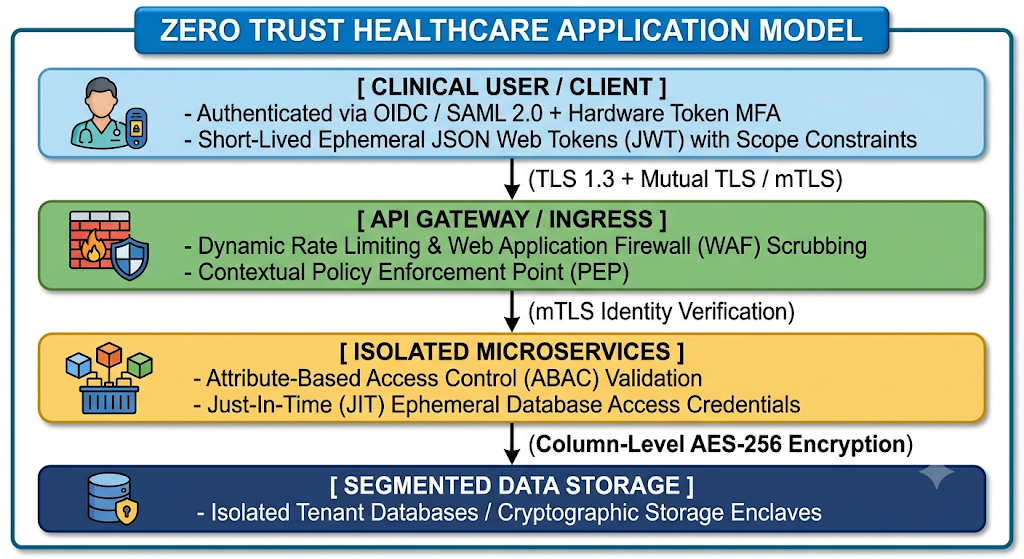
Implementing Zero Trust at the software application layer involves several engineering patterns:
Granular Identity and Access Management (IAM): Combine Role-Based Access Control (RBAC) with Attribute-Based Access Control (ABAC) where appropriate. Access policies can consider the requesting user's identity, role, device posture, time, and the clinical context of the requested record.
Mutual TLS (mTLS) for Service-to-Service Communication: Use mutual TLS where appropriate to authenticate services and encrypt communication between internal cloud workloads. A service mesh such as Istio or Linkerd can help manage service identities and certificate-based authentication.
Just-In-Time (JIT) Credentialing: Replace long-lived credentials with short-lived tokens or temporary access wherever practical. Database and engineering access should be limited to the required duration and scope.
Micro-Segmentation and Data Isolation: Separate workloads and sensitive data according to risk, tenant boundaries, and access requirements. High-risk patient information should have appropriately restricted access and encryption controls.
Ready to Secure Your Healthcare Software?

Healthcare API Security: FHIR, HL7, and Interoperability
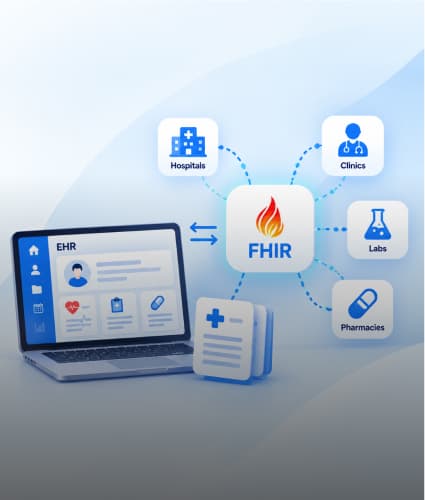
Modern healthcare applications frequently exchange information with EHR platforms, laboratories, clinical systems, patient applications, and other healthcare services. APIs therefore need strong authentication, authorization, validation, monitoring, and abuse-prevention controls.
1. SMART on FHIR Authentication and Authorization
Where supported by the implementation, SMART on FHIR provides an authorization framework built around OAuth 2.0 and OpenID Connect. Healthcare applications should apply appropriate scopes, token expiration, token storage, revocation, and user authorization controls based on the integration architecture.
2. API Rate Limiting and BOLA Prevention in Healthcare
Broken Object Level Authorization (BOLA) can expose sensitive healthcare records when an application fails to verify whether an authenticated user is authorized to access a specific resource.
Object-Level Authorization Checks: Verify that the authenticated user or service has permission to access the specific patient, encounter, observation, document, or other resource requested.
Adaptive Rate Limiting: Apply appropriate rate limits based on endpoint sensitivity and expected traffic. Monitor suspicious patterns such as rapid sequential record requests or unexpected bulk queries.
3. Healthcare API Payload Validation and Schema Security
Validate incoming API payloads against the expected FHIR profiles, schemas, data types, and business rules before processing them. Reject malformed requests, unexpected structures, invalid content types, and other inputs that could create security or data-integrity risks.
Healthcare Software Security: Compliance and Regulatory Requirements
Healthcare software deployed across different jurisdictions may need to address multiple privacy, security, and regulatory frameworks. The exact requirements depend on the product, data processed, organization, deployment model, and applicable jurisdiction.
Jurisdiction / Standard | Key Frameworks | Important Security Considerations |
|---|---|---|
United States | HIPAA Security Rule, HITECH, applicable CMS and ONC requirements | Access controls, audit controls, authentication, transmission security, risk analysis, incident response, and appropriate safeguards for protected health information. |
European Union | GDPR, EU AI Act where applicable, NIS2 where applicable | Data minimization, privacy by design, access controls, security measures, data-subject rights, breach response, and appropriate cross-border data-transfer safeguards. |
United Kingdom | UK GDPR, Data Protection Act 2018, NHS Data Security and Protection Toolkit where applicable | Data protection, access management, risk assessment, incident management, privacy controls, and applicable NHS security requirements. |
Canada | PIPEDA and applicable provincial or territorial privacy and health-information laws | Consent, safeguards, access controls, privacy governance, retention, breach management, and applicable provincial requirements. |
Global Enterprise | ISO/IEC 27001, SOC 2, NIST Cybersecurity Framework | Information security governance, risk management, security controls, monitoring, supplier risk management, and continuous improvement. |
Ready to Secure Your Healthcare Software?
Healthcare Software Supply Chain Security
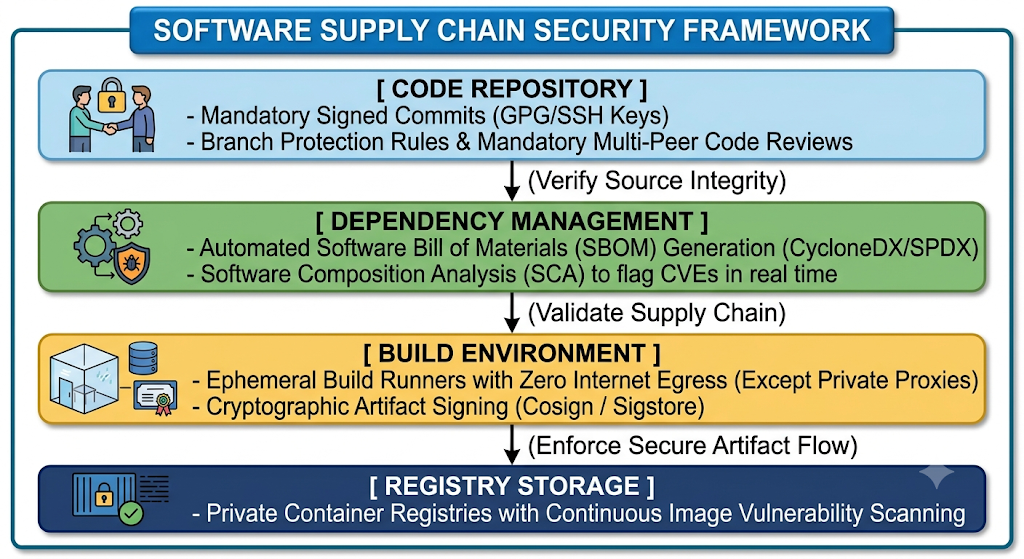
Modern healthcare applications depend heavily on third-party libraries, frameworks, APIs, containers, and open-source packages. Vulnerabilities in these dependencies can create risks across the application supply chain.
1. SBOM Management for Healthcare Software
Generate and maintain a machine-readable Software Bill of Materials (SBOM) using standards such as CycloneDX or SPDX. An SBOM provides visibility into third-party components, versions, and dependencies used within a software product.
2. Software Composition Analysis for Healthcare Applications
Integrate Software Composition Analysis tools into developer workflows and CI/CD pipelines. Security teams can use SCA to identify vulnerable or outdated dependencies and prioritize remediation based on severity, exploitability, and application context.
3. Dependency Management and Supply Chain Protection
Use trusted package repositories and dependency-management controls to reduce the risk of dependency confusion and typosquatting. Pinning dependency versions and using lockfiles can also improve build reproducibility and supply chain integrity.
DevSecOps for Healthcare Software Security
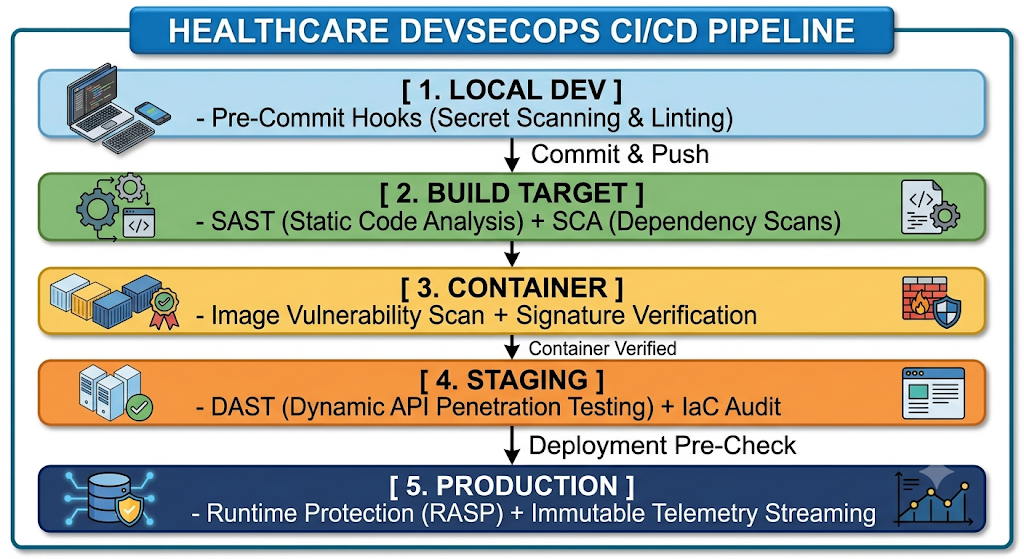
Healthcare security should be addressed throughout the software development lifecycle rather than treated as a final-stage audit. DevSecOps practices bring automated security checks into development, testing, deployment, and monitoring workflows.
1. SAST and DAST for Healthcare Application Security
SAST (Static Application Security Testing): Analyzes source code or compiled code to identify potential vulnerabilities such as injection risks, insecure coding patterns, and weak security controls.
DAST (Dynamic Application Security Testing): Tests running applications and APIs to identify issues involving authentication, authorization, input handling, security headers, and other runtime behaviors.
2. Infrastructure as Code Security for Healthcare Cloud Environments
Manage cloud infrastructure through version-controlled Infrastructure as Code (IaC) tools such as Terraform, OpenTofu, or AWS CloudFormation. Automated IaC security scanning can identify configuration risks such as overly permissive security groups, publicly exposed resources, or missing encryption settings before deployment.
3. Centralized Logging and SIEM for Healthcare Security
Centralize application, access, infrastructure, and security logs within an appropriate Security Information and Event Management (SIEM) or observability platform. Platforms such as Datadog, Splunk, and AWS CloudWatch can support monitoring and investigation depending on the organization's architecture.
For sensitive audit records, organizations can use appropriate retention and integrity controls, including immutable or write-once storage where required by their security and compliance policies.
Ready to Secure Your Healthcare Software?
Healthcare Software Security Best Practices Checklist
Use this checklist during technical reviews with internal engineering teams and healthcare software development partners:
Is Zero Trust applied across appropriate application and service communication layers?
Does the API layer enforce object-level authorization for every sensitive clinical data request?
Are sensitive patient identifiers protected with appropriate encryption and key-management controls?
Do CI/CD pipelines generate an SBOM and identify vulnerable third-party dependencies?
How does the SMART-on-FHIR implementation handle token expiration, revocation, and scope validation?
Are infrastructure deployments managed through version-controlled IaC and subjected to automated security analysis?
Are application telemetry and audit logs protected against unauthorized modification or deletion?
How frequently are automated security scans and third-party penetration tests performed?
Are developer access paths protected with appropriate MFA and least-privilege controls?
Does the deployment architecture address applicable data residency, privacy, and regulatory requirements?
Secure Healthcare Software Engineering Services
Engineering healthcare platforms that address complex security and regulatory requirements requires secure architecture, healthcare domain knowledge, interoperability expertise, and disciplined engineering practices.
At Zignuts, we work with digital health companies, healthcare organizations, and medical SaaS businesses to build, modernize, integrate, and secure healthcare platforms.
Secure Cloud Architecture & Zero Trust Engineering: Designing cloud-native architectures with appropriate IAM, service authentication, network segmentation, encryption, and security controls.
Interoperable API Development: Building secure FHIR APIs, HL7 transformation adapters, EHR integrations, and healthcare integration layers.
DevSecOps Pipeline Integration: Integrating SAST, DAST, SCA, SBOM generation, IaC security checks, vulnerability management, and security monitoring into development workflows.
Security and Compliance Engineering: Designing software architectures around applicable HIPAA, GDPR, UK GDPR, Canadian privacy requirements, ISO 27001, SOC 2, and other relevant security frameworks.
By combining modern engineering practices with security-focused development workflows, we help healthcare organizations reduce security risks, protect sensitive data, and build scalable digital health platforms.
How to Improve Healthcare Software Security
Healthcare software security requires continuous attention across application architecture, APIs, identities, infrastructure, third-party dependencies, development pipelines, and monitoring. A Zero Trust approach, strong API authorization, supply chain visibility, automated security testing, and appropriate compliance controls can help organizations build more resilient healthcare platforms.
How is your engineering team assessing its software architecture against evolving cyber threats and regional compliance requirements? Contact us today to discuss your healthcare software security requirements and explore a secure architecture approach for your digital health platform.

Utkrishti Mishra
Business Analyst Intern | Exploring data, processes, and business strategies to turn insights into smarter decisions and impactful solutions.