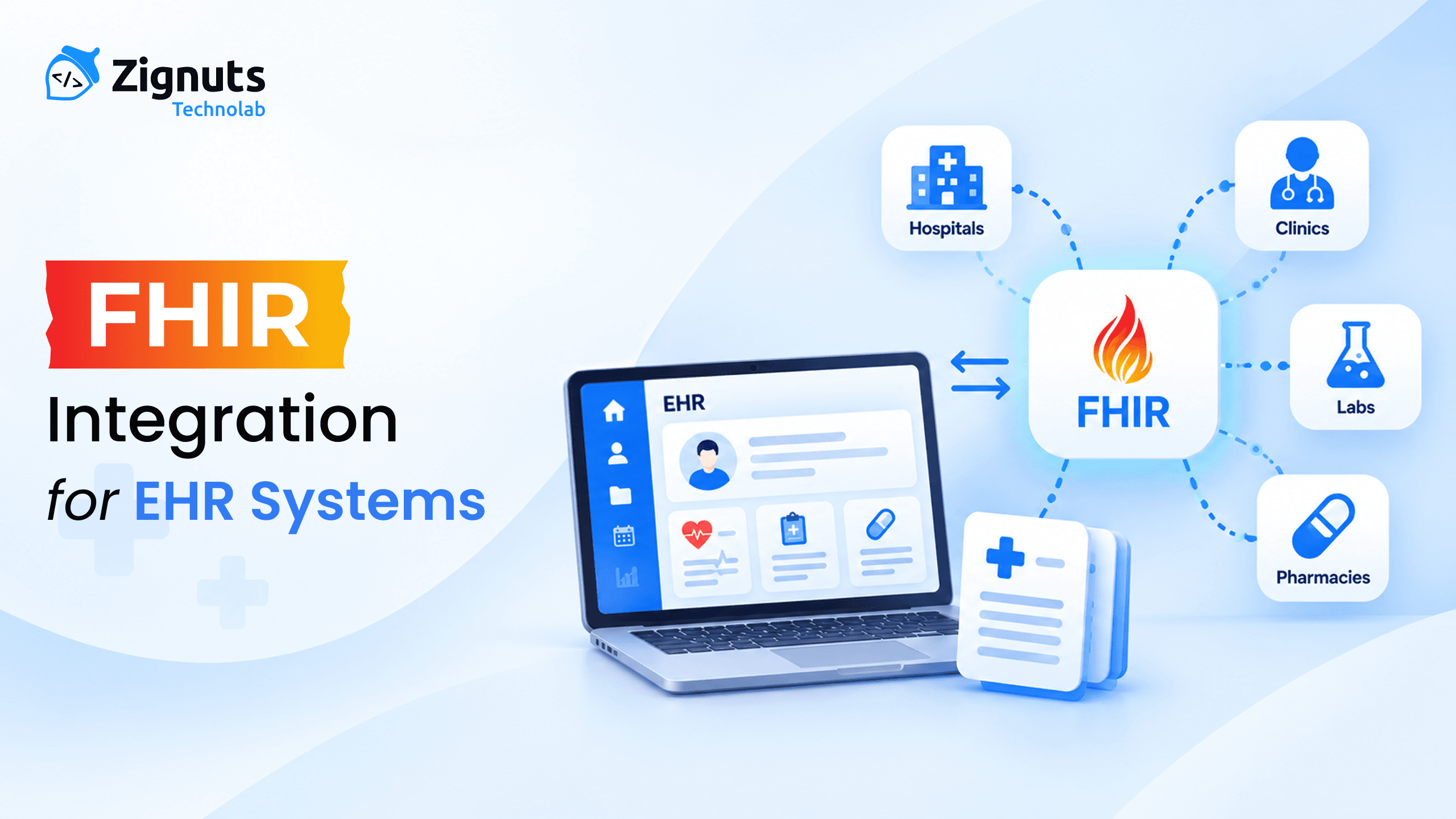
In modern digital health engineering, Fast Healthcare Interoperability Resources (HL7 FHIR Release 4) has become an important standard for exchanging healthcare data. In the United States, federal interoperability and health IT certification requirements increasingly rely on FHIR-based capabilities, including requirements associated with the 21st Century Cures Act, the ONC Health IT Certification Program, and CMS interoperability initiatives.
Integrating FHIR with enterprise Electronic Health Record (EHR) systems supports several healthcare applications and workflows:
EHR System Integration: Integrating FHIR with enterprise EHR systems such as Epic, Oracle Health, MEDITECH, athenahealth, and eClinicalWorks.
Patient-Facing Applications: Supporting applications that enable patients to access and manage their healthcare information.
Clinical Decision Support: Enabling clinical decision support through structured healthcare data.
Remote Patient Monitoring (RPM): Supporting remote patient monitoring applications and workflows.
Healthcare AI Workflows: Enabling healthcare AI workflows through standardized clinical data exchange.
EHR Software Development: Helping healthcare applications exchange structured clinical data with existing systems.
This technical guide explains the architectural patterns, resource models, security considerations, and implementation practices involved in building resilient FHIR integrations for healthcare applications.
FHIR R4 Resource Model for EHR Integration
At the foundation of FHIR are discrete, modular building blocks known as Resources. Unlike monolithic clinical documents or legacy HL7 v2 messages that can bundle multiple clinical domains into a single payload, FHIR represents clinical concepts as individual resources that can be connected through explicit references.
The clinical data model commonly centers around the Patient resource, which can be referenced by related clinical resources such as encounters, observations, conditions, and medication requests.
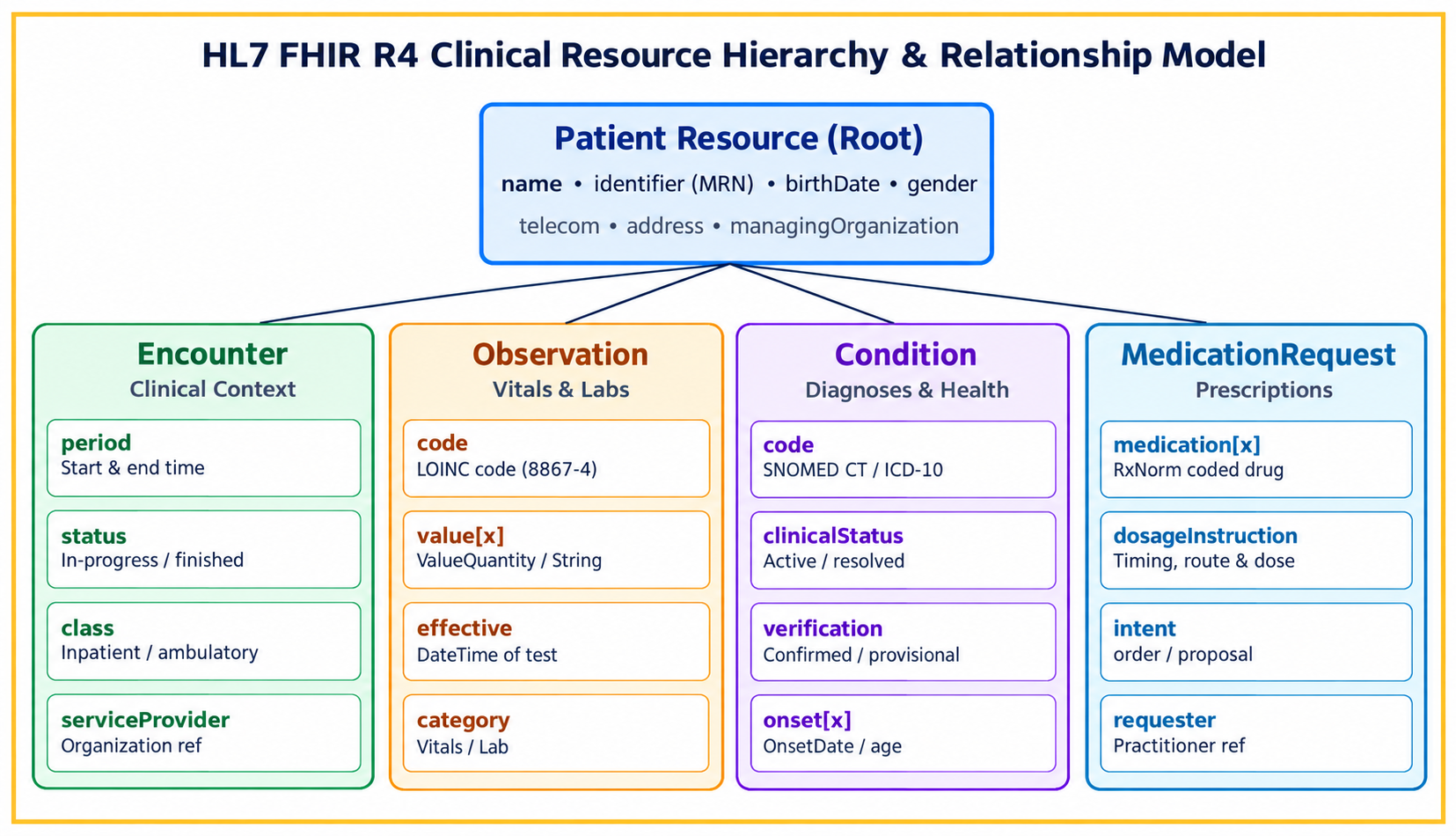
Figure 1: HL7 FHIR R4 Clinical Resource Hierarchy and Relationship Model
Central Patient resource connected to Encounters, Observations, Conditions, MedicationRequests, and other related healthcare resources.
Core FHIR R4 Resources for EHR Data Mapping
FHIR R4 Resource | Clinical Purpose and Domain | Core JSON Elements | Legacy EHR / HL7 v2 Mapping |
|---|---|---|---|
Patient | Demographics, administrative identifiers, contact information, and managing organization. | identifier, name, telecom, gender, birthDate, address | Commonly mapped from HL7 v2 PID and relevant C-CDA patient information. |
Encounter | Inpatient, outpatient, emergency, or telehealth clinical interaction context. | status, class, type, period, participant, serviceProvider | Commonly mapped from HL7 v2 PV1 and related visit information. |
Observation | Vital signs, laboratory results, social history, and other clinical measurements. | code, valueQuantity, effectiveDateTime, interpretation | Commonly mapped from HL7 v2 OBX and relevant C-CDA results sections. |
Condition | Clinical problems, acute diagnoses, chronic conditions, and health concerns. | code, clinicalStatus, verificationStatus, onsetDateTime | Commonly mapped from HL7 v2 DG1 and problem-related messages. |
MedicationRequest | Medication orders, prescription details, and dosage instructions. | medicationCodeableConcept, dosageInstruction, intent, authoredOn | May be mapped from relevant medication-related HL7 and pharmacy workflows. |
DocumentReference | Clinical notes, discharge summaries, reports, and other referenced clinical documents. | status, type, category, subject, content.attachment | Can support mappings from HL7 v2 document-management messages and C-CDA documents. |
Ready to Build Reliable EHR Integrations?

SMART on FHIR Authorization for EHR Integration
Third-party healthcare applications should not rely on static database credentials or unrestricted service accounts to access EHR data. SMART on FHIR provides a standardized authorization framework built around OAuth 2.0 and, where applicable, OpenID Connect (OIDC).
SMART on FHIR commonly supports two application launch scenarios:
EHR Launch: A clinician launches an application from within an EHR interface. The EHR provides the application with the FHIR server context and launch information.
Standalone Launch: A patient or clinician starts a web or mobile application independently and authenticates through the appropriate identity and authorization flow.
5-Step SMART on FHIR Authorization Workflow
Launch Initialization: The EHR launches the application and provides the FHIR server endpoint and relevant launch context.
Conformance Discovery: The application discovers the authorization configuration and supported endpoints from the FHIR server.
Authorization Request: The application redirects the user to the authorization endpoint and requests appropriate SMART scopes.
Token Exchange: After authentication and authorization, the application exchanges the authorization code for an access token and, where applicable, a refresh token and patient context.
Authenticated FHIR Queries: The application uses the access token to make authorized FHIR API requests against permitted resources.
FHIR REST APIs and Advanced Search for EHR Integration
FHIR provides RESTful interactions that allow applications to create, read, update, delete, and search healthcare resources. These interactions can be implemented at instance, type, and system levels, with additional operations available for specific use cases.
1. FHIR Search Parameters and Resource Chaining
FHIR search parameters can reduce unnecessary API calls by allowing applications to retrieve resources based on specific clinical criteria.
Parametric Filtering:
GET /Observation?patient=123&code=8867-4&date=ge2026-01-01can be used to retrieve relevant heart-rate observations for a patient after a specified date, subject to the server's supported search parameters.Chained Searches:
GET /DiagnosticReport?subject:Patient.name=Smithcan search reports using information from a referenced Patient resource when supported by the FHIR server.Compound Inclusions:
_includeand_revincludecan retrieve related resources within a search response where supported.
2. FHIR Transaction and Batch Bundles
For multi-resource operations, FHIR supports Bundle resources. A batch bundle contains independent operations, while a transaction bundle is processed as a coordinated transaction by a FHIR server. If a transaction cannot be completed successfully, the server can reject the transaction rather than applying a partial set of changes.
3. FHIR Bulk Data Access with $export
The FHIR Bulk Data Access specification provides an asynchronous mechanism for exporting large healthcare datasets. Bulk exports commonly produce newline-delimited JSON (NDJSON), making the approach useful for analytics, population health, research, and large-scale data processing where supported by the implementation.
Ready to Build Reliable EHR Integrations?
Legacy HL7 to FHIR Integration and Data Ingestion
Many healthcare environments continue to operate legacy HL7 v2 interfaces alongside newer FHIR APIs. A modernization architecture can receive legacy messages, transform the relevant clinical information, validate it against applicable FHIR profiles, and expose the resulting resources to downstream applications.
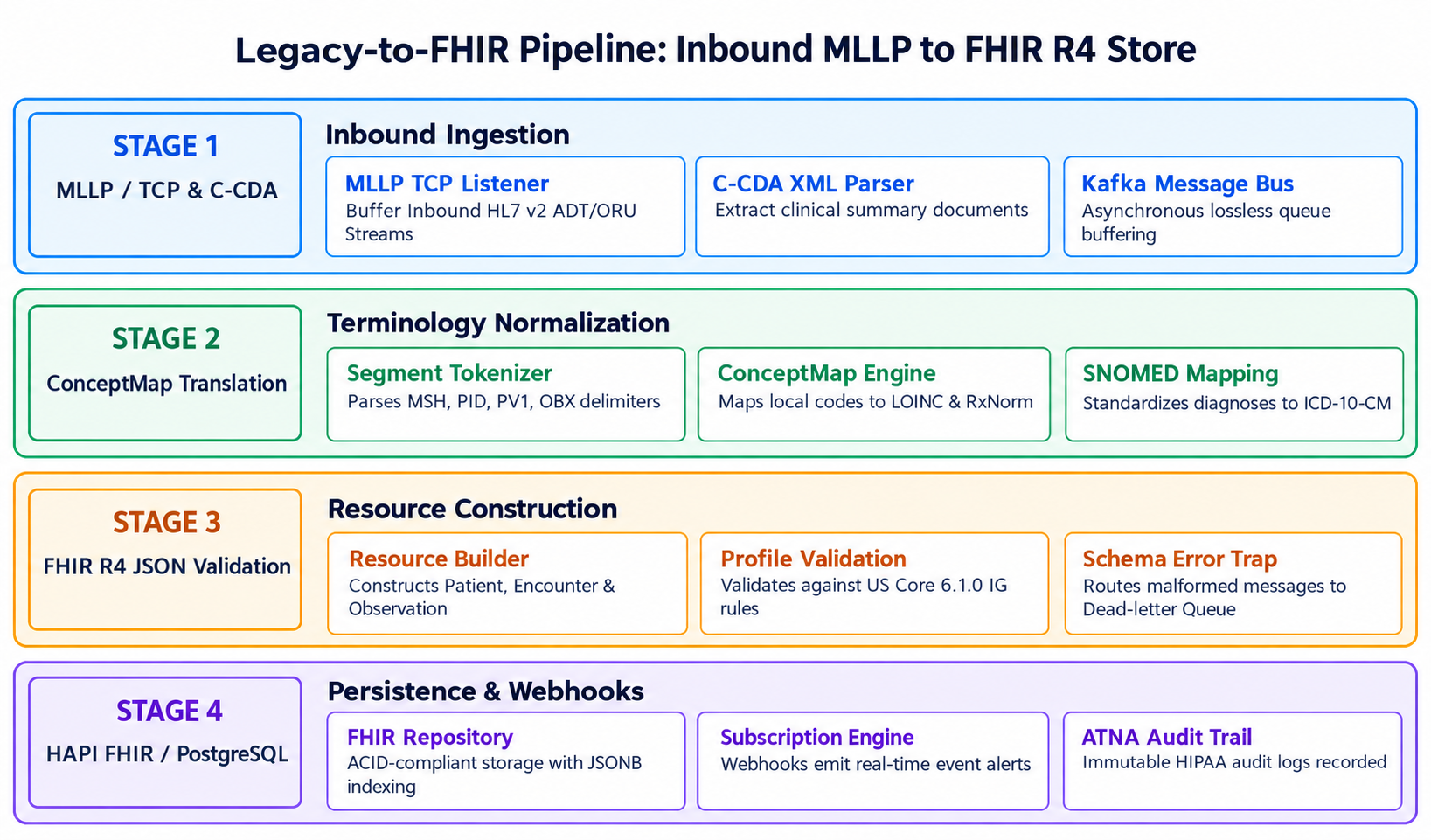
Key Steps in an HL7 to FHIR Integration Pipeline
Inbound Listener and Message Queuing: MLLP-based listeners can receive HL7 v2 messages and publish them to an asynchronous message-processing layer such as Apache Kafka.
Segment Tokenization and Terminology Normalization: Transformation services parse relevant HL7 segments and map local codes to standardized terminologies such as LOINC, SNOMED CT, and RxNorm where appropriate.
FHIR Resource Building and Validation: The pipeline converts relevant clinical information into FHIR resources and validates the resulting payloads against applicable implementation guides and profiles.
Persistence and Distribution: Validated resources can be stored in a FHIR repository and distributed to downstream applications through APIs, events, or other supported integration mechanisms.
FHIR Integration Architecture: Build, Buy, or Direct EHR APIs
When implementing a FHIR integration strategy, healthcare technology leaders can evaluate several delivery models based on interoperability requirements, internal engineering capabilities, implementation timelines, governance, and long-term ownership.
FHIR Integration Architecture Comparison
Architectural Approach | Custom FHIR Integration Gateway | Commercial Healthcare Integration Platform | Direct EHR Vendor APIs |
|---|---|---|---|
Multi-EHR Interoperability | Can normalize data from multiple EHR environments into a common integration layer. | May provide pre-built transformation and integration channels for supported healthcare workflows. | Typically requires separate implementation work for each EHR vendor and API environment. |
Throughput and Latency | Can be optimized using asynchronous processing, caching, and scalable infrastructure. | Depends on platform architecture, tenant configuration, and available throughput. | Depends on vendor API performance, rate limits, quotas, and implementation constraints. |
Licensing and Ongoing Costs | Infrastructure and engineering costs are primarily controlled by the organization. | Usually involves platform licensing and potentially transaction- or usage-based charges. | Costs and program requirements vary by EHR vendor and integration arrangement. |
IP Ownership and Control | Organizations can retain control over custom integration code and infrastructure when contracts are structured accordingly. | Some integration logic may remain dependent on the platform provider. | Capabilities are constrained by the APIs, scopes, and access models exposed by each EHR vendor. |
Ready to Build Reliable EHR Integrations?
FHIR Integration Security and USCDI Compliance
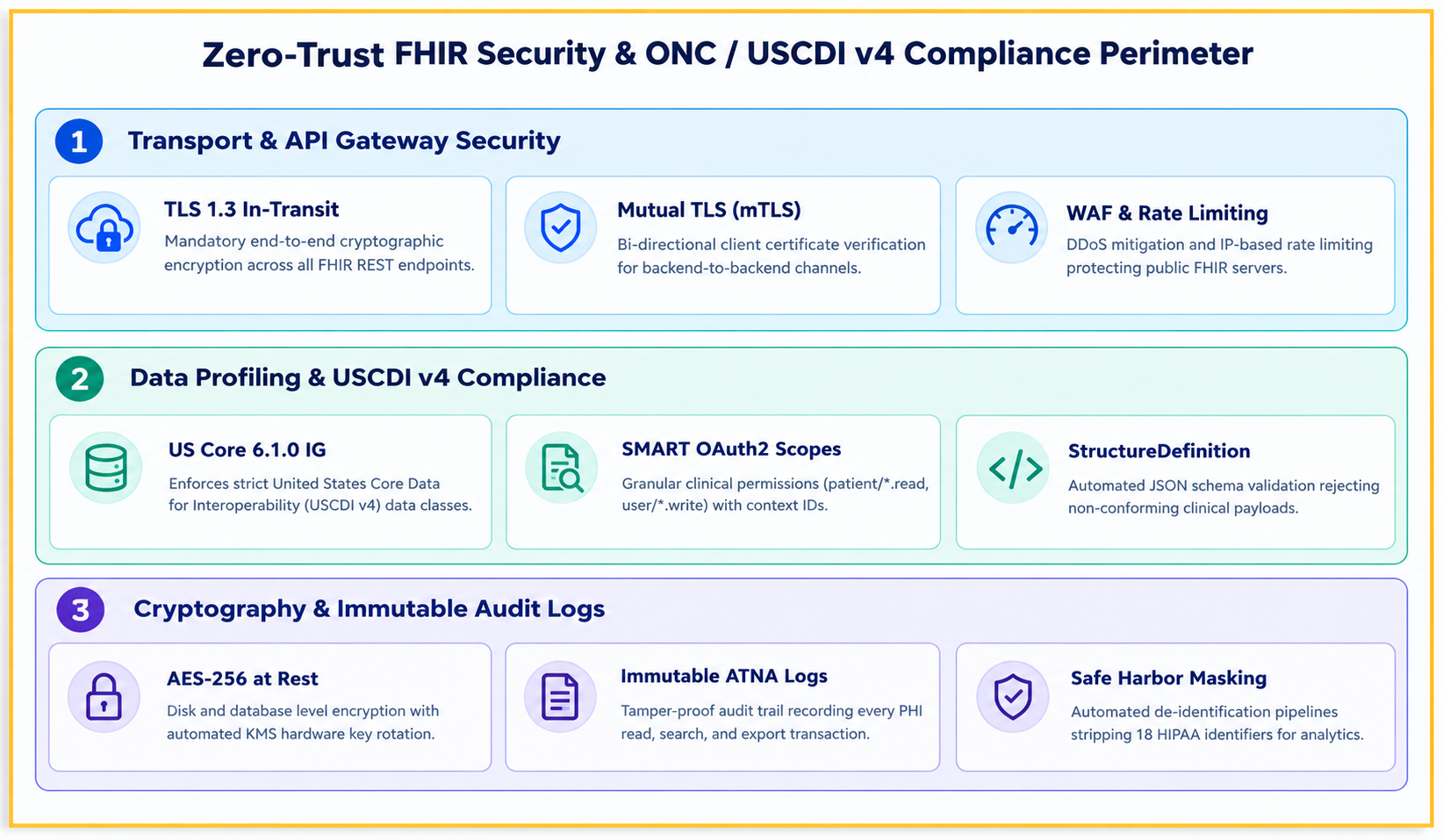
FHIR APIs should be implemented within a broader security architecture that considers HIPAA Security Rule requirements, applicable ONC interoperability requirements, organizational policies, and the specific data being exchanged.
Transport Security: Use current secure transport configurations such as TLS for public APIs and consider stronger controls such as mutual TLS for appropriate server-to-server integration scenarios.
FHIR Profile Validation: Validate resources against the applicable implementation guides and profiles for the target interoperability use case.
Access Controls: Apply least-privilege authorization, role-based access controls, appropriate SMART scopes, and identity-management controls.
Audit Logging: Maintain appropriate audit records for access to protected health information and other sensitive clinical data. Where applicable, healthcare organizations can use standards such as IHE ATNA as part of their audit architecture.
FHIR Integration Case Studies and Healthcare Engineering Examples
A strong healthcare software engineering partner should demonstrate practical experience across healthcare applications, interoperability, automation, connected health, and data governance. These examples reflect different areas of healthcare engineering that can support FHIR integration and broader digital health initiatives.
Digital Healthcare and Patient Engagement Platform: Developed healthcare applications with secure architectures, interoperability capabilities, appointment workflows, vitals tracking, and secure doctor-patient communication.
SaaS-Based Clinical Staffing and Credentialing Solution: Built a healthcare workforce platform supporting credential verification, licensing information, scheduling, and operational workflows.
AI-Powered Health and Diagnostic Applications: Applied structured healthcare data to AI-enabled workflows, including vital-sign analysis, anomaly detection, and clinical decision-support use cases.
Fitness Tracker and Remote Patient Monitoring App: Developed connected health capabilities for collecting wearable and Bluetooth device data and synchronizing relevant health information with cloud-based platforms.
Healthcare Record Governance and Compliance: Implemented healthcare data workflows involving audit trails, role-based access control, validation, and governance mechanisms to support secure data operations.
Ready to Build Reliable EHR Integrations?
Key FHIR Integration Best Practices and Takeaways
Use FHIR as a Clinical Data Abstraction Layer Where Appropriate: A normalized FHIR layer can help reduce dependency on individual EHR data formats and provide a consistent interface for downstream applications.
Implement SMART on FHIR for Context-Aware Authorization: Use OAuth-based authorization and granular scopes instead of relying on shared database credentials or unrestricted access.
Buffer HL7 Streams with Asynchronous Message Queues: Message queues such as Apache Kafka can help decouple legacy HL7 ingestion from downstream transformation and processing services.
Validate Against Applicable FHIR Profiles: Define the implementation guides and profiles required for your specific interoperability use case and validate resources accordingly.
Work With Experienced Healthcare Software Engineers: Building scalable FHIR integrations requires knowledge of healthcare interoperability, distributed systems, security, clinical workflows, and EHR-specific integration constraints.
Conclusion
FHIR integration for EHR systems requires more than connecting a REST API to a healthcare application. Successful implementations need to account for FHIR resource modeling, EHR-specific APIs, SMART on FHIR authorization, legacy HL7 interoperability, terminology mapping, security controls, validation, monitoring, and clinical workflow requirements.
A well-designed FHIR architecture can provide a consistent interoperability layer between EHR systems and modern healthcare applications while supporting future requirements for digital health, AI, remote monitoring, analytics, and patient engagement.
At Zignuts, we help healthcare organizations and digital health companies build, integrate, and modernize healthcare software with a focus on interoperability, secure architecture, EHR integration, AI, automation, and practical clinical workflows. Contact us today to discuss your FHIR integration requirements and explore a secure, scalable approach for your healthcare technology project.

Swati Bais
Business Enthusiast | Curious about how businesses evolve, connecting ideas with insights to discover opportunities and shape better ways of working.