The first question we hear after “should we build or buy?” is almost always, “So what will this cost, and when can we launch?”
It is a fair question, and a frustrating one to answer. Ask five vendors, and you will get five numbers that are hard to compare. That is rarely because anyone is being evasive. It is because the phrase “Islamic banking software” can describe anything from a single Murabaha financing app to a complete core banking platform with investment pool accounting.
This guide gives you the framework we use with leadership teams to get from a vague ambition to a defensible budget and timeline.
What Determines Islamic Banking Software Development Cost and Timeline?
Cost and timeline for Islamic banking software depend on three things that vary enormously between institutions:
What you are building or buying (one product, a product layer, digital channels, or a full core)
How complex your Shariah requirements are (standard contracts or structured, hybrid products)
What you already have (a modern ledger you can build on, or a legacy system you must work around)
Two banks can both say “we need Islamic banking software” and be 10x apart in scope. So rather than quote a headline figure, let’s look at what moves the needle.
Ready to Plan Your Islamic Banking Software Project?

Key Factors That Affect Islamic Banking Software Development Cost
Product Complexity
A single-product launch, such as Murabaha-based personal or auto financing, is a very different project from a full retail and SME suite covering Ijara, Diminishing Musharakah, Wakala deposits, and Mudarabah-based investment accounts.
Every additional contract adds its own lifecycle, ownership-transfer logic, accounting treatment, and edge cases: early settlement, restructuring, default handling, rebates, and late-payment amounts that go to charity rather than income. Those edge cases consume more time than the happy path, and they are where Shariah boards ask the hardest questions.
Scope: Product Layer, Digital Channels, or Full Core
This is the biggest cost lever by far.
A product layer (contract modeling, profit calculation, Shariah rule configuration) on top of an existing ledger is the leanest route.
Digital channels (mobile app, onboarding, customer portal) add design, security, and integration work.
A full core means building a general ledger, accounts, payments, and regulatory reporting. It is a different order of magnitude, and it is rarely the right call for a single institution.
Shariah Governance and Auditability
Versioned product rules, approval workflows, override trails, and the ability to explain any transaction to a Shariah auditor all take deliberate design effort. They are cheaper to build in from the start than to retrofit after your first review.
Integrations and Data Migration
Credit bureaus, KYC and AML tools, payment rails, your existing core, document management, and reporting stacks all need connections. Migrating existing Islamic accounts and contracts (with their ownership and profit history intact) is often the most underestimated line item in the plan.
Regulatory and Jurisdictional Requirements
Requirements differ across central banks and jurisdictions. Standards from AAOIFI and IFSB guidance, local Shariah governance frameworks, and licensing conditions all shape what the system must evidence. Operating in more than one market multiplies the configuration and testing effort.
Ready to Plan Your Islamic Banking Software Project?
Islamic Banking Software Development Cost by Project Type
Treat the following as planning ranges, not quotes. Real figures depend on the factors above, your team’s capacity, and the delivery model you choose.
Scenario | What it typically includes | Indicative budget (USD) | Indicative timeline |
|---|---|---|---|
Focused MVP | One or two Islamic financing products, basic customer app, integration with an existing ledger | $8K to $250K | 4 to 7 months |
Islamic product layer + digital channels | Multi-contract product factory, profit and pool logic, Shariah rule configuration, mobile and web channels, audit trails | $30K to $900K | 8 to 14 months |
Packaged Islamic core (buy) | Vendor licenses, implementation, integration, migration, training; scales with institution size | $100k to $5M+ over the first three years | 12 to 24 months |
Custom Islamic core (build) | Ledger, accounts, product factory, reporting, payments, full compliance layer | $1M+, often well above $5M | 24 to 48 months |
A few honest notes on this table. Ranges overlap because institutions differ. Packaged platforms look cheaper at signature and often cost more by year three once customization and per-module fees arrive. And building a full core is only justified in rare cases.
Islamic Banking Software Development Timeline: Phase by Phase
Timelines fail when teams compress the early phases to “get to coding faster.” In Islamic finance, the early phases are what determine whether you rework later.
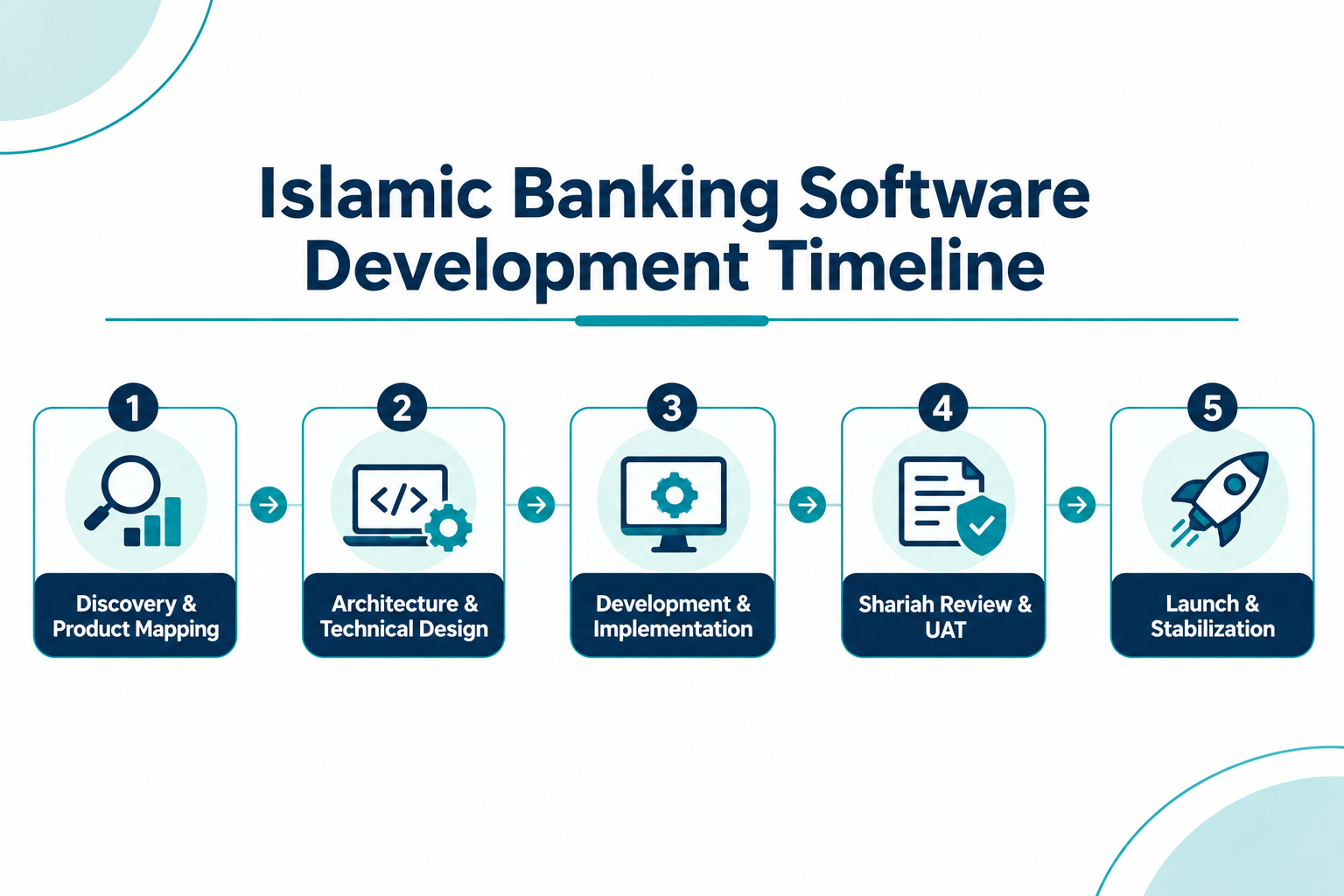
Discovery and Islamic Finance Product Mapping
Map each product’s contract structure, ownership timing, permitted and prohibited treatments, and accounting. Align engineers, product owners, and Shariah advisors on one shared model. This phase feels slow and saves the most time overall.
Software Architecture and Technical Design
Define the API-first architecture, data model, integration approach, and how Shariah rules will be configured, versioned, and audited. Decide what you buy, what you build, and what you adopt.
Development and Iterative Implementation
Deliver in increments, one product at a time. Ship the product engine first, then channels, then reporting. Demonstrate working behavior to your Shariah Supervisory Board early and often rather than at the end.
Shariah Review, User Acceptance Testing, and Certification
This is separate from ordinary testing. The Shariah board reviews contract flows, edge cases, and documentation. Regulators may need to see evidence. Budget calendar time for rounds of feedback, because they are almost never zero.
Software Launch and Post-Deployment Stabilization
Pilot with a limited customer group or branch, monitor profit calculations and accounting postings closely, and fix what real usage reveals.
Common Causes of Islamic Banking Software Development Delays
Shariah board feedback arrives late, forcing redesign
Product definitions change mid-build
Legacy system integration proves harder than expected
Data migration is scoped last instead of first
Key decision makers are unavailable for approvals
Most of these are governance problems, not engineering problems, which is why they are fixable with planning.
Ready to Plan Your Islamic Banking Software Project?
Hidden Costs of Islamic Banking Software Development
When we help leadership teams build a total cost of ownership view, these are the items that most often go missing:
Internal team time. Product owners, Shariah advisors, compliance, finance, and operations all need to give real hours.
Shariah advisory and audit. Ongoing review of new products and changes.
Customization and change requests. Every packaged system has a gap between demo and reality.
Per-module and per-volume licensing. Pricing that grows with accounts, transactions, or modules.
Infrastructure and security. Cloud, monitoring, penetration testing, and certifications.
Training and change management. Branch staff and operations teams need to understand how the products actually work.
Maintenance and evolution. Plan for roughly 15 to 25 percent of build cost annually for support, enhancements, and regulatory updates.
If a proposal does not mention most of these, ask why.
Islamic Banking Software Cost Comparison: Buy vs. Build vs. Hybrid
The cost curves look different depending on your path:
Buy: Lower upfront effort, but recurring license and customization costs rise over time, and lock-in limits your negotiating position.
Build: Higher upfront investment and longer timeline, but you own the asset, and ongoing costs are mostly engineering capacity.
Hybrid: Proven core underneath, custom Islamic product layer and digital experience on top. This usually gives the best balance of speed and control, and it limits the share of the budget spent on undifferentiated plumbing.
If you have not read our companion piece on this decision, our guide on build vs buy for Islamic banking software walks through the strategic side.
How to Reduce Islamic Banking Software Development Costs
Some savings are real. Others just move cost into the future.
Real savings:
Launch with a narrow product set and expand in phases
Reuse a proven ledger or core rather than building one
Standardize on well-understood contracts before attempting novel structures
Invest in discovery, so rework is minimal
Use configurable product rules so changes do not need code releases
False savings:
Skipping Shariah involvement until late in the project
Hard-coding rules to ship faster
Treating audit trails as a later phase
Under-scoping data migration
Choosing the cheapest estimate without checking domain experience
Ready to Plan Your Islamic Banking Software Project?
Lessons from Estimating Islamic Finance Software Projects
At Zignuts, we build software for financial institutions and fintechs, and a few patterns repeat in every scoping conversation.
The estimate improves dramatically after a short discovery. Most uncertainty in cost and timeline comes from unmapped products and unknown integrations. A few weeks of structured product mapping typically narrows the range far more than another round of vendor proposals.
Phase the work around products, not technology layers. Delivering one complete, Shariah-reviewed product end to end teaches the team more than building every layer for every product in parallel. It also gives leadership something real to evaluate early.
Put Shariah review on the project plan, with dates. Teams that treat it as an informal step get surprised. Teams that schedule it like any other dependency launch on time.
Be wary of any number given before anyone asks about your products. A reliable estimate starts with questions about contracts, volumes, integrations, and governance. If someone quotes a price on the first call, treat it as a guess.
Plan for year two. The launch is not the end of the budget. New products, new fatwa interpretations, and regulatory updates arrive on their own schedule.
Conclusion: Planning Your Islamic Banking Software Budget and Timeline
The cost of Islamic banking software can range from a low six-figure MVP to a multi-million-dollar core program, depending on product scope, Shariah governance, technical complexity, and existing systems. Implementation can take anywhere from a few months to several years.
A clear understanding of your requirements, phased planning, and a realistic five-year budget can help you make informed build-or-buy decisions. Contact us today to discuss your Islamic banking software requirements and plan a realistic budget and timeline.

Parth Trivedi
Co-founder and CTO of a global software agency, I lead innovative IT solutions across industries, focusing on scalable architectures and agile methodologies. Let’s connect to scale your digital initiatives!