


Nobody launches an AI agent with a press conference anymore. It just starts approving invoices, flagging a suspicious transfer at 2 a.m., or quietly re-routing a purchase order before a human even opens their inbox. No chatbot window, no “how can I help you today?” It just does the job.
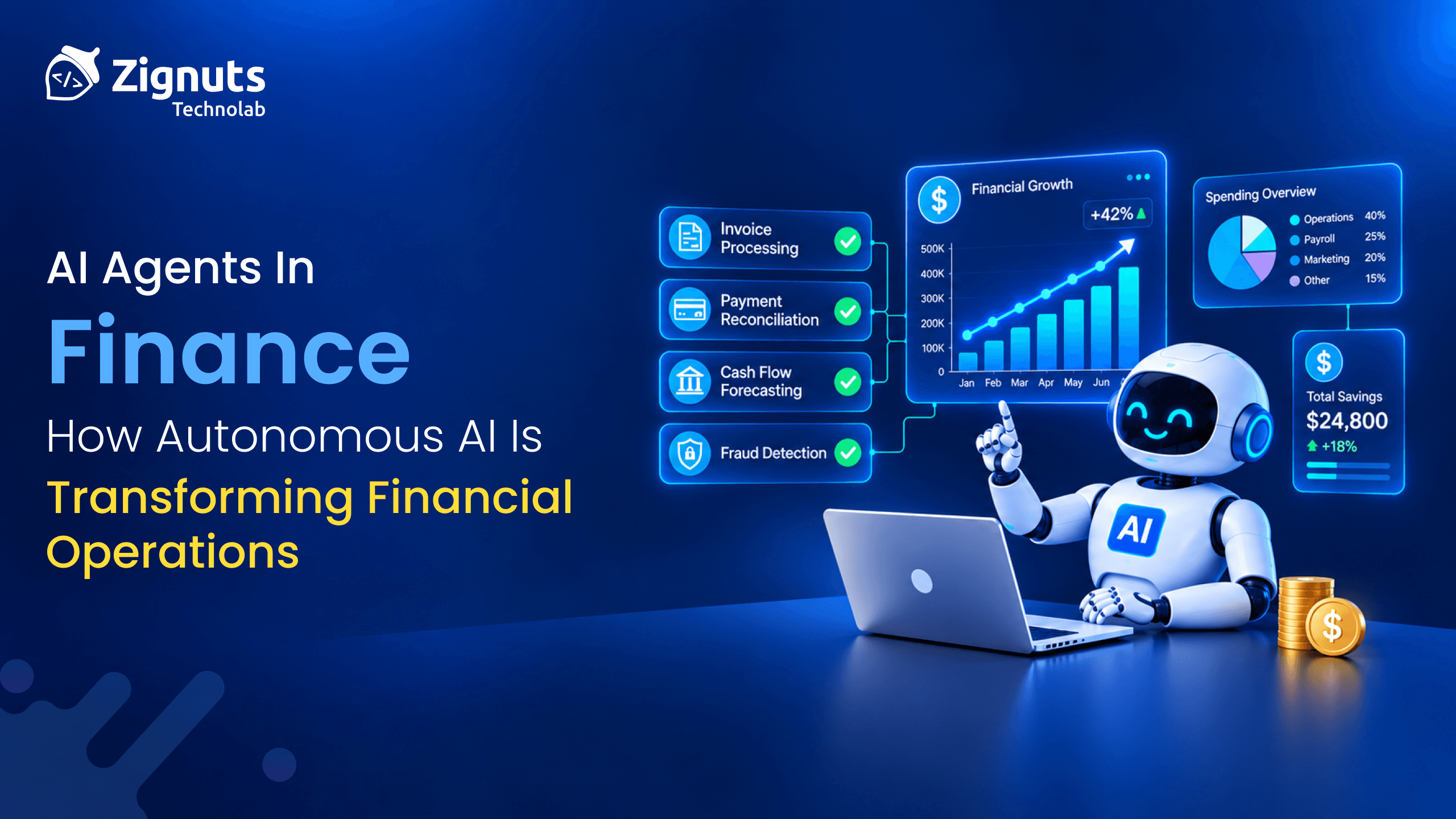
That is the real story behind the growing adoption of AI Agents in Finance. The focus is moving beyond chatbots and copilots that wait for a user to type a question. Autonomous AI systems can plan, make decisions, and take actions inside real financial workflows, connecting data, business rules, enterprise systems, and human oversight.
Here is the part that matters for finance leaders: these agents are increasingly being applied to high-volume, rules-driven activities such as fraud monitoring, invoice matching, spend classification, procurement, reconciliation, and financial administration. These workflows provide practical opportunities to introduce automation while keeping appropriate controls around sensitive financial decisions.
AI Agents in Finance for High-Volume Financial Operations
Financial operations contain many repetitive activities that require large amounts of data to be reviewed, classified, matched, or routed. Fraud monitoring, invoice processing, reconciliation, procurement administration, and transaction review are examples where AI agents can support teams by handling defined workflow steps.
The opportunity is not simply about completing tasks faster. AI agents can connect several steps within a workflow, retrieve relevant information, evaluate it against business rules or policies, and take an approved action.
This creates a different model of financial automation. Instead of a system simply identifying an issue and waiting for someone to determine the next step, an AI agent can help coordinate the process from detection through resolution or escalation.
AI Agents in Finance for Real-Time Fraud Detection
Picture a bank's fraud desk working through a continuous queue of flagged transactions. Analysts need to review transaction signals, customer behaviour, account information, and other relevant data before determining whether activity requires further investigation.
AI agents can support this workflow by analysing transaction-level signals and coordinating predefined responses. Depending on the architecture and permissions, an agent can help hold a transaction, trigger additional verification, gather supporting information, or escalate an ambiguous case to a fraud analyst.
The important distinction is autonomy within defined boundaries. Rather than allowing an AI system to make unrestricted financial decisions, organisations can establish explicit rules for which actions an agent can perform and when human review is required.
Ready to Build Smarter Financial Solutions?

AI Agents in Finance for Procurement Automation
If fraud detection provides a real-time example, procurement shows how AI agents can support high-volume enterprise operations.
Procurement involves purchase requests, supplier information, approvals, purchase orders, invoices, spend classifications, and supplier monitoring. Many of these activities follow repeatable workflows that can be connected through enterprise systems.
AI agents can assist with activities such as classifying spend, routing purchase requests, monitoring supplier information, preparing sourcing documentation, and identifying transactions that require additional review.
The broader opportunity is to connect these activities into a coordinated workflow rather than automating each task separately.
AI Agents for Autonomous Procurement Workflows
An AI agent supporting procurement can retrieve information from approved enterprise systems, evaluate a request against defined policies, prepare the appropriate workflow action, and route exceptions to an authorised employee.
For example, a standard purchase request may move through classification, policy validation, supplier checks, approval routing, and purchase-order creation. More complex requests can be escalated when the agent encounters missing information, policy exceptions, or other conditions outside its defined operating boundaries.
This model allows organisations to automate routine procurement activities while maintaining human involvement where business judgement is required.
AI Agents in Finance vs. Traditional AI Automation
Traditional automation generally follows predefined instructions. It performs a known sequence of actions when specific conditions are met.
Agentic AI introduces another layer of capability. An AI agent can interpret information, determine the next step within defined boundaries, use connected tools, and maintain workflow context while completing a task.
In financial environments, this can support workflows that involve multiple systems and changing information.
The architecture still needs clear controls. Agents should operate within defined permissions, approved data sources, workflow boundaries, and escalation paths.
This makes the engineering challenge less about simply adding an AI model and more about designing a reliable system around that model.
AI Agents in Finance for Financial Decision-Making
AI agents are increasingly relevant when financial workflows involve multiple sources of information and several operational steps.
From AI Recommendations to Financial Actions
AI systems have traditionally been used to generate predictions, classifications, summaries, or recommendations. AI agents can take the next step by connecting these outputs to approved workflow actions.
For example, an agent may review financial information, prepare a recommendation, update a workflow record, request additional information, or route a case to an authorised reviewer.
The action should always be governed by the business requirements of the workflow.
Integrating AI Agents With Existing Financial Systems
Financial organisations rarely operate from a single system. Banking applications, ERP platforms, payment systems, procurement tools, financial databases, customer platforms, and internal APIs often work together.
AI agents can be integrated with these environments through secure APIs and controlled tool interfaces. This allows agents to retrieve relevant information and perform approved actions without requiring every financial system to be replaced.
Human Oversight in AI Agent Workflows
Human involvement remains important for sensitive and high-impact financial processes.
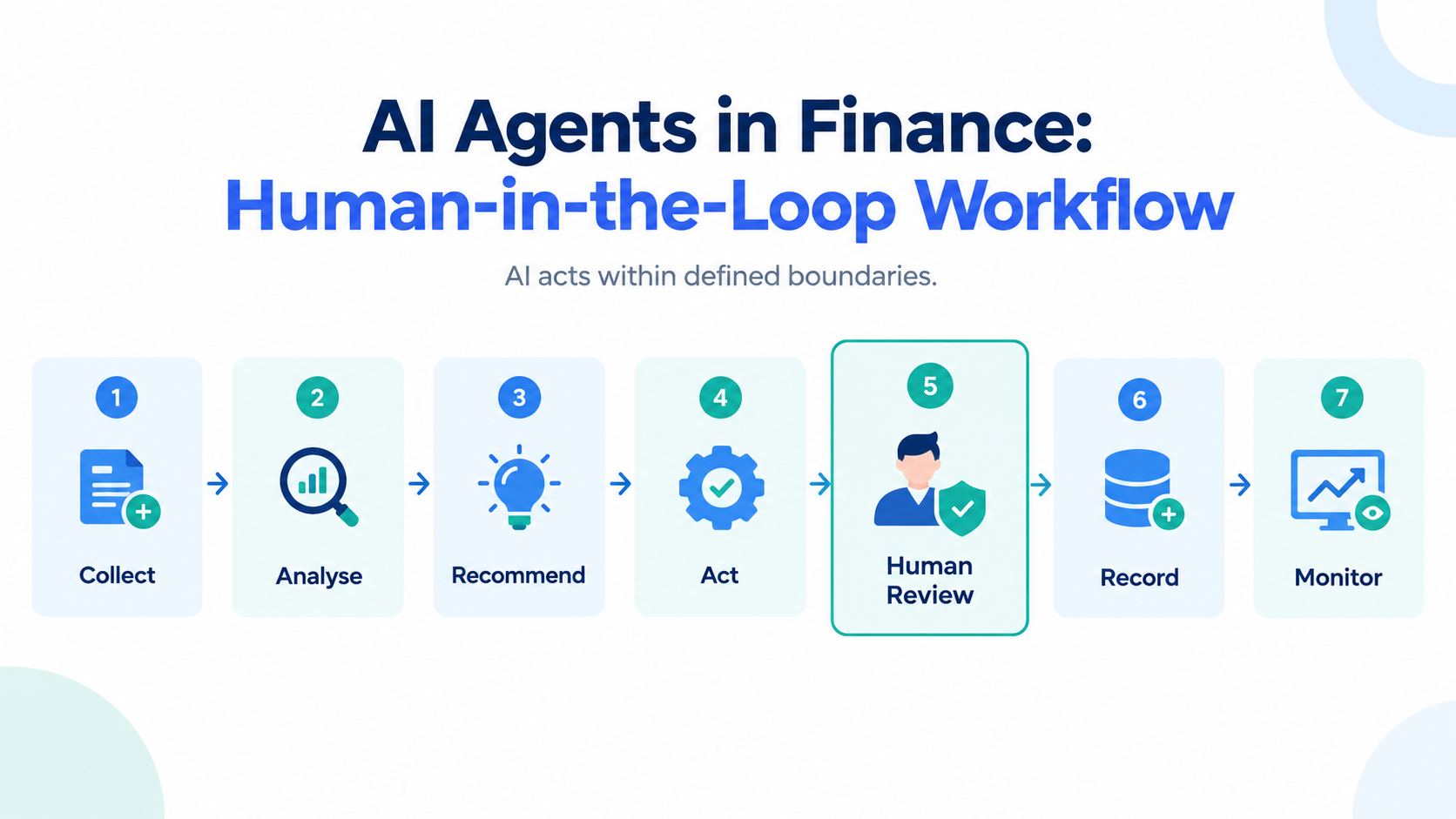
A governed workflow can allow an AI agent to handle routine activities while routing uncertain or sensitive cases to authorised employees.
A practical workflow can include:
Collect: Retrieve relevant financial and operational information.
Analyse: Evaluate the information using AI models and business rules.
Recommend: Determine the appropriate next step.
Act: Execute an approved workflow action.
Escalate: Send exceptions or sensitive cases to a human reviewer.
Record: Maintain an audit trail of relevant actions.
Monitor: Evaluate workflow outcomes and system performance.
Ready to Build Smarter Financial Solutions?
The Future of AI Agents in Finance
The impact of AI agents in finance is not limited to replacing individual tasks. The larger opportunity is to redesign how financial work is organised.
Routine activities such as transaction monitoring, invoice processing, reconciliation, classification, document preparation, and procurement administration can increasingly be supported by automated workflows.
This allows finance professionals to spend more time on exceptions, business decisions, relationships, risk management, and activities that require contextual judgement.
The organisations adopting these systems will need to think beyond individual automation projects. The broader opportunity is to combine AI agents, business rules, enterprise systems, financial data, and human oversight into connected workflows.
What to Consider Before Deploying AI Agents in Finance
Deploying AI agents in financial environments requires more than selecting an AI model. Organisations need to define where agents can operate, what information they can access, which actions they can perform, and when human approval is required.
Key considerations include:
Data access: Define which financial and customer information an agent can retrieve.
System permissions: Limit agents to authorised actions within connected systems.
Workflow boundaries: Clearly define what an agent can and cannot execute independently.
Human approval: Introduce review points for sensitive or high-impact activities.
Auditability: Record relevant agent actions, decisions, and workflow outcomes.
Monitoring: Track errors, unusual behaviour, latency, and workflow performance.
Security: Protect financial information across APIs, applications, models, and infrastructure.
Exception handling: Create clear paths for cases that fall outside defined rules.
These controls help organisations introduce AI agents into financial workflows while maintaining visibility, accountability, and operational control.
Building Enterprise AI Agents for Financial Operations
Enterprise AI agents need to operate reliably across complex financial environments. This means connecting AI capabilities with business processes, enterprise applications, financial data, and governance controls.
AI Agent Orchestration
An orchestration layer coordinates agent tasks, workflow states, tool calls, and interactions with connected systems.
This layer helps maintain context between different stages of a workflow and provides clear boundaries for agent actions.
Financial Data and Retrieval
AI agents can retrieve relevant information from approved financial databases, documents, policies, transaction records, and enterprise applications.
Retrieval mechanisms help ensure that agents work with relevant business information rather than relying only on general model knowledge.
Secure Tool Integration
APIs and controlled tools allow agents to interact with financial systems while enforcing authentication, authorisation, and defined action boundaries.
Each tool should expose only the capabilities required for the workflow.
Guardrails and Approval Controls
Business rules, validation mechanisms, spending limits, and human approval workflows can help control autonomous actions.
These controls allow organisations to determine which activities can be automated and which require additional review.
Observability and Evaluation
Monitoring and evaluation help teams understand agent behaviour, workflow outcomes, errors, and operational performance after deployment.
Continuous evaluation can also help identify areas where workflows, prompts, tools, or controls need refinement.
Ready to Build Smarter Financial Solutions?
Measuring the Impact of AI Agents in Finance
The value of financial AI agents should be evaluated through measurable operational outcomes rather than AI activity alone.
Relevant measures can include:
Processing time for financial workflows
Number of manual tasks completed automatically
Exception handling time
Fraud investigation workload
Invoice and reconciliation processing time
Human review requirements
Workflow accuracy
Agent error rates
Cost per completed workflow
User adoption and correction rates
These measurements help finance and technology teams understand where AI agents are creating operational value and where additional controls, workflow changes, or human involvement may be required.
Our AI Agent Development Approach for Financial Workflows
Building AI agents for finance requires a combination of AI engineering, enterprise integration, security, and workflow design.
At Zignuts, we focus on understanding the financial process first and then identifying where autonomous capabilities can provide practical value.
Our approach can include:
Financial workflow discovery and process mapping
AI agent architecture and orchestration
Banking, ERP, payment, and API integrations
Retrieval and financial data connectivity
Role-based permissions and action controls
Human-in-the-loop approval workflows
Monitoring, evaluation, and auditability
Phased deployment and production validation
This approach helps organisations introduce AI agents into existing financial operations while keeping the architecture aligned with business requirements, security considerations, and operational controls.
Conclusion
AI agents are changing how financial organisations approach routine, high-volume operations. Fraud monitoring, invoice processing, procurement, reconciliation, and financial administration provide practical areas where autonomous capabilities can support measurable workflow improvements.
The next stage is not simply about automating more tasks. It is about connecting AI agents with financial systems, business processes, data, and human oversight so they can perform useful work within clearly defined boundaries.
Organisations that approach AI agent adoption as an engineering and workflow-design initiative can build systems that support automation while maintaining appropriate visibility, security, and control.
If your organisation is exploring AI agents for fraud detection, procurement, financial operations, underwriting, or enterprise automation, contact us today to discuss your requirements and explore a practical approach to building AI-powered financial workflows.
Suruchi Shrivastava
Technology Enthusiast | Exploring emerging technologies, innovative ideas, and digital possibilities that inspire smarter solutions and meaningful experiences.