


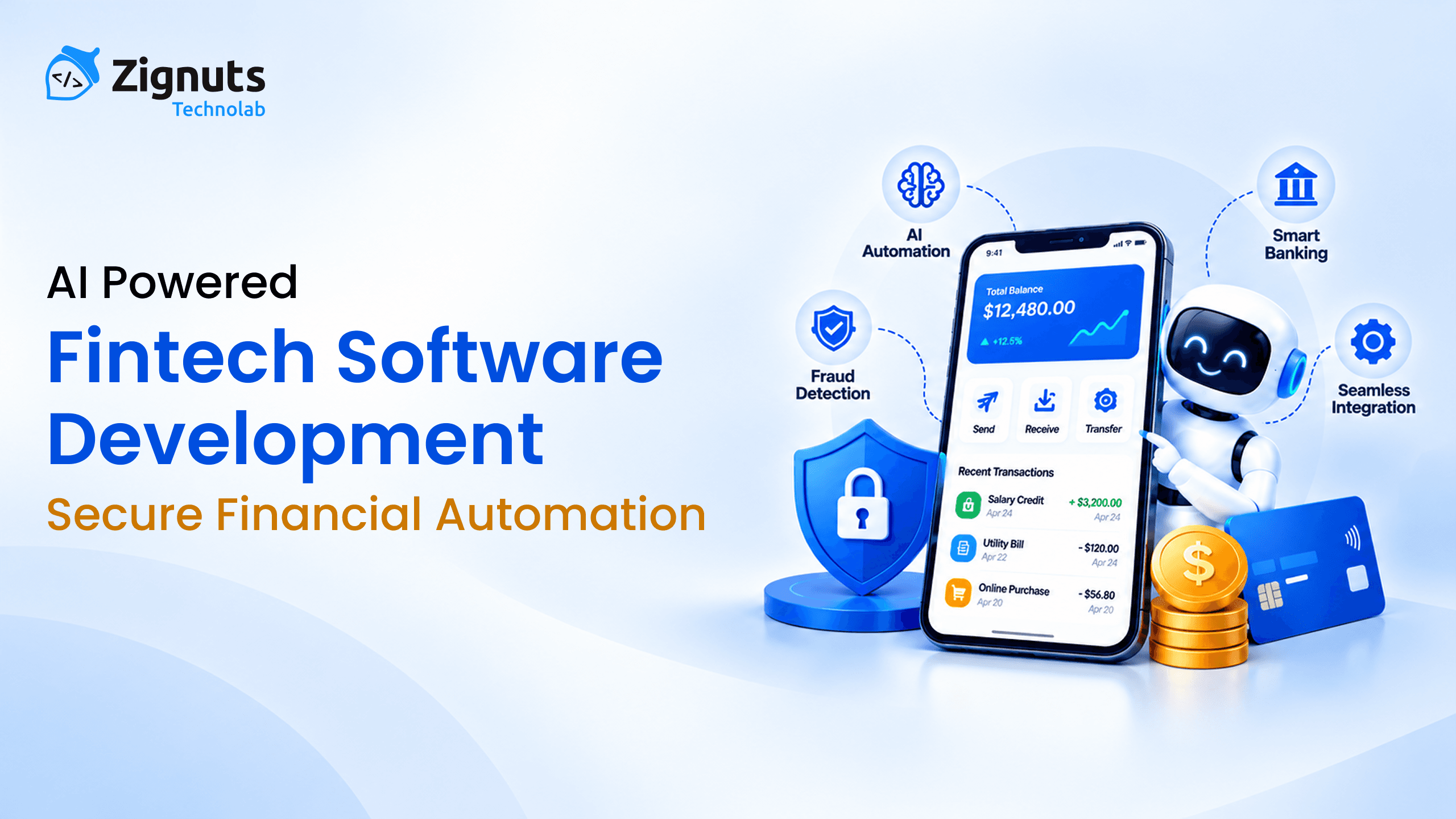
From AI-driven underwriting to real-time fraud detection and enterprise AI automation, modern financial products require more than individual AI features. They need secure, connected systems that bring financial data, intelligent decision-making, compliance, and automation together.
Fintech Software Development helps businesses create financial platforms where security, accuracy, compliance, and operational efficiency are built into the engineering process from the beginning.
PCI-DSS & SOC 2 Ready | KYC / AML Built-In | Human-in-the-Loop AI | Open Banking & Core Integrations |
Fintech software should make complex financial workflows easier to manage while maintaining appropriate controls around sensitive data, transactions, and AI-assisted decisions. Our approach focuses on building secure, scalable systems that support real financial operations and evolving business requirements.
Metric | Value |
|---|---|
Faster underwriting decisions | 3× |
Reduction in false-positive fraud flags | 45% |
Auditable financial transactions | 100% |
Global delivery hubs | 3 |
Ready to Build a More Scalable Fintech Solution?

Why Fintech Software Development Matters for Financial Businesses
Financial teams manage multiple systems across banking, payments, identity verification, fraud monitoring, compliance, and procurement. Connecting these systems effectively is essential for creating a consistent view of financial operations.
An underwriter may need information from several sources before evaluating an application. A compliance officer may review transaction information across multiple systems. Finance teams may also need a unified view of exposure, approvals, payments, and operational activity.
AI can support these workflows by helping teams analyse financial information, identify patterns, automate repetitive processes, and provide decision-support insights. However, these capabilities need to operate within secure and governed software architectures.
Modern financial organisations therefore need connected systems that bring together core banking data, AI-driven risk assessment, fraud detection, financial automation, and compliance workflows while maintaining appropriate security and auditability.
The objective is not simply to add AI features. It is to create reliable financial software where AI-assisted capabilities work alongside established financial processes and human decision-makers.
Building Fintech Software Around Real Financial Workflows
Successful fintech software starts with a clear understanding of the people, processes, systems, and data involved.
Our engineers and solution architects work with the people who understand these workflows, including underwriters, compliance officers, fraud analysts, procurement teams, finance leaders, and end customers.
The discovery process focuses on:
How financial and identity data moves through the organisation
Which users can access specific information
Where approvals are required
Which activities need audit trails
Which financial processes can benefit from automation
Where AI can provide decision-support capabilities
Which systems need to exchange data
What security and compliance requirements apply
This approach helps establish the technical foundation before development begins.
For fintech applications, security, compliance, and governance need to be considered alongside usability and performance. Designing these requirements together helps create software that can support both operational teams and customers.
Our Fintech Software Development Approach
1. Understanding Financial Workflows
We begin by mapping the financial workflows that the software needs to support. This includes users, data sources, business rules, approvals, integrations, and operational dependencies.
Understanding these relationships helps define the right application architecture and ensures that development decisions reflect actual financial processes.
2. Designing Security and Compliance Into Fintech Software
Security is incorporated into the architecture from the beginning. Depending on the project, this can include role-based access control, encryption, consent management, audit logging, secure APIs, and controlled data access.
Compliance requirements are considered alongside application architecture rather than treated as a separate activity at the end of development.
3. Connecting Financial Systems and Data
Modern fintech software often needs to connect multiple financial systems. APIs and integration layers can bring together information from core banking systems, payment services, Open Banking sources, card networks, and internal enterprise applications.
This creates a more connected financial data environment for applications, analysts, and operational teams.
4. Planning AI-Assisted Decision-Making
AI capabilities are designed around specific financial workflows. Depending on the use case, this can include underwriting support, fraud detection, financial reconciliation, compliance assistance, or enterprise workflow automation.
The goal is to ensure that AI outputs are relevant, explainable, and connected to the data and processes used by financial teams.
5. Creating Human-in-the-Loop Workflows
High-impact financial decisions can require human oversight. Human-in-the-loop workflows allow AI systems to provide recommendations while authorised users review, approve, modify, or reject those recommendations.
This approach provides a practical balance between automation and human control.
Ready to Build a More Scalable Fintech Solution?
Fintech Software Development Solutions We Build
We build connected, AI-assisted financial systems that bring together financial data, intelligent decision-making, automation, integrations, and governance.
AI-Powered Underwriting Solutions
AI-assisted underwriting can analyse relevant financial and behavioural information to support faster and more informed risk assessment.
The system can provide explainable recommendations and supporting information while keeping appropriate human review within the workflow.
Real-Time Fraud Detection in Fintech Software
Real-time fraud detection can analyse transaction-level signals and behavioural patterns to identify unusual activity.
Predictive models can evaluate multiple signals and provide risk scores that help fraud teams prioritise investigations.
AI-Powered Enterprise Financial Automation
AI-powered automation can support procurement, approvals, document workflows, financial operations, and other enterprise processes.
Controlled agent-based workflows can coordinate multiple steps while maintaining defined permissions, audit trails, and approval points.
AI-Powered Financial Reconciliation
AI-assisted reconciliation can help match financial records across different sources and identify potential discrepancies.
This can reduce repetitive manual work and help finance teams manage reconciliation workflows more efficiently.
AI Compliance Copilot for Financial Services
A compliance-focused AI assistant can help analysts prepare KYC and AML case notes, retrieve relevant information, summarise records, and support investigation workflows.
Human reviewers remain responsible for final decisions and approvals.
Consent and Audit Management in Fintech Software
Financial applications need visibility into how sensitive information is accessed and processed.
Consent management, access controls, audit logs, and traceability mechanisms can be incorporated into the platform architecture to support governance requirements.
Fintech Software Development Technology Stack
The technology stack should support application performance, financial data integrity, secure integrations, AI capabilities, and long-term maintainability.
Technology Area | Technology | Purpose |
|---|---|---|
Frontend | React & React Native | Responsive dashboards and financial experiences for customers and operational teams. |
Backend | Node.js & Python | High-throughput APIs and AI services with role-based access control. |
Data | PostgreSQL & ISO 20022 | Structured financial data and payment-message interoperability. |
AI Decisioning | Vector DB & RAG | Retrieval-augmented AI grounded in trusted financial and policy information. |
Cloud | AWS / PCI-DSS-eligible | Encrypted and auditable cloud infrastructure. |
Integrations | Core Banking, Open Banking APIs & Card Networks | Connected financial data and transaction workflows. |
Key Features of Fintech Software Development
Modern financial software can combine intelligent capabilities with secure application architecture to support different business and operational requirements.
Intelligent Financial Decision Support
AI can analyse relevant financial information and provide recommendations that help authorised users make informed decisions.
Real-Time Financial Data Processing
Streaming architectures and event-driven systems can process transaction and operational information with low latency.
Automated Financial Workflows
Financial processes such as reconciliation, approvals, case preparation, and document processing can be automated through controlled workflows.
AI-Powered Document Processing
AI and retrieval technologies can help extract, classify, summarise, and retrieve information from financial documents.
Secure User and Role Management
Role-based access controls help ensure that users can access only the financial information and capabilities appropriate to their responsibilities.
Auditability and Traceability
Application events, AI interactions, approvals, and financial activities can be logged to support operational visibility and audit requirements.
Ready to Build a More Scalable Fintech Solution?
Security and Compliance in Fintech Software Development
Security and compliance are fundamental components of financial software engineering.
A secure fintech architecture can incorporate multiple layers of protection across applications, APIs, data, infrastructure, and users.
Key considerations include:
PCI-DSS requirements
SOC 2 controls
KYC and AML workflows
Encryption of sensitive data
Role-based access control
API security
Consent management
Audit logging
Data governance
Secure cloud infrastructure
Controlled AI access
Human approval workflows
These controls help create financial software that supports secure data handling and accountable business processes.
AI Governance and Human-in-the-Loop Fintech Software
AI can significantly improve financial workflows when it operates within clearly defined controls.
Our approach keeps human oversight within high-impact processes while allowing AI to assist with analysis, recommendations, summarisation, and repetitive operational activities.
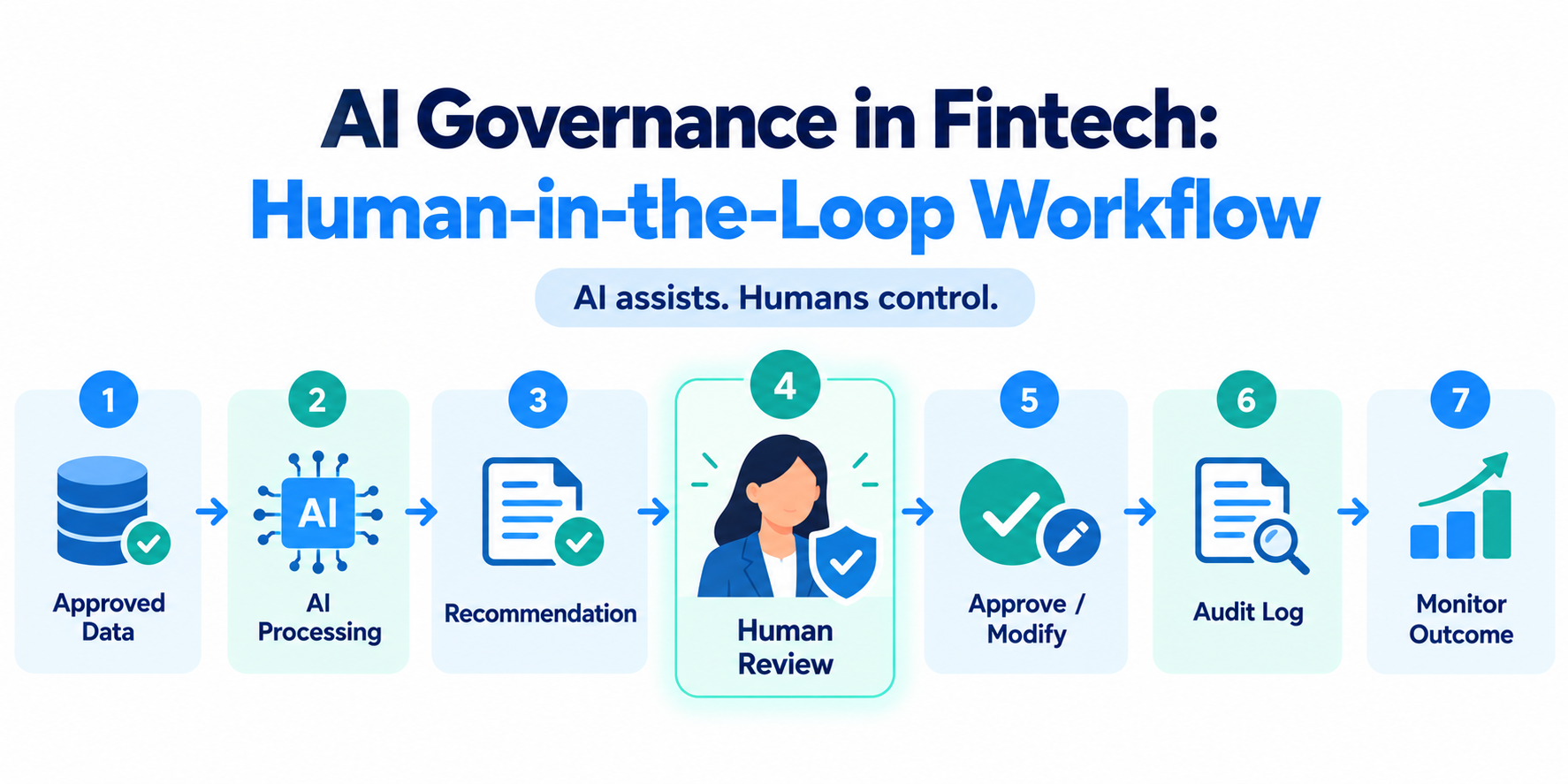
Data retrieval: Information is retrieved from approved sources.
AI processing: AI processes information based on defined business requirements.
Source-grounded recommendations: AI provides recommendations supported by relevant information.
Human review: Authorised users review the AI output.
Approval or modification: Users approve, modify, or reject the recommendation.
Audit logging: Relevant actions and decisions are recorded.
Outcome monitoring: Workflow performance and results are monitored.
This model helps organisations introduce AI automation while maintaining visibility and control over important financial workflows.
Fintech Software Integration With Existing Financial Systems
Many financial organisations already operate established banking, payment, identity, and enterprise systems.
Fintech Software Development can connect these environments through secure integration layers rather than requiring every system to be replaced.
Common integration areas include:
Core banking systems
Payment processors
Card networks
Financial data providers
Internal enterprise applications
Identity and verification services
Compliance systems
Customer-facing applications
A connected architecture can create a unified financial timeline while allowing existing systems to continue supporting their established responsibilities.
Ready to Build a More Scalable Fintech Solution?
Results of Our Fintech Software Development Approach
When financial data, AI decisioning, automation, and operational workflows are connected through a secure architecture, organisations can improve both efficiency and visibility.
Business Outcome | Impact |
|---|---|
Faster underwriting decisions | 3× |
Reduction in false-positive fraud flags | 45% |
Lower manual reconciliation effort | 35% |
Auditable financial transactions | 100% |
Better Financial Outcomes
Faster underwriting workflows and real-time fraud monitoring can help financial teams respond to relevant information more efficiently.
Lighter Compliance Workloads
AI-assisted case preparation and structured audit trails can reduce repetitive administrative activities and allow analysts to focus on review and decision-making.
Compliance by Design
Security controls, consent management, access controls, and audit capabilities can be incorporated into the application architecture from the beginning.
Connected Financial Operations
Core banking, payments, fraud signals, reconciliation, and enterprise workflows can be connected into a more consistent operational environment.
Why Choose Our Fintech Software Development Services
At Zignuts, we bring hands-on digital product engineering experience to complex fintech projects, helping businesses build secure, scalable, and AI-enabled financial software.
We combine product engineering, AI development, financial integrations, security, and phased delivery to create solutions that can adapt as business requirements evolve.
We start by understanding your financial workflows, users, data, and operational needs. From there, we select the right architecture, technologies, integrations, and AI capabilities for the project.
Our focus is on building fintech software that is secure, reliable, scalable, transparent, and practical for real-world financial operations, with responsible AI implementation built into the development process.
Conclusion
AI-powered fintech software development brings together financial data, intelligent decision-making, automation, security, compliance, and system integrations within a connected technology environment. By designing these capabilities around real financial workflows, organisations can support more efficient operations while maintaining appropriate human oversight and governance.
A well-structured fintech solution should align AI capabilities with business requirements, integrate securely with existing financial systems, and provide the controls needed for sensitive financial operations. Whether you are building a new fintech product, modernising an existing financial application, or adding AI-powered capabilities, contact us today to discuss your requirements and explore a practical development approach.
Suruchi Shrivastava
Technology Enthusiast | Exploring emerging technologies, innovative ideas, and digital possibilities that inspire smarter solutions and meaningful experiences.