Building a custom electronic health record system is a fundamentally different undertaking than building a typical healthcare application. Organizations that scope it like a standard software project can underestimate the complexity involved.
An EHR is not simply an application with a defined set of features. It serves as a system of record for patient care, expected to maintain accurate longitudinal clinical data, integrate with a broad healthcare ecosystem, support real-time clinical workflows, and meet demanding standards for security, compliance, availability, and reliability.
Most healthcare organizations evaluating a custom EHR build are doing so because an off-the-shelf platform does not fully support a specific clinical workflow, specialty documentation requirement, or integration need. While this can be a valid reason to build custom software, it also means the project inherits the complexity of a general EHR while solving the specific problem that made an existing platform insufficient.
This guide explains what EHR software development involves from an architectural perspective, where the highest-risk areas typically occur, and how organizations can evaluate the build, buy, or customize decision before committing to a long-term clinical infrastructure investment.
EHR Software Development: EHR vs. EMR and Other Clinical Systems
The terms EHR and EMR are often used interchangeably, but the distinction matters when defining project scope because each system can have different interoperability and workflow requirements.
EMR: Traditionally represents the digital version of a patient's medical chart within a specific practice or organization.
EHR: Designed to support a longitudinal patient record across care settings and facilitate information exchange between healthcare organizations.
Practice Management Software: Primarily supports scheduling, administration, billing, and related operational workflows.
Clinical Decision Support: Provides guidance, alerts, recommendations, or decision-support capabilities at the point of care and may operate alongside an EHR.
System | Primary Scope | Interoperability Expectation |
|---|---|---|
EMR | Digital patient chart within a single practice or organization | May be limited outside the organization |
EHR | Longitudinal patient record across care settings | Exchange with providers, systems, and healthcare networks is foundational |
Practice Management | Scheduling, administration, and billing | Integrates with clinical systems but is not the EHR itself |
Clinical Decision Support | Guidance, alerts, and recommendations at the point of care | Often operates on top of or alongside an EHR |
For the remainder of this guide, EHR refers to an interoperable system designed to maintain longitudinal patient records. This represents a more architecturally demanding scope for a custom build.
Ready to Build a More Secure EHR Solution?

EHR Software Development: Core Data Model and Architecture
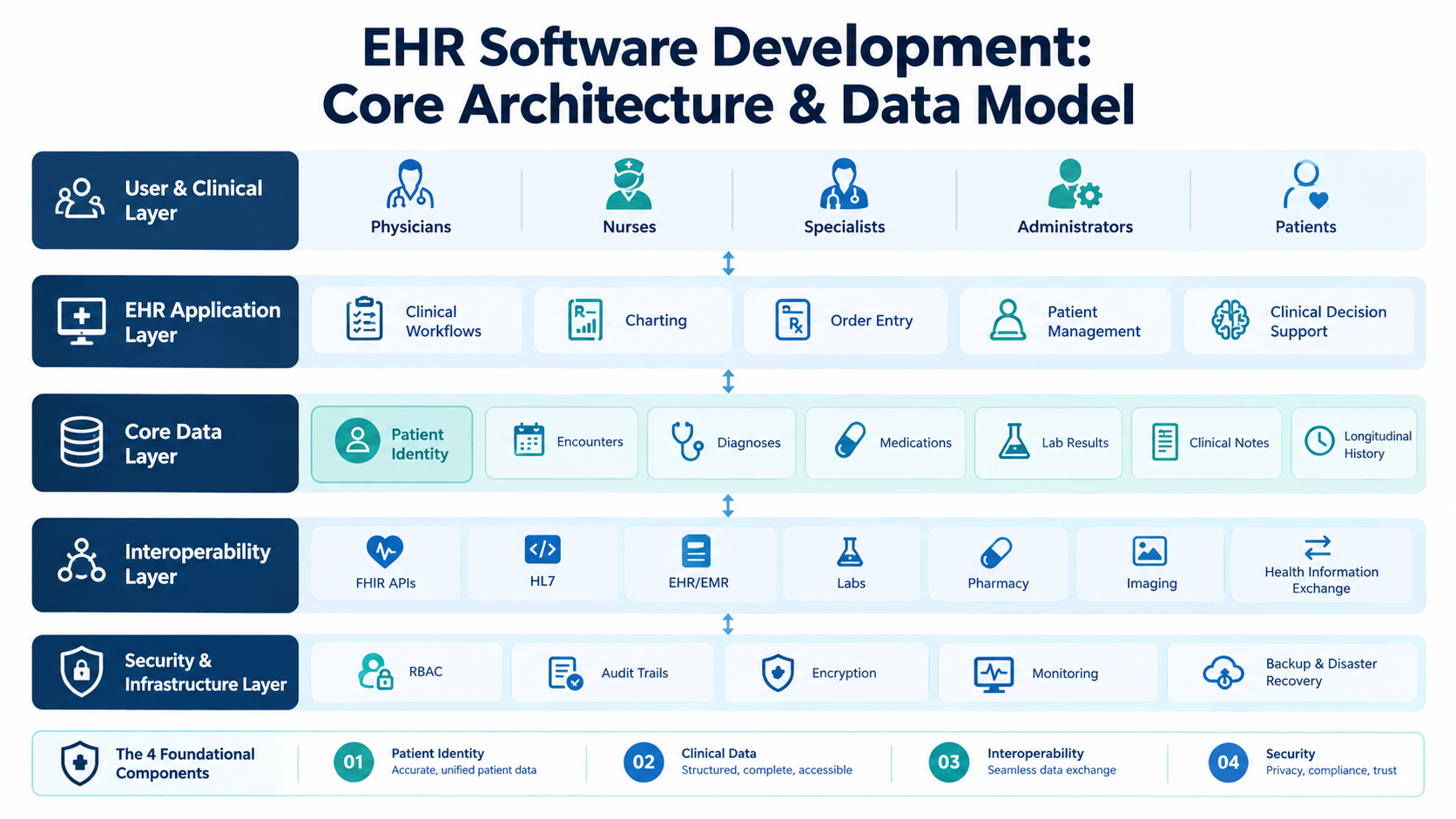
The data model is the foundation of an EHR. Decisions made during this stage can become increasingly expensive to change as more clinical workflows, integrations, and applications are built around them.
Key Data Architecture Considerations for EHR Software
Patient identity: Maintain reliable patient identity and demographic information while creating an auditable relationship between identity data and clinical records.
Clinical encounters: Represent office visits, hospital admissions, telehealth sessions, and other interactions with the healthcare system.
Structured clinical data: Support diagnoses, medications, lab results, procedures, and other coded information required for reporting and interoperability.
Unstructured clinical data: Support free-text notes and other documentation where structured fields cannot capture sufficient clinical context.
Longitudinal history: Allow clinicians and authorized users to retrieve a patient's complete clinical history efficiently.
Standardized terminology: Incorporate coding systems such as ICD, CPT, and LOINC into the architecture where applicable.
Architecture Area | Design Focus | Key Risk if Underestimated |
|---|---|---|
Patient Identity | Reliable identity and demographic linkage | Patient matching errors |
Clinical Encounters | Context and data for each care interaction | Incomplete longitudinal records |
Structured Data | Diagnoses, labs, medications, and coded fields | Weak interoperability and reporting |
Unstructured Data | Clinical notes and nuanced documentation | Reduced search and analysis capability |
Longitudinal History | Efficient retrieval across years of care | Performance degradation as records grow |
Coding Standards | ICD, CPT, LOINC, and related terminology | Costly retrofitting later |
EHR Software Development: Interoperability and Data Exchange
Interoperability is particularly important in EHR development. Unlike many healthcare applications where interoperability may be one feature among many, an EHR is expected to exchange information with a broad ecosystem of healthcare systems.
FHIR Architecture for EHR Software Development
FHIR-based architecture provides a modern approach for representing and exchanging clinical data through APIs. New EHR development should consider FHIR as a foundational interoperability layer while maintaining support for HL7 messaging where legacy healthcare systems require it.
Healthcare System Integration for EHR Software
EHR platforms may need to exchange information with laboratories, pharmacies, imaging systems, health information exchanges, and other EHR platforms. Each external system can introduce different interface requirements and data-quality challenges.
Laboratory system integration
Pharmacy integration
Medical imaging integration
Health information exchange connectivity
Interoperability with other EHR platforms
HL7 message processing
FHIR API integration
Clinical data reconciliation and normalization
Interoperability Area | Purpose | Planning Consideration |
|---|---|---|
FHIR APIs | Modern exchange of clinical data | Treat interoperability as foundational architecture |
HL7 Messaging | Integration with legacy healthcare systems | Support where existing systems require it |
Labs, Pharmacy, Imaging | Exchange structured clinical information | Expect interface-specific requirements and data variation |
Health Information Exchange | Share information across healthcare organizations | Consider during architecture planning |
Other EHRs | Exchange and reconcile patient information | Design for different structures and coding systems |
Ready to Build a More Secure EHR Solution?
EHR Software Development: Security and Compliance Requirements
EHR platforms typically contain some of an organization's most comprehensive patient information. Security and compliance therefore need to be incorporated into the architecture rather than treated as post-development requirements.
Role-Based Access Control for EHR Software
Different clinical and administrative roles require different levels of access to patient information. Physicians, nurses, administrative staff, billing personnel, specialists, and other users may need different permissions.
Audit Trails and Monitoring for EHR Software
Audit logging should provide visibility into access and changes to patient information. A reliable audit trail supports security monitoring, compliance activities, and clinical accountability.
Break-the-Glass Access in EHR Systems
Emergency access can allow authorized users to access information outside their normal permissions when clinically necessary. Such access should be subject to strong logging, review, and governance.
Data Integrity and Record Management in EHR Software
Clinical records should not be silently overwritten. Versioning, amendment workflows, change tracking, and appropriate record integrity controls help maintain a trustworthy clinical history.
Security Control | Requirement Focus | Why It Matters |
|---|---|---|
Granular Access Control | Role-specific permissions | Helps prevent inappropriate record access |
Audit Trails | Track access and modifications | Supports security, compliance, and accountability |
Break-the-Glass Access | Emergency access outside normal permissions | Supports emergency workflows while maintaining governance |
Data Integrity Controls | Versioning and change tracking | Helps prevent silent modification of clinical history |
EHR Software Development: Clinical Workflow and UX Design
An EHR's usability can directly affect clinical workflows. Documentation, ordering, alerts, and clinical decision support should therefore be designed around the way healthcare professionals actually work.
Key Clinical Workflow Requirements for EHR Software
Charting: Balance structured clinical data capture with efficient documentation workflows.
Order Entry: Support medications, laboratory orders, and other clinical orders with appropriate safety checks.
Clinical Decision Support: Deliver relevant guidance at meaningful clinical decision points.
Documentation Assistance: Consider templates, voice-to-text, or ambient documentation where appropriate.
Alert Management: Calibrate alerts to reduce unnecessary warnings and minimize alert fatigue.
Workflow Area | Design Goal | Primary Risk |
|---|---|---|
Charting | Efficient and accurate documentation | Clinician frustration and reduced usability |
Order Entry | Clinical safety checks | Alert fatigue |
Clinical Decision Support | Relevant guidance at decision points | Poor relevance and habitual dismissal |
Documentation Tools | Reduce unnecessary documentation burden | Burnout and inefficient workflows |
Ready to Build a More Secure EHR Solution?
EHR Software Development: Data Migration and System Transition
For many EHR projects, migrating existing patient information from a legacy system is one of the highest-risk implementation phases. Migration should therefore be planned as a dedicated workstream rather than treated as a final technical task.
Key Data Migration Activities for EHR Software
Assess legacy data quality. Identify duplicates, incomplete records, inconsistent coding, and other data-quality issues early.
Map legacy structures. Map existing data fields and clinical structures to the new EHR data model.
Define unmapped-data handling. Establish how information that cannot be automatically mapped will be reviewed and handled.
Validate migrated records. Use automated checks and manual clinical review of representative records.
Plan cutover and rollback. Define a controlled migration strategy and a validated rollback process before production migration.
Migration Stage | Required Activity | Risk Mitigation |
|---|---|---|
Assessment | Evaluate data quality, duplicates, gaps, and coding | Identify problems early |
Mapping | Map legacy structures to the new data model | Define handling for unmapped data |
Validation | Automated checks and clinical review | Confirm records remain clinically meaningful |
Cutover | Phased or parallel migration where appropriate | Reduce disruption to active care |
EHR Software Development: Scalability, Availability, and Reliability
An EHR functions as a system of record for clinical information, which means availability, disaster recovery, performance, and resilience need to be considered from the earliest architecture stages.
High availability: Design infrastructure redundancy around the consequences of clinical system downtime.
Disaster recovery: Establish appropriate recovery time and recovery point objectives and test the recovery process regularly.
Peak-load capacity: Model realistic high-demand scenarios and validate system performance under stress.
Offline or degraded-mode capabilities: Consider fallback functionality for critical workflows where the care setting requires it.
Monitoring: Continuously monitor infrastructure, application performance, integrations, and critical clinical workflows.
Ready to Build a More Secure EHR Solution?
EHR Software Development: Build vs. Buy vs. Customize
Choosing whether to buy, customize, or build an EHR carries significant long-term implications. The right approach depends on the specific clinical and product requirements rather than the technology preference alone.
Approach | Best Fit | Primary Trade-Off |
|---|---|---|
Buy | Organizations without highly specialized gaps | Less customization but an established ecosystem and vendor investment |
Customize | Organizations with specific workflows not supported by default configuration | Depends on the platform's extension capabilities |
Build Custom | Organizations or products with requirements that cannot be addressed through existing platforms | Substantially larger development and long-term maintenance commitment |
When Custom EHR Software Development Makes Sense
The clinical workflow is substantially different from standard platform workflows.
A specialized patient population requires a different data or workflow model.
Existing platforms cannot satisfy critical integration requirements.
EHR functionality is core to a broader health-tech product.
The organization requires control over the underlying architecture and product roadmap.
A full custom EHR build represents a significantly larger investment than buying or customizing an established platform. The specific business or clinical gap should therefore be substantial enough to justify the additional development, compliance, interoperability, and maintenance responsibilities.
EHR Software Development: Implementation Roadmap
When a custom EHR project is the appropriate path, a phased implementation approach can help manage its scope, clinical risk, and technical dependencies.
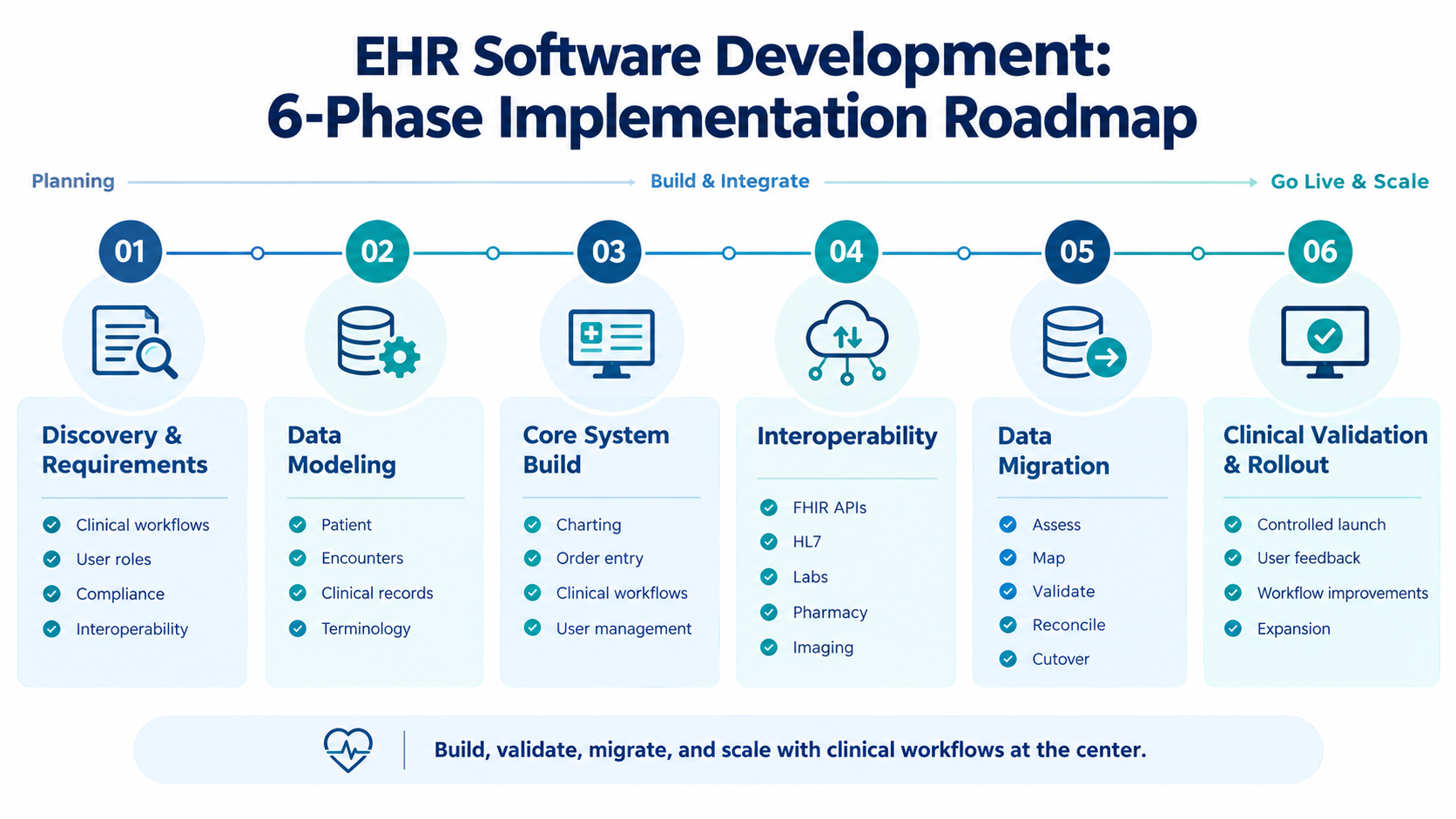
Discovery and Requirements:
Map clinical workflows, specialty requirements, interoperability needs, user roles, compliance scope, and operational requirements.
Data Modeling:
Establish patient, encounter, clinical, terminology, and longitudinal record structures.
Core System Build:
Develop charting, order entry, clinical workflows, user management, and other core capabilities through iterative development.
Interoperability Layer:
Implement FHIR APIs and required HL7 integrations for labs, pharmacies, imaging systems, and other healthcare platforms.
Data Migration:
Assess, map, migrate, validate, and reconcile legacy patient data before production cutover.
Clinical Validation and Rollout:
Begin with a controlled user group or department, collect feedback, address workflow issues, and expand adoption progressively.
Phase | Primary Focus | Key Outcome |
|---|---|---|
1. Discovery | Clinical workflows, requirements, interoperability, compliance | Validated project scope |
2. Data Modeling | Patient, encounter, and clinical structures | Stable data foundation |
3. Core System Build | Charting, order entry, and clinical workflows | Working clinical platform |
4. Interoperability | FHIR APIs and HL7 integrations | Healthcare data exchange capability |
5. Data Migration | Assessment, mapping, validation, and cutover | Controlled transition from legacy systems |
6. Clinical Validation & Rollout | Controlled launch and iterative improvement | Lower-risk organization-wide adoption |
Ready to Build a More Secure EHR Solution?
Common Challenges in EHR Software Development
EHR projects can encounter risks that are less common in conventional enterprise software. Identifying these risks early can help teams allocate the right resources and validation processes.
Common Pitfall | Likely Consequence | Recommended Response |
|---|---|---|
Underestimating migration complexity | Delays and inaccurate or incomplete records | Assess data quality and mapping early |
Late interoperability design | Costly architectural rework | Treat interoperability as foundational |
Limited clinical involvement | Low adoption and workflow workarounds | Engage clinical users continuously |
Uncalibrated alerts | Alert fatigue | Refine alerts based on real clinical usage |
Weak reliability planning | Higher risk during outages and peak demand | Design and test resilience early |
EHR Software Development: Key Takeaways
Start with the data model: Patient records, clinical encounters, terminology, and longitudinal history should be treated as foundational architecture decisions.
Make interoperability foundational: FHIR and HL7 requirements should influence architecture from the beginning rather than being treated as final-stage integrations.
Plan migration early: Legacy data quality, mapping, validation, and cutover planning should receive dedicated attention.
Design around clinical workflows: Documentation burden, alert fatigue, order entry, and clinical decision support directly affect usability and patient safety.
Evaluate build vs buy carefully: A custom EHR should have a clearly defined clinical or product gap that justifies its substantially larger long-term investment.
Conclusion
EHR software development is a long-term investment in clinical infrastructure, not just another software project. A successful EHR platform needs the right data architecture, interoperability, security, clinical workflows, data migration strategy, scalability, and reliability from the start. Addressing these areas early can help reduce costly changes and operational challenges later.
The build, buy, or customize decision should also be based on the specific needs and gaps the platform needs to address. At Zignuts, we help healthcare organizations and health-tech companies build digital healthcare applications and AI-driven clinical solutions, with expertise in interoperability, compliance-focused architecture, clinical workflows, and healthcare software engineering. Contact us today to discuss your EHR software requirements and explore an approach that fits your healthcare product.

Virang Kori
Business Analyst | Analyzing business needs, processes, and data to uncover insights, improve efficiency, and support smarter business decisions.