Healthcare software engineering in the United States requires a strong focus on security, privacy, and regulatory compliance. As health systems, digital health platforms, and healthtech companies adopt cloud-native platforms, mobile applications, and generative AI, protecting sensitive Protected Health Information (PHI) becomes increasingly important. In 2026, the average cost of a healthcare data breach in North America exceeds $10 million per incident, making healthcare one of the most costly sectors for data breaches.
For Chief Information Officers, Chief Information Security Officers, VPs of Engineering, and Healthcare Product Directors, HIPAA compliance is more than a legal requirement or a one-time audit.
It needs to be considered throughout the software architecture, from database and API design to access controls, deployment pipelines, and third-party vendors.
When compliance is not built into the foundation of healthcare software, organizations may face expensive rework, longer enterprise procurement processes, and potential regulatory action from the Department of Health and Human Services Office for Civil Rights.
Building HIPAA-compliant healthcare software means turning regulatory requirements into practical engineering and security practices. This guide covers the key technical safeguards, architecture considerations, Business Associate Agreement requirements, and DevSecOps practices needed to build secure, reliable, and compliant healthcare platforms.
HIPAA Compliance for Healthcare Software: PHI, ePHI, and Regulatory Requirements
To design software that meets US federal standards, engineering teams must first define the precise boundaries of Protected Health Information (PHI) and Electronic Protected Health Information (ePHI).
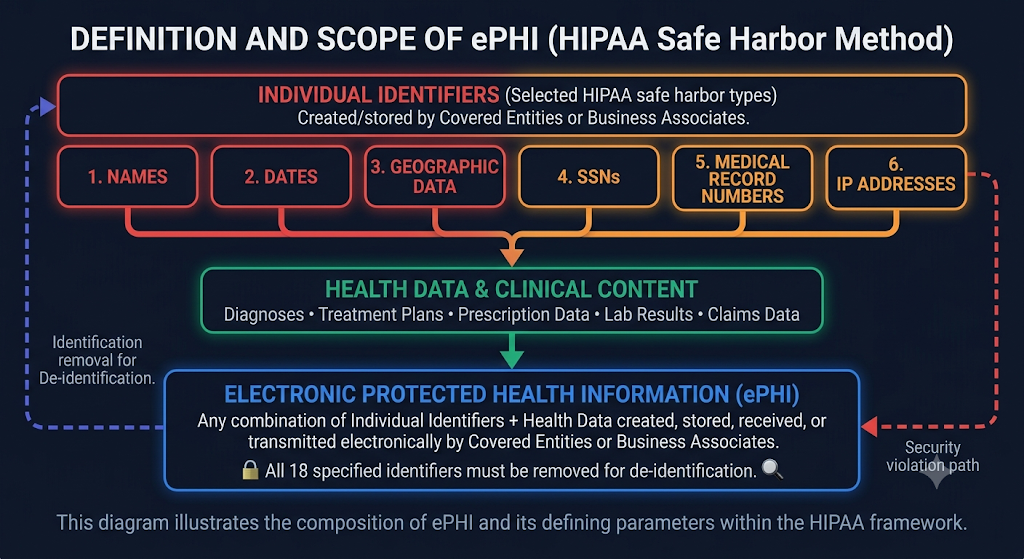
PHI consists of individually identifiable health information created, received, stored, or transmitted by a Covered Entity (such as hospitals, physician practices, or health insurers) or a Business Associate (such as healthtech software vendors and cloud service providers). When this data is handled electronically, it becomes ePHI, triggering strict compliance requirements across three primary rules:
The HIPAA Privacy Rule: Establishes national standards for the protection of individually identifiable health information. It restricts data usage to permissible treatment, payment, and healthcare operations, enforcing the Minimum Necessary Standard, which requires software systems to restrict data exposure strictly to the minimum context required for a given workflow step.
The HIPAA Security Rule defines operational, physical, and technical standards to ensure the confidentiality, integrity, and availability of ePHI. For software engineers, this rule dictates system access controls, audit logs, transmission encryption, and data storage protections.
The HIPAA Breach Notification Rule mandates clear operational procedures when unsecured ePHI is compromised. Systems must support breach detection, automated alerting, and audit trail preservation to comply with strict notification timelines to impacted individuals, HHS, and media outlets within statutory 60-day windows.
Ready to Build More Secure Healthcare Software?

HIPAA Technical Safeguards for Healthcare Software
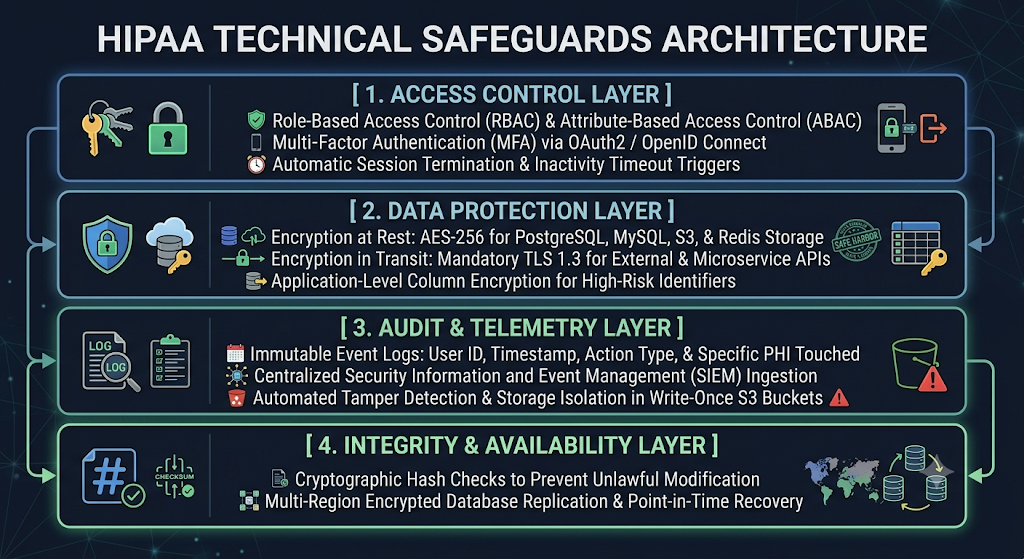
Meeting HIPAA Security Rule requirements requires embedding specific technical safeguards directly into application code, database configurations, and cloud infrastructure.
1. Access Control and Authentication for HIPAA-Compliant Healthcare Software
Software platforms must restrict ePHI access exclusively to authorised users with verified operational roles.
Role-Based Access Control (RBAC) and Attribute-Based Access Control (ABAC): Implement granular access policies at the API endpoint and database query levels. Doctors, billing specialists, and administrative clerks should only access the specific fields required for their assigned roles.
Multi-Factor Authentication (MFA): Enforce mandatory MFA for all clinical and administrative portals, integrating enterprise identity providers through SAML 2.0, OAuth 2.0, or OpenID Connect.
Session Controls and Inactivity Timeouts: Programmatically terminate active user sessions after a designated period of inactivity (typically 15 minutes or less) to prevent unauthorised endpoint access in clinical environments.
2. Data Encryption Requirements for HIPAA-Compliant Healthcare Software
Data unencrypted in memory or in transit remains the single largest vector for healthcare security enforcement actions.
Encryption at Rest: Enforce AES-256 encryption across all persistent storage assets, including relational databases (e.g., AWS RDS PostgreSQL), object stores (e.g., S3 buckets), cache layers (e.g., Redis), and system backups. Utilise managed key management services (such as AWS KMS or Azure Key Vault) with automated key rotation policies.
Encryption in Transit: Mandate TLS 1.3 (or TLS 1.2 minimum with strong cypher suites) across all client-to-server and server-to-server microservice communications. Enforce HTTP Strict Transport Security (HSTS) headers and disable legacy, insecure cryptographic protocols across all load balancers and ingress controllers.
3. Audit Logging and Monitoring for HIPAA Compliance
The Security Rule requires healthcare systems to record and examine activity in information systems containing ePHI.
Structured Event Logging: Every system interaction touching ePHI, including read, write, modify, export, or delete operations, must generate an automated audit record containing the unique user identifier, exact timestamp (UTC), IP address, action performed, and specific record keys accessed.
Immutability and Isolation: Store audit logs separately from main application databases in write-once, read-many (WORM) cloud storage buckets with object lock policies enabled. Prevent application administrative users from altering or deleting historical telemetry data.
HIPAA Compliance Vendor Evaluation and Infrastructure Readiness
Evaluating cloud infrastructure providers, third-party API vendors, and engineering partners requires auditing technical capabilities against operational requirements:
Compliance & Architectural Capability | Industry Standard Requirement | Operational Risk / Red Flag |
|---|---|---|
Business Associate Agreement (BAA) | Vendor executes a formal, enforceable legal BAA covering all consumed services prior to processing ePHI. | Vendor refuses BAA execution or limits liability for data breaches caused by service flaws. |
Data Encryption & Key Management | Native support for customer-managed encryption keys (CMEK) using AES-256 and mandatory TLS 1.3 transmission. | Shared key management with default unencrypted transit endpoints or legacy SSL/TLS support. |
Identity & Access Management | Native RBAC, SSO/SAML integration, enforced MFA, and programmatic session timeout triggers. | Shared service accounts, basic password-only authentication, or unsegmented administrative roles. |
Audit Logging Capability | Exportable, immutable, structured JSON/FHIR logs with explicit event identifiers and zero modification access. | Ephemeral system logs stored locally, lack of read tracking, or editable log files. |
Interoperability Standards | Native support for HL7 v2 and modern HL7 FHIR (Fast Healthcare Interoperability Resources) REST APIs. | Custom, non-standard proprietary database schemas requiring fragile point-to-point ETL scripts. |
Generative AI Guardrails | Verified Zero-Data-Retention (ZDR) APIs ensuring ePHI is never retained or used for foundation model training. | Commercial LLM usage without a signed BAA or opt-out confirmation for model training datasets. |
Ready to Build More Secure Healthcare Software?
HIPAA Compliance for Healthcare AI and Cloud Systems
Deploying modern healthcare software often involves integrating cloud microservices, electronic health record systems, and generative artificial intelligence features without compromising patient privacy.
1. HIPAA-Compliant Generative AI and LLM Integration
Integrating natural language processing or generative AI features into clinical software requires strict compliance safeguards:
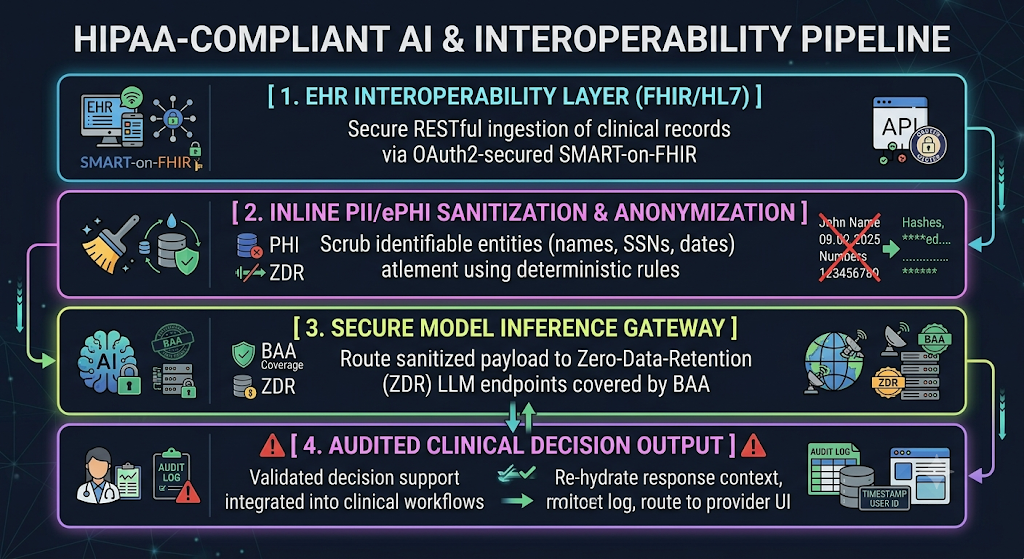
Zero-Data-Retention (ZDR) Enclaves: Enterprise healthcare platforms utilising LLMs (such as Azure OpenAI, AWS Bedrock, or private self-hosted models) must operate under explicit ZDR agreements. Vendor models must never retain, store, or utilise ePHI inputs to train public foundation models.
Inline PII/ePHI Scrubbing: Implement pre-processing pipeline guards that detect and anonymise individual identifiers before sending clinical text to model inference gateways, minimising ePHI exposure.
2. Business Associate Agreements for HIPAA-Compliant Cloud Services
Software platforms are only as compliant as their underlying vendor chains.
Infrastructure Layer: Cloud platforms like AWS, Microsoft Azure, and Google Cloud offer BAAs covering specific HIPAA-eligible services (e.g., AWS RDS, Azure Blob Storage, Cloud Healthcare API). Services outside the provider's HIPAA-eligible list must never process or store ePHI.
SaaS and Microservice API Vendors: Software dependencies that touch ePHI, such as transactional email engines, SMS communication tools (e.g., Twilio), and error-tracking monitoring frameworks (e.g., Sentry), must sign formal BAAs prior to processing production data.
3. HL7 and FHIR Integration for HIPAA-Compliant Healthcare Software
Modern US health systems require seamless data sharing across disparate systems under the CMS Interoperability and Prior Authorization rules.
SMART-on-FHIR Architecture: Build integration layers using FHIR (Fast Healthcare Interoperability Resources) APIs authenticated via OAuth 2.0. SMART-on-FHIR frameworks allow external applications to launch directly within Electronic Health Record (EHR) platforms like Epic, Cerner, or Athenahealth while maintaining standardised access boundaries.
Data Transformation Rules: Ensure that inbound legacy HL7 v2 messages or outbound FHIR resources pass through schema validation pipelines to prevent data corruption or partial record sync failures.
10 HIPAA Compliance Questions for Healthcare Engineering Teams
Before launching healthcare software into US clinical environments, technology leaders should review these technical discovery questions with their development teams:
Are all cloud services handling ePHI explicitly listed within our signed Business Associate Agreement with our cloud provider?
Does our database architecture enforce AES-256 encryption at rest with automated, rotated customer-managed encryption keys?
How do our API gateways enforce TLS 1.3 encryption and HSTS headers across all incoming and microservice traffic?
Can our audit logging system prove exactly which user viewed a specific patient record at a given second?
Are audit logs stored in isolated, WORM-compliant storage environments protected against modification or deletion?
Does our authentication framework require Multi-Factor Authentication for all administrative, developer, and end-user access points?
How does our software automatically terminate user sessions after defined periods of inactivity across mobile and web interfaces?
Are third-party software dependencies, crash analytics, and logging tools configured to scrub ePHI before transmitting payload telemetry?
If utilising AI or LLM API endpoints, do we hold signed BAAs with zero-data-retention guarantees from the AI vendor?
What is our automated failover and disaster recovery time objective (RTO) and recovery point objective (RPO) for restoring ePHI backups?
Ready to Build More Secure Healthcare Software?
DevSecOps Lifecycle for HIPAA-Compliant Healthcare Software
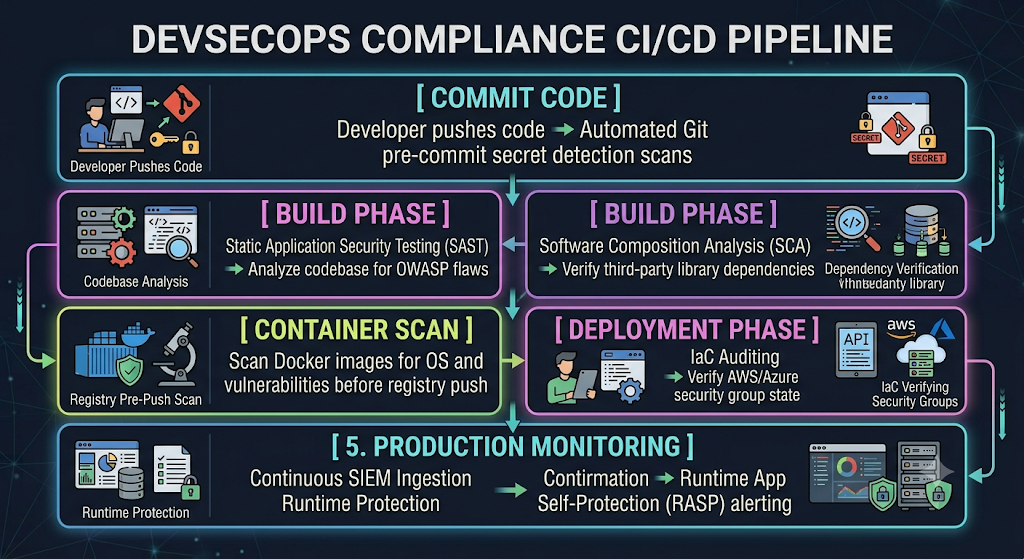
Incorporating compliance checks directly into automated CI/CD pipelines ensures that code changes do not inadvertently introduce security vulnerabilities.
1. Automated Security Scanning for HIPAA-Compliant Software
Integrate Static Application Security Testing (SAST) and Software Composition Analysis (SCA) tools into development workflows. Automatically block pull requests that introduce known security flaws or unverified open-source dependencies.
2. Infrastructure as Code Security for HIPAA Compliance
Define all cloud infrastructure using version-controlled configurations (such as Terraform or AWS CloudFormation). Run automated static analysis on IaC scripts to detect misconfigurations such as open S3 buckets, unencrypted databases, or overly permissive security groups before deployment.
3. Penetration Testing and Vulnerability Management for Healthcare Software
Schedule mandatory annual third-party penetration testing and continuous vulnerability scans. Maintain clear remediation workflows to address identified vulnerabilities based on Common Vulnerability Scoring System (CVSS) severity ratings.
Building HIPAA-Compliant Healthcare Software Platforms
Building secure, high-performing healthcare software requires more than understanding HIPAA requirements. It also takes practical experience with healthcare workflows, data security, interoperability, and scalable architecture.
At Zignuts, we help healthtech startups, digital health companies, and medical SaaS providers design, develop, and maintain HIPAA-compliant healthcare platforms.
Our work covers key areas such as:
HIPAA-Compliant Custom Software Development: We build secure web and mobile healthcare applications with access controls, encryption, authentication, and session management built into the architecture.
EHR/EMR Interoperability: We develop SMART-on-FHIR applications and HL7 integration solutions that connect healthcare applications with EHR systems such as Epic and Cerner.
AI and Secure Medical Analytics: We integrate AI capabilities for document processing, clinical data analysis, and decision support while applying appropriate data protection, BAA, and privacy controls.
DevSecOps and Infrastructure Security: We implement secure CI/CD pipelines, infrastructure security checks, vulnerability scanning, audit logging, and cloud configurations designed for regulated healthcare environments.
With established development practices and reusable architecture patterns, Zignuts helps healthcare organizations build secure software while reducing development risks and keeping compliance requirements in focus.
Getting Started with HIPAA-Compliant Healthcare Software
In highly regulated healthcare environments, planning security early can help reduce operational risks and avoid costly changes later. Building software with strong technical safeguards, encrypted data, reliable audit logging, and clear BAA requirements helps protect sensitive healthcare data while supporting enterprise adoption.
Is your engineering team preparing for upcoming health system security audits or EHR integration requirements? Contact us today to discuss your healthcare software requirements and explore an architecture designed around security, interoperability, and HIPAA compliance.

Utkrishti Mishra
Business Analyst Intern | Exploring data, processes, and business strategies to turn insights into smarter decisions and impactful solutions.