Healthcare Software Development Process: Executive Overview
The healthcare software development process in 2026 requires a more structured approach than typical web or SaaS development. Healthcare projects need to consider compliance, security, clinical workflows, interoperability, usability, testing, and regulatory requirements from the beginning rather than adding them later.
A typical healthcare software development lifecycle moves through six key stages: clinical discovery and regulatory planning, human-centered UX design, secure architecture and interoperability, development and verification, security and compliance testing, and clinical deployment with ongoing monitoring. Planning these areas early can help reduce rework, manage risks, and build software that is better suited to real healthcare environments.
Why the Healthcare Software Development Process Differs From Generic Software Development
In commercial SaaS software development, the prevailing mantra has long been "move fast and break things." Agile teams release rapid MVPs, deploy continuous code updates to production, and patch security bugs reactively based on customer issue tickets.
In healthcare software engineering, software failures can compromise patient safety, trigger regulatory consequences, and expose organizations to significant data security and privacy risks. According to IBM Security and Ponemon Institute research, healthcare data breaches have historically carried among the highest average costs across industries.
Developing software for hospitals, digital health startups, life sciences firms, and medical practices is a specialized discipline governed by overlapping regulatory frameworks:
HIPAA & HITECH (United States): Establishes requirements for protecting Protected Health Information (PHI), including administrative, physical, and technical safeguards and appropriate contractual controls such as Business Associate Agreements (BAAs).
FDA Software as a Medical Device (SaMD) & 21 CFR Part 11: May apply to certain clinical software, electronic records, and systems depending on their intended use and regulatory classification.
IEC 62304 & ISO 14971 Standards: Provide frameworks for medical device software lifecycle processes and risk management.
21st Century Cures Act & FHIR Interoperability: U.S. healthcare interoperability requirements have increased the importance of standardized APIs and FHIR-based data exchange between digital health applications and EHR platforms such as Epic, Oracle Cerner, and Athenahealth.
To navigate these complexities without unnecessarily slowing development, engineering leaders can adopt a disciplined, phase-gated Healthcare SDLC.
Ready to Build Healthcare Software the Right Way?

The 6 Phases of the Healthcare Software Development Process
A successful healthcare software development lifecycle executes across six interconnected phases, embedding clinical validation and regulatory controls into every sprint.
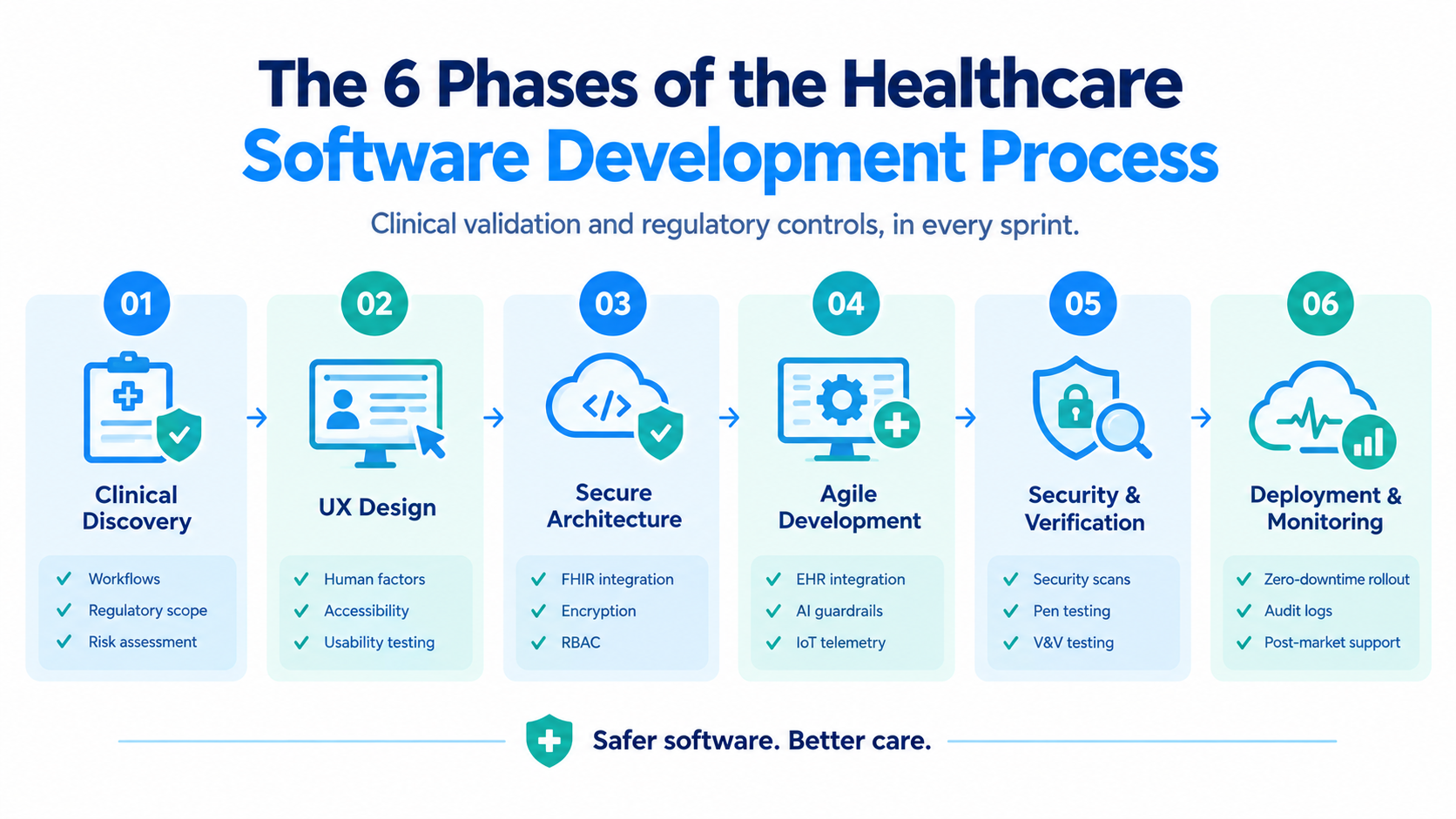
The 6-Phase Healthcare Software Development Lifecycle (SDLC) - An end-to-end engineering methodology spanning Clinical Discovery, Human Factors Design, FHIR Architecture, Agile Development with Traceability, V&V Testing, and Post-Market Surveillance.
Phase 1: Clinical Discovery, Regulatory Scope, and Risk Assessment
Healthcare software development begins by defining clinical workflows and determining regulatory scope. Software architects work with clinicians, compliance professionals, and relevant healthcare stakeholders to map patient journeys and provider documentation steps.
Key Engineering & Compliance Actions:
FDA SaMD Classification Audit: Determine whether the application falls within general wellness software, clinical decision support, or Software as a Medical Device based on its intended use and applicable regulatory framework.
Data Flow & PHI Mapping: Identify every touchpoint where Protected Health Information (PHI) is captured, processed, stored, or transmitted.
Preliminary ISO 14971 Risk Analysis: Identify potential software failure modes, clinical hazards, and safety mitigations before architecture design begins.
EHR Interoperability Scoping: Identify necessary integration endpoints for hospital EHRs, laboratory systems, pharmacy networks, and other healthcare platforms.
Phase 2: Healthcare UX Design and Human Factors
Designing medical interfaces requires balancing intuitive consumer simplicity for patients with rapid, low-friction charting efficiency for clinicians. The user interface should account for applicable human factors engineering principles and accessibility requirements.
Key Engineering & Compliance Actions:
Cognitive Load Reduction: Minimize unnecessary clicks and cognitive fatigue for clinical charting by using clear information hierarchy and contextual defaults.
High-Contrast Clinical Dashboards: Ensure visual legibility in clinical settings and on different devices and lighting conditions.
Patient Mobile Accessibility: Build accessible patient onboarding, prescription refill, and telehealth experiences with appropriate language and accessibility support.
Usability Simulation Testing: Validate interactive wireframes with representative healthcare users to verify workflow efficiency and error-prevention mechanics.
Phase 3: Secure Architecture and FHIR Interoperability
Before writing business logic, senior software architects design a secure cloud architecture appropriate for the healthcare product, applicable regulatory requirements, and expected data flows. Depending on the project, this may involve AWS, Google Cloud, or Microsoft Azure.
Key Engineering & Compliance Actions:
HL7 FHIR R4 Resource Modeling: Map application data models to appropriate FHIR resources such as Patient, Observation, Condition, Encounter, and DiagnosticReport where applicable.
Encryption Architecture: Implement appropriate encryption for data in transit and at rest based on the organization's security requirements and risk assessment.
Role-Based Access Control (RBAC): Enforce granular data access so users can access only the information appropriate to their roles and authorization.
Synthetic PHI Data Pipeline Setup: Configure synthetic patient data generators such as Synthea to populate staging databases and reduce the need to expose real patient PHI in non-production environments.
Phase 4: Agile Development and Clinical Verification
Software engineering proceeds through iterative development cycles. However, unlike generic commercial development, healthcare software projects may require additional quality, risk-management, verification, and documentation checkpoints depending on the product's intended use and regulatory classification.
Key Engineering & Compliance Actions:
SMART on FHIR EHR Integration: Build appropriate connectors using standards-based authentication and authorization flows, enabling applications to interact with supported EHR environments.
Containerized Services: Deploy isolated services using containerization and appropriate orchestration, health checks, scaling controls, and resilience patterns where justified by the architecture.
AI Clinical Scribing & Guardrails: Integrate domain-specific AI models with appropriate safety controls, deterministic boundaries, evaluation procedures, and PHI protection.
Biometric IoT Telemetry Streams: Ingest real-time vital-sign data from supported wearable or medical devices using appropriate streaming architectures.
Phase 5: Security Testing, Compliance Audits, and Verification & Validation
Before releasing software into clinical production, the system undergoes appropriate Verification and Validation activities. Verification asks whether the software was built according to specified requirements, while validation evaluates whether the resulting product meets its intended use and user needs.
Key Engineering & Compliance Actions:
Automated Security Scans: Execute static application security testing (SAST), dynamic application security testing (DAST), and open-source dependency vulnerability audits.
Third-Party Penetration Testing: Use qualified security professionals to test for unauthorized access, PHI exposure, authentication weaknesses, and other security vulnerabilities.
Design History File (DHF) Generation: Where applicable, compile software design specifications, risk-management documentation, and verification evidence required by the relevant quality and regulatory processes.
Clinical Load & Disaster Recovery Testing: Test backup restoration, failover procedures, performance under expected loads, and recovery capabilities.
Phase 6: Clinical Deployment, Monitoring, and Post-Market Support
Deploying healthcare software requires minimizing disruption to clinical operations. Post-launch, the software lifecycle continues through monitoring, security updates, operational support, and, where applicable, post-market surveillance and AI model monitoring.
Key Engineering & Compliance Actions:
Phased Zero-Downtime Rollout: Use blue/green or canary deployment strategies where appropriate to introduce features while minimizing operational disruption.
Audit Trail Logging: Maintain appropriate records of relevant data access and system activity based on security, compliance, and organizational requirements.
OpenTelemetry Distributed Tracing: Monitor transaction latency, service health, and API performance across connected systems.
Clinical AI Drift Monitoring: Where AI is used, monitor model performance, clinician feedback, and relevant quality indicators to identify degradation or unexpected behavior.
Healthcare Software Architecture for Production Systems
A scalable, regulation-ready healthcare software platform can separate presentation, clinical AI automation, interoperability, data storage, security, and observability into distinct architectural layers.
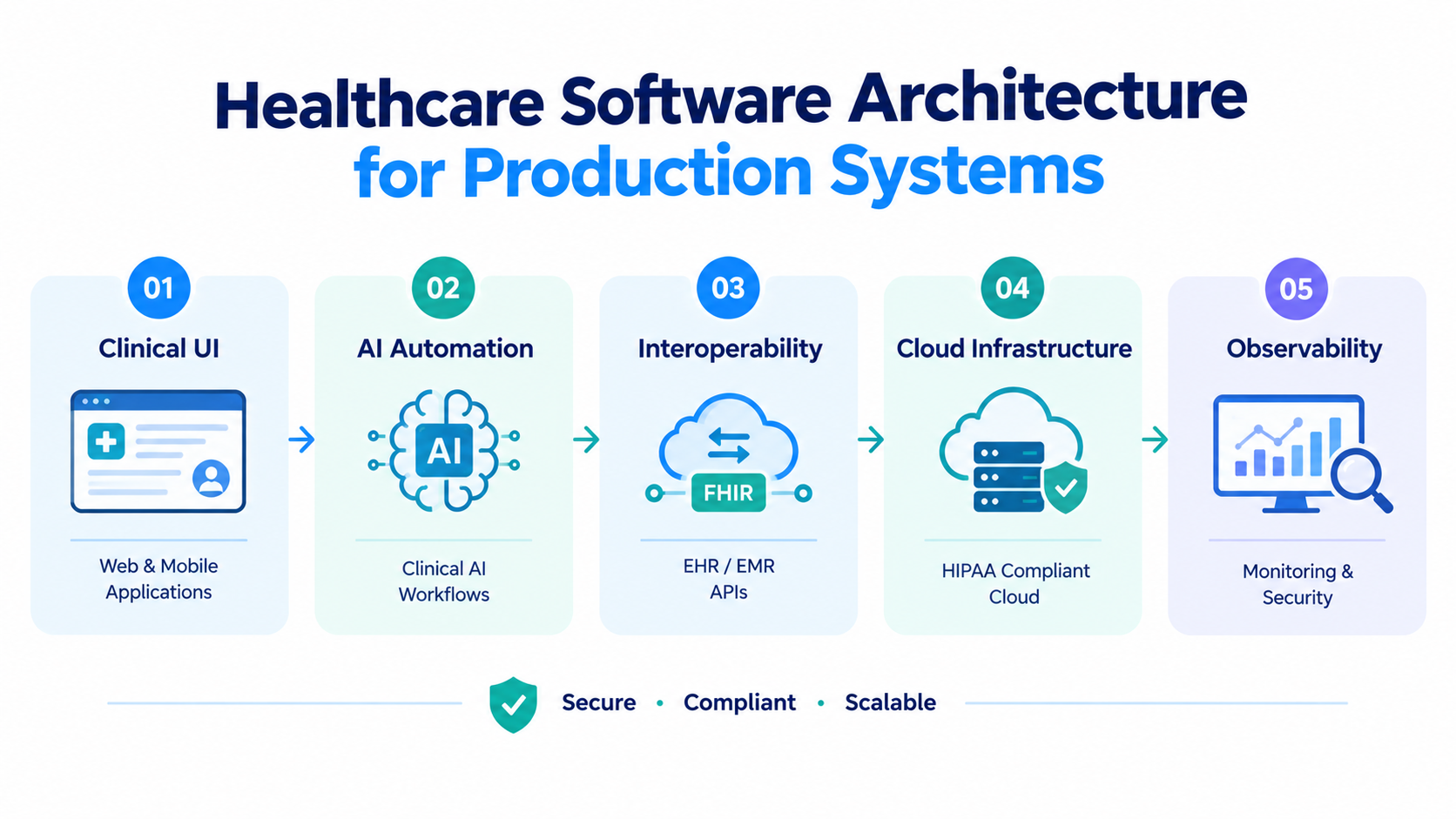
Production Healthcare Software Architecture & Security Blueprint - A 5-tier enterprise stack spanning Clinical UI, AI Automation, FHIR R4 Integration Mesh, HIPAA Cloud Infrastructure, and Post-Market Observability.
Ready to Build Healthcare Software the Right Way?
Healthcare Software Development Timeline and Cost Considerations
Healthcare software development timelines and costs depend on feature complexity, regulatory requirements, integration depth, security controls, team composition, and expected scale. The table below provides illustrative 2026 planning ranges.
Project Complexity Tier | Typical Timeline | Initial CapEx (Dev) | Monthly Cloud OpEx | Core Scope & Architecture Included |
|---|---|---|---|---|
Tier 1: Digital Health MVP / Patient Portal | 6 - 10 weeks | $40,000 - $85,000 | $800 - $2,500/mo | Healthcare-focused React Native app, appointment booking, secure messaging, basic billing, and secure cloud infrastructure. |
Tier 2: Production Clinical Platform with EHR Sync | 3 - 5 months | $90,000 - $190,000 | $3,000 - $7,000/mo | Bidirectional SMART on FHIR EHR integration, clinical documentation, telehealth, laboratory/e-prescription connectors, and RBAC. |
Tier 3: Enterprise FDA SaMD / AI Diagnostic Engine | 5 - 9 months | $200,000 - $450,000+ | $7,500 - $20,000+/mo | Applicable medical software lifecycle documentation, clinical AI decision support, real-time IoT telemetry, multi-region availability, and security/compliance controls. |
Healthcare Software Development Maturity and Evaluation Framework
To objectively audit your development methodology or evaluate prospective healthcare software engineering partners, apply a structured maturity rubric:
Evaluation Domain | Weight | Key Technical Due Diligence Verification Criteria | Critical Red Flag Warning |
|---|---|---|---|
1. Regulatory Scoping & SaMD | 20 Pts | Formal regulatory classification, documented risk management processes, and healthcare security policies. | Treating healthcare software as a generic web application with no formal regulatory strategy. |
2. Interoperability & FHIR R4 | 20 Pts | FHIR resource mapping, SMART on FHIR launch flows, and appropriate EHR connectors. | Relying primarily on proprietary non-standard interfaces or manual data imports. |
3. Security & PHI Governance | 20 Pts | Strong encryption, granular RBAC, synthetic staging data, and appropriate cloud contractual safeguards. | Using real patient PHI in staging databases or failing to address applicable Business Associate Agreements. |
4. Clinical UX & Human Factors | 15 Pts | Human factors validation, accessibility, usability testing, and efficient clinical workflows. | Complex interfaces that add unnecessary steps to clinical workflows. |
5. V&V and IEC 62304 Traceability | 15 Pts | Requirement traceability, SAST/DAST security scans, automated regression testing, and appropriate verification evidence. | Testing exclusively through manual exploratory clicking with limited regression coverage. |
6. Observability & IP Transfer | 10 Pts | Clear source-code ownership, observability, monitoring, audit logging, and knowledge transfer. | Proprietary black-box architecture or unclear ownership and transfer terms. |
Ready to Build Healthcare Software the Right Way?
Common Red Flags in Healthcare Software Development
During vendor evaluation or internal project planning, watch out for these six disqualifying indicators:
Healthcare Software Red Flag | What the Team Claims | The Clinical & Regulatory Failure Risk |
|---|---|---|
1. The "We'll Add HIPAA at the End" Trap | "Let us build the MVP first, and we can configure security and compliance before launch." | May require substantial architectural changes and increase development effort. |
2. Testing with Real Patient PHI | "We copied the production database to staging to test edge cases quickly." | Creates significant privacy and security exposure and may violate applicable requirements. |
3. Proprietary APIs Over FHIR R4 | "We built custom JSON endpoints that are faster than standardized FHIR resources." | Can create interoperability limitations and make integration with healthcare ecosystems more difficult. |
4. Omission of ISO 14971 Risk Analysis | "Our software is just an operational workflow tool, so hazard analysis is not required." | Could leave relevant clinical or safety risks unidentified. |
5. Missing Cloud Vendor BAAs | "We host on standard cloud servers; a standard terms-of-service agreement is fine." | May create contractual and compliance gaps where a BAA is required. |
6. Manual Verification & Zero Traceability | "We test sample user flows manually before each sprint release." | Creates weak regression protection and can make formal quality audits more difficult. |
Healthcare Software Development Case Studies and Real-World Examples
A credible healthcare software development partner should have experience solving real-world healthcare challenges, not just presenting polished portfolio screenshots. These examples highlight practical experience across healthcare applications, data security, interoperability, automation, and AI-driven solutions.
AI Health App Development
Business Challenge: A digital health provider needed an intelligent clinical triage assistant that could work with patient information while supporting HIPAA, GDPR, and clinical data governance requirements.
Our Approach: We developed encrypted data exchange pipelines, real-time PII de-identification, FHIR and HL7 interoperability capabilities, role-based access controls, and audit logging to establish a secure foundation for the application.
Business Impact: The solution was designed with security and governance considerations from the beginning, helping reduce the need for major security and compliance changes later in the product lifecycle.
Personal Trainer Application
Business Challenge: A health and wellness business needed a custom platform for remote lifestyle management and biometric tracking, with the ability to synchronize wearable data in real time.
Our Approach: We developed a mobile application with real-time biometric data ingestion, personalized routines, and secure cloud synchronization. The platform also provided unified dashboards for monitoring user progress.
Business Impact: The solution achieved a 94% patient engagement retention rate while giving clinicians and trainers better visibility into real-time progress.
AI Workflow Automation Platform
Business Challenge: A multi-clinic specialty group was dealing with fragmented scheduling tools, repetitive patient data entry, and appointment management challenges.
Our Approach: We built an intelligent workflow automation platform combining NLP-based intent routing, automated appointment reminders, EHR webhook integrations, and resilient workflow processing.
Business Impact: The solution reduced administrative scheduling overhead by 60% and automated clinical reminder workflows across thousands of monthly patient visits.
AI Contract Review Platform
Business Challenge: A healthcare compliance team was spending significant time reviewing complex vendor agreements and Business Associate Agreements manually.
Our Approach: We developed a domain-specific legal intelligence platform using compliance-focused embeddings, contextual citation capabilities, and hallucination-detection guardrails to support contract analysis.
Business Impact: The solution reduced agreement audit turnaround time by 75% while helping the compliance team identify potential issues more efficiently.5 Steps to Start a Healthcare Software Development Project
Ready to Build Healthcare Software the Right Way?
5 Steps to Start a Healthcare Software Development Project
To transition from planning to production execution, healthcare CTOs and digital health leaders can follow this five-step operational roadmap:
Complete a Regulatory & SaMD Classification Audit: Determine whether your software falls within Software as a Medical Device or administrative health IT based on its intended use and applicable regulatory framework.
Enforce FHIR R4 Architecture from Day One: Adopt appropriate FHIR resources and data structures to support interoperability with healthcare systems where required.
Mandate Synthetic Staging Pipelines: Implement synthetic patient data generation such as Synthea to reduce the need for real PHI in development and staging environments.
Fund a Focused 3-Week Discovery & Architecture Sprint: Partner with an experienced healthcare software engineering firm to produce a Technical Architecture Document, compliance blueprint, and working prototype.
Secure 100% Intellectual Property & Code Ownership: Ensure software repositories, infrastructure scripts, and relevant technical assets are owned and controlled according to the contractual agreement.
Conclusion
The healthcare software development process requires more than building features and deploying an application. Clinical workflows, data security, interoperability, regulatory requirements, usability, testing, and long-term maintenance all need to be considered throughout the development lifecycle. A structured approach helps identify requirements early, plan EHR and FHIR integrations properly, validate clinical workflows, and reduce the risk of costly changes later.
At Zignuts, we help healthcare organizations and digital health companies plan, develop, integrate, and maintain secure healthcare software. From discovery and architecture to interoperability, AI integration, testing, and post-launch support, we align the development approach with your technical and business requirements. Planning a healthcare software project? Contact us today to discuss your requirements and explore a secure, scalable approach for your product.

Mukund Patil
Business Enthusiast | Exploring ideas, trends, and opportunities, turning curiosity into meaningful insights and discovering smarter ways to make an impact.