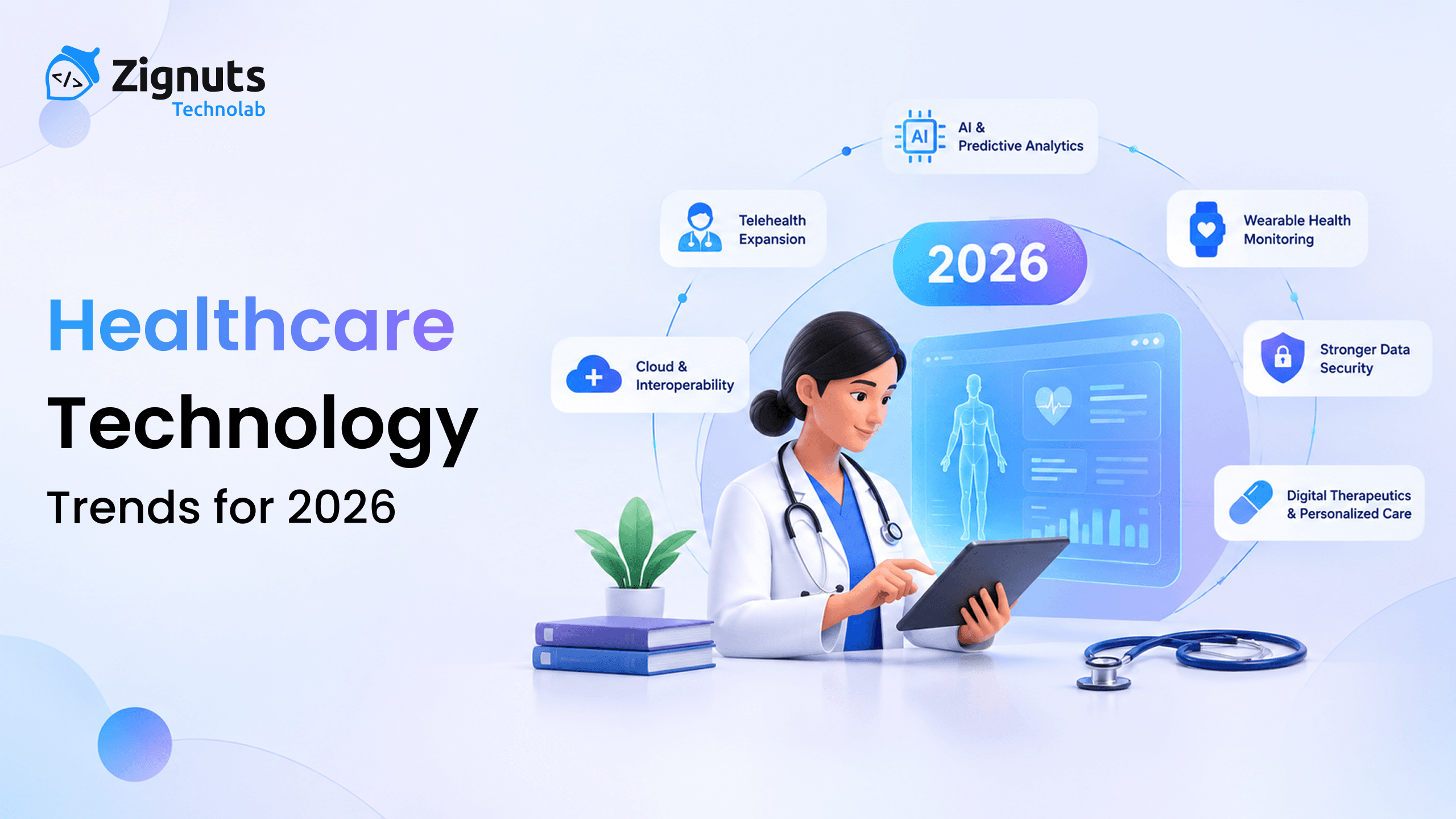
Healthcare Technology Trends for 2026: Executive Overview
Healthcare technology in 2026 is moving from experimental pilots toward production-scale clinical intelligence and more flexible healthcare infrastructure. Driven by clinician shortages, rising cybersecurity risks, and growing interoperability requirements, the key healthcare technology trends for 2026 include ambient clinical AI, agentic AI workflows, composable EHR architectures, remote patient monitoring, zero-trust IoMT security, clinical hybrid RAG, and synthetic health data.
Healthcare technology leaders are increasingly looking at interoperable, modular architectures that can work alongside existing EHR systems while supporting AI, automation, connected devices, and secure data exchange. For CTOs, CMIOs, CIOs, and digital health leaders, these trends can help shape technology investment and modernization priorities for the years ahead.
Healthcare Technology Trends in 2026: From Pilots to Production
Healthcare technology is entering a significant period of transformation. For years, health systems and digital health providers experimented with isolated point solutions such as telehealth portals, machine learning risk scores, and basic chatbots. While these technologies showed promise, they could also create fragmented workflows, alert fatigue, and additional administrative work for clinical teams.
In 2026, healthcare organizations are increasingly focusing on moving successful technologies into production environments. This includes composable healthcare IT, modular architectures connected through standardized healthcare APIs, ambient AI, autonomous administrative workflows, and stronger security for connected medical devices.
This strategic guide explores seven healthcare technology trends for 2026 that CTOs, CMIOs, CIOs, and healthcare executives should consider when planning their digital transformation and modernization roadmaps.
EHR Costs and Composable Healthcare Technology
Commercial EHR platforms can involve recurring provider, user, integration, and feature-related costs. As organizations grow, these expenses can become a significant part of their technology budgets. This is one reason healthcare organizations are exploring composable architectures that allow them to build specialized experiences around their existing systems of record.
A composable approach can allow organizations to retain their existing EHR investment while developing custom clinical portals, workflows, and applications around standardized interoperability technologies.
Ready to Build Smarter Healthcare Solutions?

7 Healthcare Technology Trends Reshaping Care Delivery in 2026
Enterprise healthcare technology leaders need to prioritize investments around technologies that can improve clinical workflows, interoperability, security, patient engagement, and operational efficiency. Seven trends stand out in particular.
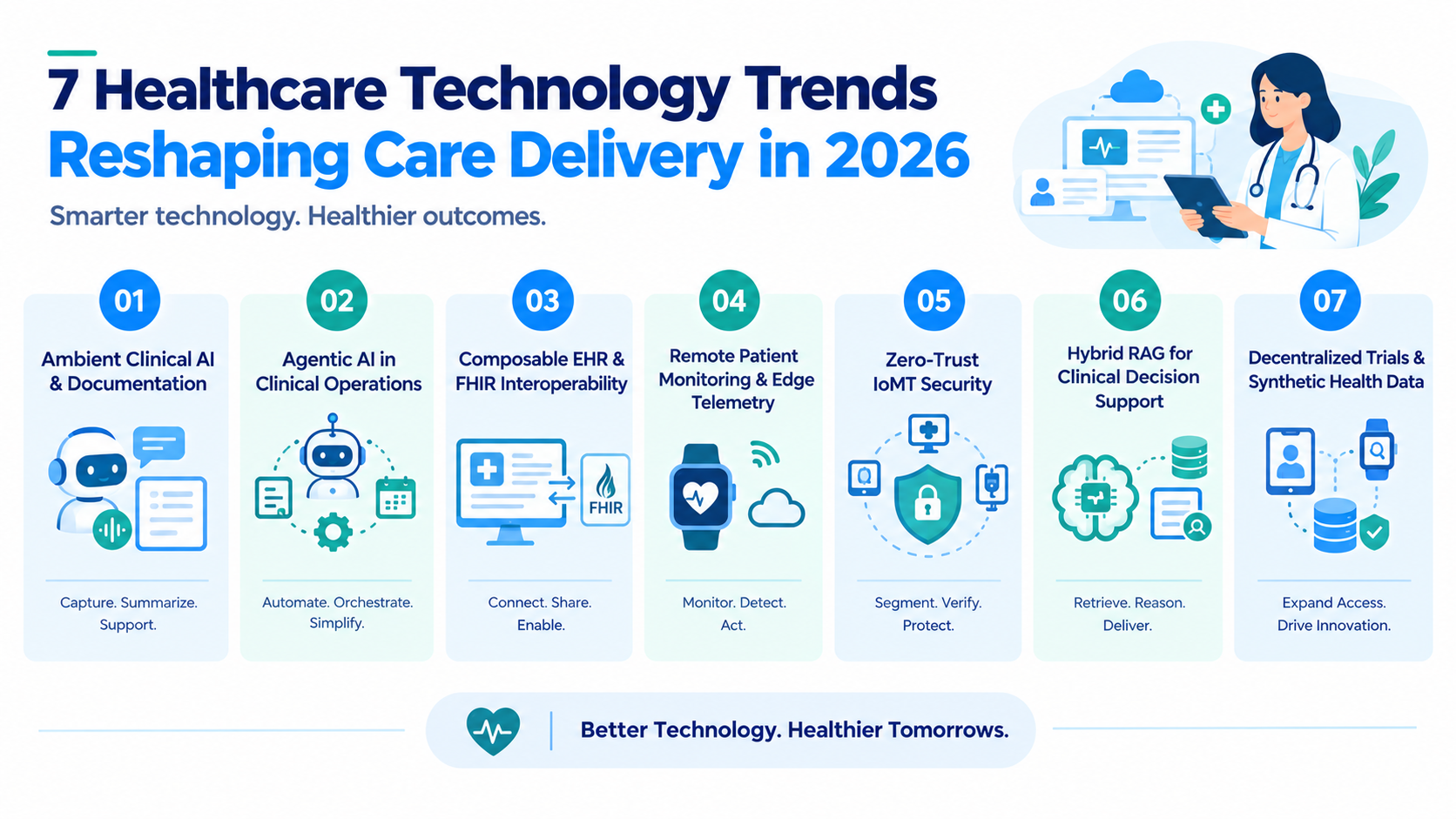
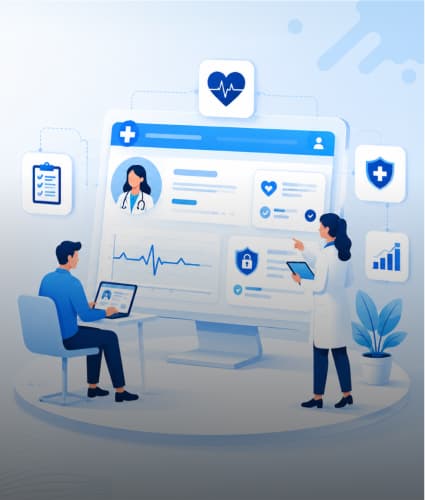
2026 Healthcare Technology Architecture Blueprint - A modern healthcare technology stack spanning digital patient interfaces, clinical AI, FHIR interoperability, secure cloud infrastructure, and connected systems.
Healthcare Technology Trend 1: Ambient Clinical AI and Automated Documentation
Ambient AI scribes are moving beyond basic speech-to-text transcription. Modern clinical AI systems can capture clinician-patient conversations, filter irrelevant dialogue, generate structured documentation, and support clinical documentation workflows.
The next stage is deeper integration with clinical workflows, including support for documentation improvement and coding suggestions. These systems can help connect relevant clinical information with coding workflows while keeping clinicians involved in review and decision-making.
Measuring the Impact of Ambient AI in Healthcare
Healthcare organizations evaluating ambient AI should measure practical outcomes such as documentation time, clinician satisfaction, note quality, workflow adoption, coding accuracy, and the amount of manual review required after AI-generated documentation.
Healthcare Technology Trend 2: Agentic AI in Clinical Operations
Prior-authorization processes, claims administration, scheduling, and other healthcare workflows often involve repetitive documentation and coordination tasks. Agentic AI can support these workflows by combining reasoning, workflow orchestration, external systems, and human review.
AI agents can review relevant records against predefined requirements, assemble supporting documentation, initiate workflow steps, and route exceptions to human teams. Technologies such as workflow orchestration platforms and Model Context Protocol can help connect AI agents with approved tools and enterprise systems.
Healthcare Technology Trend 3: Composable EHR and FHIR Interoperability
Healthcare organizations are increasingly exploring composable architectures that allow specialized applications to work alongside existing EHR platforms.
Instead of replacing the core EHR, organizations can use standards-based APIs and SMART on FHIR to build specialized web and mobile experiences while keeping clinical and administrative data synchronized with supported systems of record.
The exact interoperability approach depends on the organization's EHR environment, data requirements, security model, and applicable regulatory requirements.
Healthcare Technology Trend 4: Remote Patient Monitoring and Edge Telemetry
Remote patient monitoring is moving healthcare delivery beyond periodic clinic visits. Modern RPM platforms can collect data from supported wearables, connected sensors, and medical devices and make relevant information available to care teams.
Edge processing can help filter physiological data closer to the source before transmitting relevant information to cloud-based systems. This can support faster identification of potential anomalies while reducing unnecessary data transmission.
Healthcare Technology Trend 5: Zero-Trust IoMT Security
Connected medical devices create additional cybersecurity considerations for hospitals and healthcare organizations. Devices such as patient monitors, infusion pumps, imaging systems, and building automation equipment can increase the number of connected endpoints that need to be secured and monitored.
Zero-trust architectures and network micro-segmentation can help isolate connected medical devices from sensitive clinical and enterprise environments. Organizations can combine segmentation with device inventory, access controls, vulnerability management, monitoring, and incident response processes.
Healthcare Cybersecurity Considerations for Connected Medical Devices
Medical device security should be treated as part of the overall healthcare security architecture rather than as a separate technology concern. Segmentation, access controls, monitoring, patch management, and incident response should work together to reduce the risk of unauthorized lateral movement.
Healthcare Technology Trend 6: Hybrid RAG for Clinical Decision Support
Generic language models can produce inaccurate or unsupported responses, which makes grounding especially important for clinical use cases. Healthcare organizations are therefore exploring domain-specific Retrieval-Augmented Generation (RAG) architectures.
Hybrid clinical RAG can combine vector search, knowledge graphs, reranking, and trusted healthcare sources. Medical terminology and classification systems such as SNOMED CT, RxNorm, and ICD-10 can be used where appropriate to improve retrieval and provide more contextually relevant responses.
Healthcare Technology Trend 7: Decentralized Trials and Synthetic Health Data
Decentralized clinical trial models can reduce some of the geographic and logistical barriers associated with traditional clinical research. Remote consent, telehealth visits, mobile applications, and connected devices can support research activities outside traditional clinical settings.
Synthetic health data can also support software development, testing, and early algorithm validation without unnecessarily exposing real patient information in development environments. Tools such as Synthea can be used to generate synthetic patient populations for suitable use cases.
Ready to Build Smarter Healthcare Solutions?
Healthcare Technology Maturity Assessment and Scorecard
Healthcare organizations can use a structured maturity framework to evaluate their current digital health infrastructure and identify areas that require modernization.
Evaluation Domain | Weight | Key Technical Due Diligence Verification Criteria | Critical Red Flag Warning |
|---|---|---|---|
1. Ambient AI & Clinical Scribing | 20 Pts | Real-time conversation-to-SOAP extraction, clinical workflow integration, coding support, and appropriate EHR integration. | Using generic audio transcription tools that require extensive manual physician re-charting. |
2. Composable FHIR Interoperability | 20 Pts | Appropriate SMART on FHIR integration, FHIR resource mapping, and supported EHR connectors. | Relying primarily on proprietary interfaces or manual data imports. |
3. Zero-Trust Security & IoMT Governance | 20 Pts | Device micro-segmentation, appropriate encryption, granular access controls, monitoring, and applicable cloud contractual safeguards. | Unsegmented medical device networks with weak vulnerability management and limited monitoring. |
4. Remote Patient Monitoring & Telemetry | 15 Pts | Real-time biometric ingestion, supported device connectivity, and appropriate anomaly detection workflows. | Manual patient self-reporting with no automated clinical workflow support where monitoring is required. |
5. Precision Clinical Hybrid RAG | 10 Pts | Domain-specific medical RAG with trusted sources, healthcare terminology, knowledge graphs, and citation mechanisms. | Using general-purpose chatbots for clinical use without adequate grounding, evaluation, or human oversight. |
6. Synthetic PHI Data Pipelines | 10 Pts | Automated synthetic patient data generation and controls that reduce the use of real PHI in development and staging environments. | Testing software with real patient PHI in non-production developer environments. |
7. IP Ownership & TCO Governance | 5 Pts | Clear source-code ownership, transparent infrastructure costs, and appropriate control over technical assets. | Proprietary black-box architecture or unclear ownership and technology transfer terms. |
Common Red Flags in Healthcare Technology Adoption
During vendor evaluation or internal digital health planning, watch for the following warning signs:
Healthcare Tech Red Flag | What the Vendor Claims | The Clinical & Regulatory Failure Risk |
|---|---|---|
1. The Monolithic Lock-In Trap | "Our all-in-one platform handles everything; you do not need external APIs." | Can limit flexibility, integration options, and future clinical innovation. |
2. Unguarded Clinical AI Chatbots | "Our AI answers medical questions directly without complex guardrails." | Creates risks associated with inaccurate outputs and inappropriate clinical use. |
3. Unsegmented IoMT Networks | "Medical devices are behind the hospital firewall, so they are secure." | Can increase the risk of lateral movement from compromised devices into other hospital systems. |
4. Missing Cloud Vendor BAAs | "We host on standard cloud servers; a standard terms-of-service agreement is fine." | May create contractual and compliance gaps where a Business Associate Agreement is required. |
5. Transcription-Only Scribes | "Our tool transcribes patient dialogue fast and saves it as text." | May provide limited value if the workflow requires structured documentation, review, or coding support. |
6. Testing With Real Patient PHI | "We copied production databases to staging to test new AI models quickly." | Creates significant privacy and security exposure and may violate applicable requirements. |
Healthcare Technology Case Studies and Real-World Examples
A credible digital health software engineering partner should demonstrate experience solving real-world healthcare challenges rather than relying only on portfolio screenshots. The following examples highlight practical work across healthcare applications, data security, interoperability, automation, and AI-driven solutions.
AI Health Technology Case Study
The Business Challenge: A digital health provider required an intelligent clinical triage assistant capable of working with patient information while supporting healthcare privacy, security, and data governance requirements.
Engineered Solution: We developed encrypted data exchange pipelines, real-time PII de-identification filters, FHIR and HL7 interoperability interfaces, role-based access controls, and audit logging.
Business Impact: The solution was designed with security and governance considerations from the beginning, helping reduce the need for major security and compliance changes later in the product lifecycle.
Connected Healthcare Technology Case Study
The Business Challenge: A health and wellness business needed a platform for remote lifestyle management and biometric tracking, with the ability to synchronize wearable data in real time.
Engineered Solution: We developed a mobile application with real-time biometric data ingestion, personalized routines, secure cloud synchronization, and unified dashboards for monitoring user progress.
Business Impact: The solution achieved a 94% patient engagement retention rate while providing better visibility into real-time progress.
AI Workflow Automation in Healthcare: Case Study
The Business Challenge: A multi-clinic specialty group was dealing with fragmented scheduling tools, repetitive patient data entry, and appointment management challenges.
Engineered Solution: We built an intelligent workflow automation platform combining NLP-based intent routing, automated appointment reminders, EHR webhook integrations, and resilient workflow processing.
Business Impact: The solution reduced administrative scheduling overhead by 60% and automated clinical reminder workflows.
AI-Powered Healthcare Compliance: Case Study
The Business Challenge: A healthcare compliance team was spending significant time reviewing complex vendor agreements and Business Associate Agreements manually.
Engineered Solution: We developed a domain-specific legal intelligence platform using compliance-focused embeddings, contextual citations, and hallucination guardrails to support contract analysis.
Business Impact: The solution reduced agreement audit turnaround time by 75% while helping the compliance team identify potential issues more efficiently.
Ready to Build Smarter Healthcare Solutions?
5 Steps to Plan Your Healthcare Technology Strategy in 2026
To move from technology analysis to production execution, healthcare CTOs, CMIOs, and digital health leaders can follow this five-step roadmap:
Roll Out Ambient AI Scribes with Appropriate Clinical Oversight: Evaluate ambient AI in documentation-heavy departments and measure documentation time, note quality, clinician satisfaction, and workflow adoption.
Enforce Composable FHIR R4 Interoperability: Use appropriate SMART on FHIR and FHIR-based integrations for new software projects where interoperability requirements call for them.
Execute an IoMT Medical Device Security Audit: Review connected medical devices, network segmentation, vulnerabilities, access controls, monitoring, and incident response procedures.
Deploy Automated Prior-Authorization Agent Workflows: Identify suitable administrative workflows that can be supported by stateful AI agents while maintaining appropriate human review and controls.
Fund a Focused Healthcare Architecture Discovery Sprint: Work with an experienced healthcare software engineering team to define the technical architecture, compliance requirements, integration strategy, and initial prototype.
Conclusion
Healthcare technology in 2026 is moving beyond isolated pilots toward connected, secure, and production-ready digital ecosystems. Ambient AI, agentic workflows, FHIR interoperability, remote patient monitoring, IoMT security, clinical RAG, and synthetic health data are becoming important considerations for organizations planning their next stage of digital transformation. The right technology strategy should align these capabilities with clinical workflows, security requirements, interoperability needs, and long-term business goals.
At Zignuts, we help healthcare organizations and digital health companies build, modernize, integrate, and scale healthcare software with a focus on secure architecture, interoperability, AI, automation, and practical clinical workflows. Contact us today to discuss your healthcare technology requirements and explore a secure, scalable approach for your next healthcare software initiative.

Mukund Patil
Business Enthusiast | Exploring ideas, trends, and opportunities, turning curiosity into meaningful insights and discovering smarter ways to make an impact.