

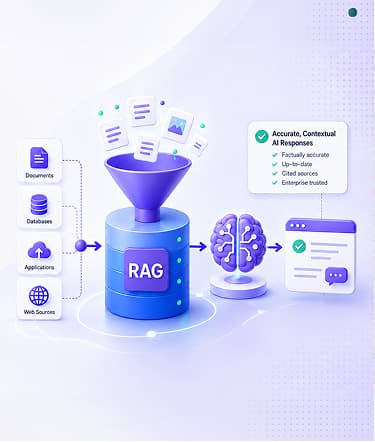
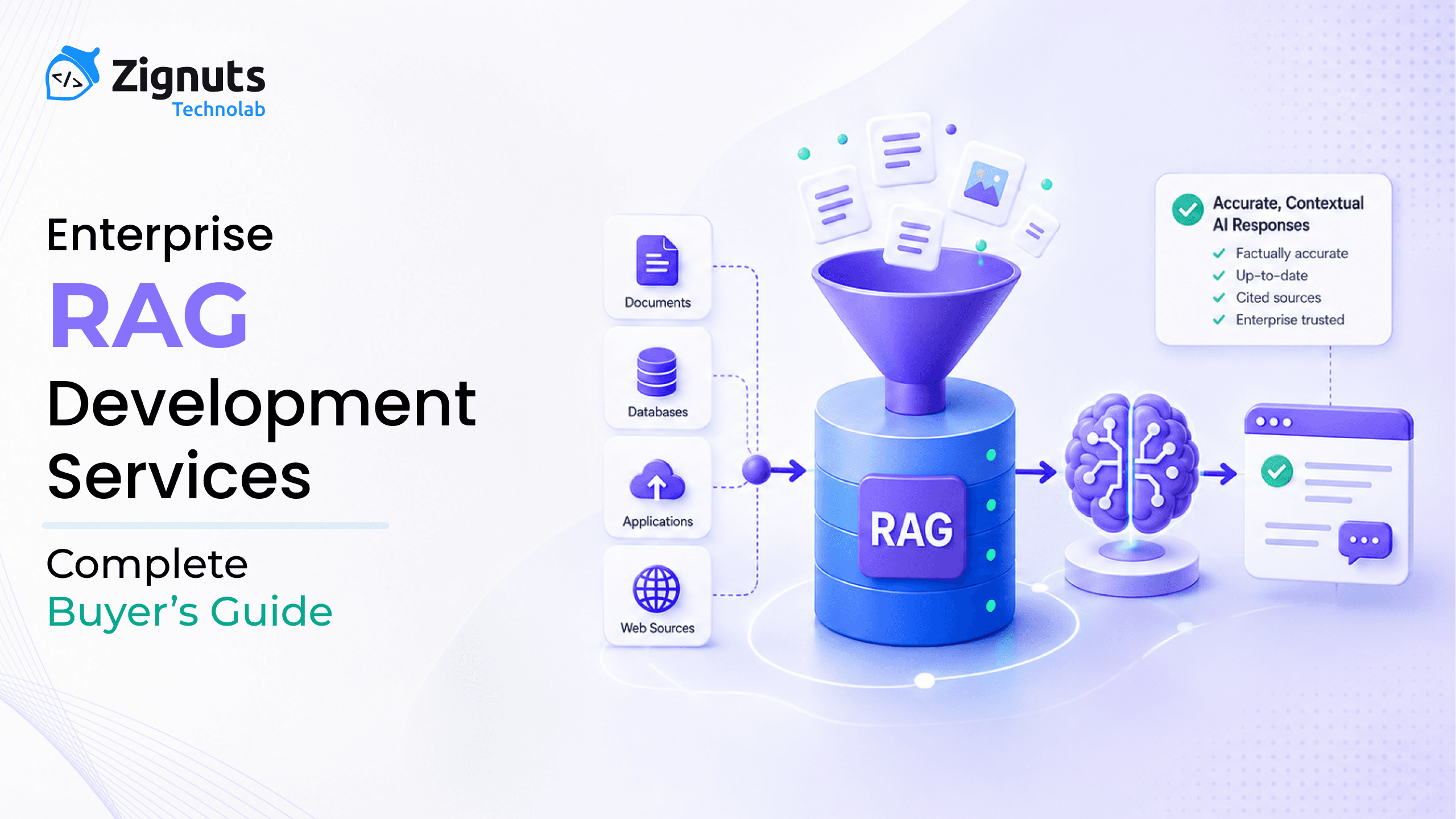
Enterprise RAG Development Services: What Enterprise Buyers Should Know
Selecting enterprise RAG development services in 2026 requires looking beyond basic vector search tutorials to evaluate complete end-to-end knowledge architectures. Production-grade Retrieval-Augmented Generation relies on a multi-stage pipeline: deep document parsing, hybrid dense-sparse retrieval (combining vector embeddings with BM25 keyword search), cross-encoder reranking, semantic prompt caching, and continuous evaluation harnesses (such as RAGAS or DeepEval). Over 78% of naive RAG proofs-of-concept fail in production because vector similarity alone cannot resolve exact entity matches, multi-hop document reasoning, or strict role-based access controls. This guide establishes the technical blueprints, pricing benchmarks ($30,000 to $200,000+), vendor evaluation scorecards, and verifiable case proof points required to procure enterprise RAG solutions.
Why Enterprise RAG Development Fails in Production
In 2023, building a Retrieval-Augmented Generation system meant running a simple Python tutorial: split PDF documents into 500-token chunks, compute OpenAI embeddings, store them in a vector database, fetch the top-5 cosine similarity matches, and stuff them into an LLM prompt. In an internal demo, this naive approach looked magical.
In enterprise production, naive RAG fails catastrophically. According to industry infrastructure data from Andreessen Horowitz and production benchmarks, more than 78% of initial enterprise RAG implementations never make it past the pilot stage. The failure is rarely caused by the underlying foundation model. It is caused by fragile retrieval mechanics.
When exposed to live enterprise corpora containing complex tables, scanned agreements, domain-specific terminology, and strict security boundaries, naive vector search breaks across three predictable failure modes:
Semantic Blindness on Exact Identifiers: Vector embeddings capture general conceptual meaning but fail on exact part numbers, contract clause numbers, legal statutes, and currency figures. Two completely opposite clauses can sit millimeters apart in vector space.
Chunk Fragmentation & Context Decapitation: Naive chunking breaks sentences and tables across arbitrary token limits, severing critical context and feeding incomplete facts to the generator.
The 'Lost in the Middle' Attention Degradation: As context windows grow, LLMs struggle to recall facts positioned in the middle third of retrieved context windows, resulting in confident, citation-backed hallucinations.
To deliver accurate, enterprise-grade AI systems, modern enterprise RAG development services build multi-stage retrieval pipelines pairing dense vector search with sparse lexical indexing, cross-encoder rerankers, semantic caching, and knowledge graphs.
Ready to Build Enterprise RAG Solutions?

How Enterprise RAG Development Services Build Production-Grade Systems
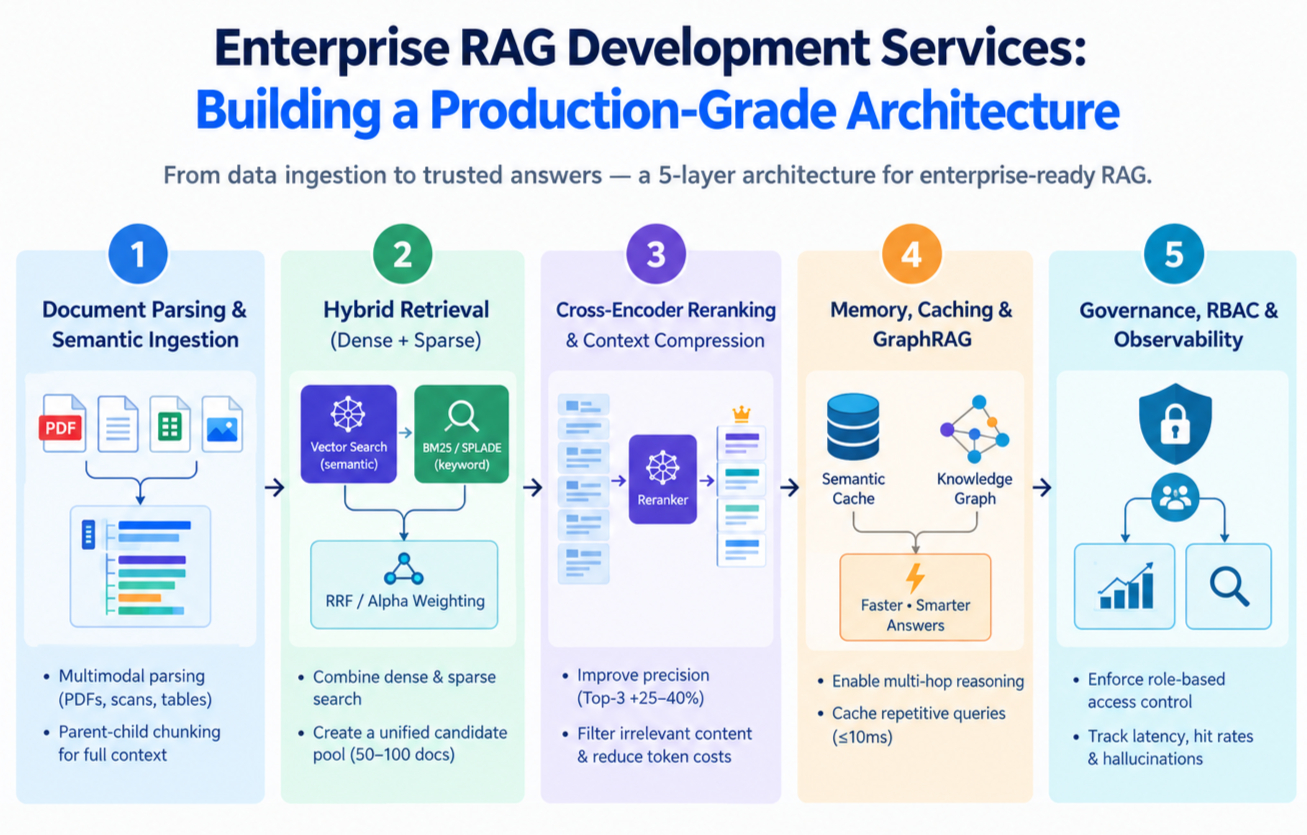
When evaluating enterprise RAG development services, engineering leadership must audit the prospective vendor across five distinct architectural layers:
Layer 1: Document Parsing and Semantic Ingestion for Enterprise RAG
Raw text extraction tools discard visual layout, table headers, footnotes, and document hierarchies. Production RAG engineering starts with deep multimodal parsing (using tools like Unstructured, LlamaParse, or custom vision-based OCR models) that converts complex PDFs, scanned reports, and spreadsheets into structured Markdown or semantic tree hierarchies.
Top engineering teams implement parent-child document chunking: indexing small 200-400 token child chunks for precise retrieval matching, while injecting the larger 1,500-2,500 token parent section into the LLM context window to preserve complete contextual integrity.
Layer 2: Hybrid Retrieval for Enterprise RAG Development
Production retrieval requires a hybrid strategy. Dense embeddings (such as OpenAI text-embedding-3-large, Cohere embed-v3, or domain-fine-tuned BGE models) capture semantic intent, while sparse inverted indexes (BM25 or SPLADE) capture exact product codes, customer IDs, and specific acronyms.
Reciprocal Rank Fusion (RRF) or learned alpha-weighting combines the ranked candidate sets into a unified candidate pool of 50 to 100 documents.
Ready to Build Enterprise RAG Solutions?
Layer 3: Reranking and Context Compression in Enterprise RAG
First-stage retrieval prioritizes recall (capturing all potential matches quickly). Second-stage cross-encoder rerankers (such as Cohere Rerank 3.5, BGE-Reranker-Large, or ColBERT) prioritize precision by evaluating the user query and each candidate chunk jointly.
Adding a cross-encoder reranking layer typically improves Top-3 retrieval precision by 25% to 40%, filtering out irrelevant passages before context injection and drastically lowering token costs.
Layer 4: Memory, Semantic Caching and GraphRAG for Enterprise RAG
For complex queries requiring multi-hop reasoning (e.g., 'Compare our Q3 supply chain risks across all European suppliers against our 2024 compliance audit'), standard chunk retrieval fails because the required facts are scattered across dozens of documents.
Enterprise RAG teams deploy Knowledge Graph RAG (GraphRAG), extracting entity-relationship graphs into Neo4j or Memgraph to enable multi-hop relationship traversal. In parallel, Redis semantic prompt caches intercept repetitive queries, returning validated answers in under 10 milliseconds and eliminating 30% to 50% of recurring model token expenses.
Layer 5: Enterprise RAG Security, Governance and Observability
An enterprise RAG system must never violate corporate security boundaries. Production systems enforce metadata-level Role-Based Access Control (RBAC), filtering vector and keyword search results so that employees only retrieve documents they are explicitly authorized to view.
Continuous observability engines (such as OpenTelemetry, LangSmith, and Arize Phoenix) track query latency, chunk hit rates, reranker score distributions, and hallucination rates across live user traffic.
Enterprise RAG Architecture Patterns: Comparing RAG Approaches
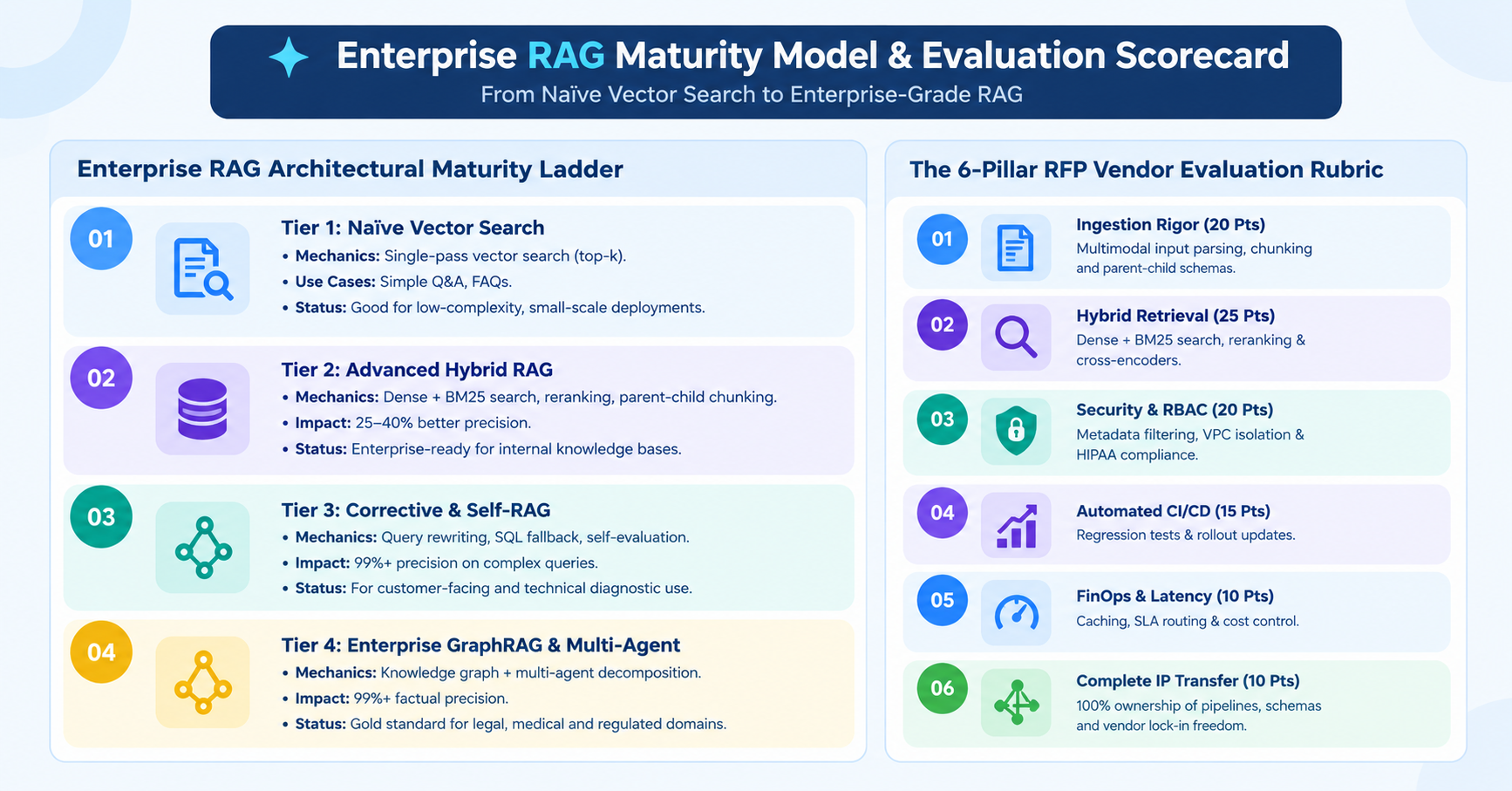
Enterprise technology leaders must match their architectural pattern to their specific domain complexity rather than over-engineering every use case:
RAG Architecture Tier | Retrieval Mechanics | Optimal Enterprise Use Case | Avg Latency | Accuracy Benchmark |
|---|---|---|---|---|
Tier 1: Baseline Semantic RAG | Single-pass dense vector search (top-k) with fixed chunking. | Simple internal FAQ bots, product manuals, unstructured blog search. | 800ms - 1.5s | 60% - 72% Precision |
Tier 2: Advanced Hybrid RAG (2026 Baseline) | Dense vector + BM25 keyword search, cross-encoder reranking, parent-child chunking. | Enterprise knowledge bases, customer support copilot, technical documentation. | 1.2s - 2.5s | 88% - 95% Precision |
Tier 3: Corrective & Self-RAG (CRAG) | LLM grader evaluates retrieval relevance; triggers web/SQL search fallback on low scores. | High-accuracy customer-facing assistants, technical diagnostic engines. | 2.0s - 4.0s | 94% - 98% Precision |
Tier 4: Enterprise GraphRAG & Multi-Agent | Knowledge graph entity traversal combined with hybrid vector search and query decomposition. | Legal contract redlining, pharmaceutical discovery, multi-entity fraud detection. | 3.5s - 7.0s | 97% - 99.5% Precision |
Ready to Build Enterprise RAG Solutions?
How to Evaluate Enterprise RAG Development Services
When vetting development agencies and systems integrators, use this quantitative 100-point evaluation rubric to score vendor proposals:
Evaluation Domain | Weight | Key Technical Due Diligence Verification Criteria | Critical Red Flag Warning |
|---|---|---|---|
1. Ingestion & Chunking Rigor | 20 Pts | Layout-aware document parsing (tables/figures), semantic chunking, parent-child document schemas. | Using naive fixed character splits (e.g., 500 characters with 50 character overlap). |
2. Hybrid Retrieval & Ranking | 25 Pts | Unified dense and BM25 sparse search with Reciprocal Rank Fusion and cross-encoder reranking. | Relying exclusively on vector similarity search with no keyword or metadata filtering. |
3. Security, RBAC & Compliance | 20 Pts | Row-level metadata filtering, private VPC deployment, PII masking, SOC 2/HIPAA compliance. | All embeddings stored in a shared, unpartitioned multi-tenant cloud without access controls. |
4. Automated Eval Harnesses | 15 Pts | Continuous automated regression evals measuring Faithfulness, Answer Relevancy, and Context Recall (RAGAS/DeepEval). | Testing exclusively by manually typing questions into a web playground interface. |
5. FinOps & Latency Controls | 10 Pts | Redis semantic prompt caching, model routing (SLMs for extraction, LLMs for synthesis), context pruning. | Streaming 50,000 raw unranked tokens into frontier reasoning models for every query. |
6. Full IP & Code Ownership | 10 Pts | 100% transfer of data pipelines, indexing scripts, prompt assets, and private cloud deployment code. | Proprietary black-box vendor platform lock-in with ongoing per-seat platform taxes. |
Ready to Build Enterprise RAG Solutions?
Enterprise RAG Development Cost: CapEx, OpEx and FinOps
Budgeting for enterprise RAG requires modeling both initial development capital expenditures (CapEx) and ongoing monthly operational expenses (OpEx):
Project Scope Tier | Typical CapEx | Timeline | Monthly OpEx | Included Architecture & Scope |
|---|---|---|---|---|
Tier 1: Departmental Knowledge PoC | $25,000 - $45,000 | 3 - 5 weeks | $500 - $1,500/mo | Single data source, Advanced Hybrid RAG pipeline, basic RBAC, standard vector DB. |
Tier 2: Production Multi-Source RAG | $50,000 - $110,000 | 2 - 3 months | $2,000 - $6,000/mo | Multi-source ingestion (SharePoint, Jira, Confluence, S3), reranking, semantic cache, automated CI/CD evals. |
Tier 3: Enterprise GraphRAG Platform | $120,000 - $250,000+ | 3 - 6 months | $6,000 - $20,000+/mo | Custom Knowledge Graph integration, multi-agent query decomposition, strict HIPAA/SOC 2 VPC vaults, continuous monitoring. |
6 Red Flags When Choosing Enterprise RAG Development Services
During discovery interviews, watch for these six disqualifying indicators that reveal whether a vendor has real production RAG engineering experience:
Red Flag 1: Vector-Only RAG Architecture
What the Vendor Says:
“Vector search is all you need in 2026; embeddings understand everything.”Production Failure Risk:
Complete failure on exact part numbers, contract IDs, financial metrics, and other keyword-sensitive information.
Red Flag 2: Fixed-Character Document Chunking
What the Vendor Says:
“We split documents every 1,000 characters to keep things fast.”Production Failure Risk:
Table corruption, severed clauses, and degraded contextual accuracy.
Ready to Build Enterprise RAG Solutions?
Red Flag 3: No Reranking in Enterprise RAG
What the Vendor Says:
“Reranking adds too much latency; top-5 vector matches are sufficient.”Production Failure Risk:
Potential precision loss and irrelevant passages entering generation prompts.
Red Flag 4: No Automated RAG Testing
What the Vendor Says:
“We test sample queries and verify that the answers look accurate.”Production Failure Risk:
No regression protection. Model updates or new data can silently break previously reliable queries.
Red Flag 5: Weak Enterprise RAG Access Controls
What the Vendor Says:
“We will ingest all company files so the AI knows everything.”Production Failure Risk:
Unauthorized access to confidential information, such as executive payroll, financial records, or restricted business documents.
Red Flag 6: Enterprise RAG Vendor Lock-In
What the Vendor Says:
“Use our proprietary hosted RAG cloud and pay per query.”Production Failure Risk:
Loss of data sovereignty, vendor lock-in, and unpredictable subscription costs.
Enterprise RAG Development Case Studies
A credible enterprise RAG engineering partner should demonstrate verifiable outcomes across regulated and high-throughput environments. Below are three real-world implementations mapped to the buyer evaluation journey:
Enterprise RAG Legal Research Case Study
The Business Challenge:
Legal practitioners and enterprise compliance teams struggled with high latency and hallucination risks when querying large databases of statutory codes, case precedents, and complex agreements.Engineered Solution:
A domain-specific Hybrid RAG engine combined dense vector embeddings with BM25 keyword search, contextual citation graphs, fine-tuned legal embeddings, and hallucination verification guardrails.Business & ROI Impact:
Reduced document audit turnaround times by 75% and cut token context retrieval costs by 45% through precision chunking.Enterprise AI Agent and RAG Platform Case Study
The Business Challenge:
Enterprise technology teams faced developer friction, architectural instability, and excessive infrastructure overhead when orchestrating custom multi-agent workflows across disconnected internal services.Engineered Solution:
A modular AI agent deployment platform featuring visual DAG state orchestration, standardized LLM routing pipelines, persistent vector memory stores, and containerized tool execution sandboxes.Business & ROI Impact:
Accelerated enterprise agent deployment velocity by 4x, reduced initial development CapEx by over 50%, and eliminated redundant prompt token consumption across multi-turn reasoning loops.Enterprise RAG Productivity and Knowledge Management Case Study
The Business Challenge:
Distributed enterprise teams struggled with context switching, unstructured communication, and institutional knowledge scattered across emails, documents, and chat channels.Engineered Solution:
Context-aware workplace copilots with real-time NLP summarization, semantic vector retrieval pipelines, and automated action-item extraction.Business & ROI Impact:
Enabled unified institutional knowledge discovery across 50,000+ internal documents and reduced information search time by 65% across distributed engineering teams.
Ready to Build Enterprise RAG Solutions?
Enterprise RAG Development: 5 Steps to Production
To move from evaluation to execution without wasting budget on disposable prototypes, engineering leaders should take these five immediate steps:
Benchmark Your Data Corpus: Audit your enterprise documents. Identify whether your corpus is dominated by unstructured prose, complex Markdown tables, scanned PDFs, or relational databases.
Enforce Hybrid Search as Your Day-One Baseline: Never approve a single-vector retrieval architecture. Require dense embeddings, sparse BM25 indexing, and cross-encoder reranking from sprint one.
Fund a Focused 3-Week Discovery & Architecture Sprint: Partner with an experienced AI engineering firm to deliver a comprehensive Technical Architecture Document (TAD), data parsing schema, and working prototype before committing to a full build.
Build Your Automated Evaluation Harness First: Create a gold-standard dataset of 50 to 100 challenging domain queries to measure Faithfulness and Answer Relevancy before writing generation prompts.
Demand 100% IP and Code Ownership: Ensure all pipeline code, vector schemas, and deployment scripts reside inside your private Virtual Private Cloud (VPC).

Mukund Patil
Business Enthusiast | Exploring ideas, trends, and opportunities, turning curiosity into meaningful insights and discovering smarter ways to make an impact.