

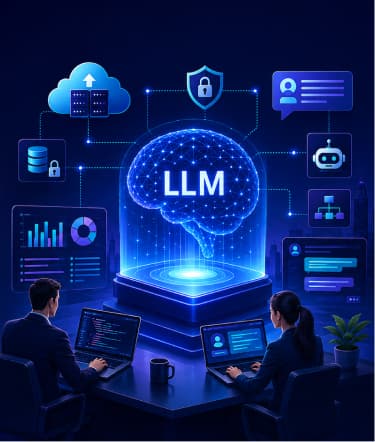
What Is Enterprise LLM Development?
Every enterprise technology leader has now run the same experiment. A team picks up ChatGPT or a similar consumer tool, gets impressive results on a demo, and assumes the same approach will scale into production. It rarely does.
The moment an LLM needs to:
Reason over proprietary data
Respect access controls
Integrate with internal systems
Produce consistent output at scale
The requirements change completely. This is where LLM Development Services go beyond simple prompting and focus on building systems that can operate reliably within an enterprise environment.
Enterprise LLM development is a distinct discipline from prompting a public model. It involves architecture decisions about:
How the model accesses data
How outputs are validated
How the system behaves under load
How the organization stays compliant with data governance and security requirements
It also involves an honest assessment of what a general-purpose model can do out of the box versus what requires custom engineering.
This guide is written for CTOs, VPs of Engineering, and enterprise architects who are past the exploration phase and need a working framework for evaluating, architecting, and building LLM systems that hold up in production.
Where implementation specifics are not tied to a documented deployment, this guide reflects current industry practice rather than a claimed case history, and is framed accordingly.
What Enterprise LLM Development Actually Involves
Enterprise LLM development is not a single deliverable. It typically spans four overlapping areas of work, and most real projects touch more than one.
Area | Role in Enterprise LLM Development |
|---|---|
Retrieval Systems | Connect a model to an organization's own data so answers are grounded in current, proprietary information rather than only model training data. |
Fine-Tuning / Adaptation | Improve consistency around specific formats, tone, domain vocabulary, or task behavior where prompting alone may not be sufficient. |
Agentic Systems | Enable the model to take multi-step actions, call internal tools and APIs, and complete workflows with limited human intervention. |
Integration & Governance | Connect the LLM system to enterprise software, authentication, logging, auditing, data governance, and risk controls. |
The Enterprise LLM Development Perspective
A useful way to frame this for a leadership team is to consider the difference between consumer AI adoption and enterprise LLM development:
Consumer AI adoption: “Can this tool help someone do their job faster?”
Enterprise LLM development: “Can this system operate correctly, securely, and predictably as part of how the business runs?”
The second question requires engineering, not just prompt design.
Ready to Build Your Enterprise LLM Solution?

Core Enterprise LLM Architecture Approaches: RAG, Fine-Tuning, Agentic Systems & Hybrid
Most enterprise LLM projects fail or succeed based on this decision, made early and often without enough rigor.
Approach | What It Does | Best Fit | Key Trade-off |
|---|---|---|---|
RAG (Retrieval-Augmented Generation) | Connects a language model to an external knowledge source at query time. Relevant documents or records are retrieved from a vector database or search index and included in the prompt context. | Best when the core problem is missing proprietary or frequently changing knowledge. Fast to implement, keeps the underlying model unchanged, and allows knowledge updates without retraining. | Quality depends heavily on retrieval. Poor retrieval can lead to confident but incorrect answers. |
Fine-Tuning | Adjusts the model's weights using a labeled dataset specific to the task. | Best when the problem is inconsistent behavior, rigid output formats, classification schemes, or narrow domain style. | Requires a meaningful, well-curated dataset and ongoing maintenance. It also creates closer dependency on a specific base model. |
Agentic Systems | Extends models with the ability to call APIs, query databases, trigger workflows, and coordinate multi-step actions. | Best when the objective is task completion rather than information retrieval. | Introduces state, error handling, side effects, and traditional software-engineering concerns. |
Hybrid Architecture | Combines approaches, such as RAG for factual grounding, light fine-tuning for consistent formatting, and an agent layer for workflows and tool calls. | Common in mature enterprise deployments because different architecture components address different gaps. | Requires careful orchestration and a clear understanding of which layer solves which business problem. |
The decision is rarely RAG versus fine-tuning versus agents in isolation. The practical question is which combination, in what order, addresses the specific gap between what a general model can do and what the business process requires.
Choosing a Foundation Model for Enterprise LLM Development
Proprietary hosted models, accessed through an API, offer the fastest path to a working system and generally the strongest raw capability, particularly for complex reasoning tasks. The trade-offs include:
Per-token cost at scale
Dependency on a third party's infrastructure and roadmap
Data-handling terms that need careful review for regulated industries
Open-source models, self-hosted or hosted through a cloud provider's managed offering, give an organization more control over:
Data residency
Customization
Long-term cost at high volume
The trade-offs are the operational burden of hosting, monitoring, and updating the model, and in many cases a capability gap versus leading proprietary models for the hardest reasoning tasks, although that gap has narrowed considerably.
The deployment environment is a related and equally important decision:
Cloud-hosted API access: Simplest operationally but sends data outside the organization's perimeter unless specific enterprise data-protection terms are in place.
Virtual private cloud deployment: Keeps the model within the organization's own cloud environment while still using a managed service.
Fully on-premises deployment: Offers maximum data control and is often required in healthcare, finance, government, and legal contexts, at the cost of significant infrastructure investment and ongoing maintenance.
Practical Decision Framework
Identify data sensitivity
Identify the data-sensitivity classification of the information the system will process first. This can eliminate deployment options before capability or cost are considered.Evaluate production costs
Evaluate cost at expected production volume rather than pilot volume, since per-token API pricing can become a high recurring cost at scale.Evaluate latency requirements
Evaluate latency requirements, since self-hosted models on well-provisioned infrastructure can outperform remote API calls for latency-sensitive use cases.
Enterprise LLM Development: Architecture Considerations
Enterprise LLM architecture involves more than selecting a foundation model. The supporting data, security, monitoring, scalability, and integration layers all need to work together to make the system reliable in production.
Data Pipelines and Vector Databases
RAG systems depend heavily on how source data is prepared and made available for retrieval. The quality of the data pipeline directly affects the quality of the responses.
Key considerations include:
Data chunking: How source documents are divided can significantly affect retrieval quality. Poor chunking strategies are a common cause of weak RAG performance.
Embedding: Source content needs to be converted into embeddings so that relevant information can be retrieved effectively.
Indexing: Retrieved information needs to be properly indexed to support efficient searches.
Data refresh: The system should account for how frequently source data changes and how quickly those updates need to become available.
Vector database selection: The choice of vector database should account for data volume, update frequency, and query latency.
Security and Compliance
Enterprise LLM systems need the same access-control discipline as other systems handling sensitive data. Security and compliance requirements should therefore be considered from the beginning of the architecture.
Important controls include:
Row- or document-level permissions to ensure users only access information they are authorized to see.
Encryption in transit and at rest to protect enterprise data.
Audit logs for retrieved and generated content to support monitoring and accountability.
Regulatory requirements such as HIPAA, SOC 2, and GDPR, which can shape architecture and deployment decisions from the start.
Observability
Traditional monitoring of uptime and errors is not enough for enterprise LLM systems. Organizations also need visibility into how well the AI system is actually performing.
Observability should cover:
Output quality
Hallucination rate
Retrieval accuracy
Cost per query
These signals provide a clearer view of whether the LLM system is delivering reliable results in production.
Scalability
Enterprise LLM workloads can behave differently as usage increases. Query volume, context-window size, and concurrent agent workflows can affect both cost and latency in non-linear ways.
For this reason:
Query volume should be considered when planning infrastructure capacity.
Context-window size should be evaluated because larger contexts can affect performance and cost.
Concurrent agent workflows should be accounted for when estimating production workloads.
Load testing should be performed before production rollout to identify scalability, cost, and latency issues early.
Integration Through APIs and MCP
Enterprise LLM systems often need to read from and write to existing business systems, including:
ERPs
Ticketing systems
Internal databases
The Model Context Protocol (MCP) provides a standardized way to connect LLM applications to external tools and data sources. This can reduce long-term maintenance compared with building and maintaining separate point-to-point integrations for each system.
A well-designed integration layer therefore allows the LLM system to interact with existing enterprise technology while keeping those connections more manageable as the AI environment grows.
Ready to Build Your Enterprise LLM Solution?
Enterprise LLM Development: Build vs. Buy vs. Partner
Choosing between buying an existing solution, building an LLM system in-house, or working with an experienced partner depends on the organization's requirements, internal expertise, customization needs, and long-term goals.
Buy
Buying an existing solution makes sense when:
A well-defined workflow is already served by vertical SaaS.
Deep customization is not required.
The primary risk is vendor lock-in and limited adaptability.
Build In-House
Building an LLM system internally makes sense when:
The organization has ML and backend expertise.
The use case is strategically important to the business.
Proprietary integration or customization is required.
The primary risk is that the ongoing engineering investment can be underestimated.
Partner
Working with an experienced engineering partner makes sense when:
Custom, proprietary-data-aware systems are needed.
The organization lacks production LLM expertise across RAG, fine-tuning, agents, security, and observability.
The primary risk is the need to select an experienced engineering partner and manage the external relationship.
Decision Criteria
Before deciding whether to buy, build, or partner, organizations should evaluate the following:
Existing team expertise: Evaluate expertise in the specific architecture required, not merely general software engineering.
Realistic time to market: Consider the learning curve when production LLM experience is limited.
Total cost of ownership: Evaluate costs over two to three years, including evaluation pipelines, retraining, reindexing, monitoring, and maintenance.
Security and compliance: Consider the required security and compliance posture.
Customization requirements: Assess the degree of customization needed for proprietary data and business processes.
Enterprise LLM Development: Implementation Roadmap
A successful enterprise LLM project typically moves through several stages, from defining the business problem to deploying and continuously monitoring the production system.
Discovery and Scoping
The first phase is to define the foundation for the project before making architecture decisions:
Business problem: Define the specific business problem the LLM system needs to address.
Data sources: Identify the data sources required by the system.
Compliance requirements: Define applicable compliance requirements early.
Success metrics: Establish measurable success metrics before architecture decisions are made.
Proof of Concept
Build a narrow working version against real data to validate the core architecture and identify issues early.
The proof of concept should help expose:
Retrieval issues
Access-control issues
Integration issues
Core Build
Once the core architecture has been validated, develop the required LLM components based on the selected approach:
RAG pipeline
Fine-tuning process
Agent orchestration layer
Evaluation framework, built alongside the system rather than added later
Integration
Connect the LLM system with the existing enterprise environment, including:
Enterprise tools
Authentication systems
Data sources
Access controls
Audit logging
Evaluation
Test representative real queries and scenarios using key performance measures such as:
Accuracy
Hallucination rate
Latency
Cost
Evaluation should also deliberately include edge cases and adversarial inputs to identify weaknesses before production deployment.
Deployment and Monitoring
Roll out the system with observability from day one. Production monitoring should include:
Cost tracking
Output-quality tracking
A process for reviewing flagged outputs
This ensures the system can be monitored continuously after deployment rather than treated as a one-time implementation.
Ready to Build Your Enterprise LLM Solution?
Enterprise LLM Development: Common Risks and Mitigation
Risk | Mitigation |
|---|---|
Hallucination | Strong retrieval, explicit source citations, and confidence thresholds with human-review fallbacks. |
Data privacy | Review provider data-processing terms, consider VPC or on-premises deployment for sensitive categories, and enforce source-system permissions in retrieval. |
Cost overruns | Model production-volume costs before architecture commitment and implement cost monitoring and alerting from the start. |
Model drift and degradation | Continuously evaluate against a fixed benchmark set to detect changes in the model, query patterns, or source data. |
Cost Considerations for Enterprise LLM Development
The cost of enterprise LLM development depends on more than the initial build. Organizations need to consider development, inference, infrastructure, and ongoing maintenance costs when planning for production.
Cost Category | What It Includes |
|---|---|
Development cost | Initial build, including data pipeline engineering, retrieval development, evaluation framework construction, and integration work. |
Inference cost | Ongoing per-query foundation-model cost through API usage or self-hosted infrastructure. This scales directly with usage. |
Infrastructure cost | Vector database hosting, self-hosted model infrastructure where applicable, and surrounding application infrastructure. |
Maintenance cost | Ongoing evaluation, monitoring, source-data pipeline updates, and periodic retraining or reindexing. |
Enterprise LLM Development: Where They Create Business Value
Enterprise LLM development can create value across use cases where large volumes of information, repetitive workflows, and proprietary data require faster and more efficient processing.
Contract Review and Legal Document Analysis
LLM systems can support pattern recognition across large volumes of text against known criteria, while maintaining human review checkpoints for final decisions.
Legal and Compliance Research
LLM systems can ground research in:
Organizational case history
Regulatory filings
Internal precedent
Humans remain in the loop for judgment calls.
Workflow Automation
Agentic systems can handle well-defined, rule-governed tasks such as:
Data entry
Routing
Status updates across internal systems
Embedded Productivity Tools
Tools integrated into existing employee workflows tend to achieve stronger adoption than standalone applications that require employees to change their existing processes.
Across these use cases, the strongest value pattern is a high-volume, repetitive task embedded into an existing workflow, grounded in proprietary data, with a clear human checkpoint where incorrect output has meaningful consequences.
Key Takeaways
RAG, fine-tuning, and agentic architectures solve different problems and are frequently combined rather than chosen exclusively.
Foundation-model and deployment-environment decisions should start from data sensitivity and realistic production cost, not isolated benchmark performance.
Retrieval quality, access control, and observability determine production readiness more than model selection alone.
Build, buy, and partner are not mutually exclusive categories; the right choice depends on expertise, time to market, total cost of ownership, and customization requirements.
Cost planning should account for development, inference, infrastructure, and maintenance as distinct ongoing categories.
The highest-value use cases combine high-volume repetitive work, proprietary-data grounding, and a clear human checkpoint for high-stakes decisions.

Virang Kori
Business Analyst | Analyzing business needs, processes, and data to uncover insights, improve efficiency, and support smarter business decisions.