

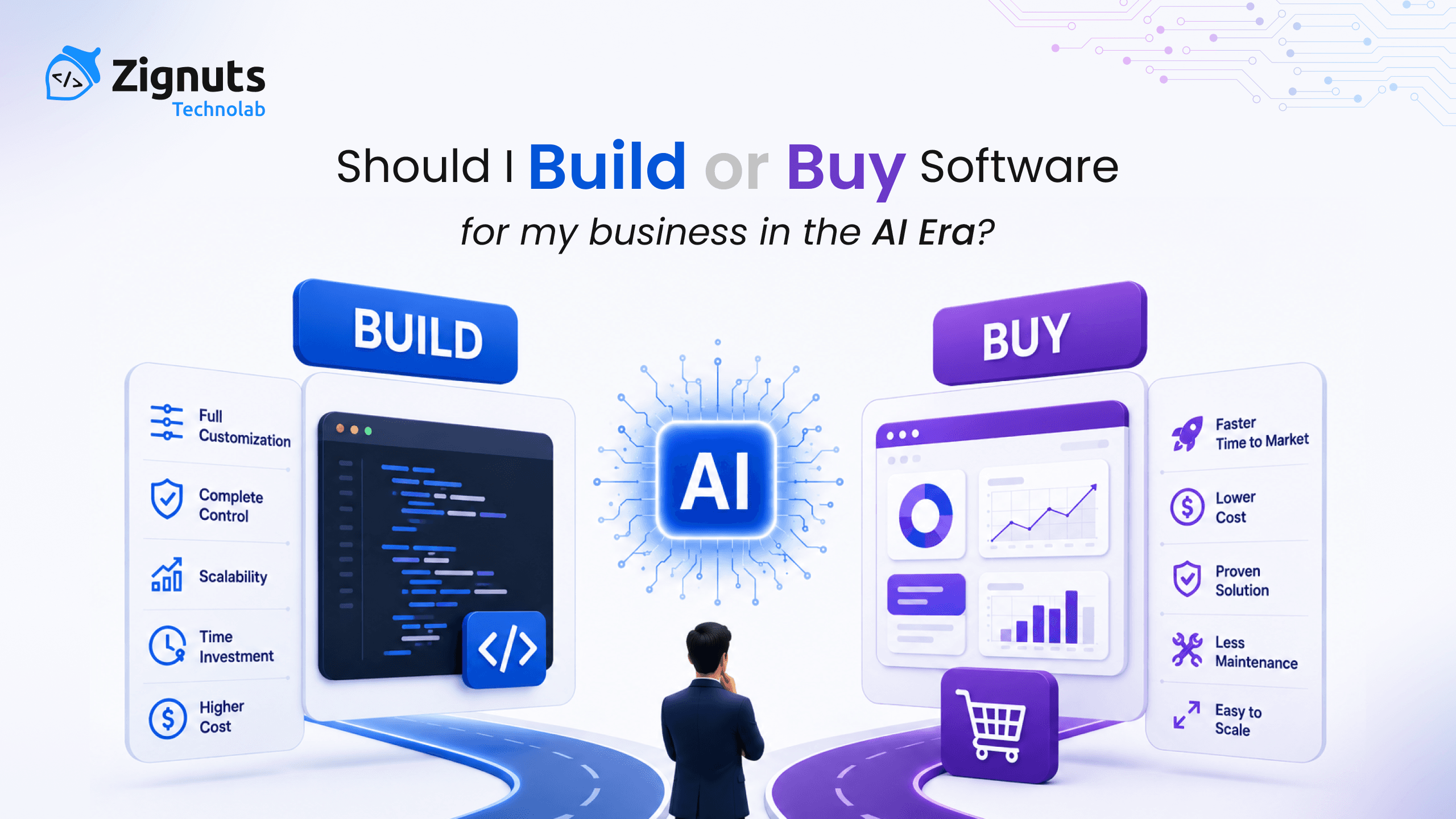
In the AI era, the build or buy software decision is no longer just a budgeting exercise. It has become a strategic decision that influences competitive advantage, operational efficiency, data ownership, AI readiness, and long-term scalability.
Many organizations initially compare software based on licensing costs or development budgets. However, enterprise leaders now need to evaluate a much broader set of factors, including workflow fit, integration complexity, security requirements, governance, vendor dependency, and how future AI capabilities will operate within their technology ecosystem.
The right decision depends on more than whether software can perform a task today. It depends on whether that software can evolve alongside your business, support proprietary workflows, and create sustainable business value over the next three to five years.
This guide explains when buying software makes the most sense, when custom software development creates a stronger competitive advantage, and why many organizations are adopting hybrid software strategies to combine the strengths of both approaches.
What build or buy software means in 2026
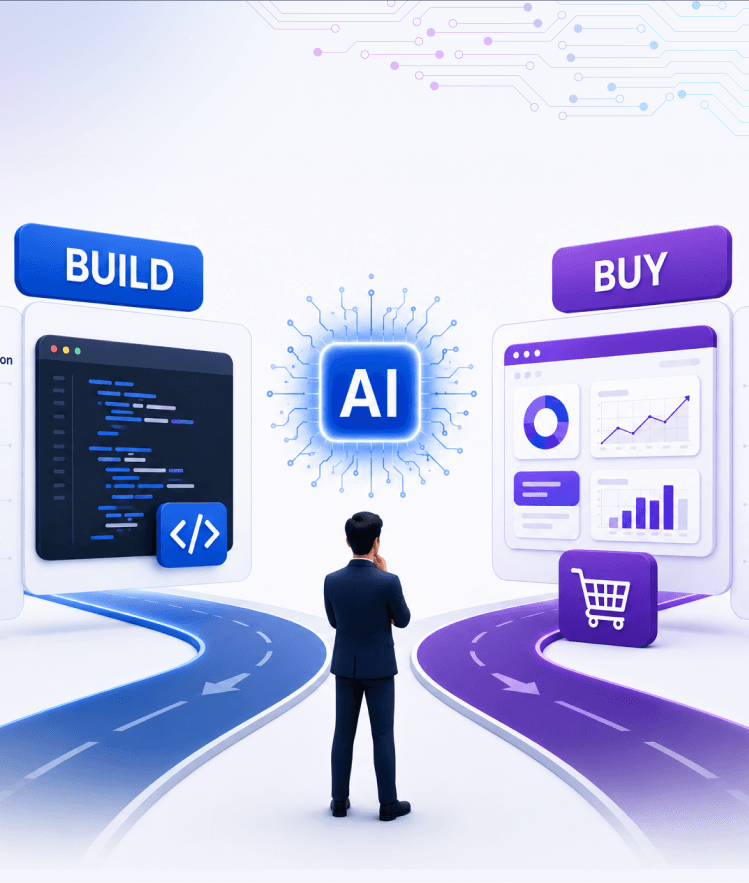
Buying software usually means adopting a SaaS platform, packaged enterprise application, or commercial AI product. Building software means creating a custom application, internal platform, AI-enabled workflow, customer portal, marketplace, SaaS product, or automation layer tailored to your business. Many modern decisions are hybrid: companies buy proven components, then build proprietary workflows, integrations, analytics, and AI capabilities around them.
This hybrid model is becoming common because AI value depends heavily on context. Generic tools can automate common tasks, but differentiated outcomes often require access to internal data, domain-specific processes, governance rules, human approval flows, and integrations with ERP, CRM, data warehouses, payment systems, legacy applications, and cloud infrastructure.
What Has Changed in the AI Era?
Ten years ago, build versus buy decisions focused primarily on implementation cost and delivery speed. Today, artificial intelligence has fundamentally changed that equation.
Modern software is expected to support intelligent automation, AI agents, predictive analytics, conversational interfaces, document intelligence, and workflow orchestration. These capabilities depend on far more than software features. They require reliable data, flexible APIs, secure integrations, scalable architecture, and governance.
A software platform that appears suitable today may become a limitation tomorrow if it cannot integrate with evolving AI capabilities or support the organization's long-term digital transformation strategy.
Enterprise leaders should evaluate software not only for its current functionality but also for its ability to become an intelligent platform over time.
Ready to Make the Right Build or Buy Decision?

When buying software is the better choice
Buying is often the right path when the process is standardized and not strategically unique. Examples include payroll, accounting, helpdesk, basic CRM, commodity collaboration, HR administration, and compliance workflows where mature vendors already provide secure, reliable functionality. Buying reduces time to value, shifts infrastructure responsibility to the vendor, and gives teams predictable maintenance and support.
Buy when these conditions apply
The workflow is common across your industry and does not create direct competitive advantage.
Speed matters more than customization, and a proven platform can be implemented quickly.
Your team can adapt its process to the software without damaging productivity or customer experience.
Security, compliance, uptime, and support are mature enough for enterprise requirements.
Total cost of ownership remains acceptable after seats, add-ons, integrations, data storage, and vendor services.
However, enterprise buyers should look beyond subscription pricing. SaaS costs can increase with user growth, transaction volume, premium AI features, API limits, data exports, or advanced security controls. Vendor lock-in also matters when critical business data, customer workflows, and operational logic become difficult to move later.
When building custom software is the better choice
Building is stronger when software supports a proprietary process, revenue model, customer experience, operational advantage, or data strategy. If your business depends on unique workflows, complex integrations, industry-specific decision logic, AI-driven automation, or differentiated digital products, custom software can become an asset rather than an expense.
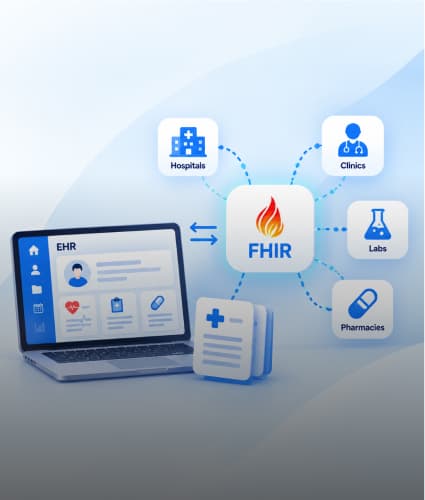
Consider a healthcare provider managing patient scheduling, insurance verification, electronic health records, and clinical documentation. While generic healthcare software may support basic administration, competitive differentiation often depends on integrating these systems with proprietary workflows, AI-assisted diagnostics, patient engagement tools, and compliance automation.
In this scenario, custom software creates operational advantages that packaged software cannot easily provide.
Build when these conditions apply
The process is unique, high-value, or central to your competitive advantage.
Off-the-shelf tools require too many workarounds, manual steps, spreadsheets, or disconnected systems.
You need deep integrations across internal systems, third-party APIs, IoT devices, AI models, or legacy platforms.
Data ownership, model governance, auditability, and compliance are business-critical.
You expect the platform to scale across regions, business units, customers, partners, or new revenue streams.
Custom software also provides control over product roadmaps. Instead of waiting for a vendor to support a specific capability, your team can prioritize features based on business value, customer feedback, regulatory needs, or market opportunity. For SaaS companies, marketplaces, logistics firms, fintech platforms, healthtech providers, manufacturers, and enterprise service businesses, that control can be strategically important.
The AI factor: why the decision has changed
AI changes the build-or-buy equation because value is not only in the model. The real value comes from the surrounding system: clean data pipelines, prompt and context management, retrieval architecture, permissions, observability, human-in-the-loop review, security policies, and integration with operational systems. A generic AI tool may improve productivity, but enterprise-grade AI adoption requires architecture.
For example, a bought AI assistant may summarize documents, but a custom AI workflow can connect to customer history, pricing rules, inventory, support tickets, contracts, and approval policies. That difference affects accuracy, accountability, and measurable business impact. Enterprises should ask whether AI is being used for convenience or for transformation.
AI build-or-buy questions leaders should ask
Does the AI solution need proprietary business data to produce reliable outcomes?
Will the system make, recommend, or automate decisions that require audit trails?
Can vendor AI features satisfy your privacy, compliance, and data residency obligations?
Do you need flexibility to use multiple models, cloud providers, or retrieval strategies?
Will AI become part of a customer-facing product, internal operating system, or revenue-generating platform?
Ready to Make the Right Build or Buy Decision?
Cost comparison: upfront price versus total cost of ownership
Buying typically has lower upfront cost, while building requires investment in product discovery, UX design, architecture, development, testing, DevOps, security, and ongoing support. But enterprise decisions should be based on total cost of ownership over three to five years, not initial budget alone.
For bought software, include subscription growth, implementation services, customization, training, integration middleware, data migration, premium support, AI usage fees, compliance features, and exit cost. For custom software, include discovery, engineering, cloud hosting, maintenance, enhancements, monitoring, security updates, and product management. The right financial question is not which is cheaper today, but which option creates more business value per dollar over time.
Decision Factor | Buy Software | Build Software |
|---|---|---|
Initial investment | Lower | Higher |
Time to deploy | Faster | Longer |
Customization | Limited | Complete |
AI flexibility | Vendor dependent | Fully customizable |
Data ownership | Shared responsibility | Full control |
Vendor lock-in | Higher | Minimal |
Competitive differentiation | Low | High |
Long-term scalability | Platform dependent | Business controlled |
Speed, flexibility, and scalability trade-offs
One pattern becomes clear across enterprise software projects. Organizations often buy software because they need immediate operational capability, but they eventually build custom platforms once standardized tools begin limiting growth.
This evolution is common among SaaS companies, logistics providers, fintech businesses, healthcare organizations, and rapidly growing startups. As customer expectations become more specialized, the limitations of generic software become increasingly visible.
Signs Buying Software Is Becoming a Limitation
Many organizations recognize the need for custom software only after recurring operational problems begin affecting productivity and customer experience.
Common indicators include:
Teams rely heavily on spreadsheets outside the platform.
Employees manually transfer data between systems.
Multiple disconnected SaaS tools create duplicate work.
Business processes adapt to software limitations instead of business requirements.
AI initiatives stall because data cannot move between systems.
API limitations prevent automation.
Reporting requires manual consolidation.
These are often signs that the organization has outgrown packaged software.
AI Readiness Checklist Before Building
Before investing in custom AI software, leadership teams should validate:
✓ Business objective is clearly defined.
✓ Required data is available and governed.
✓ Existing systems expose reliable APIs.
✓ Security and compliance requirements are documented.
✓ Success metrics are measurable.
✓ Executive ownership is established.
✓ Long-term maintenance has been planned.
AI implementation becomes significantly easier when these foundations are established before development begins.
Ready to Make the Right Build or Buy Decision?
Security, compliance, and data governance
Security should be a deciding factor, not a checklist item. Buying from a reputable vendor may provide strong baseline controls, certifications, and dedicated security teams. But if the vendor stores sensitive operational data, trains AI models on customer inputs, limits audit access, or lacks required compliance support, risk increases.
Custom software gives more control over encryption, access control, data retention, identity management, logging, data residency, and approval workflows. It also requires disciplined engineering practices such as secure architecture reviews, penetration testing, dependency management, cloud hardening, CI/CD controls, monitoring, and incident response planning. The best option depends on your internal risk profile and regulatory environment.
A practical decision framework for executives
Use a decision framework before committing budget. Score each option across strategic value, speed, fit, cost, integration, AI readiness, security, scalability, vendor dependency, and roadmap control. If most value comes from standardized execution, buy. If value comes from differentiated workflows, data intelligence, customer experience, or platform ownership, build. If both are true, design a hybrid architecture.
Recommended decision path
Map the business process and identify where software directly affects revenue, margin, risk, or customer retention.
Assess whether existing SaaS platforms can meet 80 percent of requirements without harmful workarounds.
Estimate total cost of ownership over multiple years, including integrations and AI usage.
Identify data, compliance, and security requirements before selecting vendors or architecture.
Validate with a prototype, proof of concept, or MVP before a large-scale investment.
Choose an engineering partner that can support discovery, architecture, development, cloud deployment, integrations, and ongoing product evolution.
Treating AI features as a substitute for business process improvement instead of an enhancement to well-designed workflows.
Why hybrid software strategies often win
For many enterprises, the strongest answer is not build or buy, but build around what you buy. A company might use Salesforce, HubSpot, SAP, Stripe, Shopify, Microsoft, AWS, or Google Cloud, then create a custom platform that connects data, automates workflows, adds AI recommendations, and gives teams a unified experience. This avoids reinventing commodity functions while preserving differentiation where it matters.
Hybrid architecture is especially useful for digital transformation. It allows businesses to modernize legacy systems gradually, reduce operational silos, and introduce AI without disrupting core operations. APIs, event-driven architecture, microservices, cloud-native infrastructure, and data platforms can create a flexible foundation for future product development.
Common mistakes in build-or-buy decisions
Choosing the cheapest SaaS tool without calculating integration and scaling costs.
Building custom software for a commodity process that could be solved faster with a mature platform.
Ignoring data migration, change management, user adoption, and operational ownership.
Assuming AI features are enterprise-ready without testing accuracy, governance, and privacy controls.
Over-customizing a bought platform until it becomes expensive, fragile, and difficult to maintain.
Starting development without product discovery, architecture planning, and measurable business outcomes.
How to choose the right software engineering partner
The right engineering partner should challenge assumptions before writing code. Strong software teams spend time understanding business objectives, validating requirements, evaluating build versus buy options, and designing scalable architecture before development begins.
Look for partners with experience delivering custom software, enterprise integrations, AI implementation, cloud-native applications, SaaS platforms, DevOps, API engineering, and long-term product evolution. Technical capability matters, but the ability to align engineering decisions with business outcomes is what ultimately determines project success.
Ready to Make the Right Build or Buy Decision?
Final recommendation
There is no universal answer to the build versus buy question. The best decision depends on where your organization creates competitive value.
Buy software when standardized functionality delivers the outcome efficiently. Build software when proprietary workflows, customer experience, operational intelligence, or AI capabilities become strategic differentiators. Adopt a hybrid approach when proven commercial platforms can handle commodity functions while custom engineering creates unique business value.
Organizations that treat software as a long-term business asset rather than a short-term procurement decision are better positioned to adapt to changing markets, integrate emerging AI capabilities, and scale with confidence.
For businesses evaluating custom software development, enterprise modernization, AI integration, or digital transformation initiatives, investing time in architecture, data strategy, and technology planning before development often delivers greater long-term returns than choosing between build and buy too early.

Deep Mistry
Digital Marketing Enthusiast | Diving into the world of trends, tools, and strategies, sharing discoveries that help create impactful online experiences.