

The Production Reality Facing an AI Center of Excellence
Eighteen months after funding a centralized AI initiative, enterprise leadership often faces an uncomfortable reality: disconnected LLM proofs-of-concept, security breaches involving sensitive data, rising cloud inference costs, and few or no revenue-generating AI systems in production.
This failure is rarely caused by weak machine learning models. It happens because organizations misunderstand the purpose of an AI Center of Excellence (AI CoE). Effective AI Consulting Services can help define the right AI strategy, operating model, governance, and technical foundation, but the AI CoE must turn that strategy into a scalable production capability.
The problem usually takes two forms:
Research-led CoE: Builds isolated prototypes that struggle to reach production.
Governance-led CoE: Creates approval bottlenecks that push engineering teams toward shadow IT.
A centralized delivery model creates another challenge: project backlogs grow while the CoE lacks the specialized domain expertise required for every business workflow.
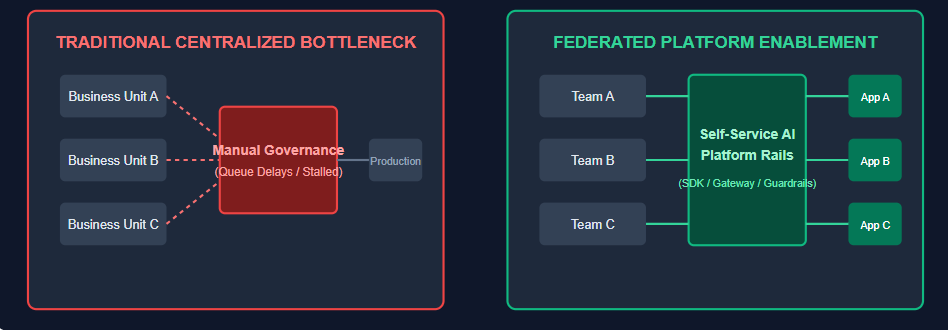
To scale AI reliably, enterprises need a federated platform engineering model: centrally governed, decentrally delivered. The AI CoE builds shared platforms, infrastructure, security guardrails, and reusable architectural patterns, allowing product teams to self-serve AI capabilities safely and accelerate production adoption.
AI Center of Excellence Operating Model: Why Most Structures Fail
Choosing the correct operating model dictates whether an AI CoE accelerates delivery or stalls momentum. Organisations generally fall into three operational structures, but only one scales to enterprise production demands.
Operating Model | Delivery Velocity | Governance & Security | Scalability | Primary Failure Mode |
|---|---|---|---|---|
Centralised Innovation Lab | Low (high backlog) | High control | Poor (does not scale) | Builds impressive prototypes that never integrate with enterprise systems of record. |
Decentralised / Shadow AI | High short-term | Uncontrolled / Dangerous | Fragmented | Duplicate API spend, PII data leakage, inconsistent security, vendor lock-in. |
Federated Platform Enablement (Recommended) | High sustainable | Embedded & Automated | High (self-service) | Requires strong initial platform engineering expertise and clear organisational decision rights. |
Why Federated AI Enablement Scales
In a federated enablement model, the AI CoE acts as an internal platform product team, with the enterprise software engineer as its primary customer. By providing production-ready software development kits (SDKs), an API gateway, pre-built retrieval-augmented generation (RAG) pipelines, and compliance guardrails, the CoE shifts governance from manual approval meetings to automated platform guardrails.
Key capabilities include:
Production-ready SDKs for enterprise software engineers.
API gateway for centralized AI access and control.
Pre-built RAG pipelines for faster AI implementation.
Compliance guardrails to automate governance and security controls.
When engineering teams have a paved path that makes secure integration faster than building custom integrations, adoption happens naturally. Instead of enforcing compliance through friction, the platform engineering approach makes compliance a default byproduct of using the core developer toolkit.
This organizational structure also aligns financial incentives across business units. Instead of individual departments negotiating separate cloud vendor contracts or managing isolated model subscriptions, the central platform aggregates token volume.
As a result, the enterprise can gain substantial volume discounts while central finance gets real-time visibility into cost allocation by business unit, project, or API consumer.
Ready to Build Your Enterprise AI Center of Excellence?

The Enterprise AI Center of Excellence Architectural Blueprint
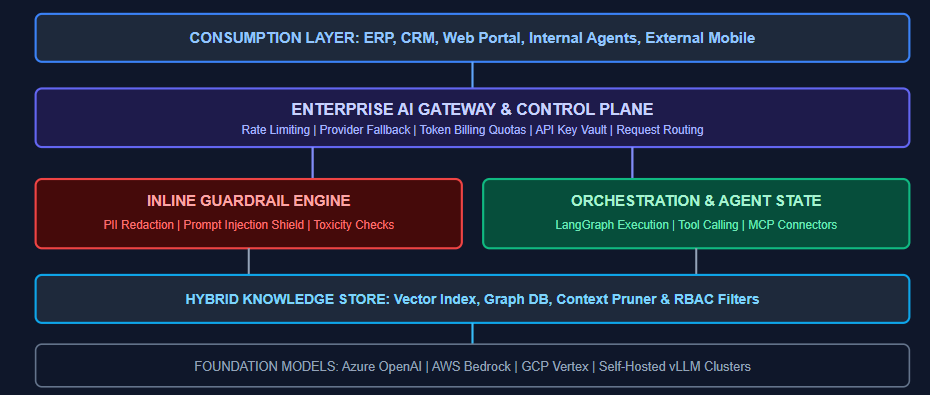
An enterprise AI platform requires a structured architecture that decouples application logic from underlying foundation model providers. Without this separation, switching model vendors or updating system prompts can require breaking code changes across multiple microservices.
1. The Enterprise AI Gateway
The AI Gateway serves as the single point of ingress for all LLM calls across the enterprise. It abstracts API provider complexity, manages global rate limits, enforces team-based cost allocations, and provides automated failover when primary model providers experience outages or latency spikes.
A unified gateway helps enterprises:
Avoid locking business logic into proprietary vendor SDKs.
Switch model providers through a single gateway configuration.
Adjust fallback chains without redeploying applications.
Deploy lower-cost quantized open-source models for specific background tasks.
This allows downstream application code to remain unchanged while the platform layer manages model-provider decisions.
2. Embedded Guardrails and Autonomy Thresholds
Security and compliance cannot rely solely on developer discipline. The guardrail engine sits inline with the gateway, automatically scrubbing personally identifiable information (PII) before requests reach external provider APIs.
For agentic AI workflows, the engine also enforces policy controls and monetary autonomy thresholds. For example, an autonomous customer service agent might process refunds under $500 automatically but trigger a human-in-the-loop workflow for higher amounts.
These guardrails help protect against:
Prompt injection attacks
Jailbreaking attempts
Non-deterministic agent loops
Unauthorized autonomous actions
By establishing centralized execution controls, compliance teams gain confidence while development teams maintain speed.
3. Unified LLMOps and Observability
Traditional Application Performance Monitoring (APM) tools cannot evaluate model hallucinations, retrieval quality, or prompt drift. An enterprise LLMOps stack provides real-time token tracking, trace analytics for multi-step agent interactions, and automated red-teaming pipelines that stress-test prompts before production deployment.
Effective observability for non-deterministic AI systems requires tracking:
Inputs and final completions
Intermediate reasoning steps
Database and tool calls
Retrieval and context quality
System prompt behavior
When an agentic workflow executes the wrong tool or returns incorrect data, trace analytics help platform engineers determine whether the failure originated from poor context retrieval, faulty system prompt instructions, or model reasoning errors.
AI Center of Excellence Governance: Establishing Decision Rights and Risk Triage
Governance fails when every AI idea undergoes the same review rigour. A two-line text summary feature does not carry the operational risk of an autonomous claim processing agent. A high-velocity AI CoE implements a three-tier intake triage process:
Tier 1: Low Risk (Self-Service)
Standard internal productivity tools using approved, read-only enterprise data sources. Product teams deploy instantly using standardised gateway templates without manual CoE sign-off.Tier 2: Medium Risk (Automated Review)
Customer-facing applications or internal systems modifying low-value data. Requires automated security scanning, policy check validation, and standard LLMOps evaluation testing.Tier 3: High Risk (Full CoE Architecture Review)
Autonomous agents executing system writes, highly regulated financial or medical processes, or systems processing highly sensitive data. Requires joint architecture, security, and legal review.
Categorising projects by objective risk profile prevents the AI CoE from becoming overwhelmed with administrative approvals. It directs specialised engineering, security, and legal resources toward high-impact, high-risk implementations while allowing low-risk productivity wins to scale autonomously.
THE HIDDEN PRODUCTION TRAP: CONTEXT WINDOW EXPLOSION
Engineers often assume larger context windows eliminate the need for optimised context retrieval. In production systems, stuffing 100,000 tokens into an LLM context window causes two severe issues: quadratic cost growth and accuracy degradation (known as "lost in the middle"). Production-grade RAG systems require dynamic context compression, hybrid vector-keyword retrieval, and precise document chunking to keep inference costs sustainable and output accuracy high.
Ready to Build Your Enterprise AI Center of Excellence?
Architectural Trade-Offs in an AI Center of Excellence
Building an enterprise AI platform requires evaluating trade-offs where no universally perfect answer exists. Engineering leaders must navigate these operational realities carefully.
Centralised Control vs. Engineering Velocity
Strict central control reduces compliance risk but can encourage teams to set up shadow cloud accounts. Overly permissive decentralisation enables rapid pilots that may fail security audits during production rollout. The solution is to provide paved paths: pre-approved infrastructure templates that make the secure approach the fastest way to ship.
When platform teams deliver clear infrastructure templates, developer experience improves. Software engineers no longer spend weeks configuring API authentication, setting up vector database indices, or writing custom PII redaction code.
Key considerations:
Use pre-approved infrastructure templates as paved paths.
Make the secure approach the fastest way to ship.
Reduce manual API authentication and infrastructure setup.
Use pre-tested infrastructure while maintaining central security standards.
Build vs. Buy for the AI Gateway Layer
Off-the-shelf gateway solutions accelerate initial setup but may lack custom integration points for proprietary enterprise identity providers, custom role-based access control (RBAC), or legacy on-premises systems. Building a gateway in-house provides complete control but consumes valuable platform engineering resources that could otherwise support core domain business tools.
Key considerations:
Evaluate custom integration requirements.
Consider proprietary identity providers and custom RBAC.
Account for legacy on-premises system integrations.
Balance maintenance overhead against customisation needs.
Consider a custom gateway for sovereign cloud mandates or complex hybrid infrastructures.
For organisations with these requirements, a custom gateway layer may be necessary to support custom encryption protocols and deep legacy system integrations.
Fine-Tuning vs. Retrieval-Augmented Generation (RAG)
Fine-tuning an LLM embeds static domain knowledge into model weights, but it does not reliably teach a model new facts and introduces high retraining costs as enterprise data changes. RAG remains the preferred pattern for dynamic knowledge retrieval, while fine-tuning should be reserved for modifying tone, output format, or domain-specific language structures.
Key considerations:
Use RAG for dynamic enterprise knowledge retrieval.
Use fine-tuning for tone, output format, or domain-specific language structures.
Avoid relying on fine-tuning for frequently changing facts.
Use vector and hybrid databases to store enterprise knowledge.
Apply strict access controls to preserve data privacy boundaries.
RAG pipelines allow organisations to leverage real-time enterprise data without modifying underlying model weights. With strict access controls, users only retrieve information they are explicitly authorised to view.
Where an Engineering Partner Strengthens Your AI Center of Excellence
Establishing an Enterprise AI Center of Excellence requires a combination of enterprise systems architecture, platform engineering, LLMOps discipline, and organisational enablement. While internal technology teams understand their core domain business logic, building reusable platform foundations can strain existing engineering bandwidth.
This is where an experienced software engineering partner can accelerate delivery. An engineering partner helps enterprise technology leaders move from strategy to production-grade architecture by building robust foundational infrastructure, including:
Custom Enterprise AI Gateways: Designing resilient ingress layers with rate limiting, provider fallback strategies, unified logging, and RBAC integration.
Production RAG & Vector Search Infrastructure: Architecting hybrid retrieval pipelines, dynamic chunking strategies, and secure enterprise data integrations.
Agentic Workflow Orchestration: Implementing stateful agent frameworks with explicit autonomy thresholds, reasoning transparency, and human-in-the-loop controls.
LLMOps Pipeline Setup: Establishing automated evaluation suites, prompt management registries, cost monitoring dashboards, and CI/CD integration for model updates.
By partnering on platform construction, enterprise teams avoid common architectural debt and establish an AI CoE that acts as a force multiplier across the entire organisation.

Utkrishti Mishra
Business Analyst Intern | Exploring data, processes, and business strategies to turn insights into smarter decisions and impactful solutions.