

Enterprise AI Center of Excellence: Executive Summary
Implementing an enterprise AI Center of Excellence (AI CoE) in 2026 requires moving from experimental data science labs and static review committees to an engineering-driven, federated Hub-and-Spoke platform model. While over 70% of enterprise AI initiatives fail to generate sustained financial returns, high-performing organizations achieve 4x deployment velocity by centralizing foundational infrastructure, including unified AI gateways, Model Context Protocol tool registries, hybrid RAG meshes, and automated CI/CD evaluation harnesses, while embedding cross-functional AI product pods within decentralized business units. AI Consulting Services can also support enterprises in defining the right AI strategy, architecture, governance, and implementation roadmap.
An effective AI CoE establishes automated code-level guardrails, risk-tiered governance aligned with the EU AI Act and NIST AI RMF, and transparent FinOps token showback models to turn isolated AI experiments into a compounding competitive moat.
Why Centralized AI Centers of Excellence Fail
Over 80% of Fortune 500 enterprises have established an AI Center of Excellence (AI CoE) over the past two years. With corporate artificial intelligence investments surging to over 41.5% of total enterprise IT spending in 2026, boardrooms expect these centralized units to drive rapid automation, reduce operating expenses, and deliver customer-facing AI products.
Yet, the majority of AI Centers of Excellence fail to deliver tangible commercial impact. Industry research indicates that between 70% and 85% of enterprise AI initiatives remain trapped in perpetual proof-of-concept stages.
The failure is rarely technical; it is rooted in fundamentally flawed organizational design.
Traditional AI CoEs succumb to the 'Ivory Tower Paradox.' Organizations hire academic data scientists and prompt engineers, sequestering them in a centralized innovation lab disconnected from business unit P&Ls.
These teams build impressive internal prototypes and run company-wide hackathons, but they lack the operational authority and software engineering depth to integrate solutions into production enterprise ERPs, CRMs, and core microservices.
Conversely, other enterprises make the opposite mistake: turning the AI CoE into an onerous 'Approval Queue.' Business units attempting to deploy AI are subjected to bureaucratic compliance checklists, creating massive delivery bottlenecks.
Frustrated business leaders route around the center, giving rise to unmonitored 'Shadow AI' that exposes the company to data leaks, unmetered API costs, and compliance penalties.
To succeed in the agentic AI era, enterprises must build a modern Platform CoE: an engineering-first hub that provides reusable infrastructure, pre-approved architectural blueprints, automated safety guardrails, and embedded delivery pods to make the right way the easiest way.
Why Manual AI Governance Creates an Approval Bottleneck
When an AI Center of Excellence operates as a manual review board, every new AI workflow requires bespoke compliance committee meetings. As demand scales from 5 to 50 concurrent business unit requests, review turnaround times balloon from days to months. Business units inevitably bypass the CoE, using personal API keys to deploy unvetted SaaS tools.
Modern CoEs eliminate this bottleneck by baking compliance into code: providing pre-approved Model Context Protocol (MCP) templates, automated CI/CD evaluation gates, and centralized AI gateways.
Ready to Build Your Enterprise AI Foundation?

Enterprise AI Center of Excellence: Federated Hub-and-Spoke Model
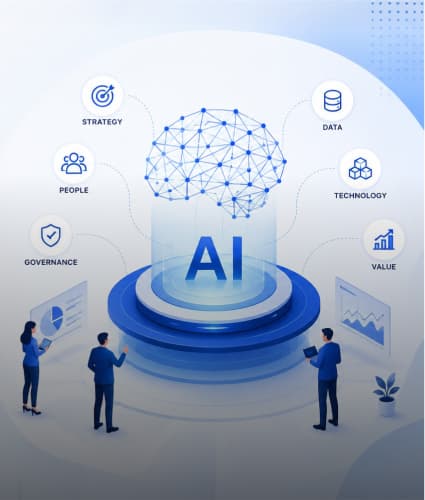
Enterprise technology executives must abandon binary choices between rigid centralization and chaotic decentralization. The industry benchmark in 2026 is the Federated Hub-and-Spoke Operating Model, balancing centralized platform governance with decentralized business execution.
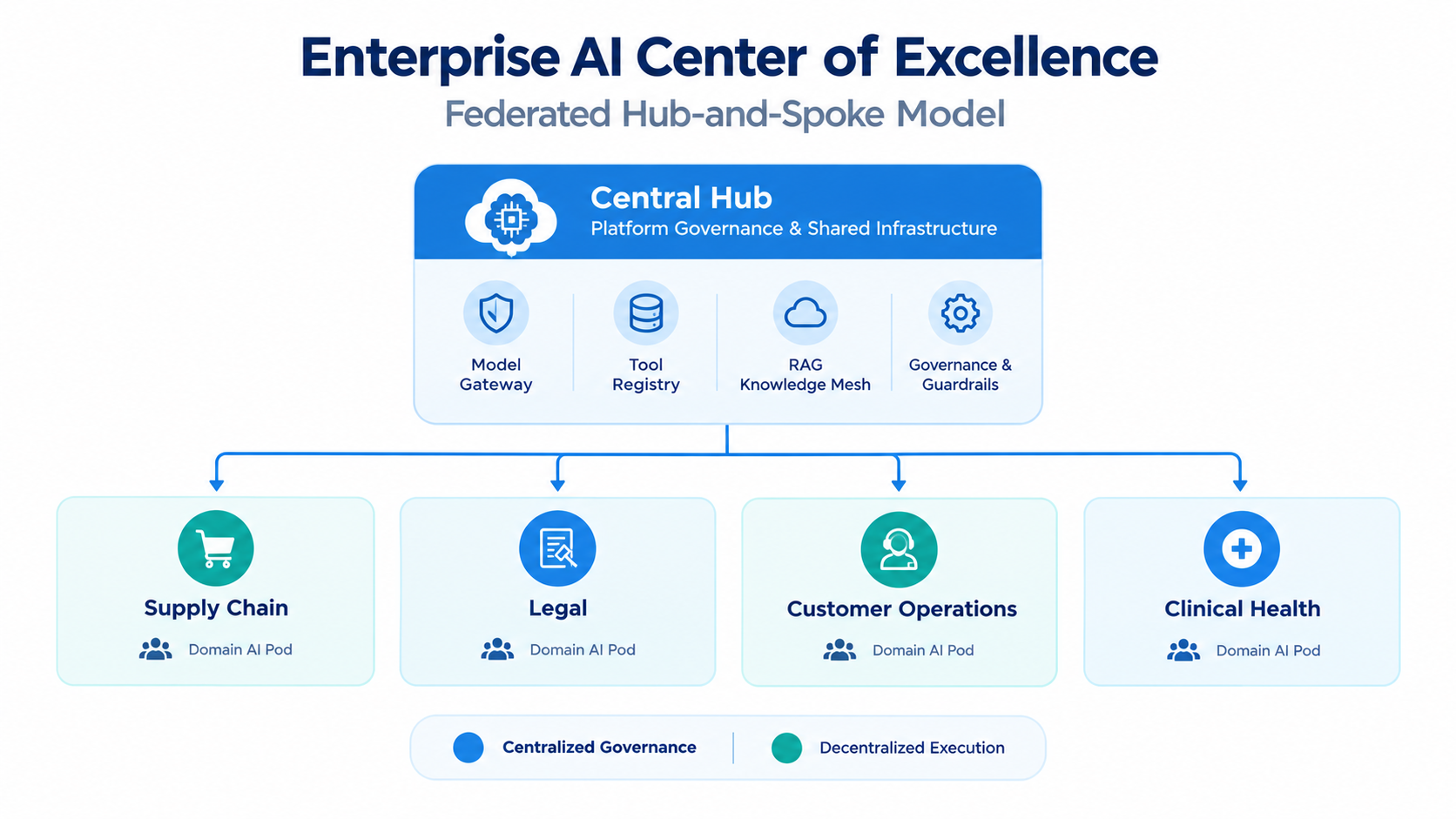
Enterprise AI Center of Excellence Operating Blueprint - The Federated Hub-and-Spoke Architecture: Centralized Governance, Model Gateways & Tool Registries paired with Decentralized Domain Execution Pods.
AI CoE Central Hub: Platform Engineering and Shared Infrastructure
The central Hub does not build every departmental chatbot. Instead, it builds and maintains the shared enterprise AI operating system:
Unified AI Gateway: Centralized reverse proxy that routes traffic across proprietary frontier models and self-hosted Small Language Models, including vLLM clusters running Llama 3.3 and Phi-4, enforcing rate limits, prompt caching, and cost meters.
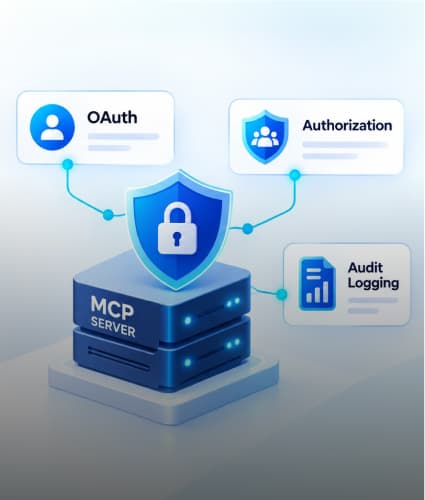
MCP Tool Registry & Sandbox Infrastructure: Standardized Model Context Protocol (MCP) servers and containerized microVM sandboxes using technologies such as Docker and Firecracker, enabling secure database reads and ERP API execution.
Shared Vector & RAG Knowledge Mesh: Multi-tenant vector database clusters using technologies such as pgvector and Qdrant with unified ingestion pipelines and Redis semantic caches.
Automated CI/CD Evaluation Harnesses: Synthetic benchmarking frameworks such as RAGAS and DeepEval that test prompt updates, model swaps, and trajectory accuracy before production release.
AI CoE Domain Spokes: Embedded Cross-Functional Product Pods
The Spokes are cross-functional agile squads embedded directly within business units such as Supply Chain, Legal, Customer Operations, and Clinical Health. Each spoke consists of a Business Unit AI Lead, a Lead Systems Architect, and Full-Stack Engineers who own the end-to-end delivery and commercial ROI of domain-specific workflows.
Enterprise AI CoE Success: The Role of Standardized AI Deployment
Research on high-performing enterprises reveals that the top 6% of organizations extracting significant bottom-line value from AI do not necessarily spend more capital than their peers. Instead, they have standardized, documented deployment pipelines and dedicated AI Product Managers embedded directly in business units. High performers treat AI deployment as a core organizational platform capability rather than isolated research experiments.
Ready to Build Your Enterprise AI Foundation?
7-Pillar Enterprise AI Center of Excellence Operating Framework
To establish a mature, high-velocity AI CoE, enterprise technical leadership should implement seven core operational pillars:
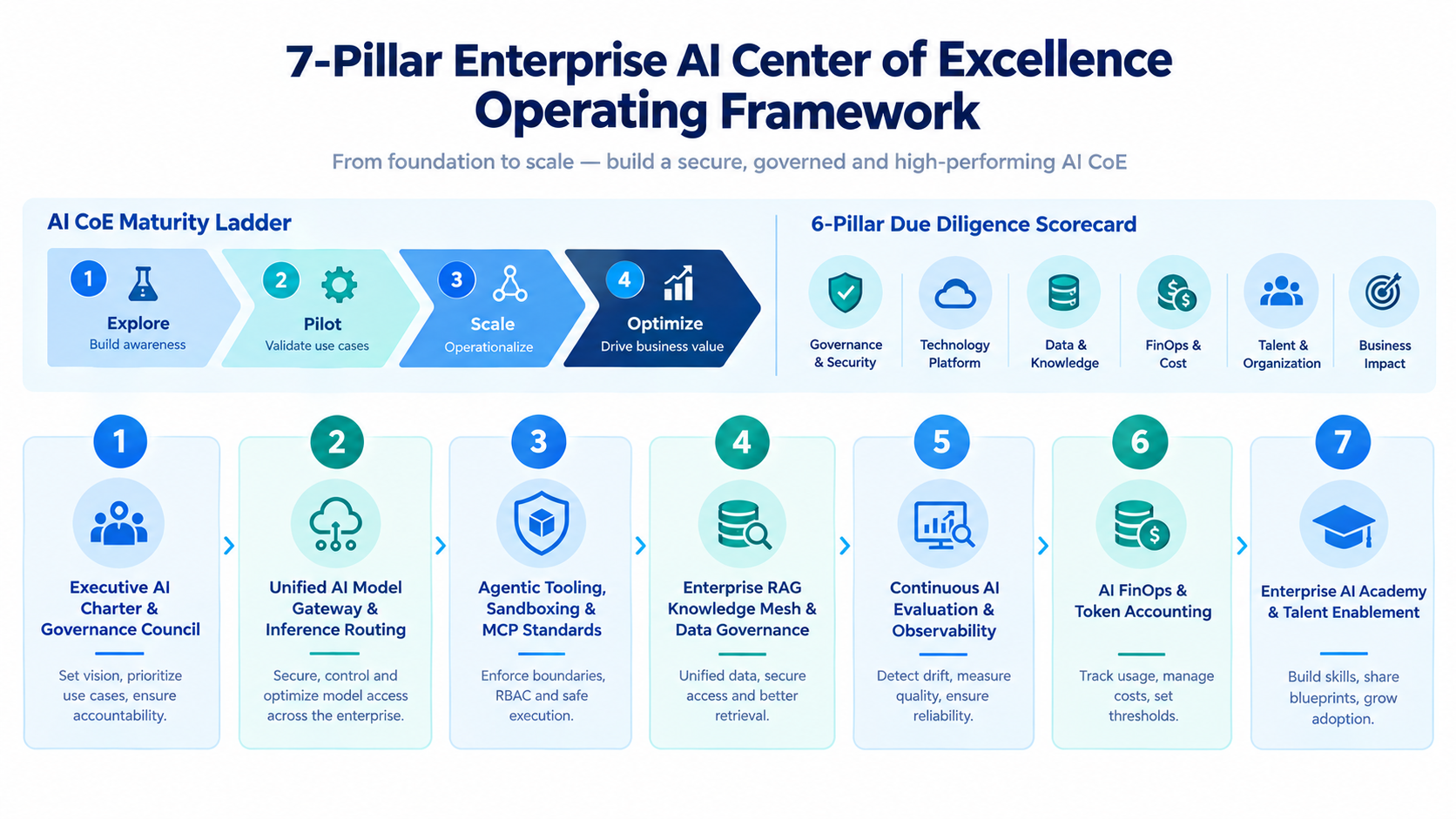
Pillar 1: Executive AI Charter and Governance Council
The CoE must operate with a clear mandate backed by the CEO, CTO, and CIO. An Executive AI Council meets monthly to prioritize use cases based on expected financial return, technical feasibility, and strategic differentiation, preventing wasted spend on low-value hobby projects.
Pillar 2: Unified AI Model Gateway and Inference Routing
Direct model API calls from individual departments create massive security and cost liabilities. The CoE standardizes all model traffic through an enterprise gateway, enabling automatic fallback, zero-data-retention enforcement, and multi-tier model routing, dispatching SLMs for intent classification and frontier models for complex reasoning.
Pillar 3: Agentic Tooling, Sandboxing and MCP Standards
When moving from static text generation to autonomous multi-agent workflows, the CoE enforces strict execution boundaries: isolating tool calls inside microVM sandboxes, enforcing least-privilege Role-Based Access Control (RBAC), and establishing independent, out-of-band kill switches for consequential actions.
Pillar 4: Enterprise RAG Knowledge Mesh and Data Governance
The CoE standardizes ingestion pipelines, parent-child document chunking, and hybrid dense-sparse search across all internal data sources. It enforces row-level security metadata matching Active Directory permissions to ensure sensitive payroll or executive files cannot be retrieved by unauthorized staff.
Pillar 5: Continuous AI Evaluation and Observability
Traditional APM monitoring tools cannot detect hallucination drift or reasoning failures. The CoE mandates OpenTelemetry distributed tracing across all live workflows and establishes synthetic evaluation test suites measuring Faithfulness, Answer Relevancy, and Context Recall within automated CI/CD pipelines.
Pillar 6: AI FinOps Cost Governance and Token Accounting
The CoE implements granular per-department token metering, showback reporting, and Redis semantic caching. It sets automated budget thresholds, alerting engineering leads before token consumption drifts off track.
Pillar 7: Enterprise AI Academy and Talent Enablement
Technology adoption succeeds only when people are trained to use it. The CoE curates an internal blueprint library of pre-approved LangGraph DAGs and MCP connectors, runs role-based training tracks for developers and product managers, and facilitates bi-weekly Communities of Practice (CoP).
Enterprise AI CoE Case Study: Preventing Runaway AI Costs
During a routine production deployment in an enterprise customer operations department, an unconstrained multi-agent customer support loop encountered a cyclic recursion bug when parsing a corrupted JSON ticket. The agent began invoking a frontier reasoning model 500 times per minute. The CoE's centralized AI gateway detected the anomalous token velocity within 8 seconds, automatically triggered an out-of-band circuit breaker, isolated the session, and prevented an estimated $300,000 cloud billing spike.
Enterprise AI Center of Excellence Maturity Scorecard
To evaluate your organization's AI operational maturity and identify critical governance gaps, technical leadership should apply this structured 100-point rubric:
Evaluation Domain | Weight | Key Technical Verification Criteria | Critical Failure Warning |
|---|---|---|---|
1. Hub-and-Spoke Governance | 20 Pts | Documented CoE charter, C-level sponsorship, centralized platform hub with embedded domain pods. | Centralized team attempts to build all use cases, creating a severe delivery bottleneck. |
2. Model Gateway & MCP Standards | 25 Pts | Unified AI proxy routing, SLMs/LLMs, token rate limits, MCP tool registry, and microVM sandboxing. | Departments make unmetered direct API calls using personal credit cards and unvetted credentials. |
3. RAG Mesh & Data Sovereignty | 15 Pts | Standardized multimodal ingestion, vector DB mesh, row-level RBAC, and private VPC deployment. | Unpartitioned vector databases leaking sensitive executive payroll records across departments. |
4. Automated CI/CD Evaluation | 15 Pts | Pre-deployment synthetic regression test suites using RAGAS/DeepEval measuring Faithfulness and Recall. | Testing exclusively by typing sample questions into a web playground with no regression baselines. |
5. FinOps & Cost Governance | 15 Pts | Redis semantic prompt caching, per-department token showback/chargeback, and budget alerts. | Unmonitored token expenses resulting in unexpected monthly billing spikes. |
6. Talent Academy & IP Transfer | 10 Pts | Reusable blueprint repository, role-based workforce training, and 100% internal code ownership. | Proprietary vendor lock-in platforms with zero internal software capability development. |
Ready to Build Your Enterprise AI Foundation?
6 Red Flags That Stall an Enterprise AI Center of Excellence
When designing or reviewing your internal AI CoE structure, watch out for these six common failure patterns:
CoE Red Flag Indicator | What Happens Internally | The Organizational Consequence |
|---|---|---|
1. The 'Ivory Tower' Research Lab | Data scientists build theoretical models with no connection to commercial product teams. | 70%+ of developed models never reach production deployment, burning capital without ROI. |
2. The Manual Approval Bottleneck | CoE requires manual committee reviews for every minor prompt tweak and pilot project. | Business units bypass the center entirely, causing uncontrolled Shadow AI proliferation. |
3. Absence of Executive Sponsorship | CoE reports to middle management without cross-departmental enforcement authority. | Cannot resolve resource conflicts or establish unified data and security standards. |
4. Unmetered Direct API Access | Departments integrate directly with external model APIs without a central proxy. | Zero visibility into corporate data egress, token expenditures, or prompt injection risks. |
5. Governance Theatre on Paper | Publishing 100-page policy PDFs without code-level enforcement or automated test gates. | Policies are universally ignored in production codebases, leaving legal vulnerabilities. |
6. Re-Inventing Custom Plumbing | Every business unit builds its own custom RAG parser, vector database, and prompt router. | Massive duplication of engineering effort, fragmented architectures, and 5x infrastructure costs. |
Enterprise AI Center of Excellence: In-House vs. Partner Co-Development
Standing up an enterprise AI CoE entirely in-house requires recruiting specialized architects, MLOps engineers, and governance leads in an extremely competitive market. The table below compares building from scratch against co-developing with an engineering partner:
Operating Dimension | Option A: 100% In-House Build | Option B: Co-Development Partner |
|---|---|---|
Year 1 Financial Outlay | $860,000 - $1,200,000+ (Full engineering payroll & recruiter fees) | $90,000 - $220,000 (Capped milestone-based sprint CapEx) |
Time to Operational Platform | 6 - 9 Months (Severe recruitment & onboarding lag) | 3 - 6 Weeks (Immediate deployment of battle-tested blueprints) |
Infrastructure Maturity | Trial-and-error custom development with high prototype rework risk | Production-tested gateways, MCP sandboxes, and RAG architectures |
Intellectual Property | 100% Owned | 100% Transferred directly to client private cloud repositories |
Talent Enablement | Internal team must self-teach emerging agentic patterns | Hands-on pairing with senior architects transfers production skills |
Enterprise AI Center of Excellence Case Studies and Implementation Examples
A credible AI CoE engineering partner should demonstrate verifiable platform outcomes across diverse enterprise domains. Below are four production implementations from our portfolio.
REAL-WORLD IMPLEMENTATION SPOTLIGHT: Build and Deploy AI Agents Platform
The Business Challenge:
Enterprise technology teams faced developer friction, architectural challenges, and high infrastructure costs when building autonomous workflows across disconnected microservices.Engineered Solution:
We built a modular platform with visual workflow orchestration, standardized LLM routing, persistent vector memory, and secure tool execution environments.Business & ROI Impact:
Increased enterprise deployment velocity by 4x, reduced initial development costs by more than 50%, and reduced unnecessary prompt token consumption across multi-step AI workflows.
REAL-WORLD IMPLEMENTATION SPOTLIGHT: AI Workflow Automation Platform
The Business Challenge:
A multi-departmental enterprise faced fragmented legacy SaaS tools, manual data re-entry, and fragile RPA scripts that failed when input formats changed.Engineered Solution:
Our engineering team designed an intelligent process automation engine combining NLP intent routing, automated event triggers, custom webhook connectors, and resilient state machines with automatic rollback.Business & ROI Impact:
Replaced fragile legacy RPA scripts with self-healing intelligent workflows, reducing operational exception handling by 60% and enabling real-time cross-departmental synchronization.
REAL-WORLD IMPLEMENTATION SPOTLIGHT: AI Legal Research Assistant
The Business Challenge:
Legal practitioners and corporate compliance teams faced high latency and hallucination risks when querying large databases of statutory codes, case precedents, and complex agreements.Engineered Solution:
We architected a domain-specific Hybrid RAG engine combining dense vector embeddings, BM25 keyword search, contextual citation graphs, fine-tuned legal embeddings, and hallucination verification guardrails.Business & ROI Impact:
Eliminated citation hallucinations in regulatory outputs, reduced document audit turnaround times by 75%, and lowered token context retrieval costs by 45% through precision chunking.
REAL-WORLD IMPLEMENTATION SPOTLIGHT: AI Health App Development
The Business Challenge:
A digital health provider needed an intelligent clinical triage assistant capable of securely querying patient records while meeting HIPAA, GDPR, and clinical data governance requirements.Engineered Solution:
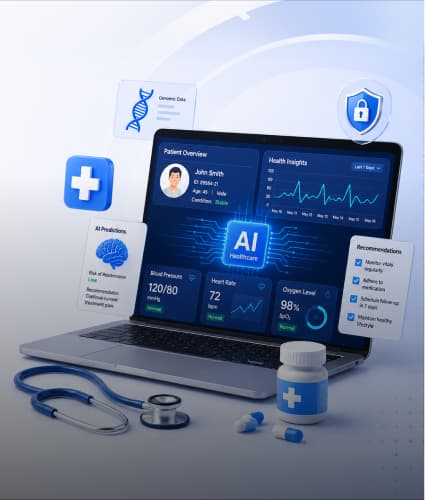
We engineered encrypted data exchange pipelines, real-time PII de-identification filters, FHIR and HL7 interoperability interfaces, role-based access control, and immutable audit logging.Business & ROI Impact:
Delivered regulatory compliance from day one and reduced the risk of costly post-deployment security refactoring and legal liability.
Ready to Build Your Enterprise AI Foundation?
5 Steps to Build an Enterprise AI Center of Excellence
To transition from fragmented experimentation to an enterprise-grade AI operating engine, technical leaders should follow this 5-step operational roadmap:
Appoint a Head of AI Platform with P&L Accountability: Ensure the CoE leader reports directly to the CTO or CIO with a mandate to balance speed and safety.
Deploy a Central AI Gateway Immediately: Intercept all outgoing LLM API traffic through a unified reverse proxy to gain instant visibility into token costs, latency, and data security.
Fund a 4-Week Foundation Sprint with a Co-Development Partner: Partner with experienced AI systems architects to establish core MCP registries, vector DB meshes, and CI/CD evaluation harnesses.
Ship Two High-Value Spoke Pilots in Under 60 Days: Select two high-impact, business-critical workflows such as invoice processing or internal knowledge search to prove immediate ROI.
Establish the Enterprise AI Blueprint Library: Document the successful pilot patterns into reusable templates, enabling downstream business units to build upon validated architectures.
Conclusion
Building an enterprise AI Center of Excellence requires more than experimenting with AI models or creating isolated proofs-of-concept. A production-ready CoE needs a strong operating model that combines centralized governance, reusable AI infrastructure, secure model and tool access, enterprise RAG, continuous evaluation, cost governance, and business-unit ownership.
The federated Hub-and-Spoke approach provides a practical way to balance governance with delivery speed, while the seven operating pillars help establish the technical and organizational foundation needed for sustainable AI adoption.
For organizations starting their AI CoE journey, the focus should be on measurable business workflows, production-ready infrastructure, automated guardrails, and reusable architecture patterns rather than simply increasing the number of AI experiments. A phased approach can help move AI initiatives from experimentation to controlled production and measurable business outcomes. Contact us today to discuss your AI strategy, architecture, governance, and implementation requirements.

Mukund Patil
Business Enthusiast | Exploring ideas, trends, and opportunities, turning curiosity into meaningful insights and discovering smarter ways to make an impact.