

Healthcare organisations are moving beyond AI pilots. The challenge is no longer whether AI can generate useful answers, summarise documents, identify patterns, or automate workflows. The real challenge is deploying these capabilities safely across fragmented data, regulated workflows, legacy systems, and environments where errors can have serious consequences.
The strongest healthcare AI opportunities are not always the most visible. Beyond conversational assistants, significant value can come from clinical documentation, patient communication, workforce management, medical-record interpretation, revenue-cycle workflows, operational forecasting, decision support, and intelligent automation.
The World Health Organisation identifies AI applications across diagnosis and clinical care, drug development, disease surveillance, outbreak response, and health-system management. It also emphasises governance , safety, equity, and responsible deployment because healthcare AI requires strong privacy, accountability, and human oversight.
The key architectural question is:
How do you move from an isolated AI capability to a production-grade enterprise AI system that integrates with healthcare workflows without creating additional operational or compliance debt?
This article examines major enterprise AI use cases in healthcare, the architecture needed to support them, integration challenges, and the governance controls required for production deployment.
AI in Healthcare: Key Enterprise Use Cases
The strongest healthcare AI programs should be evaluated by business workflow, not by model novelty.
A useful enterprise portfolio typically spans five areas:
Clinical intelligence
Patient engagement
Healthcare operations
Revenue and administrative workflows
Knowledge and workforce productivity
The technical implementation differs across each category, but the architectural foundation can be shared.
1. AI in Healthcare for Clinical Documentation and Ambient Assistance
One of the clearest enterprise use cases is reducing the administrative burden surrounding clinical documentation.
An AI system can process approved clinical conversations or structured inputs and generate draft documentation, summaries, follow-up actions, or structured fields for review.
The production architecture should not allow the model to directly write unrestricted information into the clinical record.
A safer pattern is:
Capture ↓ Transcription ↓ Contextual Retrieval ↓ Generation ↓ Validation ↓ Clinician Review ↓ Structured Write-Back |
The model becomes an assistant inside the workflow rather than the final authority.
Important engineering controls include:
Identity-aware access to patient context
Role-based authorization
Source attribution
Confidence scoring
Structured output validation
Human approval
Audit trails
Versioned prompts and model configurations
Monitoring for hallucination and extraction errors
2. AI in Healthcare for Medical Record Summarisation
Healthcare organisations often maintain longitudinal records containing clinical notes, lab results, medications, imaging reports, encounters, and administrative information.
The challenge is not simply summarising text. It is retrieving the correct context without mixing records, omitting clinically important information, or presenting generated statements as verified facts.
A production implementation can use retrieval-augmented generation, where the model receives a constrained context assembled from authorised healthcare data.
The architecture should maintain:
Patient identity boundaries
Document provenance
Timestamp information
Source-system identifiers
Access policies
Retrieval filters
Citation or evidence references
Output validation
This is particularly important for multi-facility environments where the same patient may have records across multiple systems.
3. AI in Healthcare for Patient Engagement and Personalised Guidance
AI can also operate at the patient-facing layer.
Examples include:
Appointment assistance
Medication reminders
Health education
Symptom-intake workflows
Personalised wellness guidance
Follow-up communication
Navigation of healthcare services
Patient FAQs
The AI health app case study shows how AI-driven personalisation can support a digital health experience through health habit tracking , progressive habit development, dashboards, and personalised guidance. The case study reports a 70% habit completion rate among active users and a 65% increase in nutrition-habit consistency. These results are specific to the project and should not be treated as general healthcare AI benchmarks.
The broader architectural lesson is that effective personalisation depends on combining application state, user context, behavioural data, and a controlled AI layer.
4. AI in Healthcare for Diagnostic and Clinical Decision Support
AI can support clinical teams by identifying patterns in structured or unstructured healthcare data.
Potential applications include:
Risk stratification
Medical image analysis
Clinical decision support
Early warning systems
Disease progression analysis
Patient deterioration monitoring
Diagnostic assistance
These systems require significantly stronger validation than general productivity tools.
A healthcare enterprise should establish a clear boundary between:
AI-generated recommendation
and
clinician-authorized clinical decision
That boundary should be reflected directly in the software architecture.
5. AI in Healthcare for Workforce Optimisation
Healthcare staffing is an operational problem where AI and workflow automation can complement each other.
Potential use cases include:
Shift-demand forecasting
Staff matching
Schedule optimization
Credential verification
Availability prediction
Workforce capacity planning
Automated notifications
Candidate matching
The healthcare staffing case study describes a platform that connects healthcare facilities with medical professionals for temporary and part-time staffing. It supports real-time notifications, professional and facility verification, flexible shift filtering, communication, and job matching. The published case study reports 10K+ active users, 50K job searches, and 15K+ jobs posted.
AI can extend this type of platform with predictive insights and smarter recommendations while keeping core staffing and transactional rules deterministic.
Ready to Build a More Secure Healthcare AI Solution?

6. AI in Healthcare for Revenue Cycle and Administrative Automation
A large portion of healthcare enterprise activity occurs outside the clinical encounter.
AI can assist with:
Claims documentation
Coding assistance
Prior authorization workflows
Denial analysis
Document classification
Insurance verification
Patient billing support
Revenue-cycle analytics
Administrative correspondence
The strongest architecture combines deterministic business rules with probabilistic AI.
For example:
Rules engine: determines whether required fields are present.
AI model: extracts information from supporting documentation.
Validation layer: checks the extracted values.
Human reviewer: resolves exceptions.
This separation reduces the risk of allowing a generative model to become the system of record.
7. AI in Healthcare for Knowledge Assistants
Large healthcare organisations have enormous internal knowledge bases.
AI assistants can help employees retrieve information from:
Clinical policies
SOPs
HR policies
Insurance documentation
Internal procedures
Technical documentation
Research literature
Operational manuals
The enterprise architecture should use retrieval rather than relying exclusively on the model's pretrained knowledge.
A healthcare knowledge assistant should answer:
"What does our approved source say?"
rather than:
"What does the model remember?"
This distinction is fundamental to enterprise reliability.
8. AI in Healthcare for Predictive Operations
AI can also support non-clinical operational planning.
Examples include:
Bed-demand forecasting
Appointment demand prediction
Staff-demand forecasting
Supply planning
Equipment maintenance
Patient-flow analysis
No-show prediction
Capacity planning
These use cases are often attractive because their output can be evaluated against measurable operational KPIs.
The key is to define the target variable before choosing the model.
Bad starting point: "We need predictive AI for our hospital."
Better starting point: "We need to improve appointment-capacity forecasting for outpatient clinics."
The second statement provides an observable outcome, a data boundary, and an evaluation framework.
AI in Healthcare: Core Enterprise Architecture Pillars
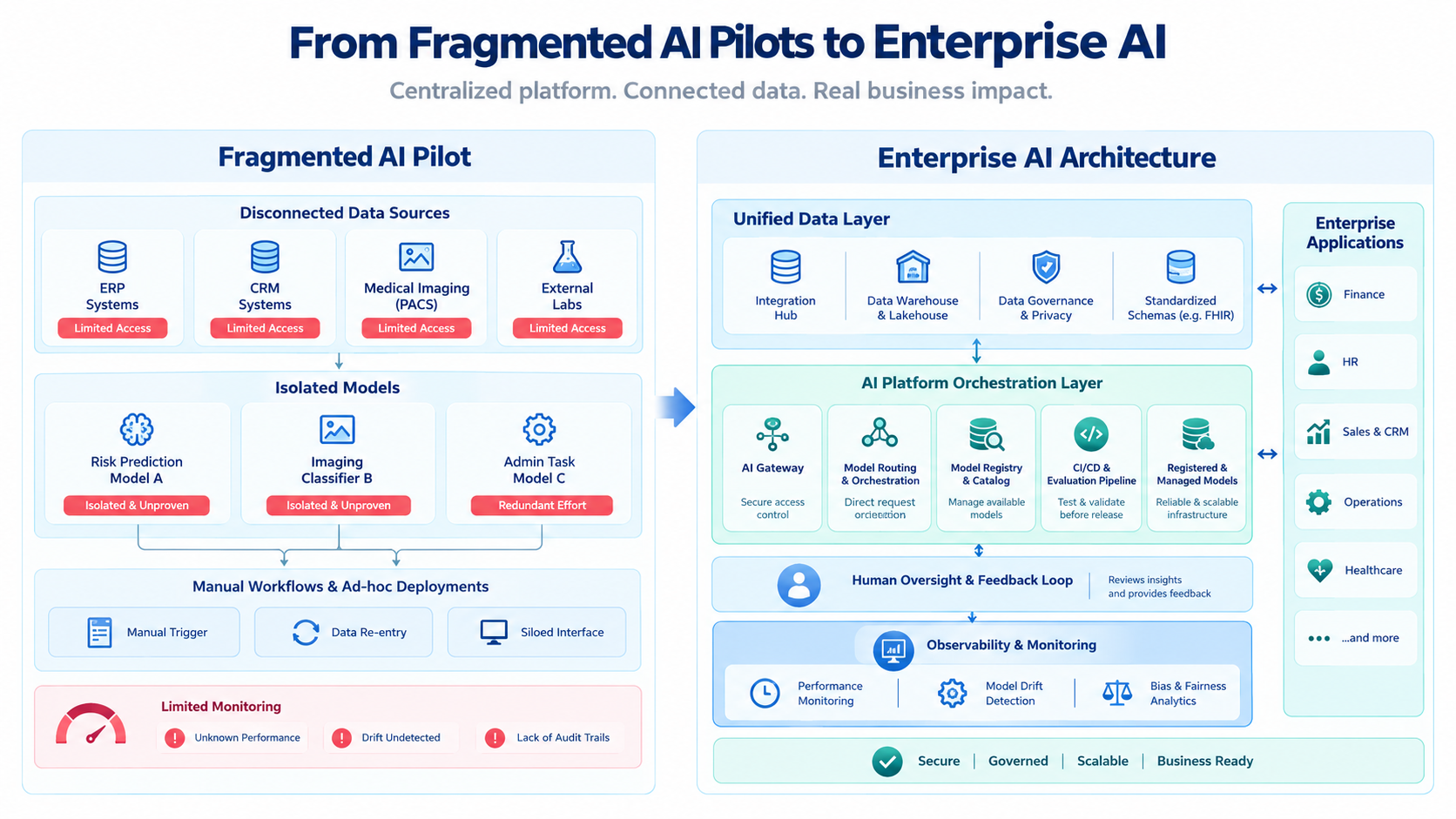
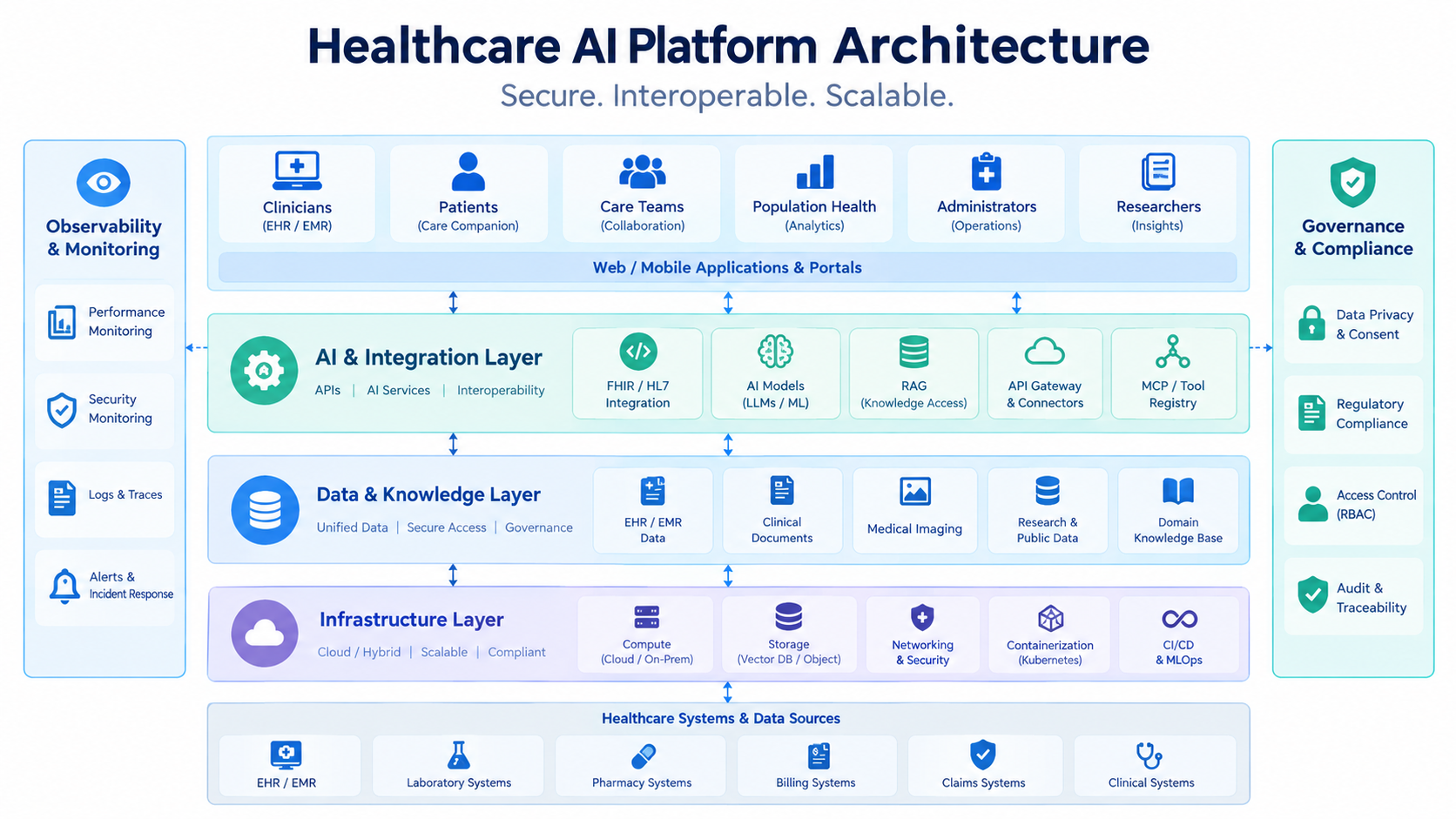
A production healthcare AI platform should not be designed as a single model endpoint.
It should be treated as a distributed system.
Healthcare AI Data Pipeline and Context Layer
Healthcare data may originate from:
Laboratory systems
Imaging systems
Claims systems
CRM platforms
Patient applications
Scheduling platforms
ERP systems
Data warehouses
Data lakes
Integration can involve APIs, event streams, database replication, HL7, FHIR, batch pipelines, and vendor-specific interfaces.
The architecture should normalise data before it reaches AI services where possible.
A canonical representation can reduce the number of direct model integrations and simplify governance.
AI Gateway Architecture for Healthcare
An enterprise AI gateway provides a controlled boundary between applications and model providers.
It can manage:
Authentication
Authorization
Rate limiting
Prompt policies
PII/PHI detection
Model selection
Token controls
Logging
Cost controls
Provider failover
Safety policies
This is especially important when an enterprise uses multiple models.
The application should not need to know whether a particular task is executed by one commercial model, another provider, a specialised healthcare model, or a self-hosted model.
AI Orchestration Layer for Healthcare Workflows
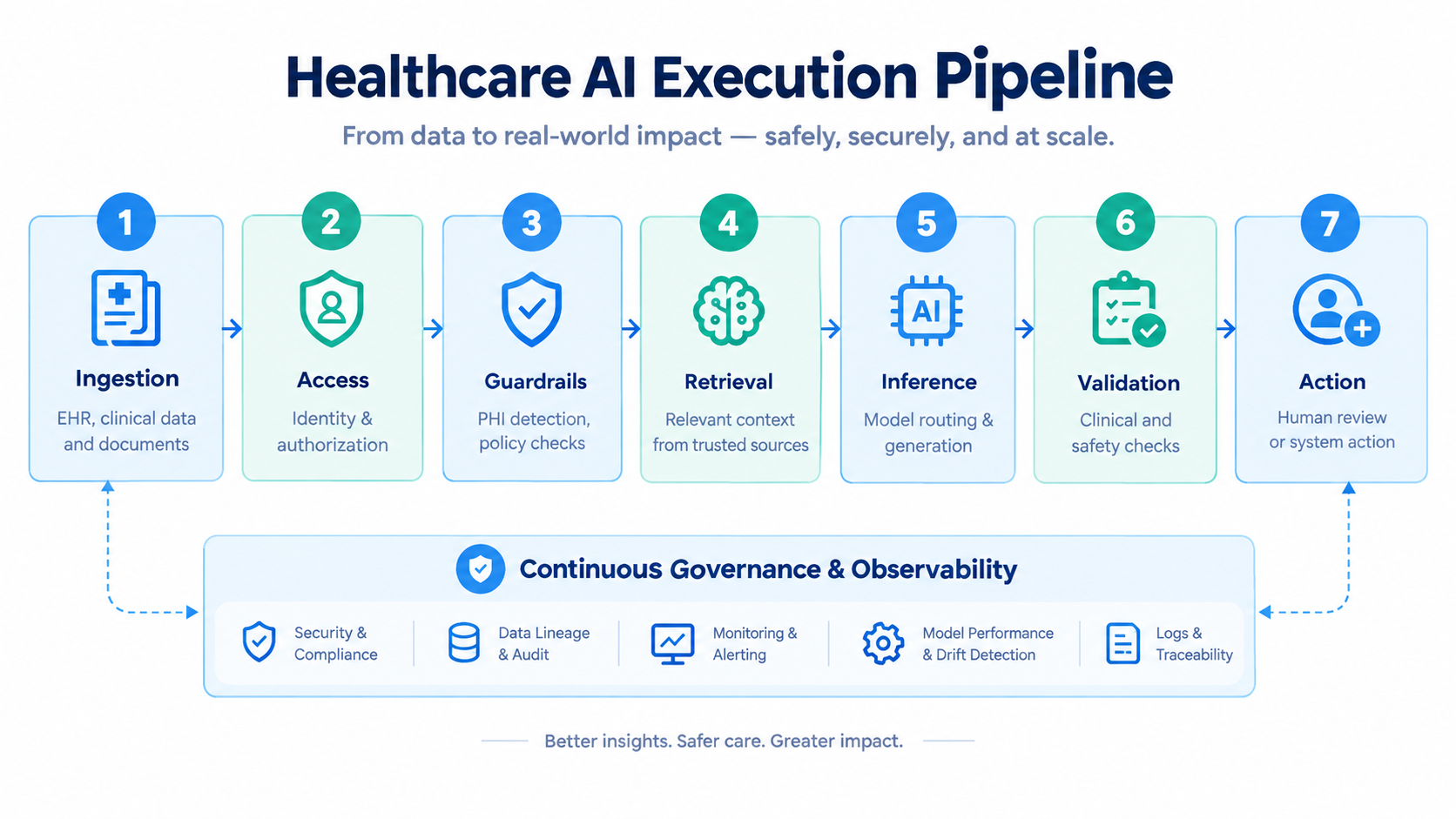
The orchestration layer determines what should happen for each request.
Authenticate the user.
Determine the workflow.
Retrieve authorised context.
Apply guardrails.
Select an appropriate model.
Execute the inference request.
Validate the output.
Request human approval when required.
Persist the approved result.
Record the complete audit trail.
This is where business logic and AI capabilities meet.
Healthcare AI LLMOps and Observability
Traditional application monitoring is insufficient for AI systems.
An AI platform should monitor:
Metric | Why It Matters |
|---|---|
Latency | Determines workflow usability |
Token usage | Controls model cost |
Model error rate | Indicates infrastructure reliability |
Retrieval quality | Determines context accuracy |
Hallucination rate | Indicates output risk |
Refusal rate | Helps identify policy conflicts |
Human override rate | Shows where AI is underperforming |
Prompt version | Enables reproducibility |
Model version | Enables change tracking |
Data lineage | Supports governance |
User feedback | Provides quality signals |
The system should preserve enough telemetry to answer:
What model generated this output, using which prompt, from which data, under which policy, and who approved it?
That question becomes critical when an AI-generated result is later challenged.
Ready to Build a More Secure Healthcare AI Solution?
AI in Healthcare: In-House Development vs. Engineering Partner
Enterprise healthcare organisations rarely need to choose between "build everything" and "buy everything." The practical question is which capabilities are strategic enough to own internally and which can be accelerated through a specialised engineering partner.
Dimension | In-House Build | Specialized Engineering Partner such as Zignuts |
|---|---|---|
Healthcare domain alignment | Requires internal domain and engineering capacity | Can supplement existing domain and engineering teams |
AI application engineering | Full internal ownership | Additional engineering capacity for architecture and implementation |
Model integration | Internal provider abstraction and routing | Can implement multi-model integration patterns |
Legacy integration | Requires internal integration bandwidth | Partner team can build APIs and integration layers |
RAG implementation | Internal data and AI engineering required | Can accelerate retrieval and orchestration implementation |
Security architecture | Internal security ownership remains essential | Engineering partner can implement agreed controls |
LLMOps | Requires new operational capabilities | Can help establish evaluation and observability foundations |
Scalability | Internal platform engineering responsibility | Partner can design and implement scalable services |
Governance | Must remain enterprise-owned | Partner can implement governance mechanisms defined by the enterprise |
Delivery capacity | Limited by hiring and internal priorities | Provides additional engineering bandwidth |
Long-term ownership | Maximum internal control | Knowledge transfer and maintainable architecture should be contractually designed |
The right model is often hybrid.
Healthcare organisations should retain ownership of clinical policy, data governance, risk acceptance, regulatory interpretation, and business decisions.
A specialised engineering partner can provide architecture, software engineering, AI integration, cloud implementation, testing, and delivery capacity.
AI in Healthcare Enterprise Integration Architecture
AI in Healthcare EHR and Clinical System Integration
EHR integration should be treated as a first-class architectural boundary.
Depending on the environment, integrations may involve FHIR APIs, HL7 interfaces, proprietary APIs, event-based integrations, or batch exchange.
The AI platform should not directly couple every application to every clinical system.
Instead, introduce an integration layer that provides:
Identity resolution
Data normalization
Authorization
Schema transformation
Provenance
Error handling
Retry policies
Auditability
This makes the AI layer replaceable without forcing the entire enterprise application estate to change.
AI in Healthcare CRM and Patient Engagement Integration
Patient engagement systems can connect AI capabilities to:
Appointment scheduling
Communication
Support
Patient education
Follow-up workflows
Service navigation
AI should have narrowly defined permissions.
For example, an assistant may be allowed to retrieve appointment availability and initiate a scheduling workflow, but not modify unrelated patient records.
AI in Healthcare ERP and Financial System Integration
Healthcare organisations also need integration across:
Procurement
Finance
Workforce management
Inventory
Billing
Revenue-cycle systems
AI can interpret documents, identify anomalies, summarise operational information, and assist with administrative workflows.
However, financial transactions should remain governed by deterministic authorisation and validation mechanisms.
Healthcare AI Data Platforms and Integration
For analytics-heavy use cases, the architecture may combine:
Operational Systems ↓ Ingestion ↓ Data Lake / Warehouse ↓ Feature / Semantic Layer ↓ AI Services |
The important distinction is that not every AI application needs direct access to the enterprise data warehouse.
Access should be scoped to the minimum context required for the workflow.
AI in Healthcare Production AI Pipeline
A reliable healthcare AI workflow should be implemented as a sequence of controlled stages.
Ready to Build a More Secure Healthcare AI Solution?
AI in Healthcare Security, Governance and Regulatory Requirements
Healthcare AI cannot be governed as an ordinary SaaS feature.
The organisation needs controls at the data, model, application, infrastructure, and organisational levels.
AI in Healthcare: HIPAA and PHI Protection
For US healthcare environments, the HIPAA Security Rule establishes requirements for appropriate administrative, physical, and technical safeguards protecting electronic protected health information.
From an engineering perspective, that means AI architecture should explicitly address:
Access control
Authentication
Encryption
Audit logging
Data minimization
Vendor boundaries
Retention
Incident response
Environment separation
Secrets management
HIPAA compliance should not be treated as a checkbox added after the AI application is built.
NIST AI RMF for Healthcare AI
NIST's AI Risk Management Framework provides a voluntary framework for managing AI risks across design, development, deployment, use, and evaluation. NIST also published a Generative AI Profile addressing risks specific to generative AI systems.
For healthcare organisations, the framework can be operationalised through:
AI use-case inventories
Risk classification
Model evaluation
Human oversight
Incident management
Monitoring
Documentation
Governance ownership
ISO/IEC 42001 for Healthcare AI Governance
ISO/IEC 42001 specifies requirements for establishing and continually improving an Artificial Intelligence Management System.
The standard addresses responsible AI management, including governance, transparency, traceability, and management of AI-related risks and opportunities.
For enterprise healthcare organisations, this can complement existing information-security and quality-management programs rather than replacing them.
OWASP LLM Security Risks in Healthcare AI
Healthcare organisations deploying generative AI should also account for application-level risks identified by OWASP.
The OWASP GenAI project currently maintains a 2026 release, while the 2025 Top 10 identifies risks including prompt injection, sensitive information disclosure, supply-chain vulnerabilities, data/model poisoning, excessive agency, and overreliance.
The architectural response should include:
Input validation
Prompt-injection defenses
Output validation
Least-privilege tool access
Retrieval authorization
Sensitive-data controls
Model and dependency scanning
Agent permission boundaries
Human approval for high-impact actions
Continuous red-team testing
Inline AI Guardrails for Healthcare Applications
Guardrails should execute inside the application path, not only in policy documentation.
A useful pattern is:
Input ↓ Identity Validation ↓ Data Policy ↓ Prompt Policy ↓ Model ↓ Output Policy ↓ Action Policy |
For higher-risk workflows, add:
Human Approval ↓ Transaction Execution |
This ensures the AI system cannot bypass the enterprise's existing control model.
AI in Healthcare: Hidden Production Risks
AI in Healthcare: Context Window and Retrieval Risks
A healthcare RAG system can appear accurate during a prototype because engineers manually provide a small number of documents. In production, the retrieval layer may return hundreds of notes, reports, medications, claims records, or policy documents for a single request. Sending all of that context to a large model increases latency, cost, and the probability that relevant evidence is buried inside irrelevant information.
The solution is not simply a larger context window. Production systems need retrieval filtering, authorisation-aware indexing, document ranking, metadata constraints, chunking strategies, context compression, source prioritisation, and evaluation datasets that measure retrieval quality separately from generation quality.
In healthcare, retrieval is part of the safety boundary. If the system retrieves the wrong patient's information, no amount of model quality can repair the architectural failure.
Building an Enterprise Healthcare AI Platform
Enterprise AI adoption can stall when organisations have strong ideas but lack the engineering capacity to turn them into reliable production systems. A specialised engineering partner can help bridge that gap.
Our published healthcare work spans digital health applications , healthcare staffing platforms, backend and API development, mobile applications, health-data interpretation, notifications, performance optimisation, and scalable cloud-based application architecture.
The key capability is not simply AI development. It is the ability to connect AI with the wider enterprise software system, including healthcare data, applications, workflows, integrations, and production infrastructure.
That includes:
Healthcare AI Application Engineering
Designing applications where AI is one controlled component within a broader workflow.
Healthcare AI Integration Services
Connecting AI applications with existing healthcare applications, APIs, databases, and operational systems.
RAG and Knowledge Systems for Healthcare AI
Building retrieval pipelines that connect enterprise knowledge to AI models while enforcing access controls and source traceability.
AI Gateway and Model Abstraction for Healthcare AI
Creating a provider-independent layer that can route requests across different models based on task, quality, latency, cost, or data constraints.
Healthcare AI Workflow Automation
Combining deterministic business logic, AI inference, notifications, approval workflows, and system actions.
Healthcare AI Production Infrastructure
Engineering cloud environments that support independent scaling of APIs, workers, vector search, inference workloads, databases, and observability systems.
Healthcare AI Evaluation and Observability
Moving beyond "the model produced a good answer" toward measurable evaluation of retrieval quality, factuality, latency, cost, policy adherence, and human overrides.
Healthcare AI Engineering Team Extension
For organisations with internal healthcare product and architecture teams, we can work as an engineering extension without replacing internal ownership. This approach adds specialised development capacity while keeping product strategy, architecture, and key decisions within the organisation.
That model allows the enterprise to retain control over product strategy, clinical policy, security requirements, and governance while using additional engineering capacity to accelerate implementation.
How to Choose the Right AI in Healthcare Use Case
Not every AI opportunity deserves immediate production investment.
A practical prioritisation framework is:
Evaluation Factor | Low-Risk Opportunity | Higher-Risk Opportunity |
|---|---|---|
Clinical impact | Administrative support | Direct clinical decision |
Data complexity | Structured internal data | Multi-source longitudinal records |
Human oversight | Easy to review | Difficult to review |
Regulatory exposure | Internal productivity | Patient-facing clinical output |
Reversibility | Easily corrected | Potentially irreversible |
KPI measurement | Clear operational KPI | Difficult clinical attribution |
Integration | Single system | Multiple legacy systems |
Model dependency | Limited | Core workflow dependency |
Start with use cases where:
The business problem is clearly defined.
The data is accessible and governed.
The output can be evaluated.
Human review is practical.
The workflow has measurable KPIs.
Failure does not create unacceptable risk.
The organisation can establish ownership.
Ready to Build a More Secure Healthcare AI Solution?
Enterprise AI in Healthcare Roadmap
A healthcare organisation can structure its AI program in four stages.
Stage 1: Identify and Validate Healthcare AI Use Cases
Map business processes and identify AI opportunities.
Prioritise use cases based on:
value × feasibility × risk × data readiness |
Stage 2: Build a Controlled Healthcare AI Pilot
Develop the smallest production-like workflow.
Do not build an isolated demo that ignores authentication, logging, data access, or integration.
Stage 3: Productionize the Healthcare AI Solution
Add:
High availability
Monitoring
Evaluation
Human approval
Error handling
Data lineage
Cost controls
Model versioning
Disaster recovery
Stage 4: Scale AI Across the Healthcare Enterprise
Once the architecture is proven, standardise shared services:
AI gateway
Model registry
Prompt management
Evaluation framework
RAG infrastructure
Identity integration
Observability
Governance
Security controls
This creates an enterprise AI platform instead of a collection of unrelated AI applications.
AI in Healthcare: From AI Models to Production Architecture
The most valuable healthcare AI opportunities span clinical workflows, patient engagement, workforce management, revenue operations, knowledge management, and predictive operations. But the AI model is only one part of a production system.
A reliable healthcare AI platform needs governed data, secure integrations, retrieval, validation, observability, human oversight, and clear ownership. The focus should be on improving measurable healthcare workflows while maintaining security and compliance.
For healthcare technology leaders, the key question is not simply, “Which AI model should we deploy?” It is “Which healthcare workflow should AI improve, how will we measure its impact, and how will we keep it reliable in production?”
If you are planning a healthcare AI initiative, contact us today to discuss your use case, integration requirements, and path from AI pilot to production.

Utkrishti Mishra
Business Analyst Intern | Exploring data, processes, and business strategies to turn insights into smarter decisions and impactful solutions.