Healthcare software development cost depends on much more than the number of screens or features. EHR integration, compliance, security, interoperability, clinical workflows, and AI can significantly affect the overall budget.
In 2026, a focused healthcare MVP may start around $40,000, while complex production platforms can reach $500,000+. Enterprise healthcare ecosystems involving advanced AI, medical devices, or multiple integrations may exceed $1 million.
Healthcare Software Development Cost: Pricing Overview
Software Type | Typical Cost | Timeline |
|---|---|---|
Basic Healthcare or Clinic App | $40,000–$80,000 | 3–5 months |
Patient Portal | $50,000–$120,000 | 4–7 months |
Telemedicine Platform | $80,000–$200,000+ | 5–9 months |
Healthcare Management System | $100,000–$250,000+ | 6–10 months |
Custom EHR/EMR Platform | $150,000–$400,000+ | 9–15+ months |
AI-Enabled Healthcare Platform | $150,000–$500,000+ | 8–18+ months |
Enterprise Healthcare Ecosystem | $300,000–$1M+ | 12–24+ months |
These are planning ranges rather than fixed prices. The final healthcare software development cost depends on product scope, integrations, compliance requirements, team structure, technology choices, and expected scale.
Why Healthcare Software Development Costs More Than Standard SaaS
Healthcare applications handle sensitive data and often support workflows where reliability and security are critical. As a result, development usually requires more than standard SaaS functionality.
Role-based access and identity management
Encryption and secure API communication
Audit logging and access tracking
Healthcare interoperability
Backup and disaster recovery
Security testing and vulnerability management
Compliance-focused documentation and processes
These requirements need to be considered during architecture and development rather than added after the product is built.
Ready to Plan Your Healthcare Software Budget?

Healthcare Software Development Cost Breakdown
Discovery and Workflow Analysis Costs
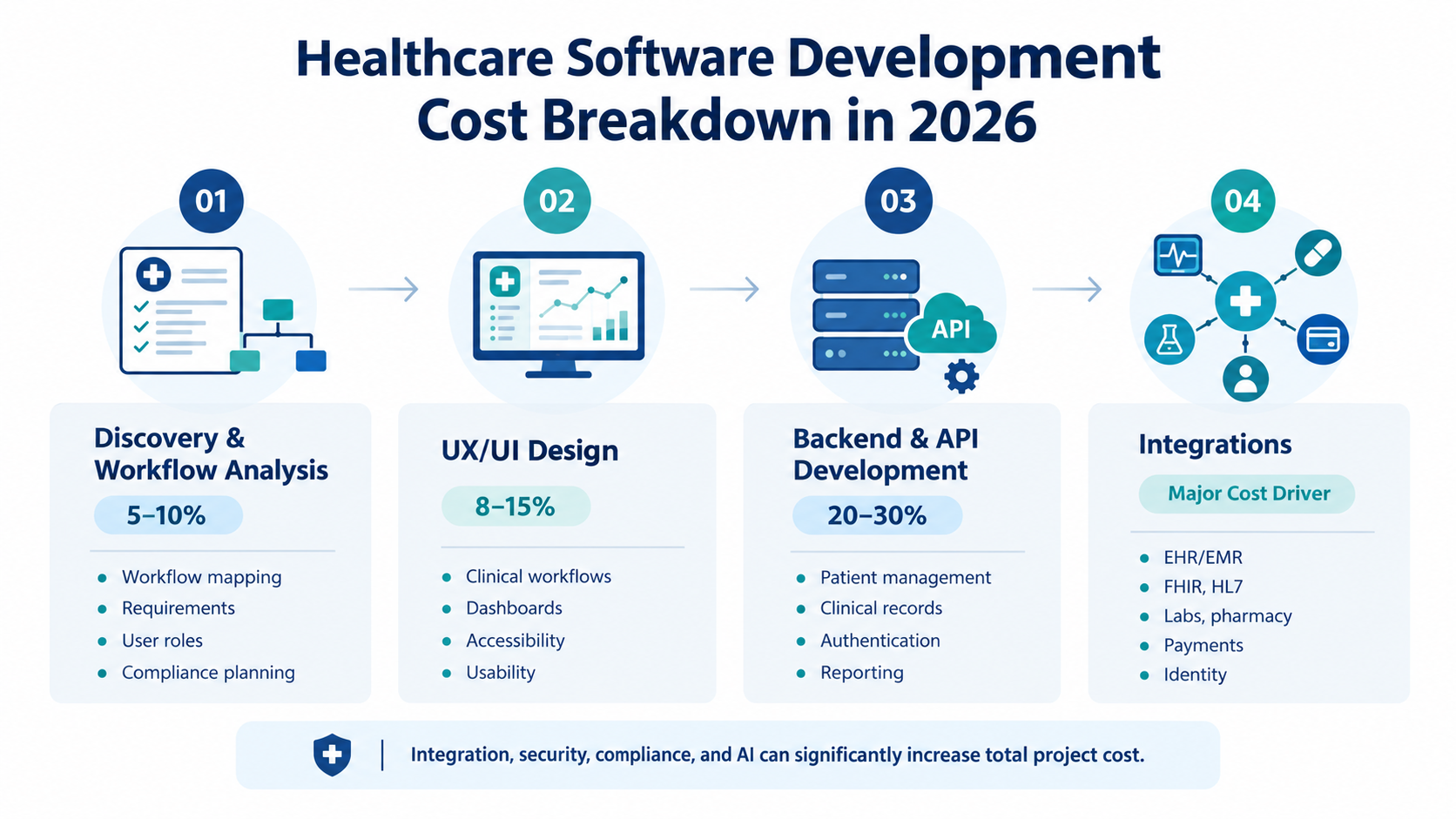
Discovery can account for roughly 5–10% of the project. It covers stakeholder discussions, workflow mapping, user roles, regulatory requirements, data flows, integration requirements, and MVP planning.
Healthcare UX/UI Design Costs
Healthcare UX needs to support fast and accurate workflows. Design work may include role-specific dashboards, accessibility, information hierarchy, error prevention, patient-facing interfaces, and clinical workflows.
Backend and API Development Costs
Backend development usually represents one of the largest parts of the budget. It can include:
Patient and provider management
Appointments and clinical records
Authentication and permissions
Notifications and messaging
Reporting and analytics
Audit trails and data management
Healthcare Software Integration Costs
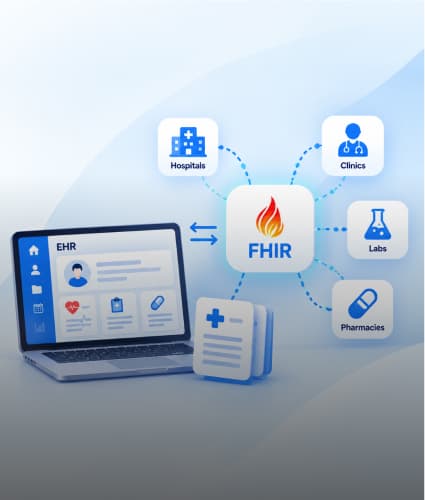
Healthcare integrations can significantly increase development effort. EHR/EMR, laboratory, pharmacy, insurance, payment, identity, wearable, and communication integrations may require custom data mapping, authentication, synchronization, error handling, retries, and testing.
How Interoperability Impacts Healthcare Software Development Cost
Healthcare platforms often need to exchange information with multiple external systems. FHIR and HL7 can help establish standardized data exchange, but implementing interoperability still requires substantial engineering work.
An EHR integration may involve:
API discovery and integration planning
FHIR or HL7 data mapping
Patient matching and identity handling
Authentication and authorization
Data transformation and synchronization
Error handling, retries, and monitoring
Integration testing and audit logging
For this reason, the number and complexity of integrations should be defined early when estimating healthcare software development cost.
Ready to Plan Your Healthcare Software Budget?
How Compliance Impacts Healthcare Software Development Cost
Healthcare compliance requirements depend on the product, market, users, and type of data being processed. A U.S. healthcare product may need HIPAA safeguards, while products operating internationally may also need to address GDPR or other regional health-data requirements.
Budget considerations can include:
Encryption and secure data storage
Role-based access controls
Audit trails and secure logging
Risk analysis and security assessments
Vulnerability and penetration testing
Compliance documentation and operational controls
Compliance should therefore be treated as part of the engineering architecture rather than as a final-stage checklist.
How AI Impacts Healthcare Software Development Cost
AI requirements can range from simple search and summarization to advanced clinical decision support. The complexity of the AI capability has a direct impact on development effort.
Healthcare AI may support:
Medical document summarization
Clinical transcription
Patient engagement
Predictive analytics
Medical imaging
Clinical decision support
Advanced implementations may also require data pipelines, retrieval systems, model evaluation, guardrails, human review, monitoring, governance, and security. This can move an AI-enabled healthcare platform into the $150,000–$500,000+ range.
How Features Affect Healthcare Software Development Cost
Not every feature has the same effect on the development budget. Basic authentication and appointment scheduling are generally less complex than healthcare interoperability or medical-device integrations.
Low impact: Authentication, user profiles, basic scheduling
Medium impact: Patient portals, secure messaging, video consultations
Medium to high impact: E-prescription, analytics, payment integrations
High impact: EHR integration and HL7/FHIR interoperability
High to very high impact: Medical-device integrations and advanced AI
Very high impact: Clinical decision support and complex multi-system platforms
Ready to Plan Your Healthcare Software Budget?
Hidden Costs in Healthcare Software Development
Initial development is only part of the total cost of ownership. Healthcare software often requires ongoing investment after launch.
Cloud hosting and database infrastructure
Monitoring, logging, and security tools
Backups and disaster recovery
Third-party APIs and communication services
AI model usage
Security and penetration testing
Compliance reviews and updates
Bug fixes and ongoing maintenance
New EHR and healthcare system integrations
A realistic budget should therefore consider development, infrastructure, security, compliance, integrations, support, and maintenance together.
Healthcare Software Development Cost by Project Budget
Budget | Typical Scope |
|---|---|
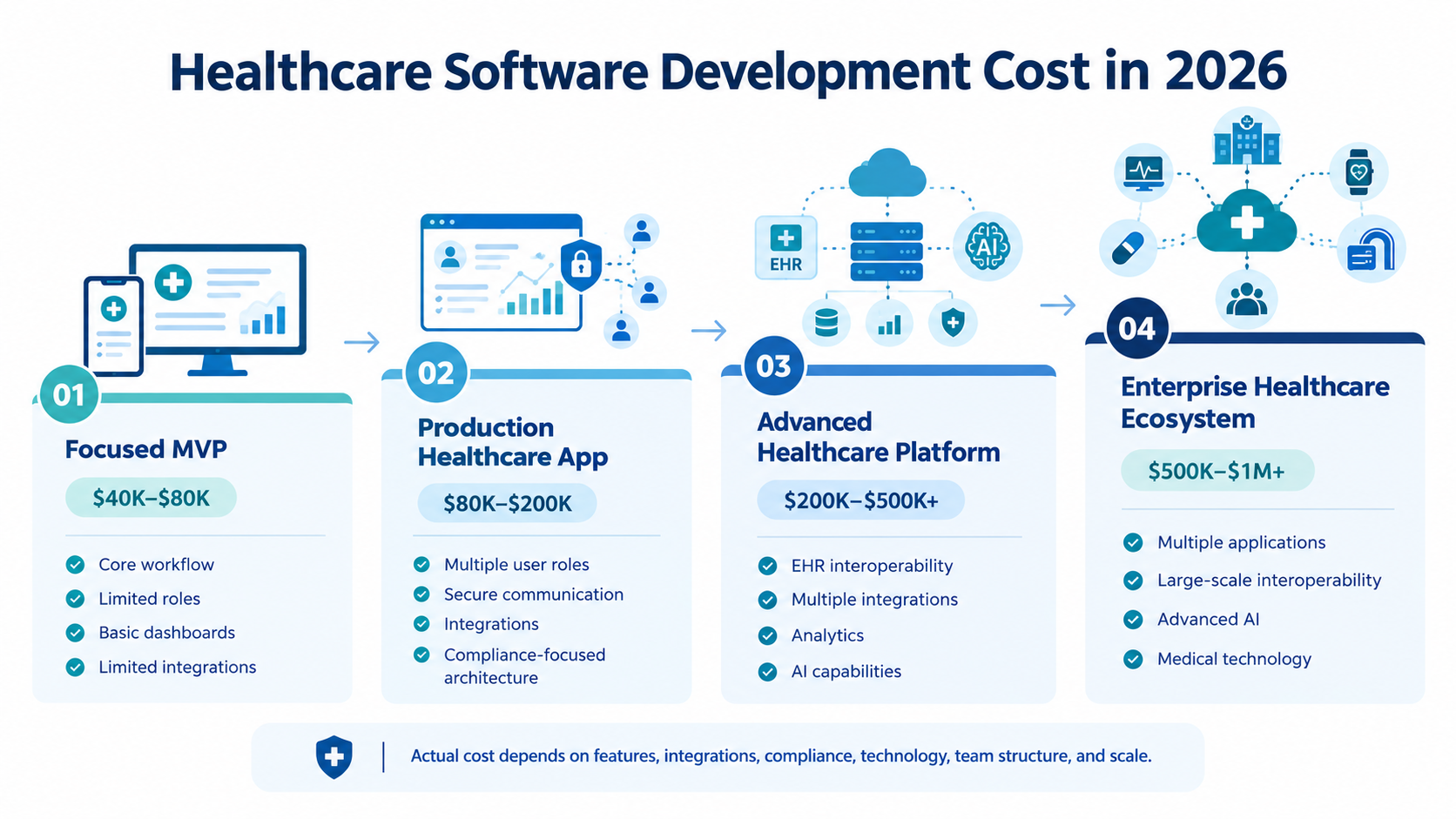
$40K–$80K | Focused MVP with a core workflow, limited roles, basic dashboards, and limited integrations. |
$80K–$200K | Production healthcare application with multiple roles, secure communication, integrations, and compliance-focused architecture. |
$200K–$500K+ | Advanced platform with EHR interoperability, multiple integrations, analytics, AI, and complex workflows. |
$500K–$1M+ | Enterprise ecosystem with multiple applications, large-scale interoperability, advanced AI, or medical technology. |
How Development Location Affects Healthcare Software Development Cost
Development rates vary based on geography, team structure, healthcare expertise, and engagement model. Offshore and nearshore teams may have different hourly rates than teams based in the United States or Western Europe, but hourly rate alone does not determine the final project cost.
Healthcare domain expertise, integration experience, development efficiency, security practices, and project management can have a greater impact on the total budget than the quoted hourly rate.
How to Control Healthcare Software Development Costs
The best way to control healthcare app development costs is to avoid building everything at once. A focused MVP can validate the most important workflow before additional features and integrations are introduced.
Define must-have and future features separately.
Prioritize the highest-value healthcare workflows.
Plan integrations before development begins.
Use established healthcare interoperability standards.
Build security and compliance into the architecture early.
Use real user feedback to guide later development.
Ready to Plan Your Healthcare Software Budget?
What You Need for an Accurate Healthcare Software Development Cost Estimate
A development partner needs enough product and technical context to create a meaningful estimate. At minimum, define:
Product type and primary users
Web, mobile, or both platforms
Required EHR/EMR and third-party integrations
Compliance and geographic requirements
AI capabilities, if required
Expected user volume and system scale
Core workflows and must-have features
With these details, the project can be estimated by workstream instead of relying on a generic per-app price.
Final Takeaway
Healthcare software development cost in 2026 depends on far more than the number of screens or features. Clinical workflows, integrations, interoperability, security, compliance, AI capabilities, scalability, and ongoing maintenance can all have a significant impact on the final budget.
A practical approach is to start with a focused MVP, establish the right security and compliance foundation, plan integrations early, and expand the platform as your requirements grow. If you’re planning a healthcare software project and want to understand the likely budget and development approach, contact us today to discuss your requirements and explore a solution that fits your goals.

Deep Gondaliya
Business Analyst | Turning business challenges into clear insights, practical solutions, and meaningful improvements that help teams move forward.