

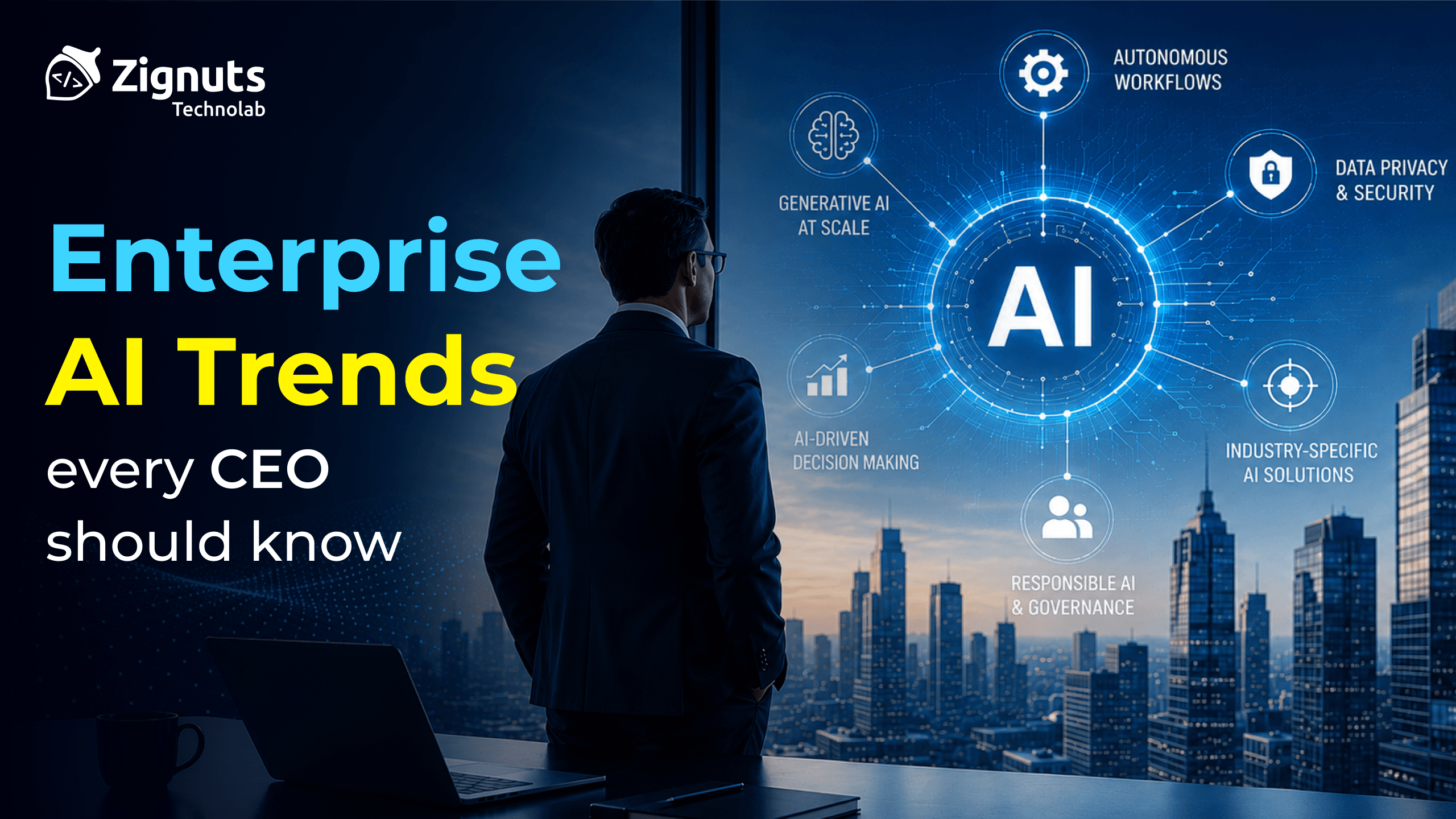
Enterprise AI is moving from experimentation to operating model change. For CEOs, the priority is no longer whether AI can improve productivity; it is where AI creates measurable advantage, how risk is controlled, and which engineering capabilities are needed to scale beyond pilots. The most important enterprise AI trends combine strategy, data readiness, secure architecture, product thinking, and governance.
Enterprise AI by the Numbers
The rapid shift toward enterprise AI adoption is backed by measurable business investment and executive priorities. Recent industry research highlights why AI has become a boardroom discussion rather than just another technology initiative.
Metric | Latest Insight |
|---|---|
80% | CEOs believe AI will significantly reshape their organization's operational capabilities. (Gartner CEO Survey 2026) |
78% | Organizations have adopted AI in at least one business function, demonstrating that AI has moved into the enterprise mainstream. (McKinsey Global Survey) |
92% | Companies plan to increase AI investments over the next three years, although many are still working to achieve meaningful business returns. (McKinsey 2025) |
$632 Billion | Projected global AI market size by 2028, reflecting rapid enterprise adoption across industries. (IDC) |
40–60% | Productivity improvements have been reported in selected knowledge-work tasks when AI is implemented effectively with human oversight. (Various enterprise studies) |
Why This Matters for CEOs
These numbers show that the competitive advantage no longer comes from simply experimenting with AI. It comes from building secure, scalable, and governed AI capabilities that are tightly integrated with business processes. Organizations that combine strong strategy, high-quality data, modern software engineering, and responsible governance are far more likely to move from isolated pilots to measurable enterprise value.
1. AI Strategy Is Becoming a Board-Level Growth Agenda
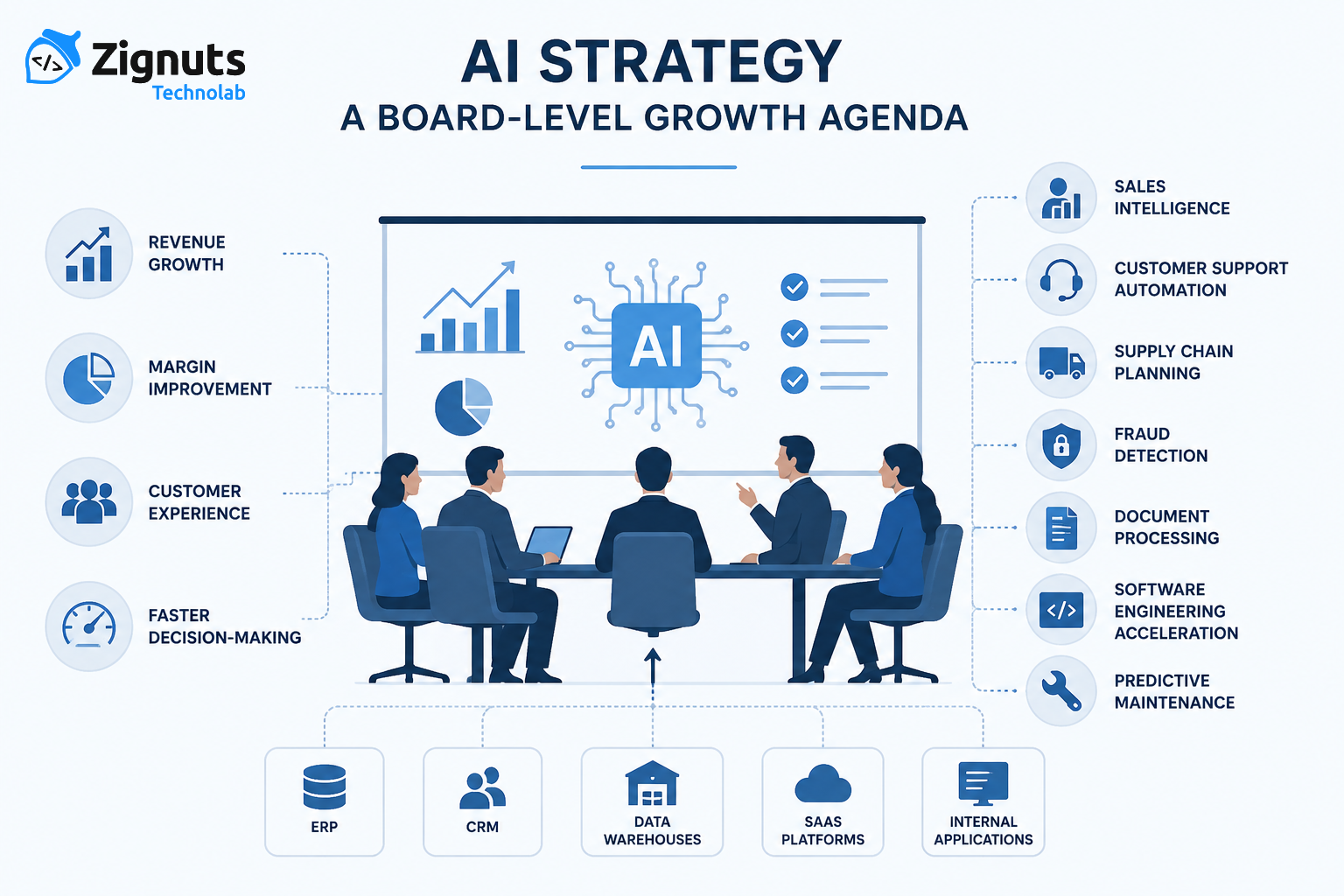
AI initiatives that remain isolated inside innovation teams rarely generate enterprise value. CEOs are now treating AI as a business transformation program linked to revenue growth, margin improvement, customer experience, and faster decision-making. The strongest programs begin with high-value workflows: sales intelligence, customer support automation, supply chain planning, fraud detection, document processing, software engineering acceleration, and predictive maintenance.
The executive question is not which model to use first. It is which business process can be redesigned with AI, what data is required, how success will be measured, and how the solution will integrate with existing systems such as ERP, CRM, data warehouses, SaaS platforms, and internal applications.
2. Generative AI Is Shifting From Chatbots to Embedded Workflows
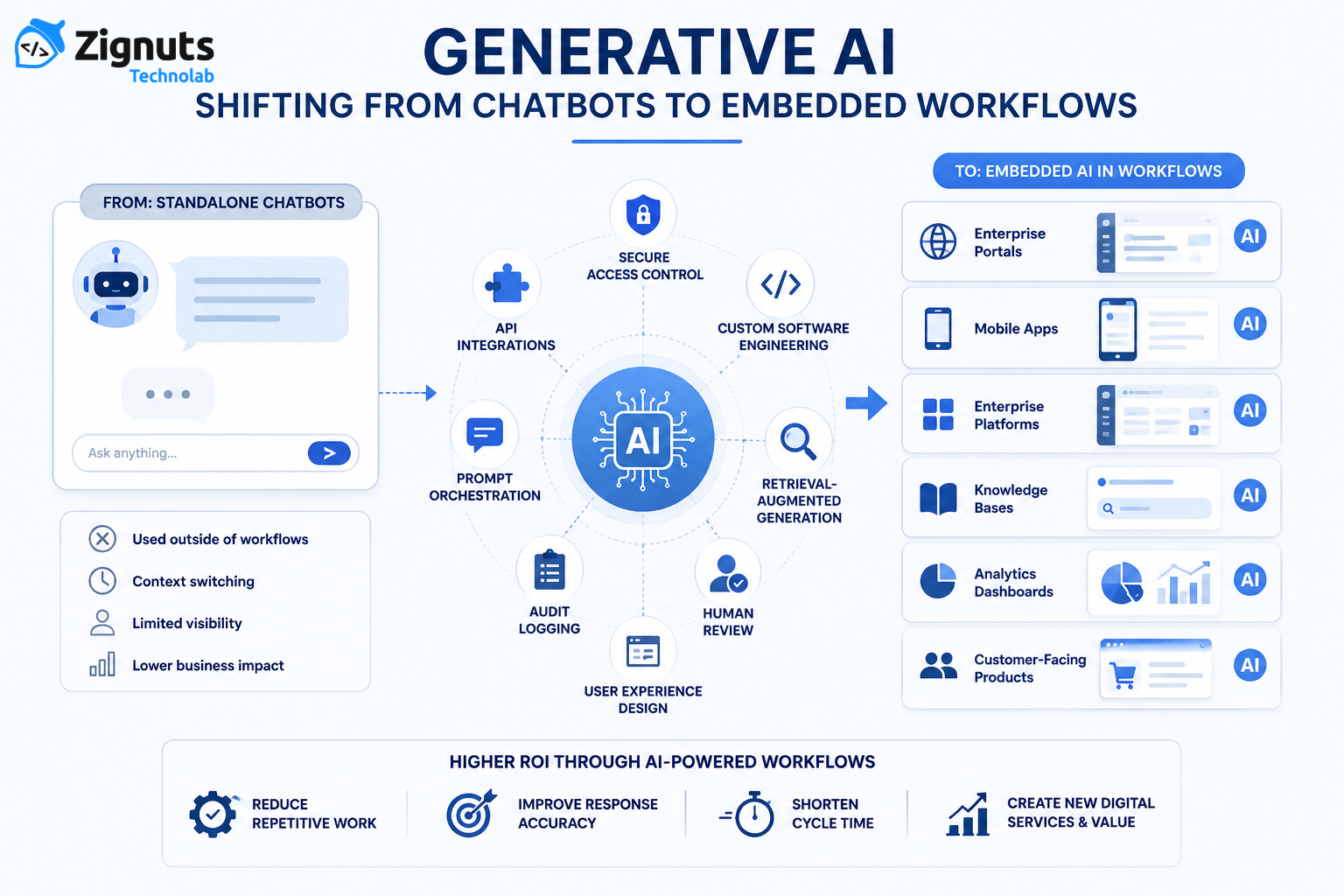
Early generative AI adoption focused on assistants and content generation. Enterprise adoption is now moving toward embedded AI inside business workflows. Instead of asking employees to use a separate tool, companies are integrating AI into portals, mobile apps, enterprise platforms, knowledge bases, analytics dashboards, and customer-facing products.
This shift requires custom software engineering, API integrations, secure access control, prompt orchestration, retrieval-augmented generation, audit logging, human review, and user experience design. CEOs should expect the highest ROI where AI reduces repetitive work, improves response accuracy, shortens cycle time, or creates a new digital service customers are willing to adopt.
Ready to Turn Enterprise AI Into Business Value?

3. Private, Governed Enterprise Data Is the AI Differentiator
Public models are increasingly accessible, but enterprise advantage comes from proprietary data, domain context, and process knowledge. This makes data strategy central to every AI roadmap. Companies need clean, governed, permission-aware data across documents, databases, applications, event streams, and customer interactions.
Practical priorities include data classification, master data quality, metadata management, secure data pipelines, vector databases, enterprise search, and access policies aligned with compliance requirements. Without these foundations, AI outputs become inconsistent, risky, or disconnected from the real operating environment.
4. AI Governance Is Moving From Policy Documents to Engineering Controls
CEOs are right to focus on AI risk, but governance must be implemented in systems, not only in guidelines. Enterprise AI needs controls for data privacy, model usage, bias monitoring, hallucination reduction, approval workflows, logging, observability, and incident response. Regulated industries also need evidence of how AI decisions are made, reviewed, and improved over time.
A mature AI governance model defines which use cases are allowed, which data can be used, who approves deployment, how outputs are verified, and how performance is monitored after release. This is where AI engineering, cybersecurity, legal, compliance, and business teams must operate together.
5. AI Agents Will Automate Multi-Step Business Processes
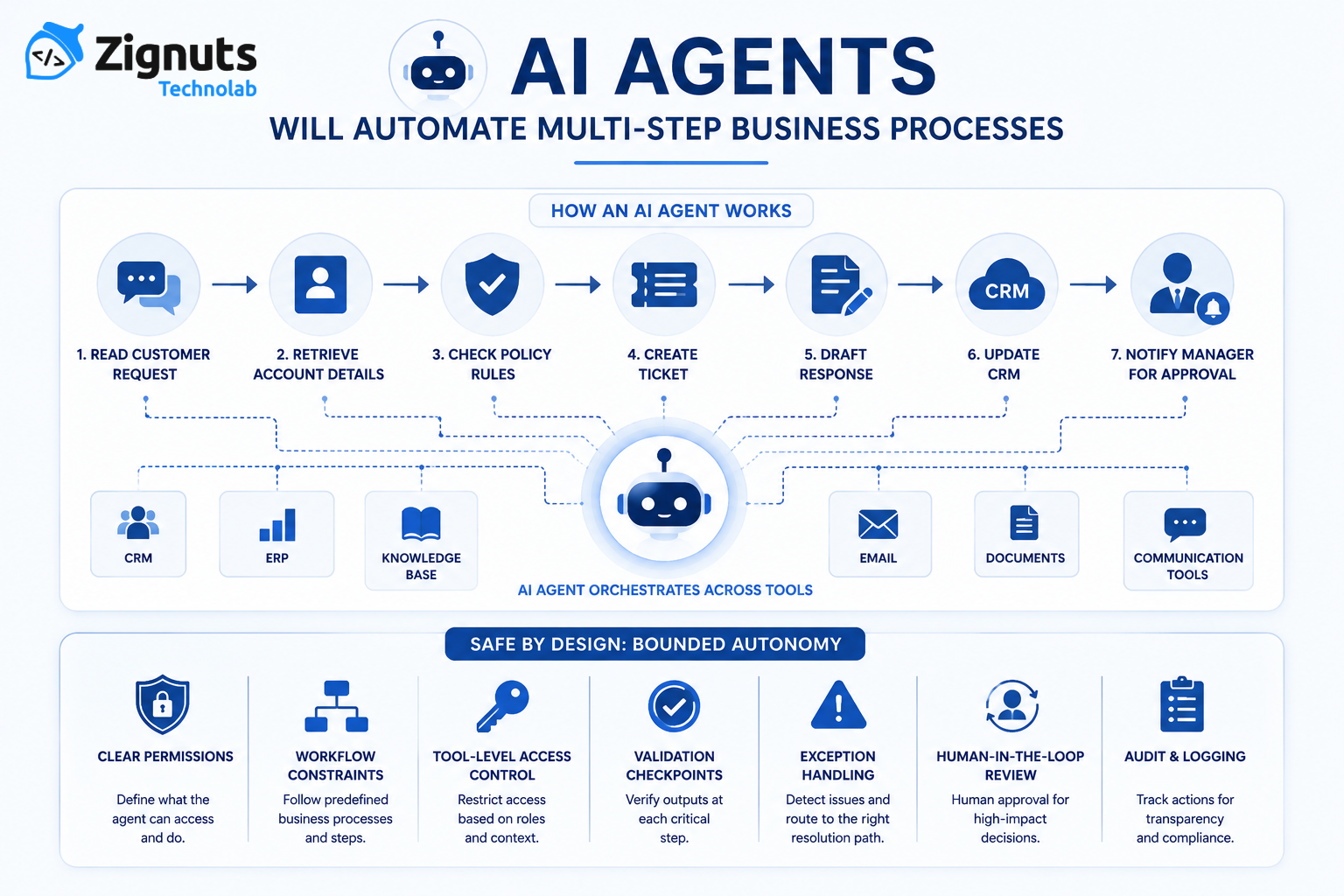
AI agents are one of the most commercially relevant enterprise AI trends because they can coordinate multi-step tasks across tools. In practice, an agent may read a customer request, retrieve account details, check policy rules, create a ticket, draft a response, update CRM, and notify a manager when human approval is required.
However, enterprise agents must be designed carefully. Open-ended autonomy can create operational and security risks. The safer approach is bounded autonomy: clear permissions, workflow constraints, tool-level access control, validation checkpoints, exception handling, and human-in-the-loop review for high-impact decisions.
6. AI-Native SaaS and Product Engineering Are Changing Buyer Expectations
For SaaS companies and digital product teams, AI is becoming part of the core product experience. Buyers increasingly expect intelligent search, recommendations, forecasting, natural language reporting, automated onboarding, proactive alerts, and personalized workflows. AI features that are bolted on without product strategy often fail to drive adoption.
AI-native product engineering starts with user problems, not model capability. Product leaders should prioritize features that reduce friction, improve decision quality, or make complex workflows easier. Technical teams must evaluate latency, cost per request, model accuracy, user permissions, data retention, and scalability before committing to a feature roadmap.
7. Cloud Architecture and MLOps Are Critical for Scale
Enterprise AI cannot scale reliably without cloud engineering and operational discipline. Teams need repeatable deployment pipelines, model evaluation, versioning, monitoring, cost controls, and rollback plans. Whether using AWS, Azure, Google Cloud, OpenAI, Anthropic, open-source models, or hybrid infrastructure, the architecture must support security, performance, and business continuity.
MLOps and LLMOps help enterprises move from proofs of concept to production systems. Key capabilities include environment management, evaluation datasets, prompt versioning, model performance tracking, observability, automated testing, and usage analytics. CEOs should ask whether their organization can operate AI continuously, not just launch it once.
8. Software Modernization Is Becoming an AI Readiness Requirement
Many enterprises want AI outcomes but are limited by legacy systems, fragmented data, manual workflows, and outdated application architecture. AI adoption often exposes technical debt that has been slowing the business for years. Modernization may include API enablement, cloud migration, microservices, data platform upgrades, workflow automation, and replacement of brittle internal tools.
This is why AI strategy and digital transformation are increasingly connected. A legacy application that cannot expose data securely or integrate with modern AI services will restrict innovation. Modern architecture gives AI systems the context, connectivity, and resilience needed for enterprise use.
9. Cost Management Will Separate Successful AI Programs From Experiments
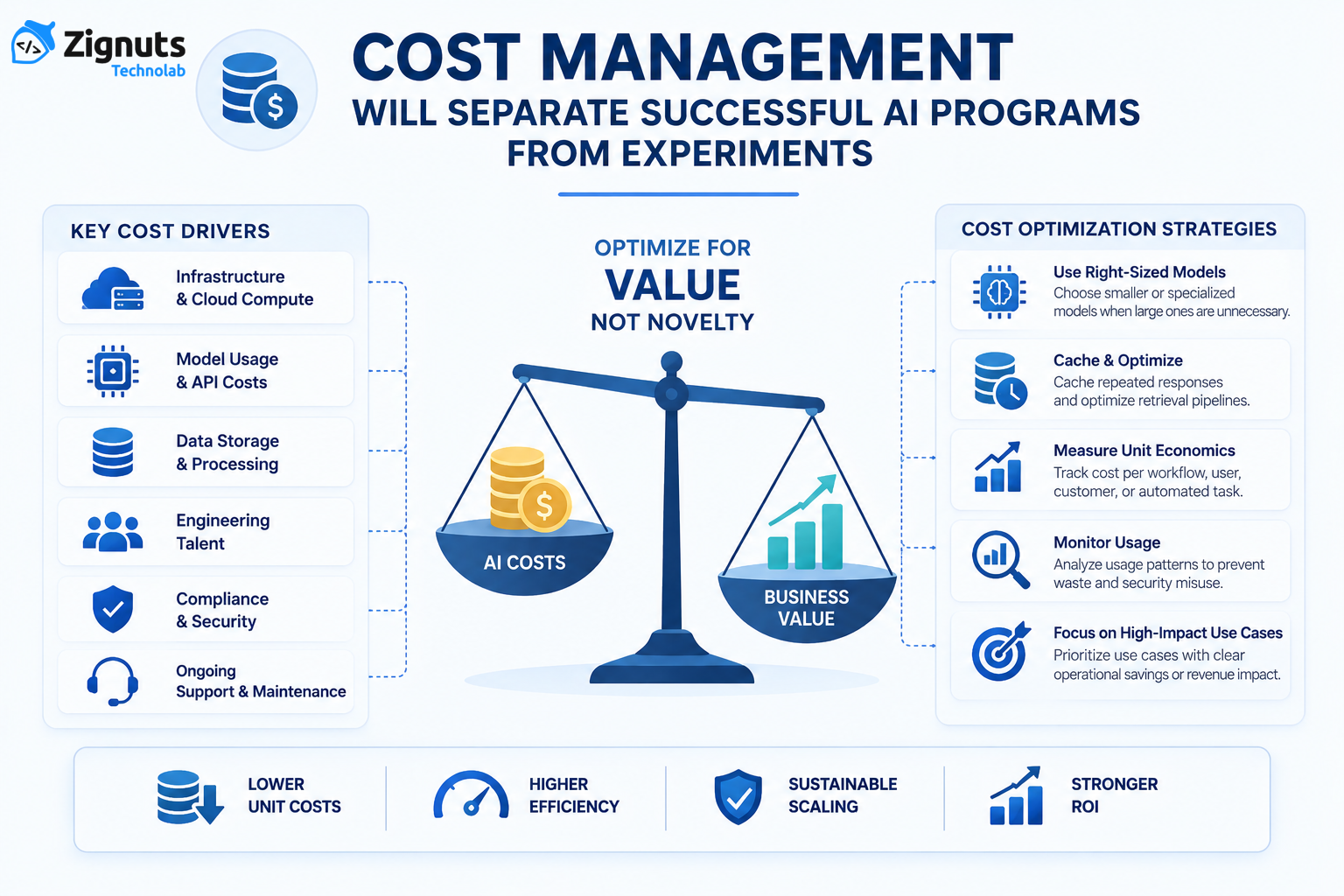
AI costs can grow quickly when usage scales across employees, customers, and products. CEOs should expect financial planning around infrastructure, model usage, data storage, engineering talent, compliance, and ongoing support. The best teams design for value per transaction, not novelty.
Use smaller or specialized models where large models are unnecessary.
Cache repeated responses and optimize retrieval pipelines.
Measure cost per workflow, user, customer, or automated task.
Monitor usage patterns to prevent waste and security misuse.
Prioritize use cases with clear operational savings or revenue impact.
10. Human-AI Collaboration Will Matter More Than Full Automation
The highest-value AI systems often assist skilled employees rather than replace them. In healthcare, finance, logistics, legal operations, manufacturing, and enterprise support, human oversight remains essential. AI can summarize, recommend, classify, predict, and draft, while people handle judgment, exceptions, relationships, and accountability.
CEOs should frame AI adoption as workforce augmentation supported by training, change management, and redesigned processes. Adoption improves when employees see AI as a practical tool that removes low-value work rather than an unclear threat to their role.
Ready to Turn Enterprise AI Into Business Value?
How CEOs Should Prioritize Enterprise AI Investments
A clear decision framework prevents scattered experimentation. Start by ranking opportunities based on business value, data availability, workflow complexity, integration needs, risk level, and time to impact. A use case with moderate technical complexity and strong business value is often a better starting point than a highly ambitious transformation with uncertain adoption.
Recommended executive checklist
Define the business outcome before selecting AI technology.
Confirm the data required is available, accurate, and permission-safe.
Assess integration needs across ERP, CRM, SaaS, cloud, and internal systems.
Build governance, security, and monitoring into the architecture from day one.
Start with a production-minded MVP, not a disconnected demo.
Measure ROI through cycle time, cost reduction, conversion, accuracy, retention, or revenue.
When to Work With an AI Engineering Partner
Enterprises often need external expertise when internal teams are strong in business operations but lack production AI architecture, cloud engineering, product design, or integration depth. An experienced engineering partner can help validate use cases, build AI-enabled applications, modernize legacy systems, create secure data pipelines, and move pilots into scalable platforms.
The right partner should understand both enterprise constraints and product velocity. Look for practical experience in custom software development, SaaS platforms, mobile and web applications, API integrations, cloud infrastructure, data engineering, security, and long-term maintenance. AI success depends on engineering execution as much as model selection.
Final Perspective
The enterprise AI trends CEOs should watch are not limited to generative AI tools. The real shift is toward intelligent, integrated, governed systems that improve how businesses operate and compete. Companies that combine AI strategy with strong software engineering, secure data architecture, cloud readiness, and product thinking will move faster from experimentation to measurable enterprise value.

Parth Trivedi
Co-founder and CTO of a global software agency, I lead innovative IT solutions across industries, focusing on scalable architectures and agile methodologies. Let’s connect to scale your digital initiatives!