


Every digital health team tracks downloads, daily actives, and session length. Almost none of them track whether patients still trust their Digital Health Platform Development Services three months in, and that gap is exactly why so many otherwise well-built platforms quietly get uninstalled.
Key Takeaways |
|---|
Engagement metrics such as downloads, DAU, and session length measure activity, not trust, and activity fades fast once trust cracks.
Most patient trust failures trace back to five fixable design and process decisions, not to patients not caring about their health.
Clinician-anchored design, visible data practices, and compliance built in from day one consistently outperform bolt-on approaches.
We build digital health products with patient trust integrated from the first sprint, rather than treating it as a final launch requirement.
Ready to Build a More Trusted Digital Health App?

The Patient Trust Gap in Digital Health Apps
Digital health has a well-documented adoption problem: most apps see steep drop-off within the first 90 days, long before any real health outcome could show up in the data. Teams usually respond by adding features such as more reminders, more gamification, and more content. It rarely works, because the underlying issue isn't a feature gap. It's a trust gap.
Patients don't abandon health apps because the UI is ugly. They abandon them when the app asks for sensitive health data and gives nothing trustworthy back: no clinician context, no clear reasoning, and no sense that anyone is actually looking at what they entered. An app can be technically excellent and still fail this test.
5 Common Mistakes in Digital Health Apps
1. Digital Health Apps Overlook Clinician Involvement
Most patient-facing apps are designed, tested, and shipped with almost no clinician involvement beyond a final sign-off. Patients trust their care team far more than they trust a logo. When an app never surfaces that relationship, such as no clinician-reviewed content or no way to see who's behind a recommendation, it reads as generic wellness software, not care.
2. Digital Health Apps Confuse Compliance With Patient Trust
A privacy policy link in the footer satisfies a legal checklist. It does nothing to reassure a patient in the moment they're asked to log a symptom, a medication, or a mental health note. Trust has to be visible at the point of data entry, with a short, plain-language explanation of what happens to this specific piece of data, not buried three taps away.
3. Digital Health Apps Focus on Engagement Instead of Outcomes
Streaks, badges, and push notifications move DAU numbers in the short term and burn patients out in the long term. The apps that retain patients past six months tend to measure something harder: whether a logged symptom actually led to a care action, whether adherence improved, and whether a return visit was tied to a real change in condition.
4. Digital Health Apps Delay EHR Integration and Compliance
HIPAA safeguards and EHR interoperability (HL7/FHIR) are frequently treated as a pre-launch checklist rather than an architectural decision. That's how apps end up with clunky consent flows, delayed data sync, and clinician-facing dashboards that don't match what the patient actually submitted, all of which can affect trust from both sides.
5. Digital Health Apps Need Continuous Post-Launch Improvement
Launch is where most vendor relationships end and where the real learning starts. Patient behavior in production almost never matches what testing predicted. Teams that don't have a partner still iterating with them post-launch tend to freeze the product exactly at its least-informed version.
Ready to Build a More Trusted Digital Health App?
What Builds Patient Trust in Digital Health Apps
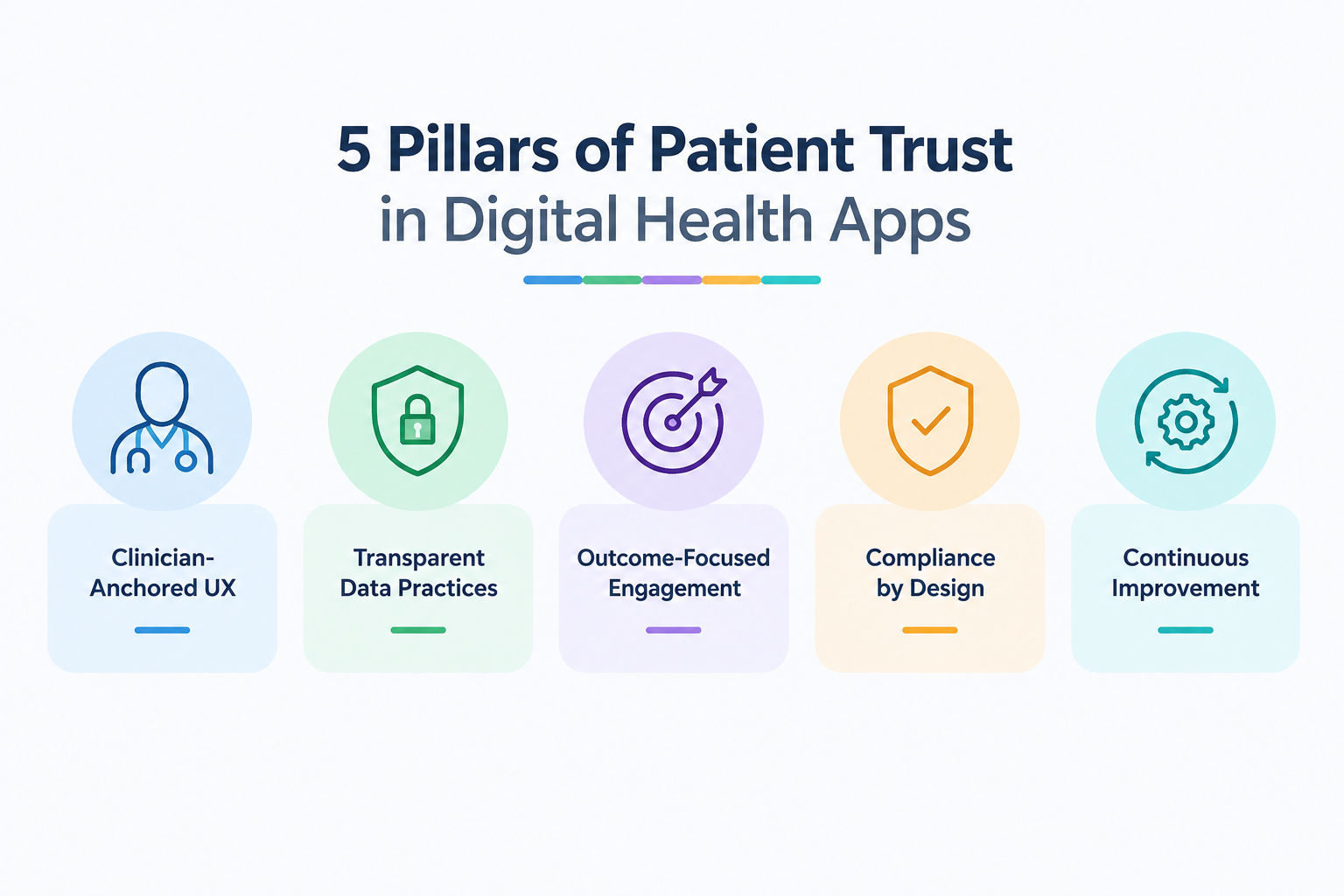
Clinician-anchored UX: Design that puts the clinician relationship in the product itself, not just in the care plan behind it.
Visible data practices: Short, specific, in-context explanations of how each piece of health data is used, not a policy document.
Outcome-linked engagement metrics: Track whether app activity produces a real care action, not just whether the app was opened.
Compliance by design: HIPAA safeguards and HL7/FHIR interoperability designed in from the architecture stage, not patched in before launch.
Post-launch iteration: A team that keeps refining the product against real patient behavior after go-live, not just before it.
Ready to Build a More Trusted Digital Health App?
How Digital Health Apps Can Create Transparent Patient Experiences
Trust is shaped by what patients can understand and see while using a digital health product. Clear communication around data collection, recommendations, care-team involvement, and next steps can make the experience easier to understand and more predictable.
Digital health apps can support this experience by explaining why information is requested, showing how it contributes to the patient's care journey, and making important actions visible. Patients should be able to understand what information they are providing, how it is being used, and when a clinician or care team may review it.
Make Data Collection in Digital Health Apps Easy to Understand
When an app requests sensitive information, the purpose of that request should be clear. Short explanations near forms, symptom trackers, medication records, and assessments can help patients understand why the information matters.
Show Human Oversight in Digital Health Apps
Patients should be able to distinguish between automated recommendations and decisions that involve a clinician or care team. Clear attribution and review indicators can make AI-assisted experiences more transparent.
Connect Digital Health App Actions to Care Outcomes
When patients can see how their inputs contribute to care plans, follow-ups, recommendations, or other meaningful actions, the product experience becomes more connected to their healthcare journey.
Patient-Centered UX Principles for Digital Health Apps
Patient trust is closely connected to the overall product experience. A digital health app should make important healthcare interactions feel understandable, respectful, and consistent rather than treating patients as sources of data.
UX Principle | What It Means for Patients |
|---|---|
Clarity | Patients understand what the app is asking and why. |
Transparency | Patients can see how their information is used. |
Clinical Context | Recommendations and information are connected to appropriate care workflows. |
Control | Patients have appropriate visibility and control over their information and interactions. |
Consistency | The experience remains predictable across different stages of the care journey. |
Ready to Build a More Trusted Digital Health App?
How We Build Trust-First Digital Health Apps
We built our healthcare practice around the pattern above because we kept seeing the same failure mode across the industry: strong engineering, weak trust layer. Here's what that means in how we actually work.
We Start With Clinical Workflows for Digital Health Apps
Before any wireframe, our team maps how the care actually happens, who reviews what, when a human needs to be in the loop, and where automation genuinely helps versus where it just adds friction. That mapping becomes the product's information architecture, not an afterthought layered on top of it.
We Build Compliance Into Digital Health App Architecture
HIPAA-aligned data handling and HL7/FHIR-based EHR integration are part of our starting technical spec, not a pre-launch audit. Our engineering teams have delivered this across telehealth, remote monitoring, and patient engagement builds for healthcare organizations across the US, UK, Europe, and the Middle East.
We Support Digital Health Apps After Launch
Our team-extension model means the same engineers who built the product keep working from real production data after go-live, adjusting onboarding flows, notification logic, and clinician-facing views based on what patients actually do, not what a pre-launch test predicted.
How We Use AI in Digital Health Apps
Our AI engineering practice focuses on places where intelligent automation measurably reduces clinician or patient burden, such as smart triage, adherence prediction, and personalized nudges grounded in a patient's actual history, always with a clear, explainable path back to a human decision-maker.
The comparison below is a simplified view of the difference this makes in practice:
Typical Vendor | Zignuts Approach | |
|---|---|---|
What patients experience | A polished app that goes quiet after onboarding | An app that adapts to how their care actually unfolds |
How trust is built | Legal disclaimers and privacy policies | Clinician-anchored design + visible data practices |
Engagement measured by | Downloads, DAUs, session length | Care actions completed, adherence, return visits tied to outcomes |
Compliance approach | Bolted on before launch | Built into architecture from day one (HIPAA, HL7/FHIR) |
Post-launch relationship | Ticket-based support | Embedded team that iterates with your clinical + product data |
Key Features That Build Trust in Digital Health Apps
Trust should be supported by practical product capabilities rather than treated only as a messaging or branding exercise. Several features can help make healthcare interactions clearer and more accountable.
Clear consent experiences: Explain what information is being collected and how it supports the product or care workflow.
Role-based access: Ensure users and care teams can access information according to their appropriate permissions.
Clinician attribution: Make it clear when content, recommendations, or care actions involve a clinician.
Data visibility: Give patients appropriate insight into how their information is collected, processed, and used.
Secure communication: Protect sensitive interactions between patients, providers, and healthcare systems.
Auditability: Maintain appropriate records of important data access, changes, and workflow actions.
Accessible support: Provide clear pathways for patients to ask questions or receive assistance when needed.
How to Measure Patient Trust in Digital Health Apps
Downloads, daily active users, and session length can show how often patients interact with an app, but they do not fully explain whether patients find the product useful, transparent, or trustworthy.
Digital health teams can complement traditional engagement metrics with indicators that provide more context around patient experience and care workflows.
Metric Area | What to Monitor |
|---|---|
Patient retention | Continued usage across meaningful stages of the care journey. |
Consent interaction | Completion, clarification, and abandonment patterns around consent flows. |
Care actions | Whether patient inputs contribute to appropriate follow-up or care workflows. |
Support requests | Questions or concerns related to privacy, data, recommendations, or usability. |
Correction patterns | How frequently patients or clinicians need to correct information or recommendations. |
Patient feedback | Direct feedback about clarity, usefulness, confidence, and overall experience. |
Ready to Build a More Trusted Digital Health App?
Building Long-Term Patient Trust Through Digital Health App Development
Patient trust is not created by a single feature or compliance document. It develops through repeated interactions with the product, from onboarding and consent to data collection, recommendations, communication, and ongoing care.
For product teams, this means trust should be considered throughout the digital health app development lifecycle. Clinical workflows, security, data architecture, interoperability, UX, AI governance, and post-launch iteration all contribute to how patients experience the product.
A trust-focused development process can help teams make these decisions earlier and create a more consistent experience as the product evolves.
Conclusion
Patient trust is not a marketing line; it is a design decision shaped by every interaction within a digital health product. Digital health apps can create stronger patient experiences by combining clinician involvement, transparent data practices, meaningful engagement, secure architecture, and continuous product improvement.
Clear consent, appropriate clinical context, explainable AI, secure data handling, and reliable healthcare integrations can help patients better understand and confidently use digital health products throughout their care journey.
If you're building or improving a digital health product, contact us today to discuss your requirements and explore a secure, patient-centered approach to digital health app development.

Rajvi Patel
AI & Digital Transformation Enthusiast | Exploring emerging technologies, innovative ideas, and smarter approaches that turn business challenges into meaningful digital opportunities.